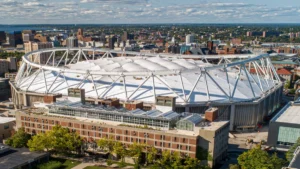
The plan would push the teen first bell 70 minutes later starting in September 2028, riding on the district’s $242.4 million building program.
Baldwinsville’s teenagers could gain 70 minutes of morning sleep, and the decision lands in three weeks. The Board of Education is set to vote Aug. 3 on a plan that moves the first bell for grades 7 through 12 from 7:35 a.m. to 8:45 a.m., a change Superintendent Joseph DeBarbieri has tied directly to the district’s $242.4 million construction program now underway across the village and the towns of Lysander and Van Buren.
This story came from public records we pulled ourselves
Get the next one, plus overnight incidents, in your inbox at 6 AM. Free, no spam.
“We felt it was the right time if we’re going to make changes that we also take into consideration our start and end times,” DeBarbieri told CNY Central after a community meeting on June 1.
The vote caps a study the district launched in October 2025, and it would not change a single bus route this fall. If the board says yes on Aug. 3, the new schedule takes effect in the 2028 to 2029 school year, timed to arrive with the reshuffled grade levels the construction program will produce.
What would actually change
Under the proposal the district presented in June, the school day flips for nearly every one of Baldwinsville’s roughly 5,465 students. The federal National Center for Education Statistics counts eight schools in the district, with 366 full time equivalent teachers and a ratio of about 15 students per teacher.
Those eight buildings are Charles W. Baker High School, Theodore R. Durgee Junior High School, Donald S. Ray Middle School, and five elementary schools: Harry E. Elden, Catherine M. McNamara, L. Pearl Palmer, Mae E. Reynolds and Van Buren. Every one of them gets a new bell schedule, a new grade band, or both before this plan is finished.
Here is the schedule the district has posted on its “Shifting School Start and End Times” page. Secondary students in grades 7 through 12 would run from 8:45 a.m. to 3:30 p.m. Elementary students in prekindergarten through grade 3 would go from 8:15 a.m. to 3:00 p.m. Intermediate students in grades 4 through 6 would start earliest, 7:45 a.m. to 2:15 p.m. The district labels the times examples rather than final bell schedules.
That intermediate slot is worth a second look. In the district’s original proposal, the younger elementary students had the 7:45 a.m. start and the grade 4 through 6 group had 8:15 a.m. The updated version swapped them, putting the youngest kids at 8:15 a.m. and handing the earliest bell to grades 4 through 6.
Today, students in grades 7 through 12 report at 7:35 a.m. The proposed 8:45 a.m. start adds 70 minutes to a teenager’s morning. It also hands the district’s earliest wakeup to 9, 10 and 11 year olds, whose 7:45 a.m. bell would ring an hour before the high schoolers’. The logic tracks the pediatric guidance, which centers on teenagers rather than younger children. It is still the piece of the plan most likely to draw questions from parents juggling before school childcare, and the district has kept a feedback survey open on its start times page while the board weighs the resolution.
Why now: a $242.4 million domino chain
The start time question did not appear out of thin air. On Dec. 10, 2024, district voters approved a capital program called Funding Improvements and Building the Future by a margin of 1,217 to 424. The full package totals $242.4 million, and it rebuilds how the district assigns grades to buildings.
The first visible piece is at Donald S. Ray Middle School, where crews broke ground on Phase 1A on April 6, 2026. The Ray project adds 23,500 square feet with 23 new classrooms, plus renovations, a playground, locker replacement and window and roof work. When it is done, Ray converts to an intermediate school serving grades 4 through 6.
The district’s published plan moves other buildings too. Theodore R. Durgee Junior High School is slated to house grades 8 and 9, Charles W. Baker High School grades 10 through 12, and Harry E. Elden Elementary School becomes what the district calls swing space while construction rolls through the elementary buildings between 2026 and 2028.
Because busing, buildings and grade bands are all moving at once, district leaders concluded the bell schedule should move with them. The published timeline puts planning, stakeholder feedback, a transportation study and a board resolution in the 2025 to 2026 school year, construction in 2026 through 2028, and implementation of the new times in 2028 to 2029.
The transportation study matters more than it sounds. Staggered bell times are what let a district run one bus fleet in multiple waves instead of buying and staffing more buses. Rearranging which grade band rides first is the operational puzzle underneath every start time debate, and it is the reason the district paired the schedule question with the same planning year as its busing review rather than bolting it on later.
One thing the Aug. 3 vote does not decide: the construction itself. Voters settled that in December 2024, and the outcome of the start time resolution changes nothing about the $242.4 million program. If the board votes no, the buildings still get rebuilt and regraded on the same calendar. The teenagers would simply keep reporting at 7:35 a.m. while everything around them changes.

The science the district is leaning on
The research case for later teen start times is not new, and it is not local. In 2014 the American Academy of Pediatrics urged middle and high schools to start no earlier than 8:30 a.m. so adolescents can get the 8.5 to 9.5 hours of sleep the academy recommends on school nights.
Most schools never got there. A Centers for Disease Control and Prevention analysis released in August 2015 found the average American middle and high school opened at 8:03 a.m., and fewer than one in five started at 8:30 a.m. or later. The same release reported that about two thirds of American high school students fall short of adequate sleep on school nights, a figure the CDC said had held steady since 2007.
Baldwinsville’s current 7:35 a.m. secondary start sits 55 minutes ahead of the pediatricians’ line. The proposed 8:45 a.m. start clears it by 15 minutes.
Students already have opinions
When CNY Central visited the June 1 community meeting, two Baker High School seniors made the case from opposite ends.
“I know a lot of students in our grade who are sleep deprived, myself included. I think pushing the time back is honestly a great switch for students our age,” senior Bianca Capilli said.
Her classmate Quinn Rost saw the tradeoff. “I think I would be more focused in class. But I also think that having the time after school to work with teachers has been extraordinarily helpful for me,” Rost said.
Rost’s point is the practical friction in every later start debate. A 3:30 p.m. dismissal compresses the window between the last bell and practices, rehearsals, jobs and extra help. In winter, it also pushes more of that window past dark. Neither senior will feel it personally. Both graduate before September 2028, which means the students who would actually live under the new schedule are in elementary and middle school right now.
The district next door already lives at 8:50
Baldwinsville does not have to guess what a later schedule feels like. East Syracuse Minoa high school students start at 8:50 a.m. and leave at 3:20 p.m., a schedule WSYR reported the district built around medical research decades ago. Both districts serve Onondaga County suburbs, so the comparison is not theoretical. It is the district down the road.
“It’s our culture. It’s what we know. This is the E.S.M. way,” East Syracuse Minoa Superintendent Donna DeSiato told WSYR in February.
DeSiato framed the biology plainly: “The child is in development during their teen years and their brain is developing and their staying awake later into the evening.” Her advice to districts weighing the switch was just as direct. “Change is not easy. But change is well worth it if you’re going to have a healthier outcome,” she said.
If Baldwinsville adopts 8:45 a.m., its secondary students would still ring in five minutes before their East Syracuse Minoa peers.
Who is steering this
DeBarbieri has run the district since July 1, 2023, but his Baldwinsville roots go back further. He joined the district in 2002 as a math teacher at Baker High School, then climbed through building administration, the assistant superintendency for curriculum and instruction, and the deputy superintendent’s office, which he held starting in 2016. He holds a doctorate in education from Syracuse University and a master’s from Le Moyne College.
The board he answers to meets at the district’s Transportation Center at 2810 W. Entry Road. Its 2026 to 2027 calendar shows the two dates that matter here: a special meeting held July 1 at 5 p.m., which CNY Central reported was the scheduled first reading of the start time resolution, and the regular meeting on Aug. 3 at 5 p.m., where the final vote is expected.
The district office at 29 East Oneida Street has kept a public survey open on the start times page, and district leaders said they would keep gathering community feedback between the first reading and the vote.
What to watch on Aug. 3
Three things are worth tracking when the board convenes. First, whether the vote happens on schedule or gets pushed while the district digests survey results. Second, whether the swapped elementary and intermediate tiers survive, since the family that wins under one version loses under the other. Third, whether board members attach conditions tied to the construction timeline, because the whole schedule depends on Ray Middle School and the elementary renovations finishing on pace between now and 2028.
None of this changes the first day of school this September. Students will report at the same times they did last year while crews keep working at Ray.
The decision point is fixed: Monday, Aug. 3, 5 p.m., at the Transportation Center on W. Entry Road. If the board votes yes, the first 8:45 a.m. bell for Baldwinsville’s secondary students rings in September 2028.
Sources & Verification
Baldwinsville Central School District, “Shifting School Start and End Times,” district webpage, retrieved July 15, 2026, bville.org/times. Baldwinsville CSD, Board and Committee Meetings calendar 2026 to 2027, bville.org/boemeetings. Baldwinsville CSD, Building Projects Updates, $242.4 million program approved Dec. 10, 2024 by a 1,217 to 424 vote, Ray Phase 1A groundbreaking April 6, 2026, bville.org/358804_2. Baldwinsville CSD, Superintendent’s Office page, bville.org/superintendent. CNY Central (WSTM), “Baldwinsville considering later school start times for older students,” June 2, 2026. WSYR / localsyr.com, “Baldwinsville high schools may be starting later in the day. A neighboring district has some advice,” Ashley Cafaro, Feb. 26, 2026. National Center for Education Statistics, Common Core of Data, Baldwinsville CSD district detail, 2024 to 2025 school year. Centers for Disease Control and Prevention, “Most US middle and high schools start the school day too early,” Aug. 6, 2015. Edited by: the CNY Signal news team. Published: July 15, 2026.