
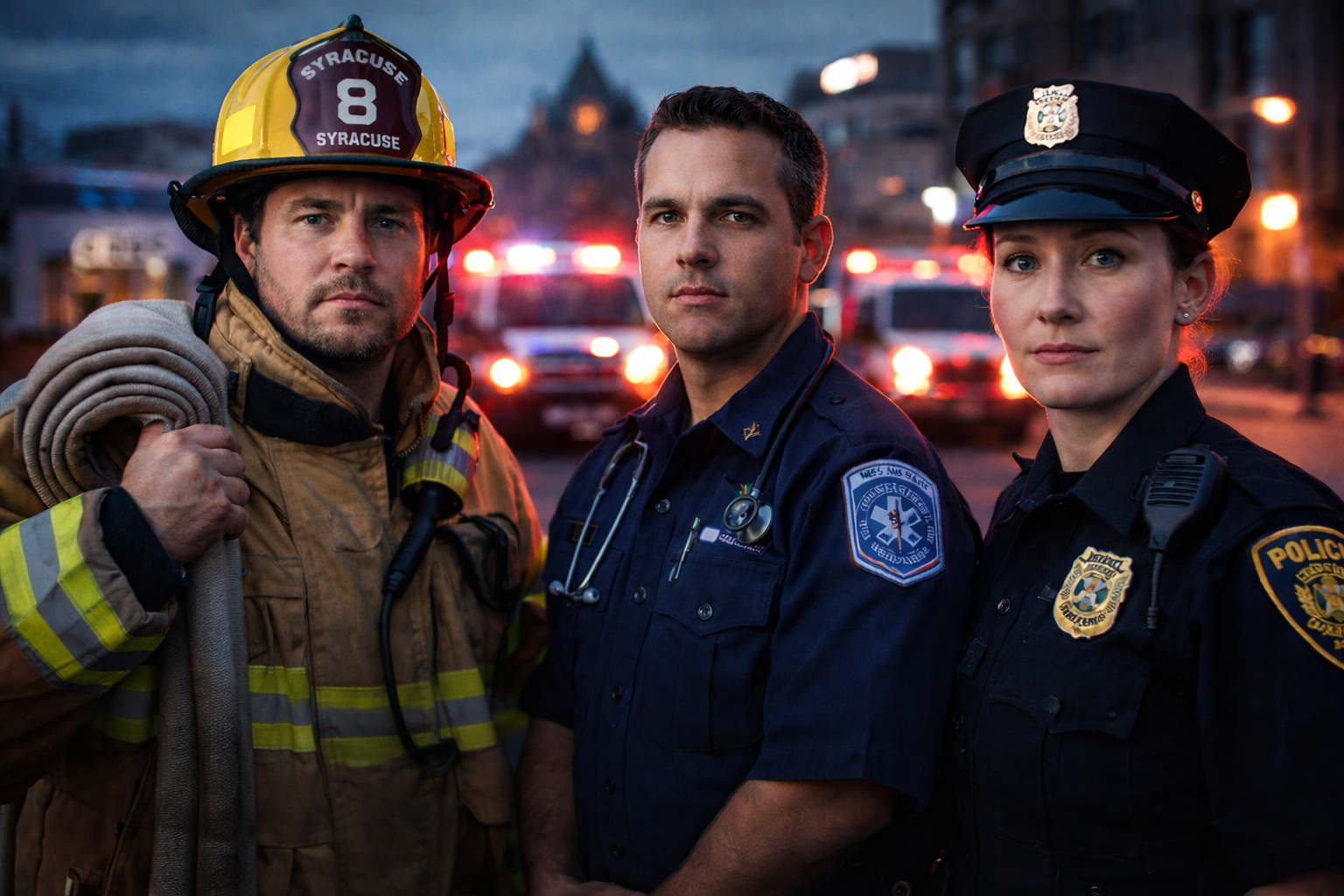
The Advice Local First Responders Actually Give Their Own Families
Syracuse isn’t a hurricane zone or an earthquake zone. But anyone who’s lived here longer than a couple winters knows that Central New York has its own brand of emergencies — and they arrive fast. A lake effect band that drops two feet overnight. An ice storm that takes out power lines across three counties. Spring flooding along Onondaga Creek that puts basements underwater from the Valley to Armory Square. A summer derecho that snaps hundred-year-old oaks in Thornden Park.
We talked to fire chiefs, emergency medical responders, and emergency management officials from across Onondaga County to compile the preparedness advice they give their own families. This isn’t generic FEMA boilerplate — it’s specific to what goes wrong here, and how to be ready for it.
1. Build a 72-Hour Kit, and Actually Check It Twice a Year
“Everyone says they have one. Almost nobody actually does,” says Chief Mark Vendetti of the Solvay Fire Department. “And the people who do have one assembled it in 2018 and haven’t looked at it since. The batteries are dead, the water’s stale, and the canned food expired two years ago.”
The American Red Cross Central & Northern New York Chapter (headquartered on West Genesee Street in Syracuse) recommends checking your emergency kit at the start of every Daylight Saving Time change — spring forward, fall back. Here’s what should be in it for a CNY household:
- One gallon of water per person per day, minimum three days
- 72 hours of non-perishable food (canned soup, peanut butter, crackers, dried fruit)
- Manual can opener — electric ones don’t work in a blackout
- Flashlights and extra batteries (or better yet, a hand-crank flashlight)
- First aid kit
- Seven-day supply of all prescription medications
- Battery-powered or hand-crank NOAA weather radio
- Copies of important documents (insurance cards, IDs) in a waterproof bag
- $200 in small bills — ATMs and card readers go down when the power does
- Extra phone charger and a fully charged power bank
“The cash thing surprises people,” Vendetti adds. “After the Labor Day storm in 2024, there were gas stations in Cicero running on generator power but their card systems were down. Cash only. People were stuck.”
2. Know Your Heat Source — and Its Risks
When the power goes out in January and it’s 8 degrees outside, people get desperate for heat. That’s when carbon monoxide calls spike.
“We respond to more CO incidents during winter power outages than any other time of year,” says Deputy Chief Karen Albright of the Syracuse Fire Department. “Generators in garages with the door cracked, propane heaters in sealed rooms, people running their gas oven with the door open. All of those can kill you.”
The rules are simple:
- Generators go outside, at least 20 feet from any window or door. The exhaust is carbon monoxide — colorless, odorless, and lethal.
- Propane space heaters rated for indoor use (like the Mr. Heater Buddy) are acceptable with ventilation — crack a window at least one inch.
- Kerosene heaters require the same ventilation. Use only K-1 grade kerosene, never gasoline.
- Never use a gas oven or stovetop for heat. This produces carbon monoxide and is the number one cause of CO poisoning during outages.
- Install CO detectors on every level. Battery-powered units cost $20 at any hardware store. The Syracuse Fire Department gives them out free at fire safety events — check the SFD Facebook page for upcoming dates.
3. Have a Family Communication Plan
“Cell towers get overwhelmed during big events,” says Tom Nance, Director of Onondaga County Emergency Management. “After the October 2025 ice storm, voice calls were failing across the south side for almost four hours because every tower in the area was overloaded.”
Nance recommends:
- Designate an out-of-area contact person — someone in another state who everyone in your family checks in with if you can’t reach each other directly. Text messages go through more reliably than voice calls when networks are congested.
- Pick a meeting point outside your home (neighbor’s driveway, a specific tree) in case of evacuation. Pick a second one outside your neighborhood (a church, a school) in case the area is blocked off.
- Make sure every family member knows the address of the nearest Red Cross shelter. In Onondaga County, primary shelter sites include Nottingham High School (Meadowbrook Drive), Henninger High School (Robinson Street), and the OnCenter (Montgomery Street).
4. Clear Your Drains Before Storm Season — Both Seasons
“Flooding is our most underestimated hazard,” Nance says. “People think flooding means rivers overflowing. In Syracuse, it usually means storm drains clogged with leaves backing up into basements, or snowmelt overwhelming an already full system.”
The city’s storm drain system is old — parts of it date to the early 1900s — and capacity is limited. When heavy rain combines with snowmelt in March and April, neighborhoods along Onondaga Creek, Harbor Brook, and Ley Creek are particularly vulnerable.
What you can do:
- Clear leaves and debris from the storm drain nearest your house before spring thaw and before fall leaf drop. The city technically handles this, but in practice, the drain in front of your house might not get cleared before the next rain.
- Know where your sump pump discharge goes. If it drains to a spot that freezes over in winter, the water backs up and your pump runs nonstop until it burns out.
- Install a battery backup for your sump pump. Power outages and flooding often happen simultaneously. A Wayne ESP25 battery backup system runs about $300 and can keep your sump running for 8-10 hours without power.
5. Trim Your Trees Now, Not After the Storm
“I’ve been a firefighter for 22 years and I can tell you — 80% of our power-related storm calls involve trees,” says Captain James Perez of the North Syracuse Fire Department. “Limbs on wires, trees on houses, trees blocking roads. And most of it is preventable.”
Dead limbs, diseased trees, and branches growing into power lines are ticking clocks. Onondaga County sees significant tree damage from ice loading (half an inch of ice adds 500 pounds of weight to a large tree), summer thunderstorm downbursts, and heavy wet lake effect snow early and late in the season.
“Get a certified arborist out to look at any large tree within striking distance of your house or power line,” Perez advises. “It costs $200-400 for a consultation and trim. A tree through your roof costs $30,000.” Local options include Nelson Tree Service, Bartlett Tree Experts (they have a Syracuse branch on Thompson Road), and Davey Tree.
6. Keep Your Car at Half a Tank or Above from November Through March
This is one of those tips that sounds excessive until you need it. During a widespread power outage, gas stations can’t pump fuel. Even stations with backup generators may shut down as deliveries get delayed by road closures.
“After every big winter event, we get calls from people stranded with empty tanks,” says Sergeant Mike DiCarlo of the Onondaga County Sheriff’s Office. “They were going to get gas ‘tomorrow’ and then the storm hit. Keep it above half. It takes zero extra effort — just stop at the pump a day earlier than you normally would.”
This also prevents fuel line freezing in older vehicles, which is still a thing when temperatures drop below zero.
7. Know the Difference Between a Watch and a Warning
The National Weather Service issues dozens of advisories each winter for the Syracuse area, and many people tune them out because they don’t know what they actually mean:
- Winter Weather Advisory: Conditions could be inconvenient and possibly hazardous. 4-7 inches of snow, or light freezing rain. Slow down, be careful.
- Winter Storm Watch: Significant winter weather is possible in the next 24-48 hours. This is your signal to prepare — charge devices, get groceries, gas up the car.
- Winter Storm Warning: Heavy snow (8+ inches), ice, or dangerous wind chill is expected or occurring. Stay home if you can.
- Lake Effect Snow Warning: Heavy lake effect snow is expected — typically 7+ inches in 12 hours or 9+ in 18 hours. These can escalate quickly.
- Blizzard Warning: Snow plus sustained winds of 35+ mph creating near-zero visibility. This is the big one. Do not drive.
CNY Signal’s weather dashboard displays all active NWS alerts for Onondaga County in real time, along with current conditions, radar, and forecasts. It’s a faster way to check than navigating the NWS website.
8. Register for Every Alert System Available
You should be signed up for all of these — they’re free and they could save your life:
- Onondaga County Hyper-Reach: The county’s emergency notification system. Text, call, or email alerts for severe weather, evacuations, shelter openings, and road closures. Sign up at ongov.net/em.
- Wireless Emergency Alerts (WEA): These are the loud alerts that go to all cell phones in an affected area. They’re automatic — you don’t need to sign up, but make sure you haven’t turned them off in your phone settings.
- NOAA Weather Radio: Station WXM46 (162.400 MHz) covers the Syracuse metro. A battery-powered weather radio will wake you up at 3 a.m. when a warning drops while your phone is on silent.
- CNY Signal: Our platform monitors NWS alerts, 511NY road data, and local emergency communications in one place. Bookmark us for storms — we’re built for exactly this.
9. Check on Your Neighbors — Especially the Elderly
“Every winter we lose people in Onondaga County to hypothermia — in their own homes,” says Chief Albright. “It’s almost always elderly residents living alone who lost power and didn’t tell anyone, or who couldn’t afford to heat their home adequately.”
HEAP (Home Energy Assistance Program) applications are accepted at the Onondaga County Department of Social Services on Civic Center Plaza. Eligibility is more generous than most people assume — a household of two earning up to $38,000 can qualify.
Beyond financial help: if you have elderly or disabled neighbors, check on them during and after every significant weather event. A two-minute knock on the door can be the difference between someone getting help and someone suffering alone.
10. Make a Plan for Your Pets
“People always forget the pets,” says Nance. “Then we’re at a shelter opening and people can’t evacuate because they won’t leave their dog.”
- Keep a pet emergency kit: 3 days of food, water, any medications, copies of vaccination records, a leash and carrier.
- Know which shelters accept pets. Not all Red Cross shelters do. The Onondaga County SPCA (Molloy Road) coordinates pet sheltering during large-scale emergencies — their number is (315) 454-4479.
- If you evacuate, take your pets. If it’s not safe for you, it’s not safe for them.
The One Thing Every First Responder Said
Every single person we spoke with came back to the same point: the time to prepare is before you need to. “Nobody thinks the emergency is going to happen to them,” Chief Vendetti told us. “Until it does. And then it’s too late to prep — you’re just reacting.”
Syracuse weather is survivable and manageable, but it demands respect. Spend one afternoon this month getting your household ready. A 72-hour kit, a communication plan, CO detectors, a weather radio, and a reliable information source — that’s the baseline. Everything after that is bonus.
Stay safe out there, Syracuse.