Staff Reporter

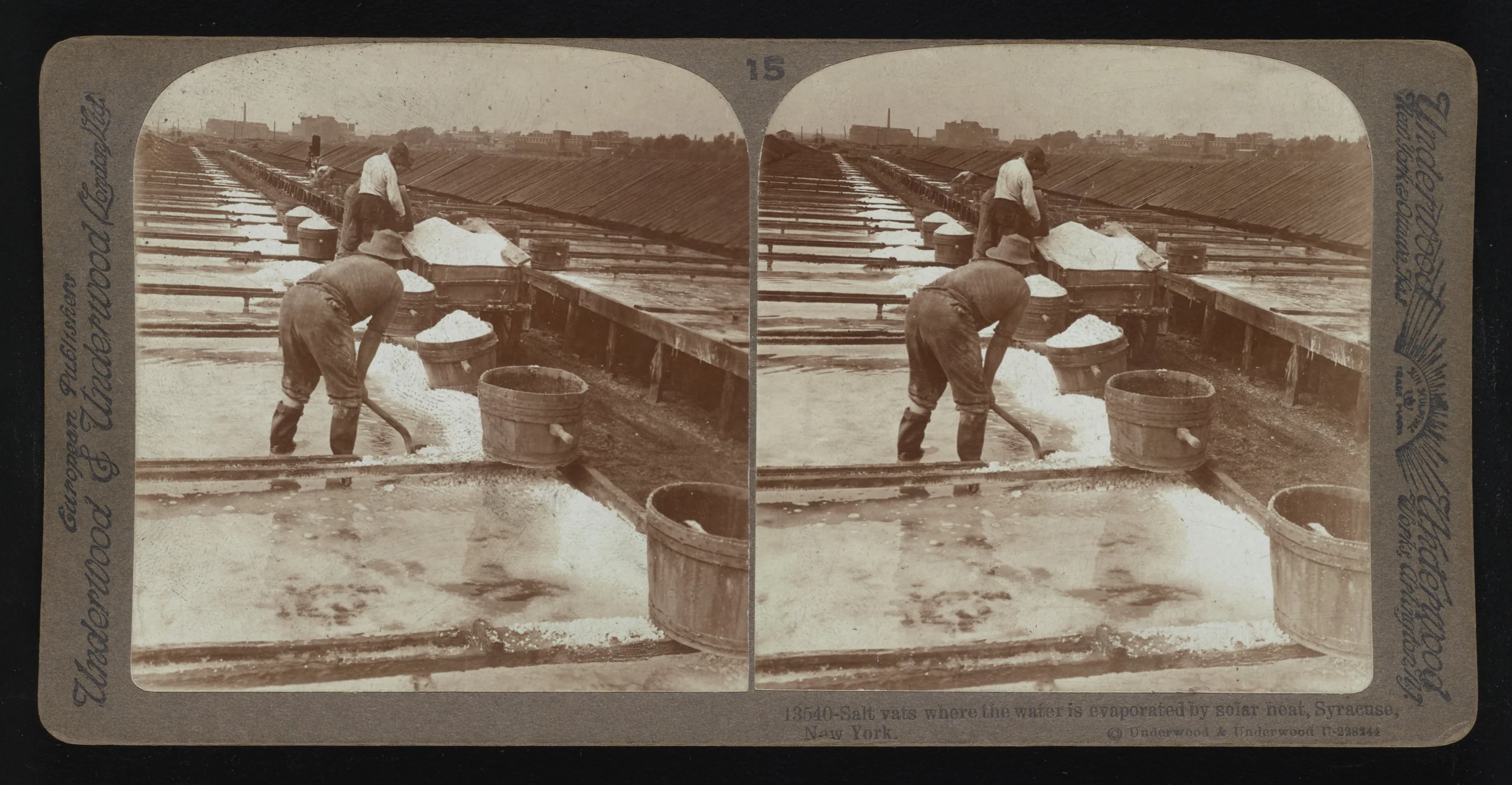
SYRACUSE, N.Y. In 1862, while the Civil War devoured the rest of the country, the salt works on the south end of Onondaga Lake hit their peak. Roughly 17,000 iron kettles boiled, day and night, from April to November.
Almost nine million bushels of salt were drawn out, packed into wood barrels, weighed at the canal, and shipped from Syracuse on the Erie.
This story came from public records we pulled ourselves
Get the next one, plus overnight incidents, in your inbox at 6 AM. Free, no spam.
By 1872, more than 5,000 men were on the payrolls of the boiling blocks and the solar yards. Over the full life of the industry, from 1797 to 1917, more than 11.5 million tons of salt left the Onondaga Salt Springs Reservation.
The men who pumped the brine, fed the firewood, scraped the kettles, and hauled the barrels are mostly not in the museum. Their names are mostly not on the markers. Their wages, their company-store debts, the days they were scalded, the years they were buried after a fever swept the swamp, are in ledgers, parish books, census sheets, and superintendents’ annual reports that almost nobody has read end to end. This is a story about that gap.
The lake, the brine, the demon
The salt was geological luck. Onondaga Lake sits on top of an ancient inland sea, and brine springs bubbled up around its southern shore for nearly nine miles, from what is now Salina through Syracuse and out to Geddes. The Onondaga Nation knew the springs long before the Jesuits arrived. In August 1654, the missionary Simon Le Moyne came north from Quebec and was shown a spring his Iroquois hosts said was “defiled by a demon.” Le Moyne tasted it, recognized it as salt brine, and wrote home about it. Two years later, French Jesuits boiled brine in kettles at their Ste. Marie de Ganentaa mission and shipped samples back to Quebec.
European commercial production started in 1788, when Asa Danforth and Comfort Tyler hung a five-pail kettle from a chain over a fire and boiled their first salt. By 1797, the New York Legislature had taken control of the springs. The state divided the marsh into salt lots, store lots, and pasture lots, appointed William Stephens as superintendent, and started taxing every bushel that came off the reservation. The Onondaga Salt Springs Reservation existed under direct state ownership until 1908.

The workers
Salt boiling did not need skill. It needed bodies. From the very beginning the work pulled in whoever was newest and poorest in town. In the early years, that meant a small handful of permanent residents, including, by some early accounts, enslaved people brought to Salt Point in the 1770s. By the 1820s and 1830s, when Joshua Forman developed solar evaporation and the Erie Canal opened a route to market, it meant the Irish.
The Irish came first as Erie Canal laborers in the 1820s and stayed, then came as famine refugees from 1848 to 1855. The hill west of Syracuse where many of them settled, overlooking the canal and the salt blocks, was named for County Tipperary. More than 5,000 Irish immigrants landed in Onondaga County during and after the famine years, predominantly Catholic, mostly unskilled, and walked into work at the salt blocks because the salt blocks were hiring. The work was hot and twelve hours long. According to summaries of the surviving worker records, men labored in 90-degree heat and high humidity, twelve hours a day, seven days a week, from April through November. Pay was tied to the bushel. In the early decades, a worker could produce roughly 600 bushels in a season at about a dollar a bushel, which was real money in 1820 and was the only money for a man who arrived with nothing.
The Black community in Syracuse and Salina was much smaller and harder to track in the salt-block records. Roughly 100 African Americans were living in the area by 1837, organized around the AME Zion Church on East Fayette Street. The church, founded by the formerly enslaved Reverend Thomas James and later home to the abolitionist Reverend Jermain Loguen, was the most important Black institution in 19th-century Syracuse. Members were employed, in the main, as porters and servants. How many worked the salt blocks specifically is not clear from the published church histories. What is clear is that during the Civil War, false rumors circulated through the boiling blocks that freed slaves were going to be sent north to take the salt jobs. The rumor matters. It tells you that the white salt workers, mostly Irish, understood themselves as competing for the same jobs Black workers might also want.
Women and children were also part of the workforce. Young women packaged the finished salt into cotton bags. The packing rooms do not appear in the famous photographs. They appear in the bills of sale.
| Decade | Workforce makeup | Approx. men employed |
|---|---|---|
| 1820s | Erie Canal Irish, early Yankee farmers, transient laborers | ~500 |
| 1840s | Famine Irish surge, German tradesmen, small Black community in Salina | ~1,500 |
| 1860s | Civil War demand, Irish dominant in boiling blocks, women in packing rooms | ~3,000 |
| 1870s | Peak of paid headcount, multi-generational Irish families, expanded solar yards | 5,000 |
The dying
Salt did not kill workers the way coal did. There is no Onondaga equivalent of a Triangle Shirtwaist or an Avondale Mine. What killed salt workers, in the early years, was the swamp. In 1793, the very first season of organized production, 33 people were living and working at the springs. Thirty of them got sick. In 1794, malaria carried off 23 people in a single year out of a tiny population. The local memory keeps one name from those early epidemics: Patrick Riley, a salt worker who, by historical archives held in the area, kept the kettles boiling while caring for the sick when the village was in danger of collapse. Riley is the rare salt worker remembered by a single name, and the reason he is remembered is essentially that he refused to die.
Once the marsh was diked and the wood-fired kettles were running at full capacity, the danger shifted. Boiling brine in iron cauldrons heated from underneath does not require an explosion to maim a man. It only requires a slip on a wet plank, a kettle that buckles after years of brine corrosion, or a roof that gives way under the weight of accumulated salt and rain. Newspapers from the salt district in the 1850s, including the local sheet called Bastinado that ran out of the Salt Works in Syracuse and is held by the Library of Congress, would have carried these accidents in single paragraphs. The systematic count of who was scalded, who lost a hand, and who died of lung trouble after years in the boiling sheds has not, to our knowledge, been published in book form. The Onondaga Historical Association holds the business and industry records that would let a historian build that count.
The labor question
The question every reader will want answered is whether the salt workers organized. The honest answer, based on the published record we have been able to verify, is that the surviving evidence is thin. Local lore mentions a salt boilers’ uprising in the 1850s. We have not been able to confirm a specific event, name it, and date it with multiple primary sources. What we can confirm is that the wage structure was paternalistic in a way that left workers exposed. Pay was per bushel. The state set the price ceiling on salt and taxed every barrel. When western salt from Michigan started competing in the 1870s and prices fell, that pressure went straight down the chain to the men at the kettles. By 1876, Michigan and Canadian salt were eating market share. By 1882, Wyoming County had been found to sit on superior rock-salt deposits. The wages a salt boiler made in the 1880s did not buy what they bought in the 1850s.
Whose land it was
None of this happened on neutral ground. The Onondaga Salt Springs Reservation was carved out of Onondaga Nation territory under the Treaty of Fort Schuyler of 1788, which the Onondaga Nation today holds was never legitimately negotiated. That treaty reserved a one-mile strip around Onondaga Lake to the Onondagas for the purpose of making salt “in common” with the new arrivals. In practice, state ownership of the reservation, leasing of the salt lots to private operators, and the eventual industrialization of the lake under the Solvay Process Company did the opposite of common use. The brine that the salt industry pulled out of the ground for over a century is part of why Onondaga Lake today is one of the most polluted lakes in the United States, ranked as a Superfund site since 1994.
The Onondaga Nation has been clear about the throughline. Tadodaho Sid Hill has called for “the water, land, and air returned to its condition prior to being illegally taken by New York State in the 18th and 19th centuries.” The Nation’s federal land-rights case was dismissed in 2010, and the Nation has since taken the matter to the Inter-American Commission on Human Rights, which in May 2023 allowed two of its claims to proceed. The salt era is not a closed chapter for the Onondaga Nation. It is the start of an unfinished argument about the lake.
The disappearance
By the time the Solvay Process Company incorporated in 1881 and started drilling its own brine wells at the lake in 1883, the bushel-counting era was already losing ground. Solvay was not a salt company. Solvay was a chemical company that needed salt brine, limestone, and water to make soda ash. It found all three at Syracuse. Soda-ash production began in 1884 at about 20 tons a day, and the byproducts started going straight into the lake. By the time New York State sold off the salt-springs infrastructure in 1908, the chemical era had eclipsed the salt era. The last batch of Onondaga salt was drawn in August 1926. The Solvay descendant company, Allied Chemical, ran on the lake until 1986, dumped roughly six million pounds of salty waste a day at peak, and discharged 165,000 pounds of mercury between 1946 and 1970.
The boiling-block workers did not get a closing ceremony. The blocks closed because the price was wrong, because the brine ran thin, because the chemical plants paid better. Most of the Irish families on Tipperary Hill stayed put and changed jobs. The salt-potato tradition, where workers boiled small potatoes in the brine kettles for lunch and ate them with butter, is what survived publicly from the daily life of the salt blocks. It became a Syracuse food. The men who invented it did not, in the main, get plaques.
Civil War year 1862
10M
7.5M
5M
2.5M
0
1797
1820
1840
1862
1880
1900
1917
1862 PEAK · 9M bushels · 17,000 kettles
What is and is not commemorated
The Salt Museum on the eastern shore of Onondaga Lake opened in 1933, at the bottom of the Depression, built by Civilian Conservation Corps labor partly out of wood salvaged from the demolished blocks. It was constructed around the original chimney of the Jaquith Block, which still stands. The museum reconstructs the boiling apparatus and walks visitors through the process, the brine sheds, and the scale of the industry. It is a real museum. It is also, by its nature, a museum of objects, not of names.
The Onondaga Historical Association in downtown Syracuse holds more than one million civilian and military documents, including business and industry records from the salt era. Those records, the wage books, the company-store accounts, the lists of leaseholders and their workers, are the place a full worker-by-worker history would have to come from. To our knowledge, no such history has been published. The names of nearly all the men who boiled salt at Onondaga are still in the boxes.
That is the honest state of the commemoration. The geology has a museum. The capital has a state historical marker on Route 11. The Solvay industrial era has its own historical marker at the old plant. The Irish neighborhood has its upside-down traffic light, its Tipperary Hill memorial, and its salt potatoes. The Onondaga Nation has, since 2005, been arguing for the return of the lake itself.
The men who actually boiled the salt are still mostly unnamed. The ledgers exist. The work has not been done.
Soft claim flagged: References to a specific salt-boilers’ labor uprising in the 1850s are part of local lore. We have not been able to confirm a specific named event with multiple primary sources and have written the labor section accordingly. Tips on a primary source for any such event can be sent to [email protected].
Sources: Onondaga Nation; Onondaga Historical Association (cnyhistory.org); Library of Congress, Detroit Publishing Company Collection; New York Almanack; Salt Museum, Onondaga County Parks; Empire State Plaza, NY State; PACNY Freedom Trail (AME Zion Church); Inter-American Commission on Human Rights filings; New York State Department of Environmental Conservation; U.S. Environmental Protection Agency Superfund record for Onondaga Lake.
{
“@context”: “https://schema.org”,
“@graph”: [
{
“@type”: “NewsArticle”,
“@id”: “https://cnysignal.com/forgotten-salt-workers-syracuse#article”,
“headline”: “The Forgotten Salt Workers: Who Actually Built Syracuse’s First Industry”,
“description”: “More than 5,000 men were on the salt-block payrolls in 1872, and over 11.5 million tons of salt left the Onondaga Salt Springs Reservation between 1797 and 1917. Most of the workers, mostly Irish immigrants and a smaller community of free Black laborers, are not on plaques. The ledgers are still in the boxes.”,
“datePublished”: “2026-04-27”,
“author”: {“@type”: “Organization”, “name”: “CNY Signal”},
“publisher”: {
“@type”: “Organization”,
“name”: “CNY Signal”,
“url”: “https://cnysignal.com”,
“logo”: {
“@type”: “ImageObject”,
“url”: “https://cnysignal.com/wp-content/uploads/2024/01/cny-signal-logo.png”
}
},
“image”: “https://tile.loc.gov/storage-services/service/pnp/det/4a10000/4a12000/4a12800/4a12804v.jpg”,
“articleSection”: “History”,
“keywords”: “Onondaga salt, Syracuse history, salt boilers, Solvay Process, Onondaga Lake, Tipperary Hill, Onondaga Nation, AME Zion Church, Erie Canal, Salt Museum”,
“about”: [
{
“@type”: “Place”,
“@id”: “https://cnysignal.com/forgotten-salt-workers-syracuse#place”,
“name”: “Onondaga Salt Springs Reservation”,
“description”: “State-owned reservation under New York from 1797 to 1908, encompassing salt springs from Salina through Syracuse to Geddes along the southern shore of Onondaga Lake.”,
“geo”: {
“@type”: “GeoCoordinates”,
“latitude”: 43.0865,
“longitude”: -76.19
}
},
{
“@type”: “Organization”,
“name”: “Onondaga Nation”,
“url”: “https://www.onondaganation.org/”
}
],
“mentions”: [
{
“@type”: “Person”,
“name”: “Simon Le Moyne”
},
{
“@type”: “Person”,
“name”: “Asa Danforth”
},
{
“@type”: “Person”,
“name”: “Comfort Tyler”
},
{
“@type”: “Person”,
“name”: “Joshua Forman”
},
{
“@type”: “Person”,
“name”: “William Stephens”
},
{
“@type”: “Person”,
“name”: “William Kirkpatrick”
},
{
“@type”: “Person”,
“name”: “Patrick Riley”
},
{
“@type”: “Person”,
“name”: “Thomas James”
},
{
“@type”: “Person”,
“name”: “Jermain Loguen”
},
{
“@type”: “Person”,
“name”: “Sid Hill”,
“jobTitle”: “Tadodaho of the Onondaga Nation”
}
]
}
]
}