
Micron is bringing 9,000 jobs to Central New York. But the region can’t care for the children of the workers who’ll fill them — and a statewide funding crisis just made it worse.
It’s spring in Central New York, and parents of infants and toddlers are doing what they do every year: scrambling to lock down childcare for fall. They’re calling providers, joining waitlists, doing the math — and many are discovering that the math doesn’t work.
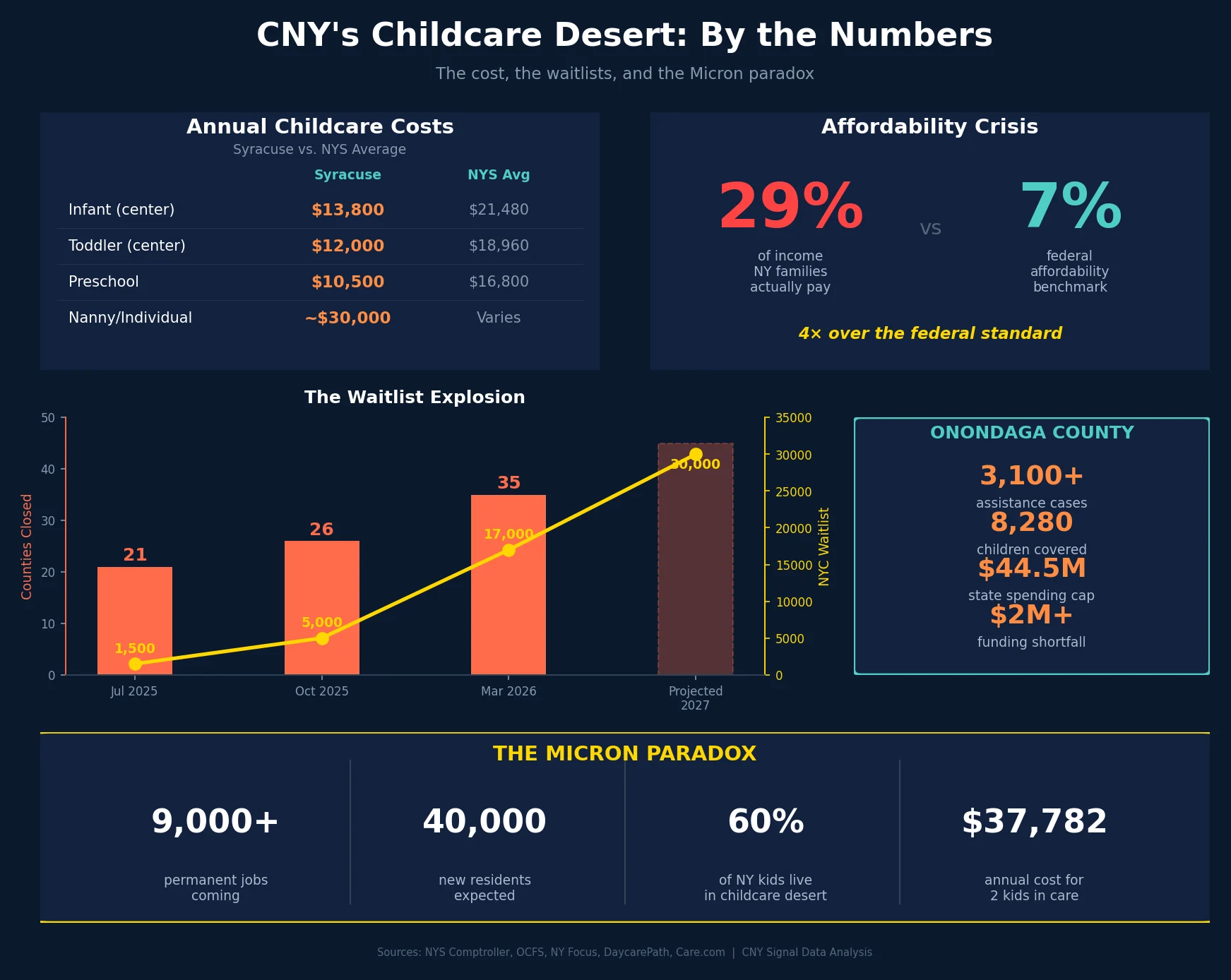
In Onondaga County, full-time infant center care runs approximately $1,150 per month — about $13,800 a year. Toddler care averages $1,000/month ($12,000/year). And that’s if you can find a slot.
More than 60% of New York children live in a childcare desert, according to the NYS Comptroller’s February 2025 report. Across the state, the safety net that was supposed to help — the Child Care Assistance Program (CCAP) — is collapsing under its own demand.
And then there’s Micron.
The Numbers: A System in Freefall
The childcare crisis in New York has escalated dramatically between 2025 and 2026:
- By July 2025, at least 21 counties had stopped accepting new CCAP applications due to lack of funding. Thirteen were maintaining waitlists.
- By March 2026, that number swelled to 35 counties plus New York City with closed applications. Twenty-one are keeping waitlists.
- New York City’s CCAP waitlist has grown from 1,500 families in July 2025 to over 17,000 families in March 2026 — a more than 1,000% increase in eight months.
- Without additional funding, NYC’s waitlist alone could surpass 30,000 families by next year.
CCAP spending exceeded its allocation for the first time in 2025, topping $2.2 billion statewide. Governor Hochul and state legislators are negotiating proposals to add $1.2 billion in supplemental funding, but local officials and advocates say it won’t come close to clearing the backlog.
Erie County provides a telling example: even with $14 million in proposed supplemental funding, the county would still face an $8.5 million deficit and 300+ families on its waitlist. The crisis is so severe that at least one county has already withdrawn from the Governor’s signature universal childcare pilot for children aged 3 and younger.
Onondaga County: 3,100 Cases and Counting
The local picture is just as stark. In 2021, Onondaga County managed 1,500 childcare assistance cases costing about $20 million. By 2025, that had more than doubled to over 3,100 cases covering approximately 8,280 children, according to state data.
County Executive Ryan McMahon said in February 2025 that the state capped their spending at $44.5 million — at least $2 million below what the county needs based on its OCFS-approved plan of $46.7 million. The result: Onondaga County has paused new childcare assistance applications. Completed, eligible applications go on a waiting list until funding materializes.
Families currently receiving assistance won’t lose it unless their case comes up for recertification and doesn’t qualify for a waiver. Foster care and protective care cases continue without interruption. But for new families trying to enter the system? The door is closed.
What Parents Are Actually Paying
For families who can’t access CCAP — which is most families, given the income thresholds and closed waitlists — the out-of-pocket numbers are sobering:
Syracuse is cheaper than New York City (where infant center care averages $2,450/month), but Upstate families aren’t earning NYC salaries. Childcare can consume up to 29% of a New York family’s income — more than four times the federal affordability benchmark of 7%.
Two children in full-time care can cost over $37,782 per year statewide. In Syracuse, a family with an infant and a toddler is looking at roughly $25,800 annually — before taxes, food, or rent.
The Micron Paradox
Here’s the part that should keep workforce development officials up at night.
Micron’s $100 billion investment in Clay is projected to create 9,000+ permanent jobs with average salaries exceeding $100,000, plus nearly 50,000 construction and indirect jobs. The region is planning for 40,000 new residents.
Those workers will need housing — and the housing conversation is happening. But many of those workers will also have children. And the childcare infrastructure to support them does not exist.
This isn’t a new problem, but Micron turns it into a bottleneck. You can’t fill a $100,000/year semiconductor job if the person you’re hiring can’t find childcare for their 18-month-old. You can’t attract relocating professionals from Austin or Boise if they discover that the local daycare has a 9-month waitlist and costs $14,000 a year.
Every Micron story you’ve read has been about jobs, housing, and construction. Nobody is reporting on the invisible infrastructure — childcare — that determines whether working families can actually fill those jobs.
The Provider Pipeline Is Broken Too
It’s not just funding. The providers themselves are disappearing.
The NYS Comptroller’s 2025 report found that 60% of the state’s census tracts qualify as childcare deserts — areas where the supply of licensed childcare slots falls far short of the number of children who need them.
Family daycare providers — the small, home-based operations that serve as the backbone of rural and suburban childcare — have been closing at an accelerating rate since 2020. The economics are brutal: providers earn low wages while navigating complex licensing requirements, and the families they serve often can’t afford to pay more.
Average childcare worker wages in New York hover around $15–$17/hour — barely above minimum wage in many parts of the state. In a labor market where Amazon and Wegmans pay comparable starting wages with better benefits, childcare workers leave.
What’s Being Done — And What Isn’t
Governor Hochul dramatically expanded the Empire State Child Credit in 2026, eliminating income phase-in restrictions that had prevented the poorest families from accessing the full credit. A proposed Child Care Expansion Act aims to increase slots statewide, particularly in underserved rural and urban areas.
For Tax Year 2025, New York offers a child tax credit of up to $1,000 per child under age 4 and $330 per child ages 4–16. Helpful, but not remotely enough to cover $13,800 in annual infant care costs.
What’s missing is the structural investment: building and subsidizing new provider capacity in the Micron corridor and across CNY, paying childcare workers a living wage, and connecting workforce development planning to childcare infrastructure in a way that doesn’t treat kids as an afterthought.
CenterState CEO and the Micron workforce pipeline planners know this. Whether it becomes a priority before 9,000 families show up needing care — that’s the question.
Are you a parent struggling to find childcare in CNY? A provider who’s considering closing? CNY Signal is investigating. Email [email protected].