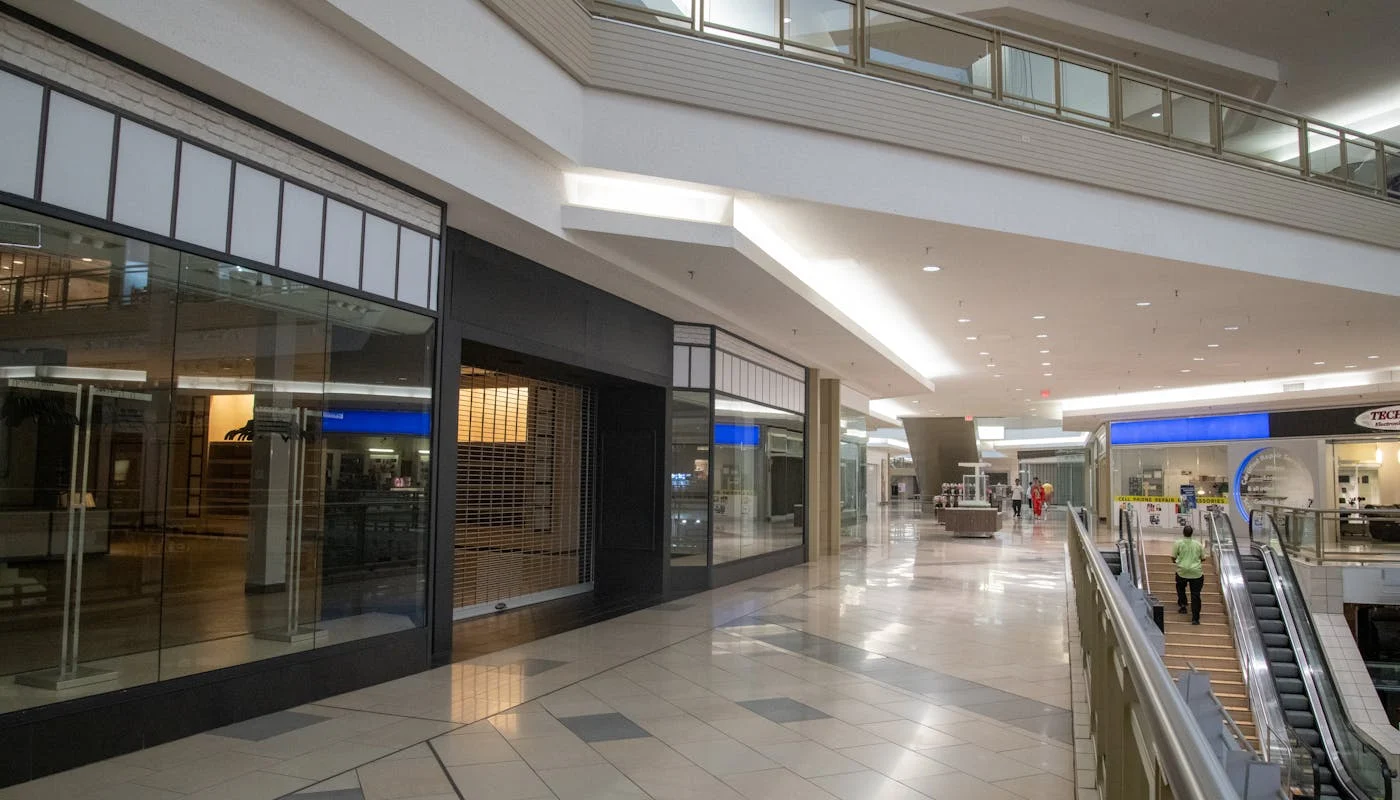
You don’t need a retail analyst to tell you something is wrong at Destiny USA. Walk through the upper levels on a Tuesday afternoon and count the darkened storefronts.
The 2.4-million-square-foot complex on Syracuse’s lakefront — the sixth-largest shopping center in the United States when it opened — has been shedding tenants for years. But the financial picture behind those shuttered gates is far worse than empty stores.
The Valuation Collapse
Destiny USA was appraised at $710 million in 2014. By 2021, the reappraisal came in at $203 million. KBRA, a credit ratings agency, assigned a liquidation value of just $65.3 million — a 91% decline from the 2014 peak.
In June 2024, Carousel Center Co., the Pyramid entity that owns the mall, defaulted on a $300 million mortgage when it failed to lock in a maturity extension. The entire balance became due immediately. An independent auditor’s report stated these conditions “raise substantial doubt about the company’s ability to continue as a going concern.”
Total debt on the property: $715 million — $300 million for the original Carousel Center, $130 million for the Destiny expansion, plus additional obligations. The building is worth a fraction of what is owed.
The PILOT Deal Syracuse Can’t Ignore
The deal that made Destiny possible is now the deal that costs Syracuse the most. Under a 30-year Payment in Lieu of Taxes agreement struck in 2002, Pyramid pays $800,000 annually in property taxes for the land. The mall building itself is untaxed.
If fully taxed at normal rates, the property tax bill would be approximately $19.4 million per year. That means Syracuse forfeits roughly $18.4 million annually in potential property tax revenue. The expansion alone netted the city just $210,000 per year in additional revenue. The PILOT expires around 2032.
The Broken Promise
Developer Robert Congel originally promised a 4.5-million-square-foot LEED Platinum complex with 400 stores, 4,000 hotel rooms, a saltwater aquarium, ice-climbing walls, a 65-acre domed park, two Broadway theaters, and a $500 million clean-energy technology park. None of these materialized.
What actually got built: an 850,000-square-foot expansion completed in 2012, pushing the mall to 2.4 million square feet. Congel publicly admitted the mall would not expand further. He died in February 2021 at age 85.
The project also received $228 million in tax-exempt green bonds, giving it an estimated $120 million subsidy over 30 years. The bonds required renewable energy, solar panels, and LEED certification. The green features were never built. The IRS began auditing the bonds in March 2011.
The Anchor Exodus
Lost anchors include Lord & Taylor (bankruptcy, August 2020), JCPenney (June 2020), Best Buy (March 2021), At Home, Bon-Ton, and Sports Authority. In 2025, Hugo Boss, Ardene, Margaritaville (a 10-year tenant), and World of Beer all closed.
IKEA opened in November 2025 in the former At Home space — a bright spot. Mystery Bins, selling discounted Amazon returns, took over the former JCPenney. A 40,000-square-foot indoor pickleball facility and a 14,000-square-foot VR venue were added. But entertainment can’t replace anchor-scale retail revenue.
Pyramid Is Losing Malls Everywhere
Pyramid Management Group has lost three other malls to foreclosure in the past year: Aviation Mall in Queensbury, Hampshire Mall in Hadley, MA, and Palisades Center in West Nyack ($418.5 million in debt). Walden Galleria outside Buffalo also defaulted but was refinanced in February 2026.
What Nobody’s Saying Out Loud
For Syracuse’s fiscal health — already under pressure from a $24 million reserve draw and frozen state aid — any significant reduction in Destiny USA’s tax contribution would compound the revenue problem. Mayor Ben Walsh publicly stated “they need to invest more resources” regarding Destiny’s ownership.
Nobody in local government is publicly discussing what a worst-case scenario looks like: a 2.4-million-square-foot building at 40-50% occupancy, generating a fraction of its original tax revenue, sitting on the most valuable lakefront real estate in CNY, adjacent to the Inner Harbor development the county is betting on.
That conversation should probably start now.
What to Know
- Valuation collapse: $710M (2014) to $203M (2021) to $65.3M liquidation value — 91% decline
- $300M mortgage default in June 2024 — auditor raised “going concern” doubt
- Total debt: $715 million on a property worth a fraction of that
- PILOT deal: Pyramid pays $800K/year vs. $19.4M if fully taxed — city forfeits $18.4M/year
- $228M in green bonds — green features never built, IRS audit since 2011
- Congel’s original promise of 4.5M sq ft, 4,000 hotel rooms — none built
- Pyramid lost 3 other malls to foreclosure in the past year
- PILOT expires ~2032 — the tax question gets real
Photo: Pexels. Sources: Bisnow, The Real Deal, Daily Orange, GreenBiz, WRVO, CNY Central, KBRA.