By Matt Russo, Senior Reporter
I.M. Pei was 51 years old when the Everson Museum of Art opened on Harrison Street in 1968. The building was his first commissioned museum, his first attempt at a public-facing art institution as architecture, and the design vocabulary he would carry forward into the East Building of the National Gallery of Art in Washington in 1978, the Louvre Pyramid in Paris in 1989, and the Miho Museum near Kyoto in 1997. Three of the most photographed museums on Earth begin here, in a concrete box at the corner of Harrison and State Streets in Syracuse.
The Everson Museum sits at 401 Harrison Street, accessible from Interstate 81 Exit 18 and adjacent to the Oncenter complex. The museum is the public face of the Syracuse Museum of Fine Arts, which was founded in 1897 by art historian and Syracuse University professor George Fisk Comfort, twenty years before the Whitney and 32 years before the Museum of Modern Art. By 1911, the museum had committed to collecting only American art, a decision that pre-dated the modern canon of American collecting institutions.
This story came from public records we pulled ourselves
Get the next one, plus overnight incidents, in your inbox at 6 AM. Free, no spam.
The Helen Everson gift
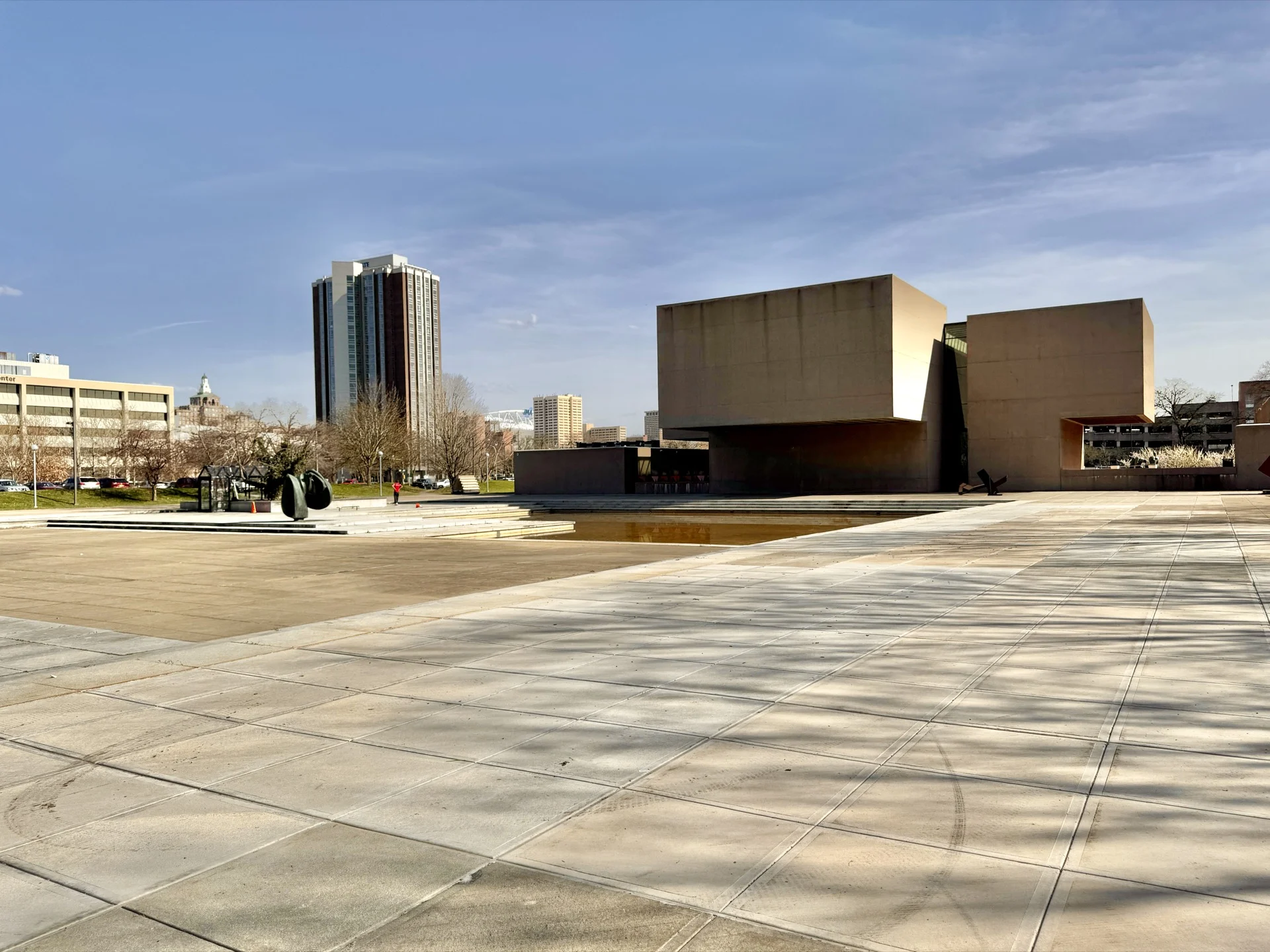
Helen Everson, a Syracuse philanthropist, left a $1 million bequest in 1941 specifically for the construction of a new museum building. Her gift waited nearly a quarter century before construction began. Ground broke in 1965. The museum opened in 1968 with Pei as architect of record. The building has four cantilevered square volumes anchored on a sculpted plaza, a composition Pei would refine later into the broken pyramid of the National Gallery East Building.
The Everson collection holds approximately 11,000 works. The strongest department is American ceramics, which is one of the most notable holdings of ceramic art in the United States and includes more than 100 works by Adelaide Alsop Robineau alone. Robineau’s Scarab Vase, the most famous single object in the collection, took more than 1,000 hours of carving to produce.
Source: Wikipedia “Everson Museum of Art”; ArtNews coverage of the 2020 Christie’s sale; everson.org “About” and “The Building.”
The Ceramic National story
The Everson’s ceramic prominence is older than the building. In 1932, then-museum director Anna Wetherill Olmsted founded the Ceramic National exhibitions as a tribute to Adelaide Alsop Robineau, who had died in 1929. Olmsted ran them out of the predecessor Syracuse Museum of Fine Arts. The Ceramic Nationals became the most prestigious juried exhibition in the field of ceramics for the next forty years. Purchase prizes added works to the museum’s collection on a continuous basis, building the deepest American ceramic holding of any U.S. museum. The series later evolved into the International Ceramic Triennial, which the Everson revived in modern form.
The Pei design language, born here
Pei’s original brief was conventional: a museum to hold the predecessor collection. He answered with the opposite of a conventional museum. Where his contemporaries were still building neoclassical containers in 1968, Pei pushed sculpted concrete volumes that looked like a piece of art themselves. The Everson is regarded by critics as a work of art in its own right. Its Brutalist exterior mimics its interior. Galleries cling to concrete walls, lit by lightwells and skylights pouring natural daylight into cavernous rooms. Ada Louise Huxtable, then chief architecture critic for The New York Times, lavishly praised the design when it opened.
The vocabulary returned ten years later in the East Building of the National Gallery of Art in Washington, completed in 1978, where Pei pushed the cantilever-and-skylight idea into a more refined geometry. The Louvre Pyramid followed in 1989, the Miho Museum in 1997, the Museum of Islamic Art in Doha in 2008. Each iteration carries the Everson’s central rule: a museum should be a sculptural object, not a container.
Source: I. M. Pei official biography; ArchDaily AD Classics: Everson Museum; National Gallery of Art official history; Louvre press archives; Miho Museum institutional history.
The 2020 Pollock decision
In October 2020, the Everson sold Jackson Pollock’s Red Composition (1946) at Christie’s New York for a hammer price of $12 million, $13 million with buyer’s premium, against a pre-sale estimate of $12 million to $18 million. The proceeds were directed by the board of trustees, in a unanimous vote, to fund acquisitions of works by underrepresented artists, an extension of the museum’s Collecting Priorities plan adopted in 2017. The sale generated significant national debate over deaccession ethics. The museum subsequently used the proceeds to acquire works by Shinique Smith, Ellen Lesperance, and others. Director Elizabeth Dunbar, who continues to lead the institution, defended the move publicly in the art press.
The 2024 East Wing renovation
Los Angeles-based architecture studio MILLIØNS completed a transformative renovation of the East Wing of the Everson Museum in 2024, drawing explicitly on Pei’s original concrete vocabulary. The renovation expanded public access and integrated the museum’s functional ceramics collection into a new cafe space inside the building. The studio described its design philosophy as a continuation of Pei’s logic, not a replacement of it.
What it means for Syracuse
Most American cities the size of Syracuse do not have a single I.M. Pei building, much less his first museum. The Everson is a working public museum, not a closed monument. The museum publishes general operating hours that include free admission days, and serves as the visual anchor of the Cultural Resources Council’s downtown district. As of 2026, the building is 58 years old. Its concrete is gray, its skylights still throw natural light onto the galleries, and the lineage from this corner to the Louvre is, at this point, an established art-historical fact.
Sources: Wikipedia, “Everson Museum of Art” and “I. M. Pei”; everson.org “About” and “The Building”; ArchDaily, “AD Classics: Everson Museum / I.M. Pei”; ArtNews, “Syracuse’s Everson Museum Will Sell $12 M. Pollock at Auction” and “Following $12 M. Pollock Sale, Everson Museum Acquires Contemporary Works”; Hyperallergic, “Everson Museum Stands By Deaccession of Pollock Painting”; Artnet News on subsequent Pollock-funded acquisitions; designboom, “I.M. Pei’s brutalist Everson Museum of Art renovated by studio MILLIØNS”; Wallpaper, “I.M. Pei’s Everson Museum of Art gets a modern makeover”; archpaper, “MILLIØNS draws from the architecture of I. M. Pei’s Everson Museum”; Time Out New York; Syracuse New Times 50th anniversary feature. Hero photo: Warren LeMay, Wikimedia Commons (CC BY-SA 2.0).