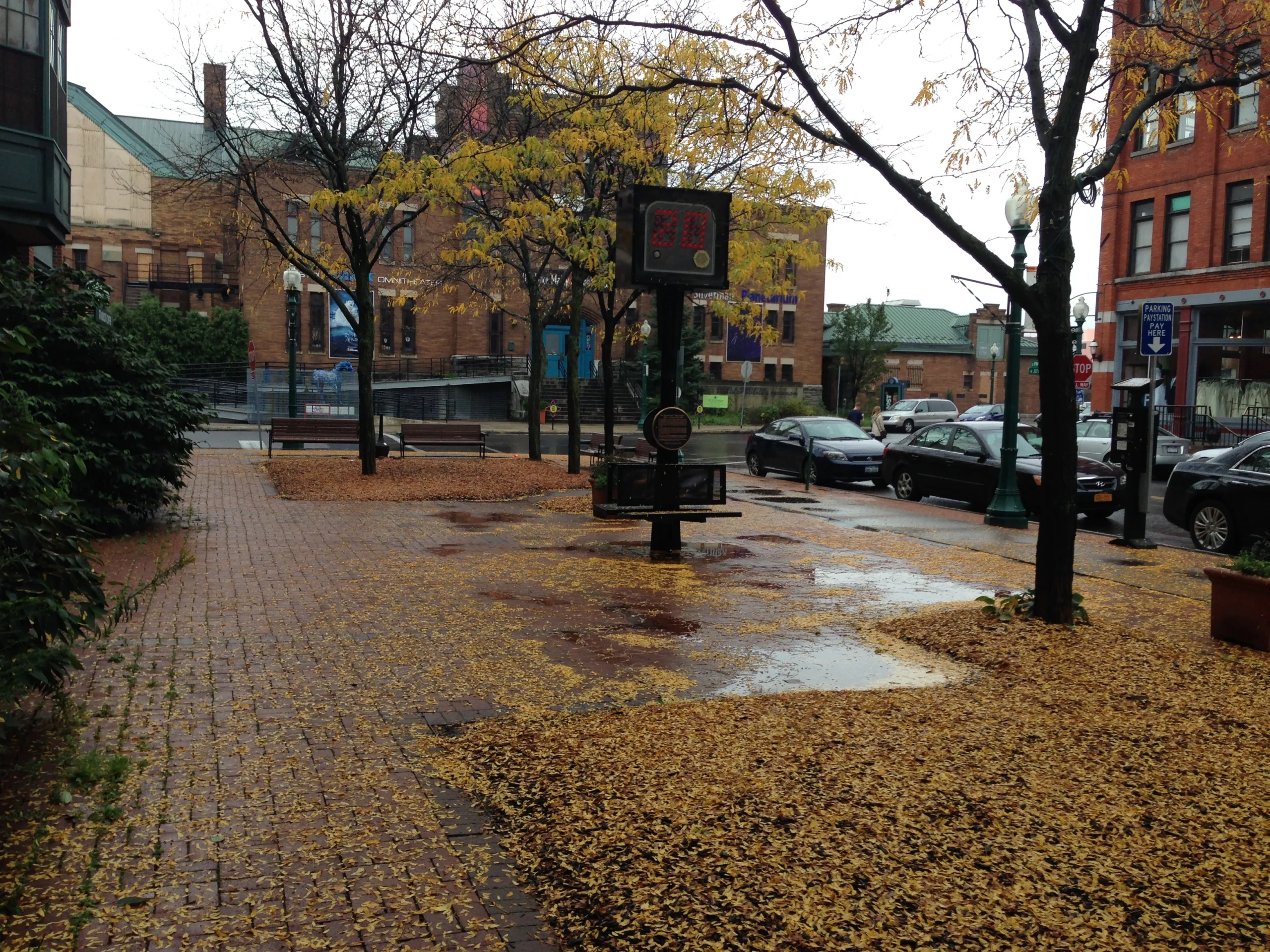

SYRACUSE, NY. The 24-second clock that changed the structure of professional basketball was lit again on May 13 in front of the Milton J. Rubenstein Museum of Science and Technology on West Jefferson Street. The Shot Clock Monument, off-line for the previous 14 months while the city dismantled it, restored it, and trucked it across the street, resumed its countdown at a rededication ceremony attended by Syracuse Mayor Sharon Owens, MOST President Lauren Kochian, and members of the Biasone, Barboni, and Ferris families who descend from the men who first put 24 seconds on the play clock in 1954.
The monument, designed by architect Bob Haley and originally unveiled in 2005, stood for 20 years in a pocket park at Franklin and West Jefferson streets across from the Armory Square Armory. It was removed in March 2025 to clear the parcel for outdoor seating at the new Crooked Cattle restaurant at 290 West Jefferson Street. The piece spent the better part of a year in restoration at Toltec Metalworks in Syracuse, where artist Devon stripped, repainted, and reconditioned the clock face and base at a cost of roughly $4,000.
Know before your neighbors do
The Morning Signal hits your inbox at 6 AM with everything that happened overnight. Real incidents, real data, zero fluff.
The new home, on the lawn between the MOST main entrance and the Onondaga Creekwalk, is across the street from the original site. City planner and landscape designer Josh Wilcox, who oversaw the relocation, has said publicly that the new placement gives the monument a longer sightline. The clock is now visible for several blocks north along Franklin Street, where the pocket park location was hemmed in by the surrounding buildings.
The 1954 Origin Story
The shot clock was conceived by Syracuse Nationals owner Danny Biasone and Nationals general manager Leo Ferris in 1954 in response to a stalling crisis that was killing the pro game. NBA teams were holding the ball for minutes at a time to protect leads, and average game attendance was dropping. Biasone, who owned the Syracuse Sports Center bowling alley on Tompkins Street in Eastwood, sat down with Ferris and a Nationals scout named Emil Barboni and worked out the math. They divided 2,880 seconds, the length of a 48-minute NBA game in seconds, by an average of 120 shots per game in faster-paced contests they had tracked. The quotient was 24.
The trio tested the rule in a scrimmage at Syracuse’s Blodgett Vocational High School in August 1954, with NBA team officials in the bleachers. The league adopted the 24-second clock for the 1954-55 season. Scoring jumped from a league-average 79.5 points per game in 1953-54 to 93.1 points per game in 1954-55, a gain of 13.6 points per team. Game attendance recovered the following year, and the league credits the rule change with saving professional basketball as a viable spectator sport. The Nationals went on to win the NBA championship in 1955 using the clock they had invented.
Coach Howard Hobson, whose work at Yale and Oregon had advocated for time-of-possession reform throughout the 1940s, is often cited as the intellectual predecessor whose research Biasone and Ferris turned into a workable game rule. But the operational rule, with the specific 24-second count and the specific format that the NBA still uses today, is a Syracuse invention.
Why The Monument Had To Move
The original 2005 monument was sited on a parcel at the southeast corner of Franklin and West Jefferson streets, a pocket park created from a single demolished commercial lot. The piece was funded by Syracuse-area philanthropist John Marsellus, who contributed more than $50,000 toward the project, with additional support from the Greater Syracuse Sports Hall of Fame and the city of Syracuse. Former Syracuse parks commissioner Pat Driscoll oversaw the original installation. It became a tourist photo stop, an Atlas Obscura entry, and a quiet but consistent piece of the Armory Square experience.
The parcel was eventually sold and is now the site of Crooked Cattle, a bar and restaurant at 290 West Jefferson Street that opened in 2025. The new owner needed the outdoor footprint for sidewalk seating. Rather than scrap the clock, the city worked with the Greater Syracuse Sports Hall of Fame, the MOST, and the families of Biasone, Barboni, and Ferris to relocate the piece across the street.
The MOST agreed to host the monument on its lawn at no cost, with the city retaining ownership and maintenance responsibility. The piece sits next to the museum’s main entrance and is visible from West Jefferson Street, the Onondaga Creekwalk, and Franklin Street to the north.
The Rededication Ceremony
The May 13 ceremony brought together civic leaders, MOST staff, and three family members who descend from the inventors. Rosemary Barboni Kelly, niece of scout Emil Barboni, stood next to Christian Figueroa, great-nephew of Nationals co-creator Leo Ferris, and Danielle Biasone Pires, niece of Danny Biasone. Mayor Owens spoke briefly, said the clock represents one of Syracuse’s strongest claims to a national sports legacy, and pressed the start button that brought the digital countdown back online for the first time in 14 months. MOST President Lauren Kochian welcomed the monument to the museum’s grounds and connected it to the MOST’s Innovation Station gallery, which highlights Central New York-born inventions.
The MOST occupies the former West Jefferson Street Armory, a 1907 building that originally housed the New York National Guard. The museum reopened the armory in 1992 after a multi-year renovation. The Shot Clock Monument is the first major exterior installation added to the museum grounds since the building’s reopening.
Why The Move Matters Beyond Sports
The pairing of the monument and the MOST is the part of the relocation that the city is most interested in. The MOST’s Innovation Station gallery already features other Central New York-born inventions, including the traffic light (developed in Syracuse by James Hoge in 1913), the Brannock Device for shoe sizing (invented by Charles Brannock in Syracuse in 1927), and the dental chair (perfected by Syracuse dentist James B. Morrison in the 1860s). The shot clock now joins that group on the museum’s exterior, giving visitors a free public encounter with one of the city’s signature inventions before they even enter the building.
The MOST is also using the relocation to launch a new permanent exhibit inside the Innovation Station gallery dedicated to the shot clock specifically. The exhibit, which the museum plans to open later in 2026, will document the August 1954 Blodgett scrimmage, the Nationals’ 1955 championship run, and the global adoption of the 24-second rule by basketball leagues across the world. FIBA, the international basketball federation, adopted the 24-second clock in 2000 after several decades of using a 30-second rule.
The Inventors The Monument Honors
Danny Biasone, born in Italy in 1909, came to Syracuse with his family as a child. He bought the Syracuse Nationals NBA franchise in 1946 and ran it through 1963, when he sold the team and it moved to Philadelphia to become the 76ers. His Syracuse Sports Center bowling alley in Eastwood remained his civic anchor for decades. He was inducted into the Naismith Memorial Basketball Hall of Fame in 2000, 8 years after his death.
Leo Ferris was born in 1917 and was the NBA’s primary architect on the operational and rules side. Beyond co-creating the shot clock, he played a leading role in the 1949 merger of the Basketball Association of America and the National Basketball League into what became the NBA. He worked for the Nationals as general manager during the formative early-1950s seasons. He was inducted into the Naismith Hall of Fame in 2024.
Emil Barboni, the scout who sat at the bowling alley table with Biasone and Ferris, is the third name engraved on the monument’s base. Less nationally famous than the other two, Barboni’s role in tracking shooting frequency and calculating the per-shot average that became the rule’s basis has been documented by Syracuse basketball historians and acknowledged by the league.
What Visitors Will See Now
The relocated monument stands roughly 20 feet tall, with the digital 24-second display running continuously throughout daylight and evening hours. The base carries plaques naming Biasone, Ferris, and Barboni, the original donor John Marsellus, and the 2005 design team. The new site includes a small informational panel installed by the MOST that gives visitors the August 1954 Blodgett scrimmage story in two paragraphs and directs them to the museum’s Innovation Station gallery for the longer exhibit.
For Syracuse University students walking from campus down Walnut Avenue toward Armory Square, the monument is now visible from the corner of West Jefferson Street and South Franklin Street, a clear sight line that did not exist at the previous pocket park location. For visitors arriving at the MOST for the museum’s family programming, the monument is a free first stop before paid admission.
The Civic Investment Question
Civic monuments age. Some get neglected, lose their lighting, weather to illegibility, and end up in storage. The Shot Clock Monument took a different path because three things happened in sequence: a private property transaction forced the move, a restored-and-relocated solution was cheaper than scrapping the piece and starting over, and the MOST had open exterior real estate next to an Innovation Station gallery already telling the same story. The result is a piece that is more visible and better contextualized than it was at the original site, at a public cost of roughly $4,000 in restoration work plus city staff time on the relocation.
For Central New York, the rededication is a marker that one of the region’s signature inventions still gets civic attention 72 years after the Blodgett scrimmage. The shot clock is on the list of inventions Syracuse can point to when it makes the case that its industrial and intellectual history extends well beyond Carrier air conditioners and Brannock Devices.

Sources & Verification
- Sean Kirst, Central Current: “Shot clock monument, in new spot, resumes its great eternal message for Syracuse,” May 13, 2026, centralcurrent.org
- WAER 88.3 FM: “Shot Clock monument resumes counting down in front of the MOST,” May 12, 2026, waer.org
- Spectrum News Central NY: “Syracuse shot clock monument moved to front of Museum of Science and Technology,” May 11, 2026, spectrumlocalnews.com
- This Is CNY: “Syracuse’s famous 24-second shot clock goes back up in new downtown location,” thisiscny.com
- Sean Kirst, Central Current: “A secret donor made sure basketball’s game-changing shot clock is monumental, in Syracuse,” centralcurrent.org
- Naismith Memorial Basketball Hall of Fame: inductee profiles for Danny Biasone (2000) and Leo Ferris (2024)
- NBA historical statistics: 1953-54 and 1954-55 league scoring averages