
A new economic impact study reveals Syracuse University athletics pumps $136.7 million into the regional economy and supports more than 1,600 jobs — but declining attendance and a leadership shakeup could reshape the equation.
Every fall Saturday when 40,000-plus fans stream into the JMA Wireless Dome for Orange football, the economic pulse of Central New York quickens. Every winter evening when the basketball faithful pack the lower bowl, cash registers from Marshall Street to Armory Square ring a little louder. And according to a January 2026 study by global consulting firm Lightcast, commissioned by Syracuse University, the numbers behind that pulse are staggering.
Syracuse Athletics contributed $136.7 million in income to the Central New York economy in fiscal year 2023-24 and supported 1,644 regional jobs, according to the study. The university’s events drew approximately 167,000 visitors that year, generating more than $57 million in direct visitor spending across Onondaga, Cayuga, Cortland, Madison, and Oswego counties.
Those athletics figures are part of a broader story: SU’s total economic footprint hit $1.8 billion in the same period, a 64 percent increase from the $1.1 billion recorded in 2017. The university supports 35,132 jobs across the five-county region — roughly one of every 13 jobs in Central New York. It is the second-largest employer in Onondaga County with nearly 5,000 benefits-eligible employees.
A Half-Billion-Dollar Enterprise
In December 2025, CNBC released its annual college sports valuations, pegging the Syracuse athletic department at $487 million — placing the Orange among the top 75 programs nationally, though firmly on the lower end of Power Four conferences.
The department’s operating numbers tell a more granular story. Syracuse sports teams generated $105.6 million in revenue against $84.6 million in expenses in fiscal 2023, producing a net profit of $21.1 million. Football led the way at $50.2 million in revenue and a $22.3 million profit, followed by men’s basketball at $34.2 million in revenue and a $19.3 million profit.
Conference money is a critical driver. The ACC distributed a record $45 million per school in the most recent calendar year, putting the league solidly in third place among major conferences. Under the ACC’s new revenue-sharing model — negotiated as part of the March 2025 settlement with Clemson and Florida State — TV revenue is now split so that 40 percent is divided equally among member schools and the remaining 60 percent funds a “brand initiative” based on five-year rolling TV viewership, weighted toward the most recent seasons.
The New Economics of Paying Players
The financial landscape shifted again on July 1, 2025, when the House v. NCAA settlement took effect and schools began directly paying athletes for the first time. Syracuse committed to paying the maximum allowed: approximately $20.5 million in year one, with roughly 75 percent of that going to football, 15 percent to men’s basketball, 5 percent to women’s basketball, and 5 percent split among remaining sports.
Then-athletic director John Wildhack confirmed that Syracuse would pay the full cap in the first year but expressed uncertainty about sustaining that level going forward. It’s a legitimate concern: paying $20.5 million in player compensation on top of existing operating expenses fundamentally changes the department’s financial model.
Meanwhile, the NIL landscape at Syracuse has been turbulent. Orange United, the school’s primary NIL collective launched in September 2023 under the Student Athlete NIL (SANIL) umbrella, collapsed in October 2025 when SANIL shut down. That left Syracuse without a major collective supporting sports beyond football, where SU Football NIL continues to operate. The university has since partnered with Out2Win, an athlete marketing platform founded by Syracuse alum Jack Adler ’23, to rebuild NIL infrastructure.
For men’s basketball under new head coach Gerry McNamara, the target is $9 million to $10 million for the 2026-27 roster budget, with at least $4.5 million coming from the athletic department’s revenue share. “The good thing here is I’ve got a lot more help than I had last year,” McNamara said at his introductory press conference.
The Dome Deal and a $118 Million Renovation
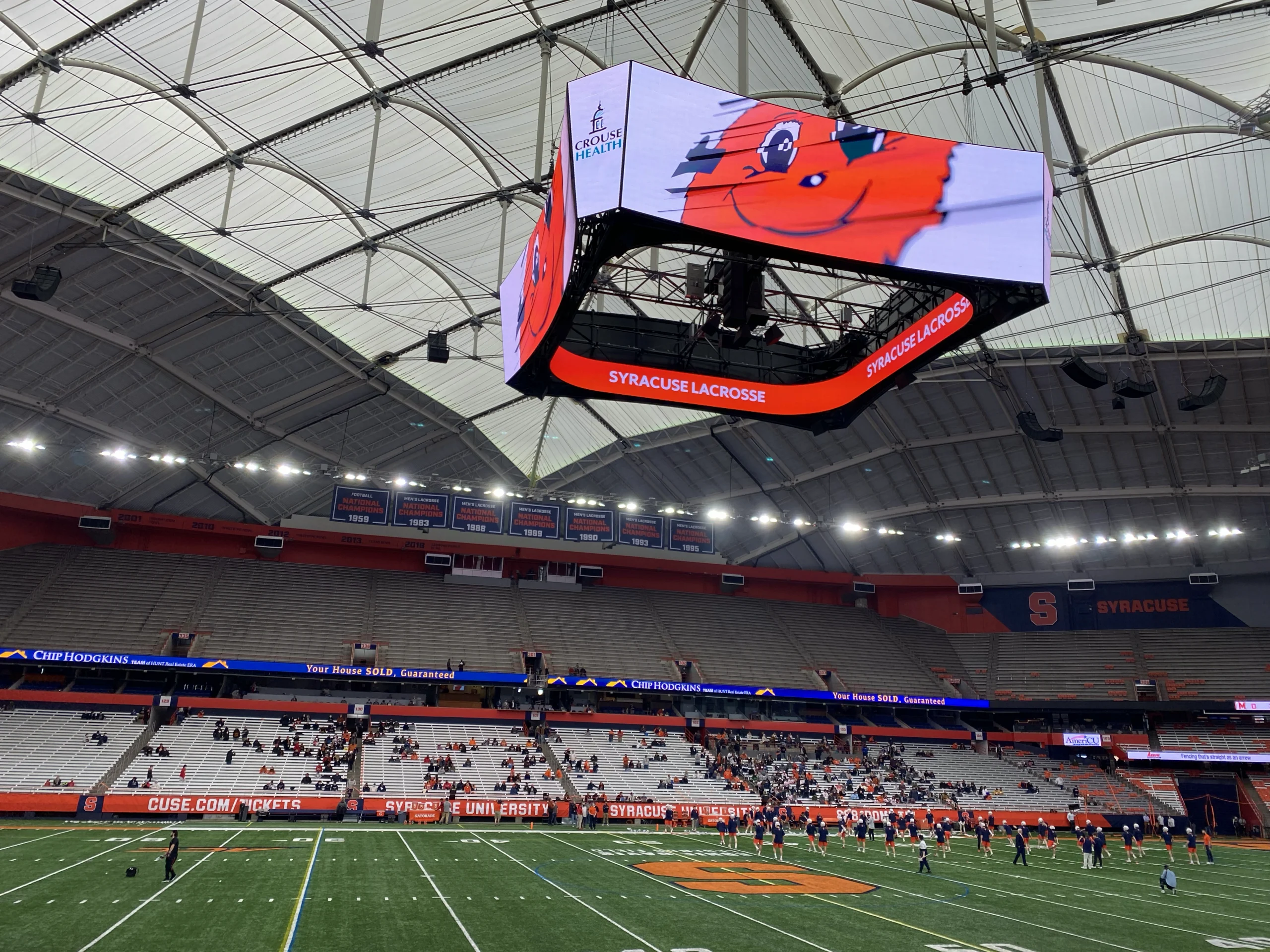
The physical infrastructure anchoring all of this is the JMA Wireless Dome, the largest on-campus domed stadium in the country. JMA Wireless signed a 10-year naming rights deal in May 2022 — the first name change since the venue opened as the Carrier Dome in 1980. While exact terms were not disclosed, a naming rights consultant estimated the deal would command upward of $3.25 million per year on the open market, putting the total value at roughly $32.5 million over the contract’s life.
The naming deal came with substance beyond signage: JMA Wireless installed advanced 5G connectivity throughout the facility. That’s part of a broader $118 million renovation, funded entirely by the university and private philanthropy, that has so far delivered a new fixed roof, the largest center-hung video scoreboard in college sports, air conditioning, and all-new chairback seating installed for fall 2024. Still to come: premium hospitality spaces, the Kuhn Game Day Lounge, and Miron Victory Court, an expansion that will connect the Dome to the Barnes Center at The Arch.
The Attendance Problem
But even a $118 million facelift can’t mask a troubling trend. Through the first 12 home basketball games of 2025-26, Syracuse averaged just 16,167 tickets sold per game — down from 18,888 the prior season — in a building that seats 30,286 for hoops. No single game has drawn more than 19,657 fans. The program that led the nation in attendance 28 times between 1980 and 2020 is in danger of setting an all-time low.
That matters beyond pride. Each fan who doesn’t show up represents lost spending — on parking, concessions, merchandise, and the pre-game dinner at Dinosaur Bar-B-Que or post-game drinks on Marshall Street. Using the Lightcast study’s figure of $57 million from 167,000 visitors, each visitor to an SU event generates roughly $341 in local spending. A season-long shortfall of 2,700 fans per game across 18 home dates is not just empty seats — it’s a measurable drain on the local economy.
New Leadership, New Playbook
Into this mix steps Bryan Blair, hired in March 2026 as Syracuse’s new athletic director, replacing the retiring Wildhack effective July 1. Blair comes from the University of Toledo, where he oversaw 13 conference championships and a 282 percent increase in fundraising. He made Toledo the first Mid-American Conference school to launch an NIL collective and hire a full-time NIL executive.
“We want to provide a clear, compelling vision that gets people excited,” Blair said at his introduction. His stated priorities: “attacking revenue generation and NIL” — the two levers that will determine whether Syracuse can compete in a Power Four landscape where 15 athletic programs are now valued at over $1 billion.
At $487 million, Syracuse has ground to make up. But with $136.7 million flowing into the regional economy, 1,644 jobs depending on the Orange’s success, and a newly renovated Dome waiting to be filled, the stakes extend well beyond the scoreboard. For Central New York, Syracuse Athletics is not just a team to root for. It’s an economic engine — and how it’s managed in the next five years will shape the financial health of an entire region.
Photo: JMA Wireless Dome as seen from the Ernie Davis statue on the Syracuse University campus. Kiran891 / Wikimedia Commons, CC BY-SA 4.0