By Charles Shack, Senior Reporter
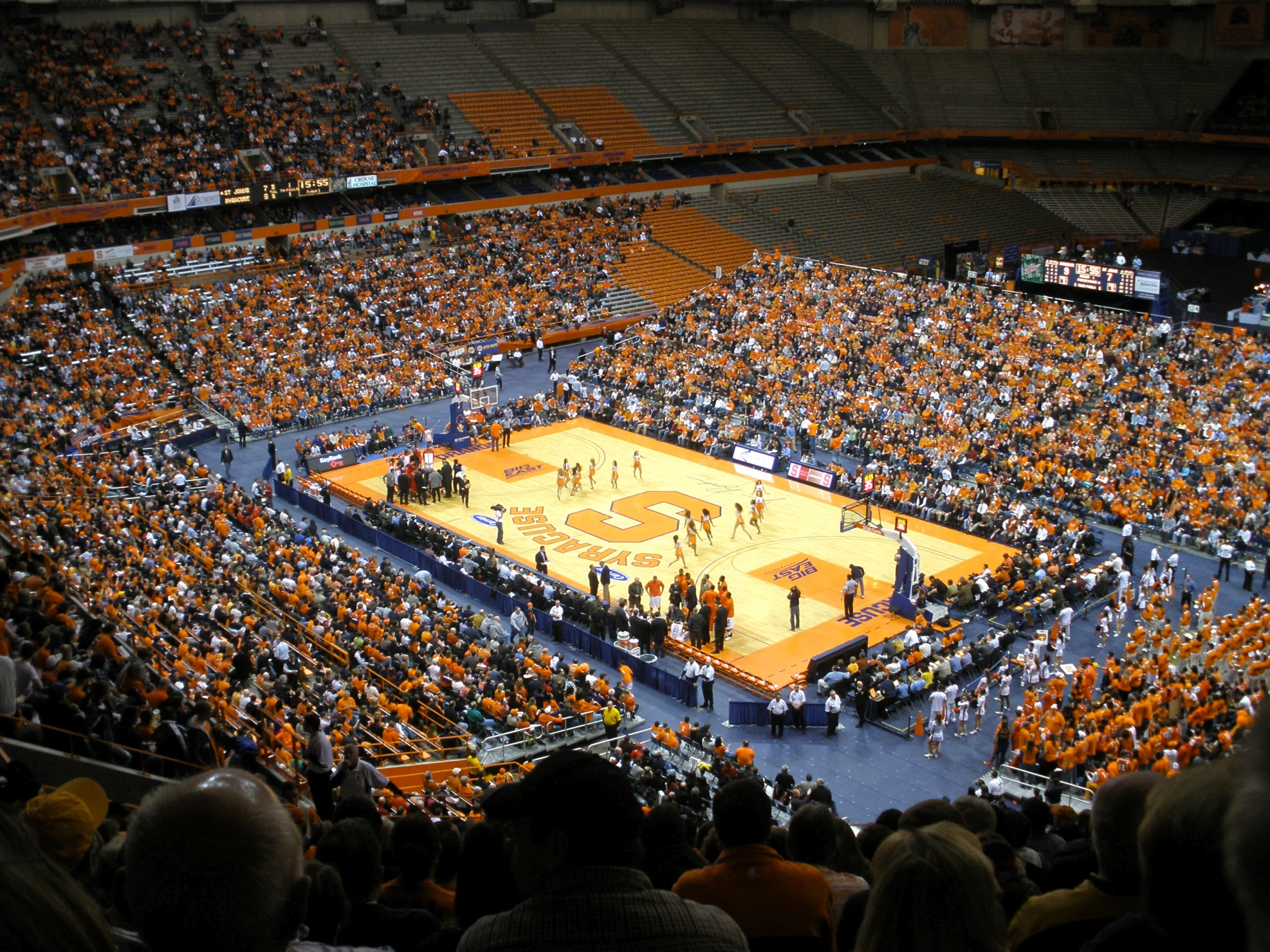
Syracuse is a basketball town. The Orange have played in six national championship games, reached six Final Fours, and put more than 40 players in the NBA. On a late Saturday night in February 2019, 35,642 people filled a converted football stadium to watch a college game. That is the context for this list.
What follows is one senior reporter’s ranking of the ten defining moments in Syracuse men’s basketball history. The criteria are simple: on-court consequence, cultural weight in Central New York, and whether the moment changed something for the program. A John Wallace putback against Georgia in 1996 mattered. A Carmelo Anthony spin move in the 2003 title game mattered more. Rankings are ordered from number ten down to number one.
This story came from public records we pulled ourselves
Get the next one, plus overnight incidents, in your inbox at 6 AM. Free, no spam.
10. The Louie and Bouie Show Puts the Program on the Map (1976 to 1980)
Before the Dome, before ESPN, before the Big East meant anything, Jim Boeheim’s first recruiting class defined what Syracuse basketball could be. Roosevelt Bouie and Louis Orr arrived in 1976, the same fall the 31-year-old Boeheim was promoted from assistant to head coach. Over the next four years they went 100 and 18, reached four straight NCAA Tournaments, and won the inaugural Big East regular season title in 1979 to 1980.
Bouie finished his career with 1,560 points, 987 rebounds and 327 blocked shots, which still ranks second in program history for blocks. Orr went 28th overall to the Indiana Pacers in the 1980 NBA Draft and later became head coach at Seton Hall. The nickname came from a 1977 Daily Orange cartoon that drew the two big men trotting up the floor in top hats and tails. Syracuse retired both jerseys together in February 2015. Everything that happened here afterward, all of it, starts with those four years at Manley Field House.
Manley itself ended on a specific night. On February 12, 1980, Georgetown snapped Syracuse’s 57-game home winning streak with a 52 to 50 upset, with Eric “Sleepy” Floyd hitting two free throws with five seconds left. Afterward John Thompson Jr. walked to the postgame podium and said six words that launched one of college basketball’s great rivalries: “Manley Field House is officially closed.” Syracuse moved to the Carrier Dome that fall.
9. The 1989 Elite Eight That Could Have Been
The 1988 to 1989 Orangemen were, on paper, the best Syracuse team never to win a championship. Sherman Douglas, Derrick Coleman, Stephen Thompson and freshman Billy Owens formed a lineup that finished 30 and 8. Five players averaged double figures. Douglas and Thompson each averaged 18 points per game. Coleman put up 17.
Syracuse built a 12-point early lead on Illinois in the Midwest Regional final on March 26, 1989, and still led by seven at halftime. Then the Illini’s Kenny Battle dropped 17 second-half points, Nick Anderson hit six of his last nine shots, and Illinois closed on a run to win 89 to 86. Battle’s two free throws with 15 seconds left set the final margin. Douglas, who would go on to a 12-year NBA career and finish his Syracuse career with 960 assists (a program record at the time), never got another crack at a Final Four. It is the best 30-win team in program history that nobody outside Central New York remembers.
8. Gerry McNamara Drags a 9 Seed to a Big East Title (March 8 to 11, 2006)
Syracuse entered the 2006 Big East Tournament as a 9 seed, unranked, bubble-team fodder on most bracket projections. Gerry McNamara, a senior guard from Scranton, Pennsylvania, then authored one of the great four-day runs in conference tournament history at Madison Square Garden.
Against Cincinnati in the opener, McNamara hit a running one-handed three with a half-second left to win it 74 to 73. Against UConn in the quarterfinals, he drained a three as time expired in regulation to force overtime, a game Syracuse won 86 to 84. Against Georgetown in the semifinals he hit five second-half threes and delivered the pass to Eric Devendorf for the game winner at the buzzer. Against Pittsburgh in the final on March 11, 2006, McNamara hit a cold-blooded three with 15 seconds left to put Syracuse ahead for good in a 65 to 61 win. Syracuse became the first school to win four games in a Big East Tournament, and the lowest seed ever to win it. McNamara took home the Dave Gavitt Trophy as Most Outstanding Player. Twenty years later, in March 2026, Syracuse would hire him as head coach.
7. Dave Bing’s Number Goes Up First (Jersey Retired 1981)
Dave Bing played three varsity seasons at Syracuse from 1963 to 1966, averaging 24.8 points per game as a senior and earning consensus All-American honors. The Detroit Pistons took him second overall in the 1966 NBA Draft, where he wore No. 21 because player-coach Dave DeBusschere already had 22. Bing’s rookie season produced 20.0 points per game and 1967 NBA Rookie of the Year. Across 12 pro seasons with Detroit, Washington and Boston, he averaged 20.3 points and 6.0 assists in 901 games, earned seven NBA All-Star selections, was named All-Star Game MVP in 1976, made the Naismith Hall of Fame, and landed on both the NBA 50th and 75th Anniversary Teams. He served as mayor of Detroit from 2009 to 2013.
What matters here, for Syracuse history, is that when the university raised Bing’s number 22 to the rafters in 1981, it was the first jersey the program had ever retired. Bing set the template. Every banner hanging in the Dome today traces back to that decision.
6. The 2018 Sweet Sixteen Run as an 11 Seed (March 14 to 23, 2018)
Most of America had Syracuse penciled out of the 2018 field entirely. The Orange finished 20 and 13 in the regular season, lost in the second round of the ACC Tournament, and drew a First Four play-in game as a No. 11 seed. Three wins later they were in the Sweet 16.
The tournament line for the 2018 run: beat Arizona State 60 to 56 in Dayton, beat No. 6 TCU 57 to 52 in the round of 64, and beat No. 3 Michigan State 55 to 53 in the round of 32 on March 18, 2018. Oshae Brissett and Tyus Battle did the heavy scoring. The 2-3 zone held Michigan State’s Cassius Winston to ten points. Syracuse lost to Duke 69 to 65 in the Sweet 16 in Omaha, but the run proved what would become a Boeheim hallmark in his final decade: this team was always a bad matchup in March.
5. Buddy Boeheim’s Shooting Fortnight (March 19 to 28, 2021)
The 2021 NCAA Tournament was the bubble tournament, played entirely in Indianapolis during the pandemic. Syracuse came in as an 11 seed with an 18 and 9 record and the same narrative as 2018: shaky resume, Boeheim’s son on the roster, zone defense nobody had practiced against.
Buddy Boeheim scored 30 in the first-round rout of San Diego State on March 19, 2021. Against 3 seed West Virginia on March 21, he put up 25 points and hit three clutch free throws in the final 30 seconds of a 75 to 72 win, 22 of those points after halftime. Against 2 seed Houston in the Sweet 16 on March 27, 2021, the run ended in a 62 to 46 loss. Across four NCAA Tournament games the junior guard averaged 23.3 points per game. The 20th Sweet 16 appearance of Jim Boeheim’s career came with his kid leading the team in scoring, a fact the elder Boeheim waved off publicly and clearly savored privately.
4. 2016 Final Four as a 10 Seed, the Lowest in History (March 27, 2016)
On March 27, 2016, in the Midwest Regional final at United Center in Chicago, Syracuse trailed top-seeded Virginia by 15 points in the second half. The Cavaliers had the best defense in the country. Boeheim went to a full-court press late in the second half. Virginia cracked.
Syracuse ripped off a 25 to 4 run, including 15 straight points. Freshman Malachi Richardson scored 21 of his 23 points in the second half; his first made field goal of the game did not come until 11:42 remained. Michael Gbinije added 11 points and six assists. Tyler Lydon had five blocks off the bench. Final score: Syracuse 68, Virginia 62. It made Syracuse the first 10 seed in NCAA Tournament history to reach the Final Four.
The Orange lost to North Carolina in the semifinal in Houston. But the run itself, taking down Dayton, Middle Tennessee, Gonzaga and Virginia as a double-digit seed, is the most improbable chapter of Boeheim’s career. Richardson entered the NBA Draft weeks later; the Sacramento Kings selected him 22nd overall.
3. Pearl Washington’s Halfcourt Heave Against Boston College (January 21, 1984)
A freshman point guard from Brooklyn named Dwayne Alonzo Washington, already called “Pearl” as an eight-year-old on Brownsville playgrounds in homage to Knicks legend Earl “The Pearl” Monroe, played his 15th college game on January 21, 1984. The freshman had been rated the top overall high school prospect in the country a year earlier at Boys and Girls High. Boston College guard Martin Clark tied the game at 73 with a free throw with seconds left, then missed the second. Washington grabbed the rebound, ran, pulled up from just past midcourt, and let it go at the buzzer. The Carrier Dome crowd of 30,293 lost its mind.
Washington finished with 20 points and seven assists. Syracuse stayed undefeated in Big East play. He ran off the floor with both arms up and disappeared straight down the tunnel before the crowd even reached full pitch. It is the single most replayed highlight in program history. The New Jersey Nets took Pearl 13th overall in the 1986 NBA Draft. He played three pro seasons, two with the Nets and one with the expansion Miami Heat, and averaged 8.6 points and 3.8 assists in 143 career games. Washington died of a brain tumor on April 20, 2016, at age 52. Syracuse revealed his retired number 31 on the Jim Boeheim Court the next season during a Georgetown game. In 2019, Brooklyn renamed his childhood block “Dwayne ‘The Pearl’ Washington Way.” No one from Central New York, a certain age, has ever forgotten where they were when Pearl let that ball go.
2. John Wallace Carries Syracuse to the 1996 National Title Game (March to April 1996)
The 1995 to 1996 Orangemen were a No. 4 seed nobody picked to go anywhere. Senior forward John Wallace had other ideas. The Rochester native averaged 22.2 points and 8.7 rebounds for the season and then elevated in March: 21 points against Montana, 30 against Drexel, 21 more against Georgia in a wild overtime Sweet 16 where he hit a step-back three in the final seconds to force the extra period.
Syracuse reached the title game at Continental Airlines Arena in East Rutherford, New Jersey, on April 1, 1996. Kentucky, coached by Boeheim’s former assistant Rick Pitino, was a juggernaut. Wallace went for 29 points on 11 of 19 shooting with 10 rebounds and fouled out with two minutes left. Todd Burgan added 19 off 7 of 10 shooting. Kentucky’s Tony Delk matched a championship-game record with seven threes. Syracuse trailed by nine at halftime, clawed within two on a 16 to 5 run, and lost 76 to 67 in front of 19,229. The loss still stings. The moment itself belongs here because Wallace willed that team into a championship game it had no business reaching. The “‘Cuse Is in Da House” 1996 run is the program’s defining underdog story.
1. Carmelo Anthony and the 2003 National Championship (April 7, 2003)
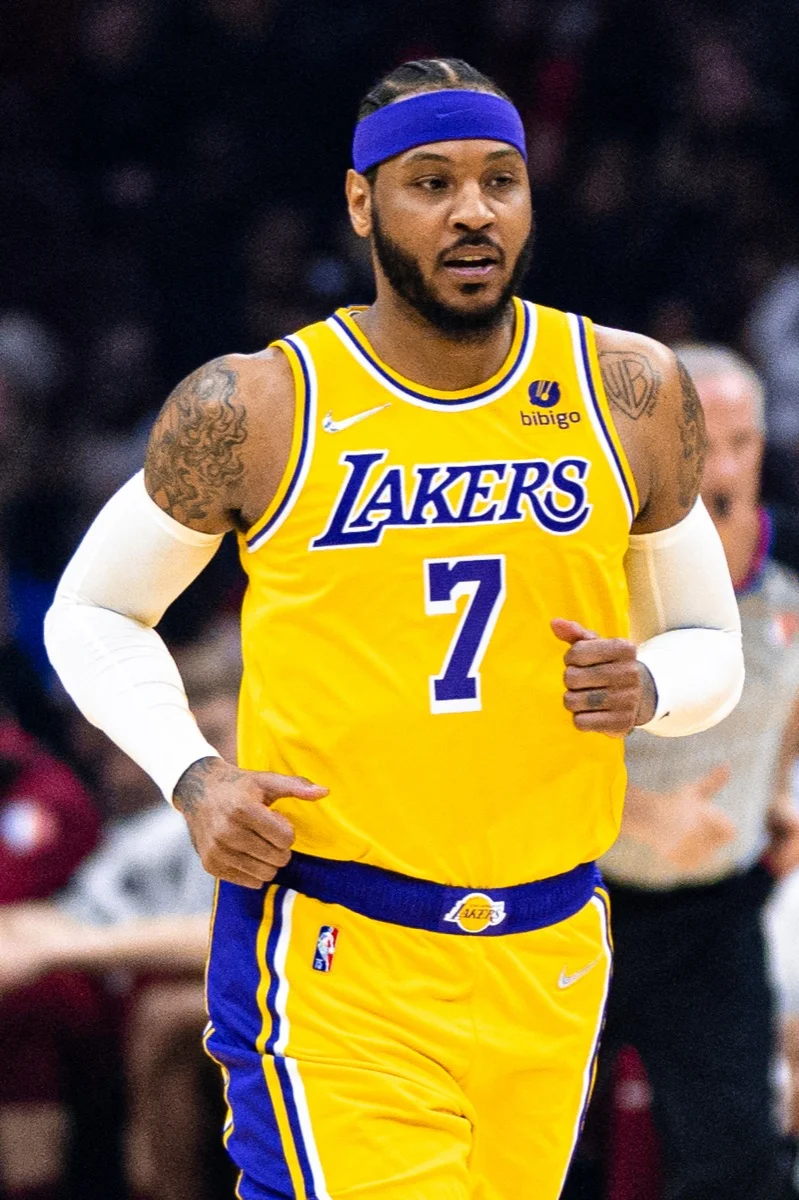
Carmelo Anthony, photographed during his NBA career. Anthony was 18 years old, a freshman, and the Most Outstanding Player of the 2003 Final Four. Photo: Wikimedia Commons.
Every list ends here. On April 7, 2003, at the Louisiana Superdome in New Orleans, 18-year-old freshman Carmelo Anthony led Syracuse past Kansas 81 to 78 to win the only men’s basketball national championship in school history. Anthony, a year out of Oak Hill Academy, finished with 20 points, 10 rebounds and seven assists. He became only the third freshman ever named Most Outstanding Player of the Final Four. Gerry McNamara hit six threes in the first half. Kueth Duany, the senior captain, added 11 points and shut down Kansas guard Kirk Hinrich down the stretch.
The final possession is why the rest of Central New York remembers every detail. Kansas trailed 81 to 78 with 1.5 seconds left, inbounded the ball, and Michael Lee caught it wide open in the left corner. Hakim Warrick, playing the five because of foul trouble, was still under the basket when the ball arrived in Lee’s hands. “I just remember looking to the corner, seeing Michael Lee wide open, and thinking, ‘No way,'” Warrick said in a later interview. “I didn’t think I had any chance of blocking it. I was still under the basket, a good 20 feet away, and he was at the three-point line.” Warrick closed the 20 feet in three strides and swatted the shot into the front row with 0.7 seconds on the clock. Lee, filed later by ESPN: “I underestimated his length, his athleticism. He made the perfect play.”
Boeheim, who had taken Syracuse to title games in 1987 and 1996 and lost both, told reporters after the buzzer, “They’re unusual freshmen. I felt that from the beginning.” On Anthony in particular, he said: “Any time a freshman comes in and takes 150, 200 more shots than the next guy, there’s always a chance somebody might not react well to that. But because he is who he is, I don’t think that was ever an issue.” Two months later, on June 26, 2003, the Denver Nuggets took Anthony third overall in the NBA Draft, behind LeBron James and Darko Milicic. Anthony never played another college game. Syracuse retired his No. 15 on February 23, 2013, during a Georgetown game, in front of a then-record on-campus crowd of 35,012. For Central New York, the 2003 championship is the central fact of the program. Every moment on this list either points forward to it or flows out of it.
Honorable Mentions, Stated Plainly
Three near-miss moments earn a mention without cracking the top ten. The 1987 national final, played March 30, 1987, at the same Louisiana Superdome Syracuse would return to in 2003, was Boeheim’s first trip to the title game. Sherman Douglas averaged 17.3 points and 7.6 assists that season, and freshman Derrick Coleman pulled down 19 rebounds in the championship, still an NCAA tournament freshman record. Syracuse led 73 to 72 with 28 seconds left when Coleman missed the front end of a one-and-one. Keith Smart hit a baseline jumper over Howard Triche from 15 feet with five seconds left. Indiana 74, Syracuse 73. Bob Knight’s fifth, and last, title.
The 2013 Final Four loss to Michigan, 61 to 56 on April 6, 2013, in Atlanta, was Boeheim’s fourth Final Four. C.J. Fair scored 22 points; Brandon Triche added 11. Trey Burke, the AP National Player of the Year, shot 1 of 8 from the floor and still won. With 19.2 seconds left and Syracuse trailing 58 to 56, Triche drove the lane and was called for a charge on Jordan Morgan. The whistle ended Syracuse’s season. “They made eight 3s and we made three,” Boeheim said afterward.
Derrick Coleman’s No. 1 overall selection by the New Jersey Nets in the 1990 NBA Draft belongs in any Orange record book. Jerami Grant and Tyler Ennis pushed the 2013 to 2014 squad to 25 and 0 out of the gate before the run cooled. Those stories matter. They just do not move a top ten list.
How the Venues Changed
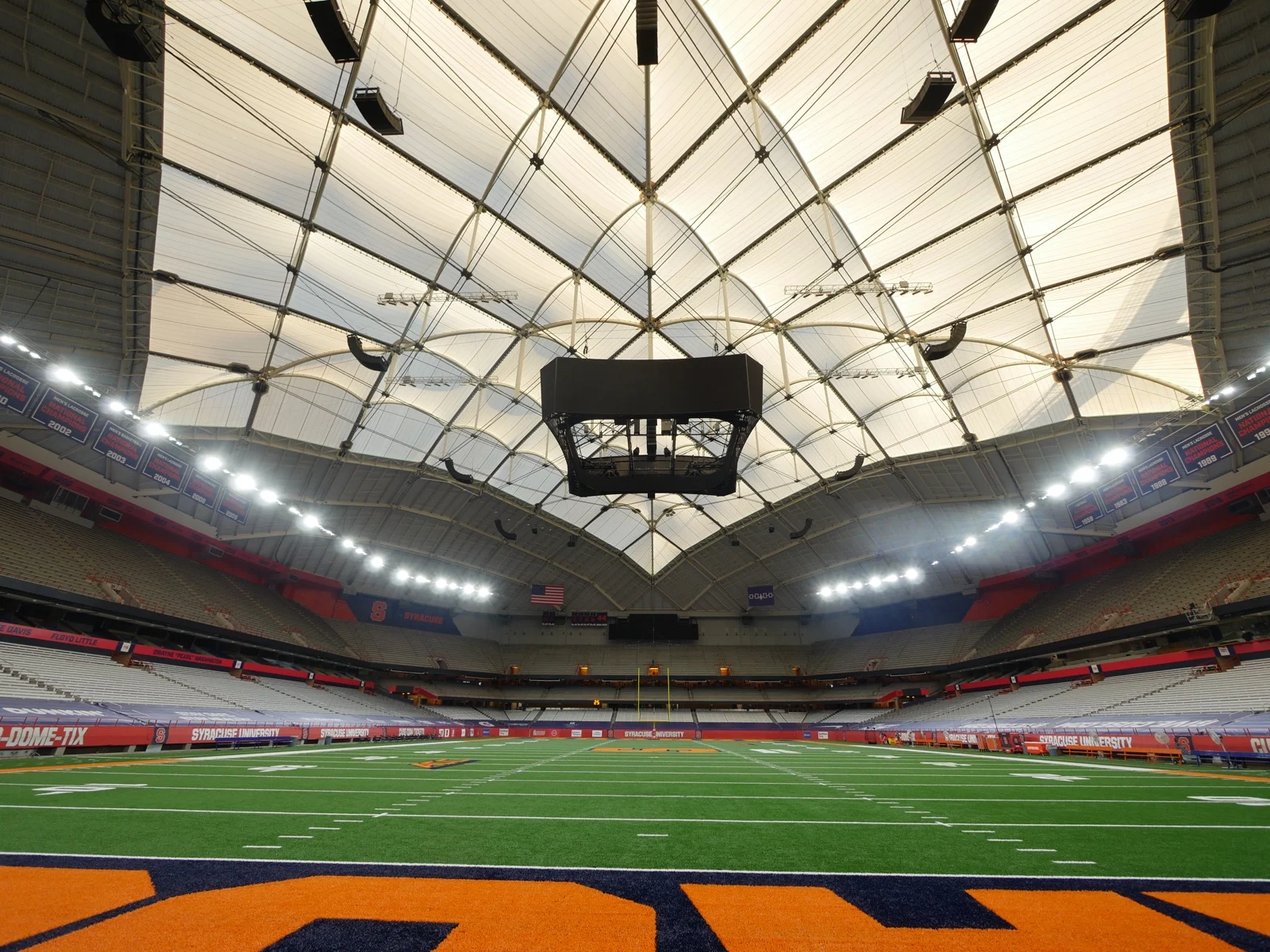
The stadium on the Syracuse University campus, home of Orange basketball. Opened as the Carrier Dome in September 1980; renamed JMA Wireless Dome in May 2022. Photo: Wikimedia Commons.
Syracuse basketball has played home games in three buildings of consequence. Manley Field House opened in 1962 with a 9,500 capacity and saw 57 straight wins broken by Georgetown on February 12, 1980. The Carrier Dome opened in September 1980 and became the loudest on-campus venue in college basketball, with Syracuse leading the NCAA in attendance for 11 straight seasons starting in 1985. The single-game on-campus record of 35,642 was set on February 23, 2019, against top-ranked Duke, a 75 to 65 loss that saw R.J. Barrett score 30 points on 14 of 20 shooting. Zion Williamson sat out that night with a Grade 1 knee sprain suffered 33 seconds into the Duke and North Carolina game four days earlier. In May 2022 the naming rights moved to JMA Wireless.
The Boeheim Context and What Came Next
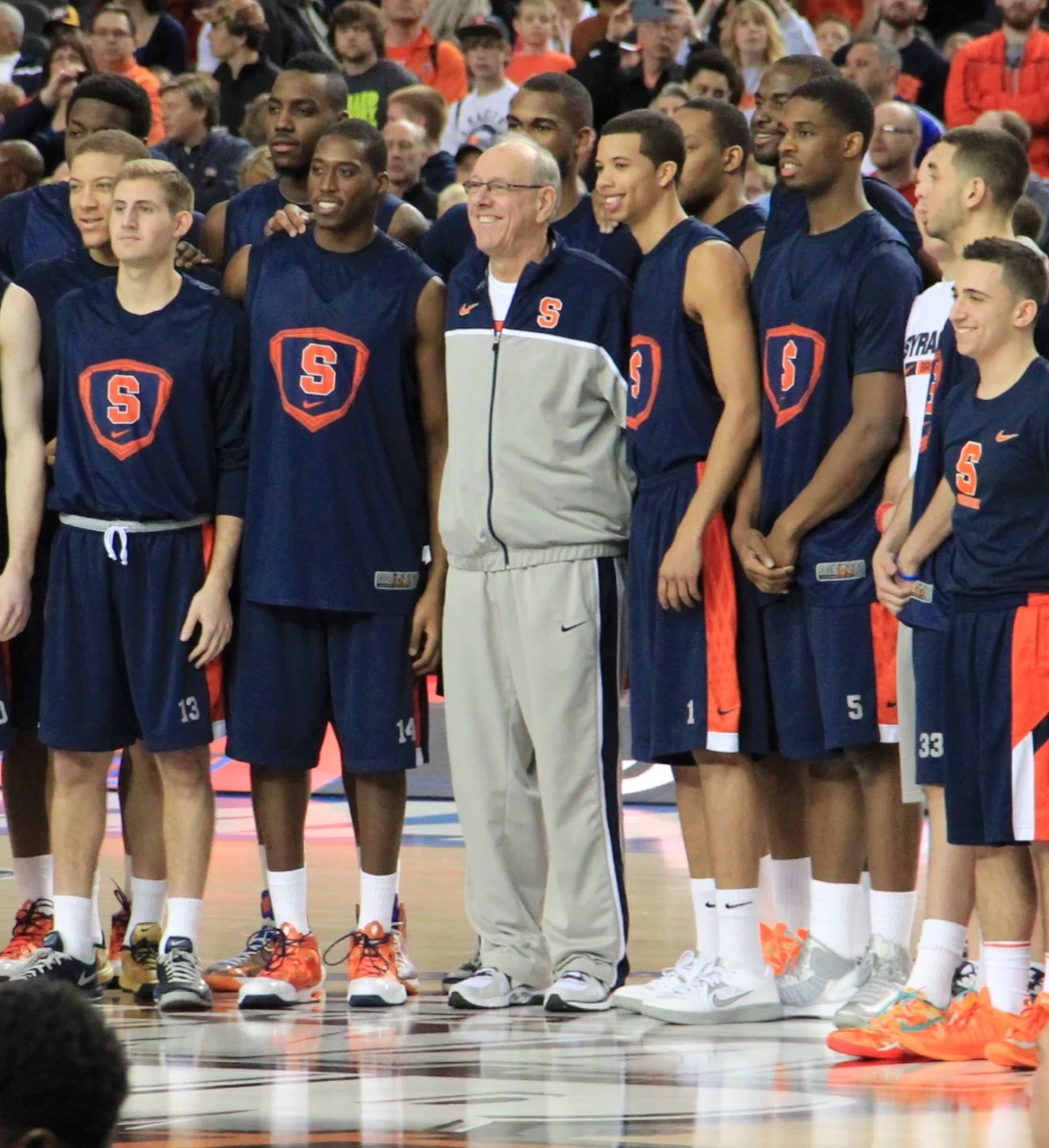
Jim Boeheim coached Syracuse from 1976 to 2023, retiring with 1,015 wins on his NCAA record. Photo: Wikimedia Commons.
Most programs would not have nine of a top ten from a single coach’s tenure. Boeheim sits on every entry here except the Dave Bing jersey retirement and the Louie and Bouie launch. He coached 47 seasons, won 1,015 games on the NCAA record, took Syracuse to five Final Fours and three national championship games, and stepped away on March 8, 2023, after a 77 to 74 loss to Wake Forest in the second round of the ACC Tournament. Adrian “Red” Autry, his former point guard from the 1990 to 1994 teams and his top assistant, took over. Autry went 20 and 12 in his first year, 14 and 19 in his second, and 15 and 17 in his third. Syracuse fired him on March 11, 2026, a day after a first-round ACC Tournament loss to SMU. On March 22, 2026, the university hired Gerry McNamara, 23 years after his freshman year as the third scorer on the 2003 title team. Boeheim’s actual on-court win count, before the NCAA vacated 101 games for violations, is 1,116. Either number still puts him at No. 2 on the all-time men’s Division I list, behind only Mike Krzyzewski.
The Bottom Line
A program that has played in six Final Fours, won one title, drawn 30,000-plus to a regular-season game more than 50 times, and produced Pearl Washington, Sherman Douglas, Dave Bing, Derrick Coleman, Billy Owens, John Wallace, Carmelo Anthony, Gerry McNamara, Jerami Grant and Tyler Ennis is going to leave great moments on the cutting room floor. The ten above are the ones that, if you grew up in Central New York, you can date and time and place without looking anything up. They are the ones that hang in the Dome rafters, literally or in memory. Start with Melo and Warrick on April 7, 2003. Work backward from there.
Sources: Sports-Reference college basketball, cuse.com press archives, NCAA.com tournament records, The Daily Orange, ESPN game recaps, The Washington Post oral history of Syracuse and Georgetown, Basketball-Reference.com player pages, and Wikipedia tournament entries verified against primary-source box scores. Quotes from ASAP Sports postgame transcripts, The Players’ Tribune, CNY Central, and Troy Nunes Is An Absolute Magician. Photographs from Wikimedia Commons, used under Creative Commons license.


