By Matt Russo, Senior Reporter
Stand at the corner of Erie Boulevard East and Montgomery Street in downtown Syracuse, and the asphalt under your feet is in the wrong place. Until 1925 there was water here. The Erie Canal ran straight through the middle of the city on this exact line, and the boulevard takes its name and its straight east-west alignment from the prism of the old canal channel.
The reason you can verify this is that the building on the corner is still standing. The 1850 Weighlock Building is the only surviving canal weighlock in the United States. It is the last physical artifact of an industry that built New York State.
Know before your neighbors do
The Morning Signal hits your inbox at 6 AM with everything that happened overnight. Real incidents, real data, zero fluff.
What a weighlock did
The original Erie Canal opened in 1825 and was financed by tolls on cargo. By the 1840s the volume of traffic was high enough that the state needed permanent infrastructure to assess those tolls. New York built five weighlocks across the canal corridor between roughly 1849 and 1852. Syracuse, sitting at the geographic midpoint of the system, got one of the largest.
The mechanism was simple in theory and complicated in execution. A canal boat steered into the lock chamber from the canal side. The chamber’s gates closed behind the boat. Operators opened a culvert that drained the chamber’s water through a tunnel under the city into Onondaga Creek. As the water dropped, the boat settled onto a wooden cradle that was suspended on rods running up to a balance scale on the second floor of the building.
The scale measured the boat’s full weight. The weighmaster subtracted the empty-weight certificate that every commercial canal boat carried, calculated the cargo tonnage, classified the cargo by category, and assessed a toll. The whole sequence took roughly 20 minutes per boat.
At peak, in the 1860s and 1870s, this lock processed thousands of boats a year. The state’s canal toll revenue from all five weighlocks paid for the canal’s operating costs and a substantial portion of New York’s general fund.
The numbers that ended the system
By the 1880s, railroads had cut into canal freight enough that the toll system was costing the state more to administer than it was bringing in. New York stopped charging tolls on canal traffic in 1883. The Syracuse Weighlock processed boats for about 33 years.
The building did not get torn down because state agencies kept using it. From 1883 to 1954 it served as a dry dock for canal boat repair and as the regional office of the New York State Department of Public Works. The original Erie Canal channel through Syracuse was paved over in the 1920s after the Barge Canal opened to the north, replacing the city-running route. The Weighlock survived the fill-in because it was set back slightly from the channel and because the state still needed an office at that corner.
By the mid-1950s the state had moved out. The building sat largely vacant for nearly a decade and was studied for demolition.
The 1962 save
An active Syracuse citizens group, organized around historians and downtown preservationists, founded the Erie Canal Museum in 1962 specifically to take possession of the building, restore it, and turn it into a public museum. The museum opened to visitors on October 25, 1962. The Weighlock Building was added to the National Register of Historic Places on February 18, 1971, locking in federal preservation status.
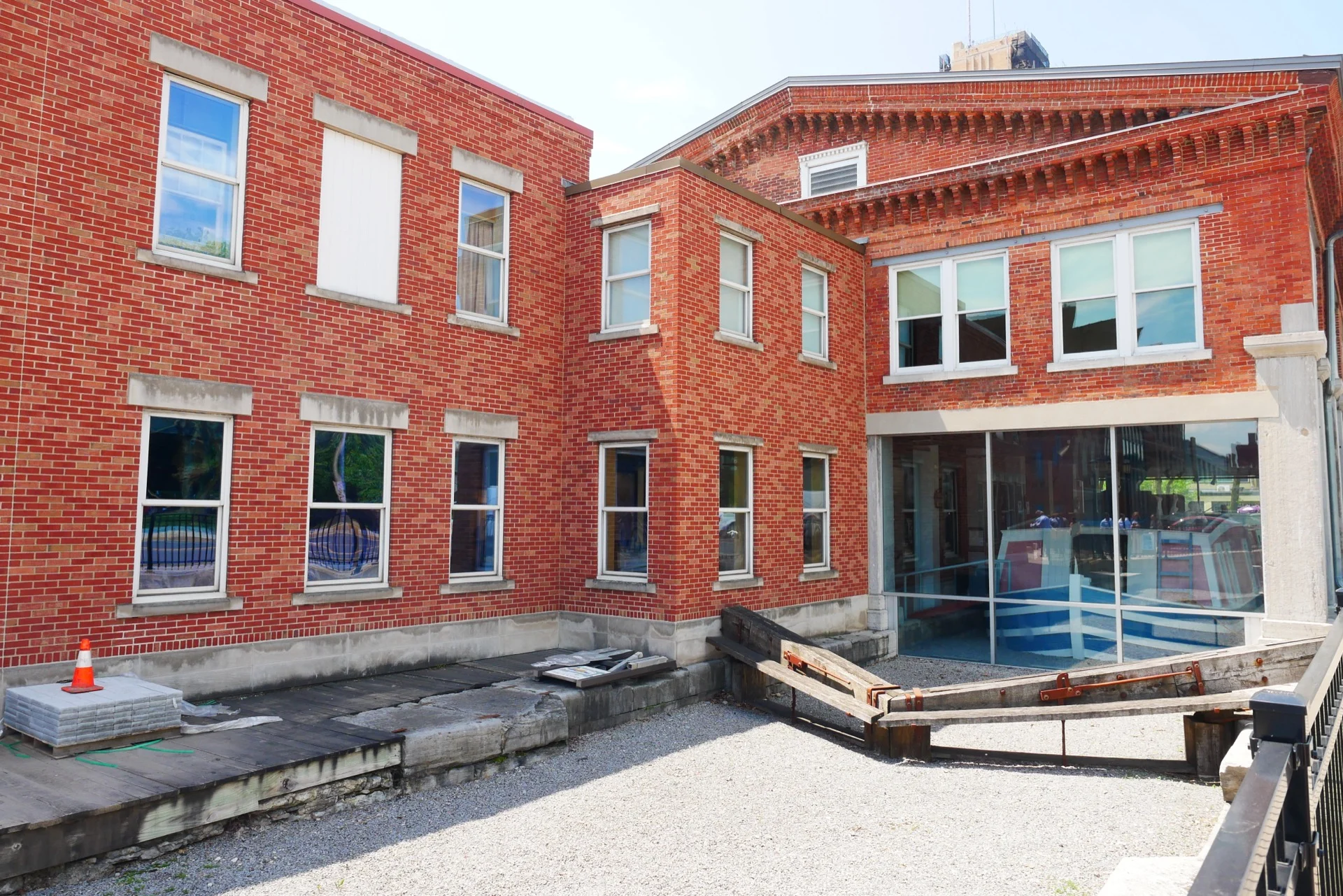
The architectural style is Greek Revival, the dominant style for New York State public buildings of the mid-19th century. The exterior is brick with stone trim and a portico facing what used to be the canal. The interior preserves the lock chamber, the scale mechanism, and the second-floor weighmaster’s office.
The collection
The Erie Canal Museum holds more than 50,000 items, including roughly 1,400 three-dimensional objects, 39,000 photographs and negatives, 1,500 prints, 950 sketches and drawings, 45 paintings, 100 glass plate negatives, and 200 rare books. The signature artifact is the Frank Buchanan Thomson, a full-size replica line boat installed inside the original lock chamber, complete with cabin interiors and a portion of cargo.
The museum’s permanent exhibits cover canal construction, immigrant labor, the rise and decline of canal commerce, and the modern Erie Canalway National Heritage Corridor. The collection runs across 200 years of Erie Canal history.
Visiting in 2026
The Erie Canal Museum is open daily from 10 a.m. to 4 p.m. Eastern Time, with limited holiday closures. Admission is by suggested donation of $12.00 per visitor, with no required ticket. The museum sits on the southeast corner of Erie Boulevard East and Montgomery Street in downtown Syracuse, with eight designated parking spots in the New York State lot adjacent to the building.
The museum runs a slate of public programming on top of its permanent exhibits, including guided tours of the lock chamber, the annual Sloan Lecture Series, school field trip programs, and rotating special exhibits.
Why the building still anchors downtown
Erie Boulevard East is the spine of downtown Syracuse east of Clinton Square. It is also a road that exists because of a canal that no longer exists. The Weighlock Building is the only structure along the boulevard that lets visitors physically read that history off the streetscape.
Walk into the lock chamber, look up, and you can see the underside of the second-floor scale. Walk outside, look at the boulevard, and you can see where the water used to be. The two views together explain why a small Greek Revival building in the middle of a parking-light intersection is the most consequential surviving piece of Erie Canal infrastructure in New York State.
The other four state weighlocks are gone, demolished between the 1880s and the 1930s as the canal system was dismantled or rebuilt. Buffalo lost its weighlock to redevelopment. Albany lost its weighlock to the Barge Canal conversion. Rochester, Utica, and the smaller stations were torn down or repurposed beyond recognition. Only Syracuse kept its weighing station intact, and only because a small group of preservationists in 1962 decided the building was worth saving.
175 years
The Weighlock Building turned 175 in 2025. The Erie Canal Museum turns 64 in October 2026. The original canal turns 201 in October 2026. The state of New York will mark the canal’s 200th anniversary as a multi-year commemoration running through 2026, with programming centered at the museum and at sites across the canal corridor.
The Weighlock Building was built to charge tolls on a transportation system that does not exist anymore. The system it replaced, by century’s end, was paved over and forgotten. The museum that occupies it was created to keep the building itself from being paved over and forgotten. 175 years in, the strategy is working.
Sources: Erie Canal Museum 1850 Syracuse Weighlock Building page; Erie Canal Museum About page; Wikipedia entry for Erie Canal Museum; Library of Congress Historic American Buildings Survey HABS NY-5451; National Register of Historic Places nomination form (NRHP reference 71000552); eriecanal.org Union College Weighlock feature; Erie Canalway National Heritage Corridor materials. Hero photo: Sgerbic, Wikimedia Commons (CC BY-SA 4.0).