I’ve been living in Syracuse for the better part of three decades, and I still stumble onto things about this city that make me stop and say wait, seriously?
Syracuse doesn’t have a tourism board running Super Bowl ads. Nobody’s hiring influencers to stand on Armory Square and point at things. What we do have is a city that’s been quietly accumulating some of the strangest, most fascinating stories in Upstate New York — and most of them never make it past the county line.
So I dug in. Talked to locals, pulled old records, raided Wikipedia at 2 AM, and put together ten things about Syracuse that even the lifers might not know. Fair warning: if you grew up here, at least three of these are going to make you text someone.
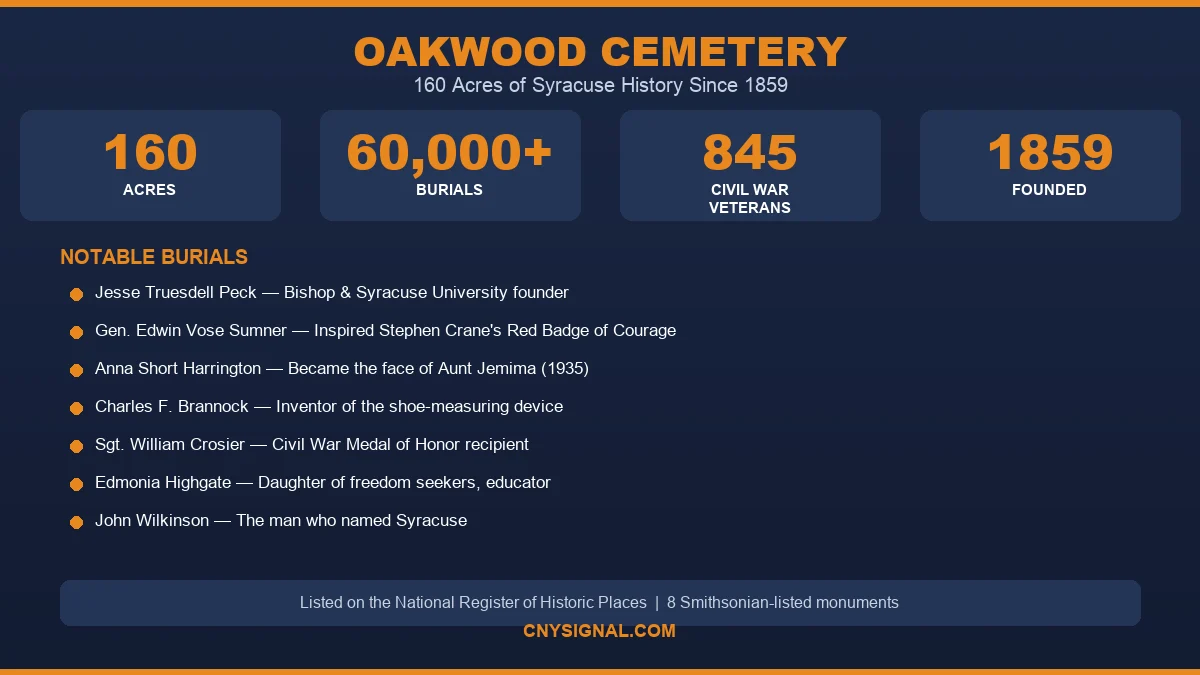
1. There are 845 Civil War veterans buried within walking distance of Syracuse University — and one of them might have inspired The Red Badge of Courage.
Oakwood Cemetery sits on 160 acres right next to SU’s campus, and most students walk past it for four years without ever setting foot inside. Their loss. This place is an outdoor museum.
Founded in 1859 and designed by Howard Daniels — one of the most important landscape architects of the 19th century — Oakwood was the final destination for over 60,000 people, including some of the most consequential figures in Syracuse history. Researcher Sue Greenhagen has verified 845 Civil War soldiers buried on the grounds. Among them: a Congressional Medal of Honor recipient named Sgt. William Henry Harrison Crosier, a member of the famous 54th Massachusetts Infantry (the Glory regiment), and Lt. Col. Augustus Root, who was killed at Appomattox Court House the day before the war ended.
Then there’s General Edwin Vose Sumner. Rick Burton, a professor at SU, has argued that Sumner’s story directly influenced former Syracuse University student Stephen Crane when he wrote The Red Badge of Courage. The guy who may have inspired one of the most famous war novels in American literature? Buried right here, next to the campus where the author studied.
Other notable names include Jesse Truesdell Peck, the bishop who co-founded Syracuse University; John Wilkinson, the man who literally named the city of Syracuse; Anna Short Harrington, who became the face of Aunt Jemima after being discovered at the Syracuse State Fair in 1935; and Charles F. Brannock — but we’ll get to him in a minute.
The cemetery has eight monuments listed by the Smithsonian, a private mausoleum designed for John Crouse (one of the wealthiest men in 19th-century Syracuse), and sits on the National Register of Historic Places. The Historic Oakwood Cemetery Preservation Association, an all-volunteer group founded in 1991, has been working to mark the previously unmarked graves of Black Civil War veterans — including James Jameson of the 54th Massachusetts, who fought in one of the most iconic engagements of the war and never got a headstone until HOCPA stepped in.
2. Syracuse University has a 139-year-old observatory that was moved 200 feet on 80 wheels — and they tested the move with a glass of water.
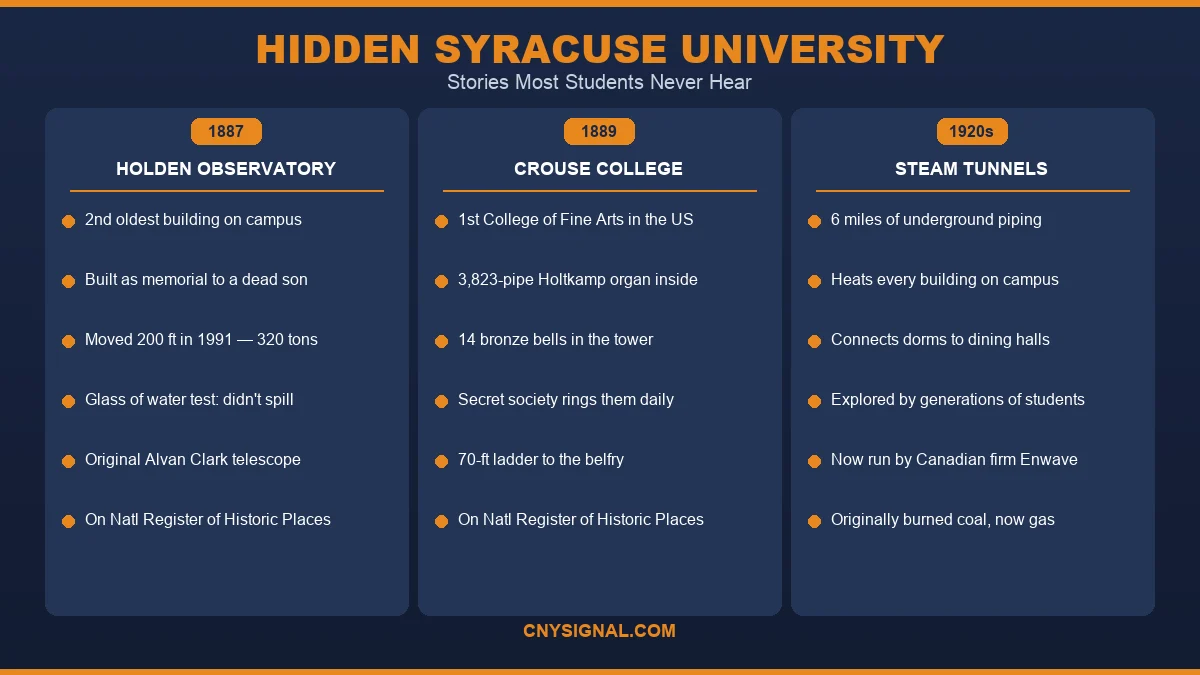
Holden Observatory, built in 1887, is the second-oldest building on the Syracuse University campus. It exists because a coal merchant named Erastus F. Holden wanted to memorialize his son, Charles Demarest Holden, who graduated from SU in 1877 and died in 1883 at age 28. The elder Holden put up the money, Chancellor Charles Sims had a thing for astronomy, and the result was a 40-by-40-foot limestone observatory with an eight-inch Alvan Clark telescope, a rotating dome, and a full suite of 19th-century astronomical instruments.
For decades, it was the crown jewel of the campus. But by the 1960s, Syracuse’s city lights had made serious stargazing nearly impossible, and the observatory fell into disuse.
Then, in 1991, the university needed to build Eggers Hall. The problem? Holden Observatory was in the way. So they moved it. The entire 320-ton limestone building, placed on twelve girders and eighty wheels, crept 200 feet at a rate of four inches per hour. The move took three days. And here’s the detail that kills me: the contractor placed a glass of water on a table inside the observatory during each day of the move. It didn’t spill.
Today, thanks to a donation from Marvin Druger, the observatory houses the Patricia Meyers Druger Astronomy Learning Center, with a restored functional telescope and a second-floor exhibition on the building’s history. It’s on the National Register of Historic Places. Most SU students have no idea it’s there.
3. There’s a secret society at SU that climbs a 70-foot ladder three times a day to ring 14 bronze bells — and they’ve been doing it for over a century.
If you’ve spent any time on the Syracuse University campus, you’ve heard the bells of Crouse College. What you probably didn’t know is who’s ringing them, or how they get up there.
Crouse College was built in 1889 by wholesale grocer and banker John Crouse as a memorial to his wife Catherine. He intended it as the “John Crouse Memorial College for Women,” but his son D. Edgar opened it to both men and women after John died before the building’s completion. It became the first College of Fine Arts in the United States.
The building is a Richardsonian Romanesque masterpiece designed by Archimedes Russell, with carved musical instruments on the exterior, a 700-seat auditorium with a 70-foot open timber ceiling, stained glass windows, and a 3,823-pipe Holtkamp organ that traces its lineage back to an 1889 Roosevelt Organ Works original. John Crouse donated $15,000 for the organ and another $5,000 for the bells — ten bronze bells cast by the Clinton Meneely Bell Co. in Troy, New York.
Today, there are 14 bells operated by a system of levers and pulleys. For nearly a century, members of Delta Kappa Epsilon fraternity rang them. Then, in the late 1980s, a group of students calling themselves the Chimesmasters took over — and they operate in complete secrecy. Three times a day, members of this elusive group scale a 70-foot ladder to the cavernous belfry and manually ring the bells that have echoed across campus since before the First World War.
The latest set of bells was cast by Royal Dutch Foundries — one of only a few operations in the world still making bells with precise pitches. The Setnor Auditorium inside Crouse now hosts more than 200 free concerts a year. The building itself has been on the National Register of Historic Places since 1974.
4. A Syracuse kid built the world’s standard shoe-measuring device out of an Erector set — and refused to ever make it out of plastic.
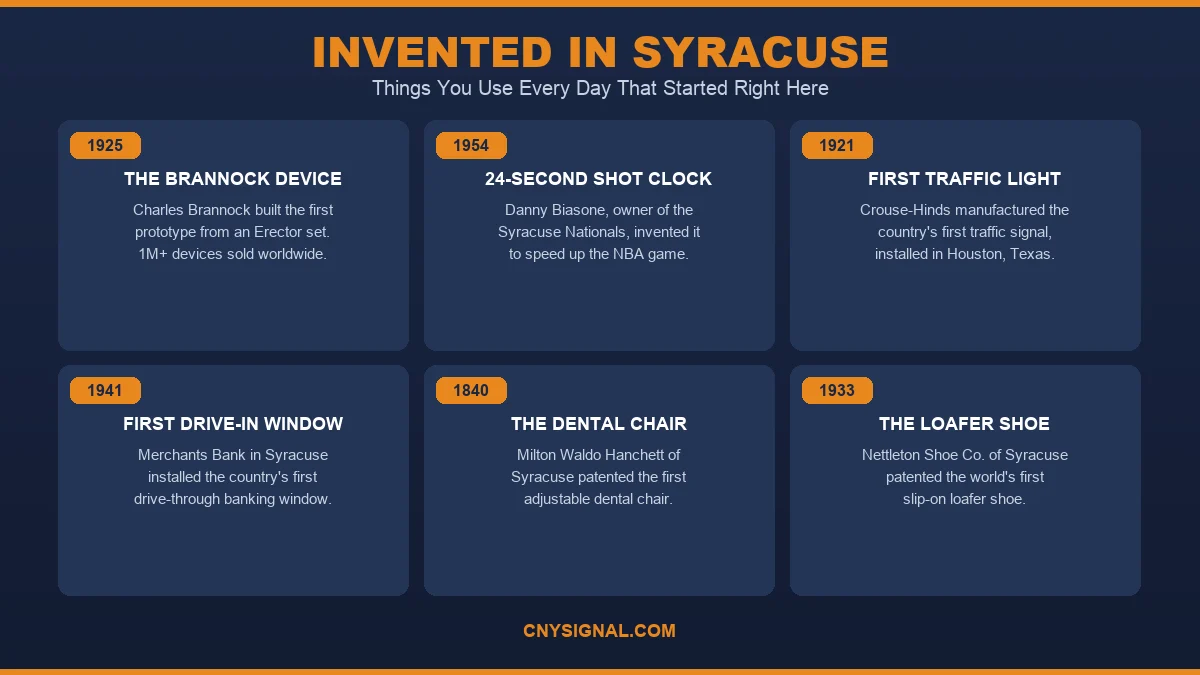
If you’ve ever walked into a shoe store, you’ve used the Brannock Device. That metal foot-measuring contraption? It was invented right here in Syracuse by Charles F. Brannock, who was born in the city in 1903.
Brannock’s father, Otis, co-founded the Park-Brannock Shoe Store in 1906 — one of the largest and finest shoe stores in the eastern United States. Young Charles grew up working weekends and summers in the store, and while he was a student at Syracuse University, he got fixated on the problem of foot measurement. Before his device, shoe salesmen used simple wooden “size sticks” that only measured length. Charles wanted to measure length, width, and heel-to-ball distance simultaneously.
His first working prototype was built from his childhood Erector set. He refined it into a cardboard model, then a wooden one, and finally a cast aluminum production version. He started manufacturing in 1925, got his patent (US Patent 1,682,366) in 1928, and started selling to retailers.
Here’s the thing that makes Brannock a Syracuse legend: when people suggested he make the devices out of plastic — which would wear out and need replacing, generating repeat sales — he flat-out refused. He only built them from durable steel. When his health failed later in life and he considered selling the business, every potential buyer had to guarantee the device would never be cheapened or changed. That point was non-negotiable.
More than one million Brannock Devices have been sold worldwide. The design has barely changed in a century. Brannock was inducted into the National Inventors Hall of Fame, and his archives are housed at the Smithsonian. He’s buried at Oakwood Cemetery — just up the hill from SU, where he got the idea in the first place.
5. The city that gave us the traffic light also has the only place in America where Irish pride overruled traffic law.
Let’s start with the less-famous half of this: Crouse-Hinds, a Syracuse manufacturing company, built the first traffic signal ever installed in the United States. It went up in Houston, Texas, in 1921. So the modern traffic light? Syracuse invention.
Now the famous half.
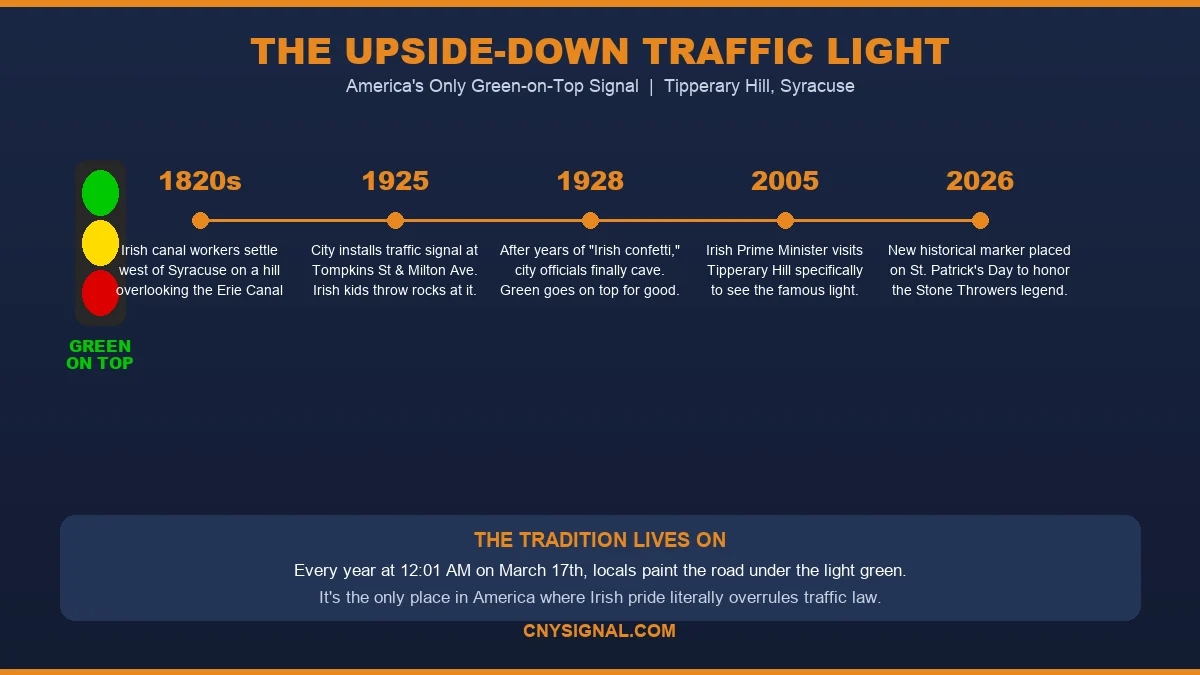
On Tipperary Hill — the neighborhood settled by Irish canal workers in the 1820s after they finished building the Erie Canal — there’s a traffic light at the corner of Tompkins Street and Milton Avenue that has been green-on-top since 1928. It is the only upside-down traffic light in the United States.
The story, as any Tipp Hill local will tell you after their second Guinness, goes like this: the city installed a standard red-on-top signal in 1925. The sons and grandsons of Irish immigrants couldn’t stomach the idea of “British red” sitting above “Irish green.” So they broke the light. Repeatedly. With rocks. They called the rocks “Irish confetti,” which is the most Syracuse thing I’ve ever heard.
The city kept replacing the light. The kids kept breaking it. A local alderman named John “Huckle” Ryan proposed just flipping the colors. The state of New York overruled it. The vandalism got worse. Finally, on March 17, 1928, city officials sat down with neighborhood residents and were told, in no uncertain terms, that the light would keep getting smashed until green went on top. The city caved.
Now, I should mention that the Daily Orange couldn’t find documentary evidence of the light before 1945 when they searched archives in 2005. But they did find widows of men who claimed to have been the stone-throwing kids back in the ’20s. It’s one of those stories that’s part history, part legend, and entirely Syracuse.
Every year at 12:01 AM on St. Patrick’s Day, locals paint the road under the light green. In 2005, the Prime Minister of Ireland made a special trip to Tipperary Hill just to see it. And on St. Patrick’s Day 2026, a new “Legends and Lore” historical marker was installed on the corner to honor the Stone Throwers.
6. Syracuse sits on top of 400-million-year-old salt deposits — but the city never actually had salt mines.
Everyone knows Syracuse is “The Salt City.” The street names give it away — Salina Street, Salt Springs Road, Solar Street. But here’s what most people get wrong: Syracuse never had salt mines. Not one.
What Syracuse had were salt springs — salty brine that bubbled up naturally around the southern shore of Onondaga Lake. The Onondaga Nation, part of the Haudenosaunee Confederacy, had been using the brine for medicinal and culinary purposes long before Europeans showed up. Father Simon Le Moyne, a Jesuit missionary, was the first European to document the springs in 1654.
By the mid-1800s, Syracuse was producing over 12 million bushels of salt per year, making it the largest salt-producing region in the United States. The Erie Canal, completed in 1825, turned Syracuse into a shipping powerhouse — salt could move in every direction. From 1797 to 1917, the Onondaga Salt Springs Reservation produced over 11.5 million tons of salt. The Solvay Process Company extracted another 96 million tons from solution mining in the Tully Valley south of the city.
And here’s where it gets wild: the salt deposits underneath Central New York are remnants of a vast sea from the Silurian period, roughly 400 million years ago. Today, more than 10,000 square miles of salt — an estimated 3.9 trillion metric tons — still sit under New York State at depths ranging from 500 feet near Syracuse to 4,000 feet near the Pennsylvania border.
The Tully Valley solution mining operations had lasting consequences, too. Decades of uncontrolled “wild brining” destabilized the subsurface, and in 1993, shortly after formal mining ended, the area experienced the biggest landslide in centuries.
The salt industry died by 1900, killed by rising costs and competition from western producers. But the legacy is everywhere — in the street names, in the Salt Museum on the north shore of Onondaga Lake, and in the salt potatoes that every Syracusan considers a constitutional right.

7. There’s a network of underground pedestrian tunnels connecting half of downtown Syracuse — built in 1967 for $65,000.
In 1967, when the MONY towers (now the Equitable buildings) were going up on the western edge of downtown, someone had the bright idea to dig tunnels. Not utility tunnels. Pedestrian tunnels. The kind you could actually walk through.
The project connected the Hotel Syracuse to the MONY Center parking garage, with underground links extending to the OnCenter, the Civic Center, the Onondaga County War Memorial, and the Everson Museum. It was a joint effort between MONY, Hotel Syracuse, and the City of Syracuse, and it cost about $65,000 — which, even in 1967, was remarkably cheap for a project that basically built an underground sidewalk system.
At one point, there were plans to turn the spaces between the tunnels into an enclosed underground mall. That never happened. Today, the tunnels are occasionally used by staff moving between buildings, but they’re mostly forgotten — a ghost of mid-century urban optimism sitting quietly beneath the streets.
And that’s just downtown. Up on the hill, Syracuse University has six miles of underground steam piping that delivers heat to every building on the main campus. The system dates to the 1920s, and for generations, adventurous students have explored the tunnels connecting residential halls to dining facilities. (Syracuse winters will motivate you to find a route that doesn’t involve going outside.) The Steam Station originally burned coal, switched to natural gas in 1970, and is now operated by Enwave Energy, a Canadian district energy firm.
Syracuse also has a deeper layer of underground history: actual Underground Railroad tunnels. At the corner of Jefferson and Onondaga Streets, the building that most locals knew as The Mission restaurant sits on tunnels that were carved into the earth to shelter freedom seekers. Syracuse received more fugitive enslaved people than any other city in the region, and the Onondaga Historical Association’s permanent Freedom Bound exhibit documents that history.
8. The building downtown with the giant metal angel on it was designed to make people believe in electricity during the Great Depression.
That Art Deco building on Erie Boulevard — the one with the winged figure perched on the facade like some kind of Gotham City cathedral — is the Niagara Mohawk Building, and its story is better than you think.
Built between 1930 and 1932 as the headquarters for the Niagara Hudson Power Company (then the nation’s largest electric utility), the building was designed by architects Bley and Lyman of Buffalo and Melvin L. King of Syracuse. Its purpose wasn’t just functional. It was propaganda — the good kind. In the middle of the Depression, when the future looked bleak, this building was designed to make people believe in the promise of electricity and progress.
The centerpiece is the “Spirit of Light” — a 28-foot stainless-steel winged sculpture at the sixth-floor level, representing the spread of electrical power. Locals call it “Iron Mike.” It was one of the first examples of stainless-steel sculpture in the country. The building’s recessed stories, designed to look like ancient ziggurats, and its extensive use of black Vitrolite glass, steel art motifs, and chrome panels made it one of the most dramatic Art Deco structures outside Manhattan.
Originally, hidden tube lights behind chrome panels illuminated the entire building at night — a literal beacon of electricity. Those lights went dark in 1939 due to World War II blackouts and were never relit. They stayed dark for 60 years until lighting designer Howard Brandston — the same guy who relit the Statue of Liberty — restored the system in 1999.
After another two-year dark spell, the building was relit in December 2024 with 600 new LED lights. National Grid, the current owner, has launched a comprehensive multi-year restoration to preserve what is now recognized as one of the most important Art Deco buildings in the United States. It went on the National Register of Historic Places in 2010.
9. The 24-second shot clock, the Brannock Device, the first traffic light, and the first drive-through window were all invented in Syracuse.
We covered the Brannock Device and the Crouse-Hinds traffic signal already, but Syracuse’s invention resume goes deeper than most people realize.
Danny Biasone owned the Syracuse Nationals (who won the 1955 NBA championship before moving to Philly and becoming the 76ers). After the 1953-54 season, Biasone was fed up with teams stalling and turning games into unwatchable free-throw contests. So he did some math: he figured 120 shots per game was the right pace, divided 48 minutes by 120, and got 24 seconds. The 24-second shot clock fundamentally changed professional basketball. Every NBA, WNBA, and international game still uses it.
In 1840, Milton Waldo Hanchett of Syracuse patented the first adjustable dental chair — the reason your dentist can tilt you back instead of making you sit bolt upright while drilling. You’re welcome.
In 1933, the Nettleton Shoe Company in Syracuse patented the world’s first loafer — the slip-on shoe that became one of the most ubiquitous footwear styles on the planet.
And in 1941, Merchants Bank in Syracuse installed the country’s first drive-through banking window. Before Syracuse figured it out, if you wanted to deposit a check, you had to park and walk inside like some kind of animal.
There’s more, too: 27 antennae currently sitting on the moon were made in Syracuse by Sims. The Franklin automobile was built here. At the turn of the 20th century, 90% of the nation’s garment pressing machines were manufactured in this city. And the Mutoscope — a coin-operated, hand-cranked movie-viewing machine that predated the cinema — was patented here.
For a city that most of the country associates exclusively with snow, Syracuse has a genuinely staggering invention portfolio.
10. Syracuse’s drinking water comes unfiltered from one of the cleanest lakes in America — piped 23 miles directly into your tap.
Skaneateles Lake, located about 20 miles southwest of Syracuse, is one of the cleanest bodies of fresh water in the United States. It’s so clean that the city of Syracuse is one of only a handful of municipalities in the country that doesn’t have to filter its drinking water. It comes straight from the lake, piped 23 miles into the city’s system.
That’s not a historical fun fact. That’s what’s coming out of your faucet right now.
The Syracuse area is also home to three “meromictic” lakes — Green Lake, Round Lake, and Glacier Lake — bodies of water whose deep layers and surface layers never mix. They’re rare enough that limnologists (that’s lake scientists, for those of you who skipped that day) consider them scientifically significant. Green Lakes State Park, which contains two of them, has that distinctive blue-green color that looks like someone dumped food coloring in it. They didn’t. That’s just what happens when a lake has been thermally stratified since the last ice age.
Between the unfiltered drinking water, the meromictic lakes, the 400-million-year-old salt deposits, and the 128 inches of snow per year, Central New York has some of the most geologically interesting real estate on the East Coast. We just don’t advertise it because we’re too busy shoveling.
Syracuse has always been the kind of city that rewards curiosity. It doesn’t announce itself. It doesn’t need to. The people who live here know there’s something under every surface — sometimes literally, in the case of the salt and the tunnels — that makes this place more interesting than the national narrative gives it credit for.
The rest of the world is starting to figure that out. We’ve been here the whole time.
Know something about Syracuse that should have made this list? Send it to [email protected] — we’re always digging.
CNY Signal — Real-time news for Central New York.