By Charles Shack, Senior Reporter
SYRACUSE, N.Y. The most expensive sentence in the Syracuse City School District’s January testimony to Albany was not a dollar amount. It was an arithmetic problem.
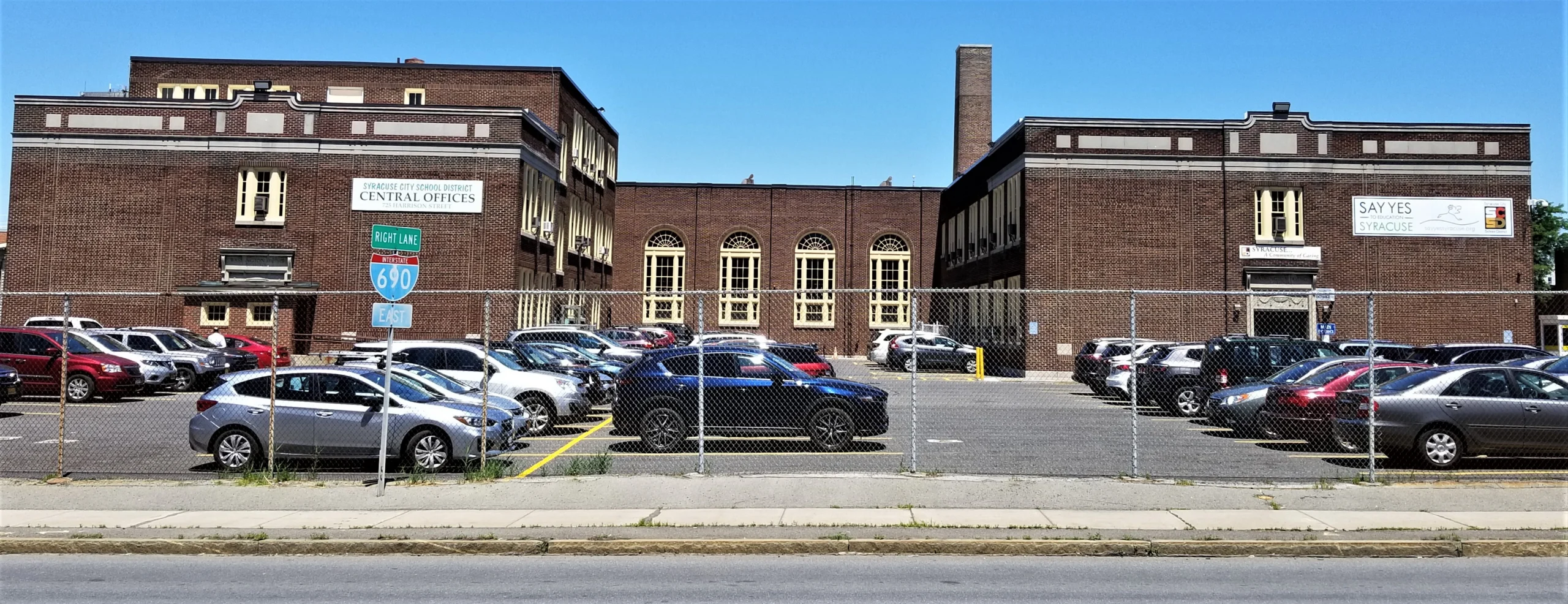
About one in ten Syracuse public-school students now attends a charter school, district leaders told the New York Senate Finance and Assembly Ways and Means committees at the Joint Legislative Public Hearing on the 2026 Executive Budget. Charter enrollment has grown to roughly 10 percent of the city’s public-school population, and SCSD’s annual bill for that growth is now closing in on $43.6 million a year.
Know before your neighbors do
The Morning Signal hits your inbox at 6 AM with everything that happened overnight. Real incidents, real data, zero fluff.
That figure is not a forecast. It is what Syracuse families and Syracuse taxpayers are already paying, every school year, to send 1,700 to 1,800 city students to schools the district does not operate, does not staff and cannot inspect. And under New York’s charter-school finance rules, the district has to write the check first and wait on Albany to make it whole later.
The $43.6 million number, decoded
Strip away the speechwriting and the $43.6 million figure is essentially three things multiplied together: a per-pupil rate set by the New York State Education Department, a head count of Syracuse children enrolled in charter schools, and a payment timing rule that puts every dollar of risk on the home district.
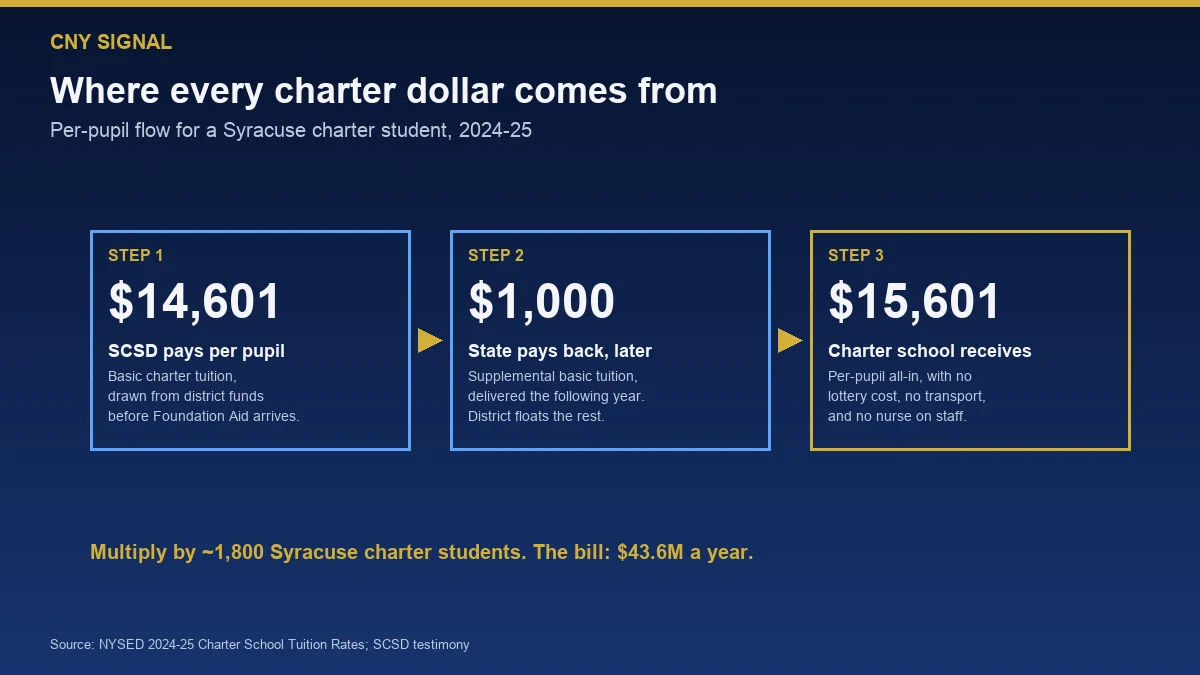
The rate is the easiest part to nail down. NYSED’s published 2024-25 charter school basic tuition table sets Syracuse’s payable rate at $14,601 per pupil, up from $14,128 the year before. That figure is calculated as the lower of two formulas: the prior year’s tuition adjusted by an approved operating expense growth factor, or the district’s total general fund expenditures divided by enrollment. For Syracuse, the growth-factor calculation wins, holding the rate well below the alternative $24,041 per-pupil figure that the spending divided by enrollment formula would have produced.
The head count is harder to pin down to the student, because charter schools authorized for Syracuse children draw across grade levels and across operators. SCSD pays tuition for every Syracuse resident enrolled at the Syracuse Academy of Science, Citizenship and Science Academy of Syracuse, Southside Academy Charter School and OnTECH Charter High School, among others. Multiply 1,700 to 1,800 city residents by the $14,601 base rate and a few hundred dollars per student in special-education set-asides and federal pass-throughs, and the math lands at the $43.6 million the district reported to legislators.
The third number, the timing, is what changes a budget line into a cash-flow problem.
Pay first, get reimbursed later
New York requires districts to send charter tuition payments throughout the school year, on a schedule charter schools control. If a district misses a payment, the state can intercept its Foundation Aid and route the money to the charter directly. So Syracuse pays first, in cash, before Foundation Aid lands in district accounts.
The state then sends Syracuse a small reimbursement, called Supplemental Basic Tuition, of $1,000 per charter pupil, payable a year after the district has already spent the money. The 2024-25 supplemental due to Syracuse will not arrive until 2025-26. The 2025-26 supplemental will not arrive until 2026-27.
“The District is mandated to pay Charter Tuition prior to receiving Foundation Aid (or risk having it intercepted) and then must wait a year,” SCSD wrote in its Albany testimony.
That one-year lag is the small print that makes a 10 percent enrollment shift feel much bigger than 10 percent on the district’s books. SCSD’s amended 2025-26 budget, presented at $619.9 million this spring, already absorbed an additional $1.7 million in charter tuition cost over the prior plan, alongside the $14 million in fresh Foundation Aid the state’s revised formula sent to Syracuse. The charter line is moving faster than the aid that backs it.
The nurse subsidy nobody outside Syracuse talks about
Buried in the same testimony is an even smaller number that says even more about how the system actually works.
SCSD told legislators it employs 49 nurses, 5 LPNs and 34 health aides at a total annual cost of $6.58 million. Those nurses staff every school in the City of Syracuse. Not just SCSD’s own buildings: by state mandate, the district also provides nursing services for charter and private schools inside city limits.
For that work, Syracuse receives $1.08 million a year in state funding, an amount the district says is sized to cover roughly 15 nurses. The remaining $5.5 million comes out of the SCSD operating budget. Charter schools and private schools inside Syracuse get the service. Syracuse property and income taxpayers, plus state aid intended for SCSD students, pay the bill.

Asked plainly, why does the district pay charter-school nurses, the answer is shorter than the question. State law requires SCSD to provide health services at every school in its boundaries, regardless of who runs the building. The state funds 15 of the 88 nursing-related positions Syracuse fields. SCSD covers the other 73.
That subsidy does not show up in the $43.6 million charter cost figure. It is on top of it. A Syracuse charter school enrolls a city child, collects $14,601 in basic tuition from SCSD, and also gets a school nurse paid for almost entirely by SCSD. None of those costs show up on the charter school’s per-pupil expense report, which is one reason charter operators consistently report lower per-pupil overhead than the district they enroll students from.
Who runs the charter schools, and how they perform
Four charter schools draw the bulk of Syracuse’s enrollment. The Syracuse Academy of Science is the largest, with 993 students reported in NYSED’s most recent profile and a 4-year graduation rate of 88 percent for its 2021 cohort. The school is part of Science Academies of New York (SANY), a nonprofit operator that also runs the Citizenship and Science Academy of Syracuse and a sister campus in Utica. Southside Academy Charter School, K-8, is operated by the for-profit National Heritage Academies management company and serves 697 students. OnTECH Charter High School, with 253 students, ran a public hearing in 2023 to revise its start time and reduce authorized enrollment from 360 to 300, an unusual public concession that enrollment was lagging the school’s footprint.
By comparison, SCSD itself reported 17,639 K-12 students in 2024-25, with 19 percent classified as English Language Learners. The district’s most recent reported 4-year graduation rate is 71 percent for the 2021 August cohort, with disaggregated figures showing 70 percent for Black students, 64 percent for Hispanic and Latino students, 57 percent for students with disabilities and 50 percent for students experiencing homelessness.

The graduation gap is real, but the comparison is incomplete without a population caveat the SCSD testimony emphasizes: charters are tuition-free public schools, but they admit by lottery. They do not, as a class, serve the same proportion of homeless students, students with the most intensive disabilities, or newcomer English Language Learners that SCSD is legally obligated to enroll. The 88 percent graduation rate at SAS and the 71 percent rate at SCSD are not comparing the same student cohorts.
The state’s charter cap, and a Syracuse application in the queue
New York’s statewide cap on charter schools has been frozen at 460 since 2010, after a 2015 amendment carved out a separate sub-cap of 50 charters that can be granted to New York City schools opened on or after July 1, 2015. The state had 352 operating charter schools serving more than 180,000 students as of October 2025, according to the New York State Education Department’s most recent fact sheet. The cap is not yet binding statewide, but the Senate cap on New York City charters has been the subject of years of debate.
For Syracuse, the more immediate question is the SUNY Charter Schools Institute’s 2026 Request for Proposals. SUNY plans one application round in 2026 for new charter schools outside New York City. Among the local groups that have signaled interest is 100 Black Men of Syracuse, which is targeting a September 2026 opening for a proposed Central New York Academy Charter School serving K-2 in its first year and expanding through eighth grade. The application is under SUNY review.
If that school opens at the size its organizers describe, every K-2 Syracuse resident enrolled there will trigger a new $14,601 per-pupil tuition bill at SCSD. Multiply across grades as the school expands, subtract the $1,000 per pupil the state will send back a year late, and the structural transfer from district budget to charter operating accounts grows by another seven figures.

The policy stakes
The Syracuse story is, at one level, a story about a single line on a single budget. SCSD will spend somewhere north of $43.6 million on charter tuition this year, plus $5.5 million the state does not reimburse for nurses inside charter and private schools, while floating a payment-timing gap that depresses cash on hand at the start of every fiscal year. None of that money is illegal, hidden or even unusual under state law. It is what the formula produces.
At a different level, it is a story about which level of government writes which check. New York’s charter law is built around the proposition that funding follows the child. Syracuse’s testimony asks legislators to take that proposition seriously and ensure that the funding source actually follows the student, rather than passing through a district balance sheet for a year before being made whole.
The numbers SCSD put on the record in Albany are airtight. The 10 percent enrollment share, the $43.6 million total, the 49 nurses and 5 LPNs and 34 aides, the $6.58 million expense, the $1.08 million reimbursement, the $14,601 per-pupil rate set by NYSED and the $1,000 supplemental check that arrives a year late. Every figure is sourced to the state’s own data or the district’s testimony to the state’s own committees.
What Albany does about them, in the 2026-27 enacted budget, is the part Syracuse is still waiting on.
Charles Shack covers schools, money and public policy for CNY Signal. Reach him at [email protected].
Sources: Syracuse City School District testimony, New York State Joint Legislative Public Hearing on 2026 Executive Budget Proposal, January 29, 2026; New York State Education Department, “2025-26 Definition of Charter School Basic Tuition and Supplemental Basic Tuition”; NYSED 2024-25 Charter School Basic Tuition Rates; NYSED Data Site profiles for Syracuse City School District and Syracuse Academy of Science Charter School; New York State Charter School Fact Sheet, October 2, 2025; SUNY Charter Schools Institute 2026 RFP announcement; CNY Central, “Renewed effort to open charter school in Syracuse targets underserved students”; Syracuse City School District amended 2025-26 budget filings.