By Charles Shack, Senior Reporter
The students gown up before they ever touch a tool. Hairnet. Hood. Coverall. Boots. Gloves. Mask. They walk through an air shower, then into a 3,000-square-foot room where the air is filtered cleaner than a hospital operating suite, and they go to work on machines that came in pieces from Micron factories in Idaho, Virginia, Singapore, Taiwan, and Japan.
Onondaga Community College spent $15 million to build this room. It opened with a ribbon cutting on October 1, 2025. Inside, students train in white “bunny suits” on tools that match what Micron will eventually install in Clay, learning to chase contamination off a silicon wafer the size of a dinner plate. They are practicing for jobs that pay around $70,000 a year to start, that will eventually number in the thousands, and that, for the most part, do not yet exist.
The first Micron fab is now scheduled to begin operating in late 2030. That is two years later than Micron promised when it announced the project in 2022. The cleanroom at OCC is open. The factory it was built to feed is not.
The Building
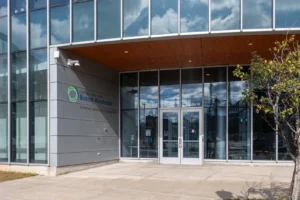
The Micron Cleanroom Simulation Lab sits on the second floor of the Whitney Applied Technology Center on OCC’s main campus. The full footprint is 5,000 square feet, with a 3,000-square-foot cleanroom certified to ISO Class 5 and 6 standards. ISO Class 5 is the same air-quality benchmark used in actual semiconductor fabs. It permits no more than 3,520 particles of half a micrometer or larger per cubic meter of air. A typical office, by comparison, contains tens of millions.
The $15 million was split three ways. Micron put up $5 million as part of its $500 million Green CHIPS Community Investment Fund. Onondaga County matched with $5 million. New York State delivered the third $5 million through SUNY’s capital program. Construction began in 2024. The architect was Ashley McGraw of Syracuse, the general contractor was PAC Associates of Oswego, and the project manager was Sara Berg.
The building required a new freight elevator with a 12,000-pound capacity to move tools weighing several thousand pounds each onto the second floor. The same Whitney Center renovation also added training space for welding, CNC machining, and diesel and heavy equipment repair.
“This is one of the largest manufacturing investments in U.S. history,” OCC President Dr. Warren M. Hilton said when ground broke. Hilton, the ninth president in OCC’s history, started in July 2022, the same year Micron announced its $100 billion plan to build four chip fabs in Clay. He hosted President Joe Biden on campus during his first year, and has staked a meaningful share of OCC’s future on whether Micron’s bet pays off.
The Curriculum
OCC launched two semiconductor-aligned programs in fall 2023, before the cleanroom was finished: an Electromechanical Technology associate degree (A.A.S.) and an Electromechanical Technology certificate program. In 2024-25, more than 400 unique students enrolled in at least one electromechanical technology course, a 78 percent jump from the pilot year.
More than 300 of those students now use the cleanroom simulation lab. They run diagnostics on the Micron tools, troubleshoot faults, and replace components. Sensors halt machinery if a hand gets where a hand should not be. The gowning process is the real one. The particles are the real ones. Only the wafer is a stand-in, because OCC is a teaching environment, not a fab.
Michael Grieb, an Applied Engineering Technology professor who oversees student training in the lab, has told local reporters that “everybody’s going to be successful that comes out of this program.” That is the kind of optimism community college instructors rarely allow themselves. Grieb works alongside John Sly, who joined OCC after 12 years at Micron, and Dr. Art Peterson, chair of the Applied Engineering Technology Department, who has led OCC’s NSF-funded semiconductor curriculum work since 2017. Odae Badwan, the facilities project manager, coordinated the assembly of the donated tools and has said the lab will keep evolving as new equipment arrives.
OCC graduates can stop after the certificate, finish the associate degree, or transfer. Syracuse University and OCC have a Direct Transfer Admission program that guarantees admission to STEM majors for OCC graduates who meet the GPA threshold. SUNY Polytechnic in Utica, where Dr. Peterson’s department co-leads a Northeast Advanced Technology Education Center funded by a $2.25 million NSF grant, accepts OCC credits toward a four-year nanoscale engineering degree. RIT and Binghamton offer parallel transfer paths.
Cleanroom Class Hierarchy: What ISO Class 5 Actually Means
How Clean Is Clean?
Source: ISO 14644-1 standard. FED-STD-209E equivalents shown in italics. Particle count for 0.5µm and larger.
The Pipeline
Micron pitched the Clay project as 9,000 direct jobs at the company and 50,000 jobs across the Central New York region once all four fabs are operating. About a third of the Micron jobs, roughly 3,000 of them, are technician roles. Those are the ones OCC’s program targets.
What does that career path actually look like? Micron has run a Registered Apprenticeship Program at its Boise headquarters since 2023. Apprentices spend the first part of the program in classroom and lab work at the College of Western Idaho, then move into hands-on training inside Micron’s facilities. Apprentices are paid during their training, and Micron has hired graduates as full-time technicians. CWI’s mechatronics program enrollment grew from 16 students per semester in 2022 to about 40 in 2026, mirroring the trajectory OCC is now on.
OCC has already pushed students into Micron’s existing facilities. In summer 2024, eleven students completed paid summer internships, eight at Micron’s Boise headquarters and three at the company’s Manassas, Virginia plant. All eleven received job offers, the college says. William Appleton, an 18-year-old from Constantia, completed the Manassas internship between his first and second year of the electromechanical program. Vincent Hubbard, a P-TECH senior at Fulton High School, spent his summer in Boise.
Nick Hay finished his electromechanical technology degree at OCC in December 2025 and was hired into Micron’s Manassas, Virginia facility starting January 2026. “If you would have told me 7 years ago that I would be here doing everything I’m doing now,” Hay said at the lab’s ribbon cutting, “I would have said to myself, ‘No, you’re a little crazy.'”
The CNY Semiconductor Talent Pipeline, 2025-2030
From High School to Fab Floor
Sources: OCC press releases (Oct 2025), Micron CHIPS Act announcement, Spectrum News interviews. Numbers reflect Micron projections, not contractual commitments.
The Hedge
Here is the part the ribbon-cutting press releases tend to skip. In November 2025, Micron quietly revised its Clay timeline. Construction on Fab 1 will now start in the second quarter of 2026 and will not begin operating until the third quarter of 2030, a two-year slip. Fab 2 construction now begins in the fourth quarter of 2030 and ends in 2033. Full build-out of the four-fab campus, originally pitched as a 20-year project, now stretches to 2041. Full production is projected for 2045.
The reasons cited are familiar to anyone watching the broader semiconductor build-out: skilled labor shortages, utility infrastructure that has to be expanded before a fab can run, supply chains for ultra-pure water and specialty gases, and the weight of having to coordinate construction trades that are also building TSMC’s facilities in Arizona and Samsung’s in Texas. The CHIPS Act contract Micron signed with the Commerce Department, as advocacy groups including the Sierra Club and CHIPS Communities United have noted, did not lock in firm wage floors, hiring quotas, or a guarantee that the 9,000 jobs would be union-scale.
That leaves OCC with a question. What happens to a 2026 cleanroom graduate when the fab she trained for does not open for four more years?
The college’s answer is that the cleanroom prepares students for any environment that uses similar contamination-controlled conditions. That includes high-tech medical device manufacturing, biotech, photovoltaic and LED production, the photonics work happening at AIM Photonics in Albany and Rochester, and even some food and pharmaceutical processing. New York’s existing semiconductor footprint, anchored at GlobalFoundries in Malta and SUNY Poly in Albany, already employs thousands and continues to hire. A program graduate who waits two years for a Clay job is not unemployed in the meantime; she is at GlobalFoundries, or at Wolfspeed in Marcy, or running diagnostics on a packaging line in Liverpool.
Starting Salary: How OCC Stacks Up
Semiconductor Technician Starting Pay
Sources: ZipRecruiter, PayScale, Indeed, Idaho Ed News, Center for American Progress, US BLS QCEW. Micron NY figure is a projection; OCC quotes “around $70,000 per year” via Spectrum News (Oct 2025).
The First Cohort
The first wave of OCC electromechanical technology graduates is small and concentrated in the December 2025 and May 2026 commencements. Most of them, like Hay, are taking jobs at existing Micron facilities outside New York, banking experience while the Clay site finishes preparation work and waits for permits. Others are heading to GlobalFoundries in Malta or to manufacturing employers in the Mohawk Valley. A handful are continuing to SUNY Poly or Syracuse University on transfer.
OCC’s strategy is to flood the pipeline ahead of demand, not match it. Hilton has said publicly that the goal is to have a steady-state output of trained technicians by 2028, two years before the first Clay fab is supposed to start running. If Micron’s timeline holds, OCC graduates will be available the day the lights come on. If the timeline slips again, those graduates will work somewhere else first and come home when the fab is ready.
The 12,000-pound freight elevator at Whitney is built. The Class 5 air is filtered. The bunny suits are folded. The students are inside, gowning up, gloves on, walking through the air shower. Whether the factory in Clay is ready for them in 2030 is the question OCC cannot answer. What it can answer, by the count of students enrolled and tools donated and ribbons cut, is whether OCC is ready for the factory.
It is.
Frequently Asked Questions
How big is OCC’s Micron Cleanroom Simulation Lab?
The full facility is 5,000 square feet, with a 3,000-square-foot certified cleanroom. It is on the second floor of the Whitney Applied Technology Center on OCC’s main campus.
How clean is an ISO Class 5 cleanroom?
An ISO Class 5 cleanroom permits at most 3,520 particles 0.5 micrometers or larger per cubic meter of air. That is roughly the same air-quality benchmark used in actual semiconductor fabs. A typical office contains tens of millions of particles per cubic meter.
How much does a Micron technician make?
OCC officials cited approximately $70,000 per year for technician roles in interviews with Spectrum News in October 2025. Micron technicians in Boise, Idaho earn an average hourly wage of about $27.83, or roughly $58,000 annually. Engineers earn substantially more, often $90,000 to $120,000 to start.
When will Micron’s first Clay fab open?
Micron revised its timeline in November 2025. Construction on Fab 1 starts in Q2 2026, with operations beginning in Q3 2030, two years later than originally promised. Full build-out of the four-fab campus is projected for 2041, with full production by 2045.
How do I enroll in OCC’s electromechanical technology program?
OCC offers both a one-year certificate and a two-year associate degree (A.A.S.) in Electromechanical Technology. Applications are processed through the SUNY Onondaga admissions office at sunyocc.edu. P-TECH dual-enrollment options exist for high school juniors and seniors at participating CNY districts.
Sources
- Office of New York Governor Kathy Hochul, $15M Cleanroom Simulation Lab announcement
- Onondaga Community College press releases and Micron partnership page
- Spectrum News Central NY (October 2, 2025)
- WAER public radio (October 6, 2025)
- WRVO Public Media (October 2, 2025)
- CNY Central, “How OCC is helping to power Micron’s future workforce”
- Ashley McGraw Architects project page
- SUNY Polytechnic NSF NEATEC announcement
- Construction Dive and Engineering News-Record on Micron timeline revision (November 2025)
- Sierra Club and CHIPS Communities United on CHIPS Act contract terms
- Idaho Education News on College of Western Idaho mechatronics program
- Maricopa Community Colleges Quick Start program documentation
- US BLS Quarterly Census of Employment and Wages
- ISO 14644-1 cleanroom standard reference
Charles Shack covers workforce, economic development, and education for CNY Signal. Contact: [email protected].