{“@context”: “https://schema.org”, “@type”: “NewsArticle”, “headline”: “75 Years Ago in Syracuse: The Nationals Game That Quietly Broke the NBA Color Line”, “datePublished”: “2026-04-27T00:00:00-04:00”, “author”: {“@type”: “Person”, “name”: “Matt Russo”, “jobTitle”: “Staff Reporter”}, “publisher”: {“@type”: “Organization”, “name”: “CNY Signal”, “url”: “https://cnysignal.com”}, “image”: “https://cnysignal.com/wp-content/uploads/2026/04/war-memorial-syracuse-loc.webp”, “mainEntityOfPage”: {“@type”: “WebPage”, “@id”: “https://cnysignal.com/”}, “about”: [{“@type”: “SportsTeam”, “name”: “Syracuse Nationals”, “sport”: “Basketball”, “memberOf”: {“@type”: “SportsOrganization”, “name”: “National Basketball Association”}}, {“@type”: “Person”, “name”: “Earl Lloyd”, “jobTitle”: “Basketball player”, “birthDate”: “1928-04-03”, “deathDate”: “2015-02-26”, “award”: “Naismith Memorial Basketball Hall of Fame (2003)”}, {“@type”: “Person”, “name”: “Jim Tucker”, “jobTitle”: “Basketball player”, “birthDate”: “1932-12-11”, “deathDate”: “2020-05-14”}, {“@type”: “Person”, “name”: “Dolph Schayes”, “jobTitle”: “Basketball player”, “birthDate”: “1928-05-19”, “deathDate”: “2015-12-10”, “award”: “Naismith Memorial Basketball Hall of Fame (1973)”}, {“@type”: “Person”, “name”: “Danny Biasone”, “jobTitle”: “Basketball team owner”, “birthDate”: “1909-02-22”, “deathDate”: “1992-05-25”, “award”: “Naismith Memorial Basketball Hall of Fame (2000)”}, {“@type”: “Place”, “name”: “Onondaga County War Memorial”, “address”: {“@type”: “PostalAddress”, “addressLocality”: “Syracuse”, “addressRegion”: “NY”}}]}

By Matt Russo, Staff Reporter
SYRACUSE. The night the NBA changed forever happened in Rochester, not Syracuse. On October 31, 1950, a 21-year-old forward from West Virginia State named Earl Lloyd checked into a season opener for the Washington Capitols against the Royals at Edgerton Park Arena.
Know before your neighbors do
The Morning Signal hits your inbox at 6 AM with everything that happened overnight. Real incidents, real data, zero fluff.
He went two-for-three from the floor, two-for-three at the line, scored six points in a 78-70 loss, and walked out the first Black player in league history.
Two and a half years later, after the Capitols folded and the Army shipped him to Korea, Lloyd would catch a Greyhound bus to a city he had never seen, take a room in a Black boarding house off Harrison Street, and put on the orange and blue of the Syracuse Nationals.
That part of the story almost never gets told.
Seventy-five years after Lloyd’s debut, the NBA is celebrating the integration anniversary with patches and league-wide tributes. Syracuse, where Lloyd spent six of his nine pro seasons, where he and Jim Tucker became the first Black players to win an NBA championship, where the franchise’s owner invented the rule that saved professional basketball, has a single mural downtown and a war memorial that has been renamed three times. The team is gone. The neighborhood Lloyd lived in is gone. The arena where Tucker set the fastest triple-double record in league history still stands a block off Salina Street, now branded as Upstate Medical University Arena. Most people walking past it have no idea what happened inside.
The League Before
The NBA in 1950 was three years old and barely solvent. It had been formed in 1949 from a merger of the Basketball Association of America and the older National Basketball League, and seven NBL teams, including the Syracuse Nationals, came in through that door. Television rights were a rumor. Several franchises played in cities that would not survive the decade: Sheboygan, Anderson, Waterloo, Tri-Cities. The Nationals, founded in 1946 by an Italian immigrant named Daniel Biasone for $5,000 and a deposit at NBL headquarters, played their home games at the State Fair Coliseum out in Geddes.
No Black player had ever appeared in a BAA or NBA game. Three changed that in 1950. Chuck Cooper became the first Black player drafted, taken in the second round by Boston on April 25. Nat “Sweetwater” Clifton was the first to sign a contract, purchased from the Harlem Globetrotters by the New York Knicks on May 24. Lloyd was the first to actually play, on Halloween, because Washington’s schedule started a day before Boston’s and four days before New York’s. Cooper made his debut November 1 against Fort Wayne. Clifton played November 4 against Rochester. A fourth player, Hank DeZonie of the Harlem Rens, signed with the Tri-Cities Blackhawks in early December, played five games and walked away.
The Nationals
Daniel Biasone, who went by Danny, ran a bowling alley called the Eastwood Sports Center on James Street and a basketball franchise on the side. He had grown up on the North Side, son of an Italian immigrant from Miglianico, and he financed the team out of his own pocket through the league’s lean years. His general manager, Leo Ferris, was a math man from Elmira who had previously helped run the Buffalo Bisons of the NBL. Together they ran a small-market club that could not match the gates of New York or Boston but could win on the floor.
The basketball was built around Adolph “Dolph” Schayes, a 6-foot-8 forward out of NYU who joined the Nats as a 20-year-old in 1948 and never played anywhere else until the franchise itself moved. Schayes would finish his career as the NBA’s all-time leading scorer at 19,249 points, a 12-time All-Star, a Hall of Fame inductee in 1973, and one of the original 50 Greatest Players in league history. Around him: Paul Seymour, the playmaking guard from Toledo; Red Rocha, a Hawaiian-born center who had played at Oregon State; and a head coach, Al Cervi, who had played for the Nats himself before taking over the bench in 1948.
The Nationals lost the 1950 NBA Finals to the Minneapolis Lakers in six games. They were back in the Finals in 1954 and lost again, this time to George Mikan and the Lakers in seven. They were good. They were not yet champions. And they were, until the fall of 1952, all white.
How Lloyd Got to Syracuse
Earl Lloyd’s first NBA contract paid him $5,000 a year. He was on the Washington Capitols, a franchise that folded in January 1951 after losing money for three straight seasons. The Syracuse Nationals claimed his rights on waivers. Before he could put on a Nats uniform, the Army claimed him for two years and shipped him to Korea.
When he came back to the States in the fall of 1952, the Capitols no longer existed. The team that owned his contract was Syracuse. He had never been to upstate New York. He stepped off the bus into a city of 220,000 people, where eight of every nine Black residents lived in a single neighborhood east and south of downtown called the 15th Ward.
That is where he found a room. Sean Kirst, the longtime Post-Standard columnist who co-wrote Lloyd’s autobiography Moonfixer: The Basketball Journey of Earl Lloyd (Syracuse University Press, 2010), documented that Lloyd took a boarding house room with J. Luther and Helen Sylvahn, who published The Progressive Herald, the city’s Black newspaper. He could not rent in white parts of Syracuse, Kirst wrote, “because he found it was almost impossible for African-Americans to rent or buy homes at the time in ‘white’ communities.” His best friend in the city was Donald “Peewee” Caldwell, who had been the first Black basketball player at Le Moyne College. Lloyd did not drink. He liked orange soda. He went to the Embassy Lounge to listen to jazz.
On the floor he was a defensive forward, 6-foot-6, 220 pounds, who set screens and rebounded and guarded the other team’s best wing. In his first season with the Nats, 1952-53, he played 64 games, averaged 7.4 points and 6.9 rebounds, and helped the team to a 47-24 record and a second-place finish in the Eastern Division. His coach, Al Cervi, told Kirst years later: “Lloyd was an excellent defensive player. That was No. 1 on my roster.”
The Championship
The Nats added Jim Tucker for the 1954-55 season. Tucker was 22 years old, a 6-foot-7 forward from Paris, Kentucky, who had played at Duquesne. Slim, fast, undersized at 170 pounds for the position, he came off the bench. Lloyd was now in his fourth NBA season, the starting power forward, and he was about to put up career numbers.
Schayes led the team in scoring at 18.5 points per game and rebounds at 12.3, shot 83.3 percent from the line, and was named First Team All-NBA. Seymour ran the offense and made Second Team All-NBA. Lloyd posted his career best at 10.2 points and 7.7 rebounds. Tucker, off the bench, averaged 4.1 points across 76 games.
On February 20, 1955, against the New York Knicks at the Onondaga County War Memorial, Tucker did something nobody had ever done. Coming off the bench in the second half, he played 17 minutes and recorded 12 points, 10 rebounds and 12 assists. The fastest triple-double in NBA history. The record stood for 63 years until Nikola Jokic broke it at 14 minutes, 33 seconds in February 2018.
The Finals against the Fort Wayne Pistons opened on March 31, 1955 at the War Memorial. The Nats took the first two games at home, 87-82 and 87-84. The series shifted to Indianapolis (Fort Wayne’s home arena was unavailable, so the Pistons were playing their home games at Butler Fieldhouse) and Fort Wayne won three straight: 96-89, 109-102, 74-71. The Nats came back to Syracuse down 3-2 and rolled the Pistons 109-104 in Game 6 in front of 4,997 fans.
Game 7 was April 10, 1955. 6,697 inside the War Memorial. The Nats led most of the night, then watched the Pistons climb back to within a single point with the clock under a minute. George King, the third-year guard from Charleston, hit a free throw with 12 seconds left to put Syracuse up 92-91. Then he stole the ball from Andy Phillip with three seconds on the clock. The Nats had their championship. Lloyd had his ring. So did Tucker. The first two Black players to win one.
The Shot Clock
Eight months earlier, on August 10, 1954, Biasone and Ferris had walked into Blodgett Vocational High School on Oswego Street with a stopwatch and an idea. The NBA in 1954 had a stalling problem. Teams ahead late would just hold the ball. The previous year a game between the Pistons and the Lakers had ended 19-18. Fans were leaving.
Ferris had run the math. 48 minutes is 2,880 seconds. The average game saw 120 shot attempts. 2,880 divided by 120 is 24. So they wrote a “24-second” rule, set up an exhibition scrimmage in Blodgett’s gymnasium, and invited NBA decision-makers to watch. Red Auerbach of the Celtics came. Eddie Gottlieb of the Philadelphia Warriors came. Maurice Podoloff, the NBA president, came. They watched the Nationals scrimmage with a 24-second possession limit and went home convinced.
The NBA adopted the rule. The first regular-season game with the shot clock was October 30, 1954, between the Rochester Royals and the Boston Celtics. League scoring jumped from 79.5 points per game to 93.1 in a single year. Biasone went to the Hall of Fame in 2000. Ferris, whose role was forgotten for decades and only restored in recent reporting (ESPN’s Marc Stein in 2015 led that revival), did not.
The shot clock did something else, less remarked on at the time. In the slow, plodding game of 1953, depth mattered less. Possessions were long, the starters could play 40 minutes, and bench players, where many of the league’s first Black players were used, sat. Faster basketball needed more bodies. Tucker came off the bench and got minutes that would not have existed two years earlier. Lloyd, already a starter, became indispensable as a defender on a team that now had to score 90 points a night. The clock did not integrate the league. But it gave Black players more floor.
What Stayed, What Left
The Nats stayed competitive through the rest of the decade. They went to the Eastern Conference Finals four more times. They never won another title. Schayes kept piling up points and rebounds. Lloyd was traded to the Detroit Pistons in 1958. Tucker’s NBA career ended in 1957. Biasone kept the franchise alive in a market that was starting to look small next to expansion cities and television markets.
On May 22, 1963, the NBA approved the sale of the Syracuse Nationals to two Philadelphia businessmen, Irv Kosloff and Ike Richman, for a price never officially disclosed but reported in the range of $500,000. The team played its final Syracuse game on March 26, 1963, a playoff overtime loss to Cincinnati. The new owners renamed the franchise the Philadelphia 76ers, formal approval coming August 6 of that year. Schayes went with them. So did the franchise’s NBA records, which the 76ers still claim. The 1955 banner hangs in Wells Fargo Center.
One year later, in 1964, demolition crews moved into Earl Lloyd’s old neighborhood. The 15th Ward, where 4,000 Black Syracusans lived in 1950, sat directly in the path of the new Interstate 81 viaduct and a federally funded “urban renewal” zone the city had been planning since the late 1950s. By 1969, the city had torn down 90 percent of the Ward’s buildings and displaced an estimated 1,300 to 2,200 families, 75 percent of whom were Black. Four hundred to 500 small businesses were lost. The Sylvahn boarding house where Lloyd had lived was gone. Most of the cultural infrastructure that supported Black Syracuse in 1955 was rubble by 1970.
What Syracuse Remembers
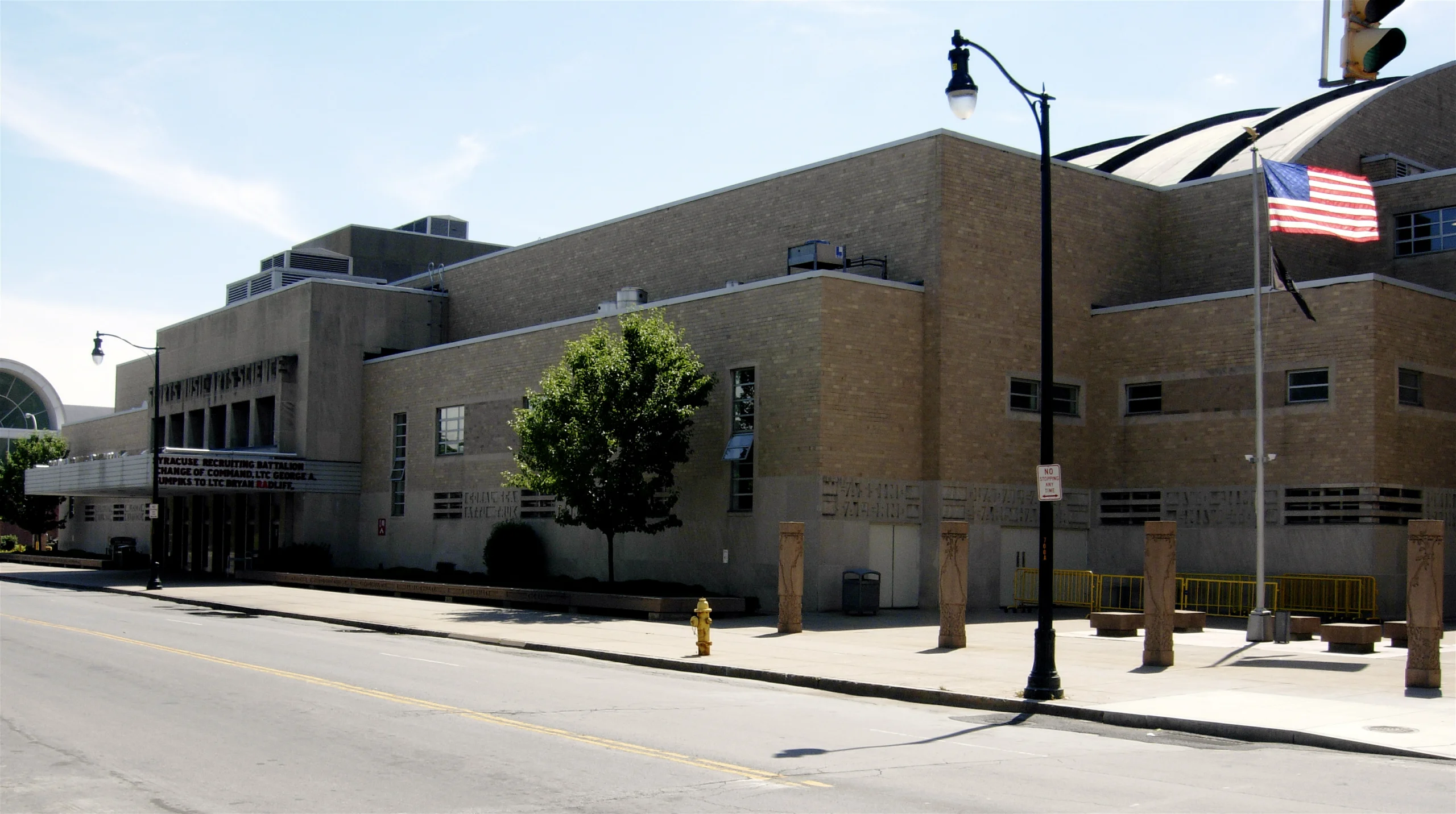
The War Memorial is still there. It opened on September 12, 1951, less than a year after Lloyd’s debut in Rochester, and it has been the home of every Nats playoff game and championship. The exterior carvings list 50,000 county veterans and 55 American battles. It now goes by Upstate Medical University Arena and hosts the Syracuse Crunch hockey team. There is no plaque inside the building marking the Nats’ 1955 championship. There is no plaque marking Tucker’s triple-double. The shot clock from the Blodgett scrimmage sits in a glass case at Le Moyne College’s library, several miles east of downtown.
The most public memorial to Lloyd in Syracuse is a mural by Los Angeles artist Jonas Never, commissioned by the Syracuse Jazz Festival’s Frank Malfitano, that put Lloyd alongside Schayes, Manny Breland, and Breanna Stewart on a downtown wall. Lloyd died on February 26, 2015 in Crossville, Tennessee, where he had retired with his wife Charlita. He was 86. He had been inducted into the Naismith Memorial Basketball Hall of Fame in 2003. West Virginia State raised a statue of him in 2014. Bill Russell and Oscar Robertson came to the dedication.
Tucker died on May 14, 2020, of complications from Alzheimer’s. He was 87. The 2018 documentary Let ‘Em Know You’re There: The Story of Big Jim & The Triple Double, produced by the Onondaga Historical Association, is the most thorough record of his Syracuse years. Schayes died on December 10, 2015 at 87. Biasone died on May 25, 1992 at 83.
The franchise that integrated, won, and changed the league has been gone from the city for 63 years. The neighborhood that housed it has been gone almost as long. What stayed in Syracuse is the building, the shot clock at the library, and a mural. The history is still here. It just is not always in front of you.
Reporting drawn from: Naismith Memorial Basketball Hall of Fame, Basketball-Reference, NBA.com, Black Fives Foundation, Onondaga Historical Association, Sean Kirst’s Moonfixer: The Basketball Journey of Earl Lloyd (Syracuse University Press, 2010), Wikipedia entries verified against primary sources, ESPN, the Library of Congress (Carol M. Highsmith Archive), Le Moyne College Falcone Library, NCC News at Newhouse, and The Daily Orange. The “75 years ago” framing follows the NBA’s official 2025-26 anniversary recognition. Population and 15th Ward displacement figures from the Onondaga Historical Association and Visualizing 81 (Newhouse).