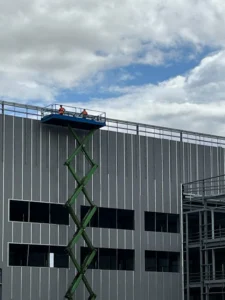
On a stretch of Madison Street where University Hill meets the city’s east side, a seven-story student housing complex is rising from a roughly two-acre site at 910 Madison Street. When it opens for the 2026 academic year, it will be the biggest purpose-built student housing project Syracuse has seen in years — 603 beds across 210 units, with floorplans running all the way up to five bedrooms.
But the most interesting thing about this building isn’t its size. It’s what’s already there.
Preserving What Matters
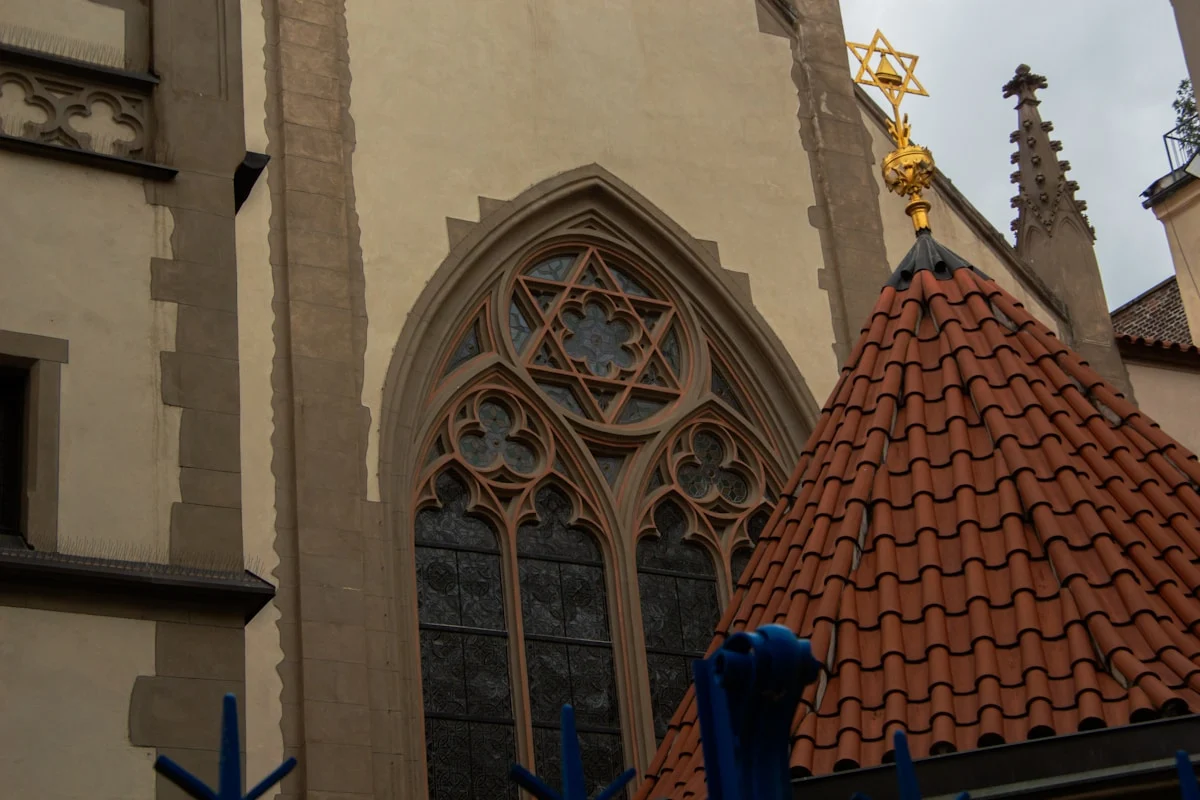
Temple Concord’s sanctuary — a roughly 4,750-square-foot space listed on the National Register of Historic Places — has stood on this site since the early 1900s. Rather than tear it down, the development team has chosen to weave the historic sanctuary directly into the fabric of the new complex, converting it into resident amenity space.
That’s a sentence worth sitting with. A 120-year-old synagogue sanctuary, still intact, functioning as a common area inside a brand-new apartment building. It’s the kind of adaptive reuse that preservation advocates dream about — not a plaque on the wall or a historical marker at the curb, but the actual building, still standing, still in daily use.
The developers behind the project are Landmark Properties, an Athens, Georgia-based firm that specializes in student housing nationwide, working alongside W5 Group. According to project documentation and materials from H+O Engineering, the structural approach uses a podium system — parking below, wood-framed residential floors above — that allows the historic sanctuary to be integrated at the ground level without compromising its architectural character.
What 603 Beds Actually Looks Like
If you’ve spent time on University Hill recently, you know that student housing demand has been a pressure point for years. Syracuse University’s enrollment has grown, off-campus options haven’t kept pace, and the rental market in neighborhoods like Westcott and the Southside has felt the squeeze.
This project is designed to absorb some of that demand at scale. The numbers: 210 units ranging from studios to five-bedroom layouts, totaling 603 beds in a single seven-story structure. It’s the first purpose-built student housing in Syracuse to offer five-bedroom floorplans — a configuration aimed squarely at friend groups who want to live together without splitting across multiple apartments.
The amenity list reads like what you’d expect from a national developer targeting the student market in 2026: in-unit washers and dryers, quartz countertops, a 24-hour fitness center, a sauna, and an outdoor hot tub. But the centerpiece remains that converted sanctuary — 4,750 square feet of historic space that no amount of quartz countertops can replicate.
The Construction Timeline
Construction began in 2024, and the project is targeting delivery in time for the 2026-2027 academic year. That’s an aggressive timeline for a project of this scope, but Landmark Properties has a deep portfolio of similar builds at university towns across the country. The podium structural system — concrete base, wood-frame upper floors — is a well-tested approach that tends to move faster than full steel-frame construction.
The two-acre site on University Hill gives the project enough footprint to accommodate the parking podium, the preserved sanctuary, and the residential tower above without the kind of tight-site gymnastics that slow down urban infill projects.
Why This One Matters
Syracuse has a complicated relationship with its historic buildings. We’ve watched significant structures come down over the decades — sometimes for parking lots, sometimes for projects that never materialized, sometimes just because nobody could figure out how to make the economics work. The old Mizpah Towers, the Wieting Opera House, the Yates Hotel — the list of what we’ve lost is long enough to fill its own article.
What makes the Temple Concord integration notable isn’t just the preservation itself. It’s the proof of concept. A national developer looked at a National Register-listed sanctuary, ran the numbers, and concluded that keeping it was not only feasible but desirable — that a 120-year-old synagogue sanctuary would be a genuine asset, not a liability, in a modern student housing project.
That calculus matters. It suggests that historic preservation and large-scale development aren’t necessarily in tension — that there’s a version of growth where the old and the new don’t just coexist but actively improve each other. A student walking through that sanctuary on their way to the fitness center is having a fundamentally different experience of place than one walking through a standard ground-floor lobby with a package room and a leasing office.
Looking Ahead
As the 2026 academic year approaches, the 910 Madison Street project will be one of the most closely watched developments on University Hill. Whether it delivers on time, how quickly it leases, and how the preserved sanctuary functions as a living space will all be data points for the next developer considering a similar approach in Syracuse or anywhere else.
For now, the sanctuary stands. The steel and wood rise around it. And a piece of Syracuse’s Jewish heritage is being carried forward not as a museum exhibit or a memory, but as a room where people will actually gather — which, when you think about it, is exactly what a sanctuary was always supposed to be.
Project details sourced from Landmark Properties, PR Newswire, and H+O Engineering documentation.