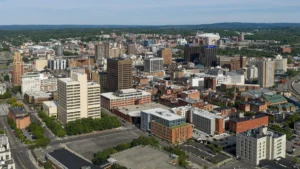
A proposed new article of the town code would bar the review, approval and permitting of data centers through December 31, 2027. The county planning board reviewed it in June and took no position.
The Town of DeWitt is proposing to stop data centers before any developer asks for one.
This story came from public records we pulled ourselves
Get the next one, plus overnight incidents, in your inbox at 6 AM. Free, no spam.
A text amendment sent to the Onondaga County Planning Board would add a new article to Chapter 192 of the town code, titled “Moratorium on Data Centers.” It would impose an 18 month freeze prohibiting the review and approval of applications and the issuance of permits for data centers anywhere in the town, running through December 31, 2027.
The county received the referral on May 22 as case Z-26-136 and took it up at its June 3 meeting. The recommendation recorded in the minutes is two words: No Position.
That is not indifference. Under General Municipal Law Section 239-m, a county planning board reviews local zoning changes for effects that cross municipal lines. A town-wide moratorium that stops development rather than permitting it does not create the kind of inter-community impact the statute is built to catch. No Position means the decision sits entirely with DeWitt.
The definition is the whole law
Moratorium laws live or die on what they define, and DeWitt’s definition is unusually specific.
The proposed law defines a data center as all buildings, equipment, structures, infrastructure within an existing structure, and other stationary items such as server racks, located on a single site or on contiguous, adjacent or otherwise connected sites, owned or operated by the same entity or by entities under common control, regardless of whether the site has one occupant or several, that is capable of using twenty megawatts of electricity or more and is designed or intended to be primarily engaged in data processing, data storage, data transport, web hosting, web streaming support, or other services described under Code 518210 of the 2022 North American Industry Classification System.
Three things in that sentence do real work.
The threshold is 20 megawatts, and it is written as capability rather than consumption. A facility does not have to draw that much power to be covered. It has to be capable of it. That closes the gap a developer could otherwise open by promising modest initial load.
The common control language stops a project from being split. Without it, a developer could file three adjacent 8 megawatt buildings under three entities and argue none of them is a data center. The law reaches contiguous, adjacent or otherwise connected sites under common ownership or control, and counts them together.
And the NAICS reference gives it a spine that does not depend on marketing. Code 518210 covers data processing and hosting. A building is what the federal classification system says it is, not what its owner calls it.
What the town says it is worried about
The proposed law states its reasoning, and the county minutes quote it directly.
DeWitt writes that the rapid expansion of data centers and related infrastructure across the United States presents significant and documented concerns regarding energy consumption, environmental quality, land use and the economic welfare of local communities.
It raises a second concern that is more local: the potential loss of agricultural lands, woodlands and other non-industrial lands to data center development.
The stated purpose of the pause is to let the town board conduct what the law calls a thorough study of these issues and determine what regulations, rules, laws or controls, if any, are necessary for the safe, orderly and sustainable development of the town and the protection of its residents and natural resources.
That phrase, if any, is worth noticing. The law as drafted does not commit the town to regulating data centers at the end of the moratorium. It commits the town to deciding.
DeWitt is watching Albany
The town gives a second reason for the timing, and it points at the state.
The proposed law says the moratorium will allow DeWitt to monitor developments related to New York State’s progress in adopting rules and regulations for data centers. It specifically cites Senate Bill S9144, introduced to the State Senate in February 2026, which proposes a three year and ninety day moratorium on data center development statewide.
A town writing an 18 month pause while a three year statewide pause sits in committee is doing something deliberate. If Albany acts, DeWitt’s local law becomes redundant and can lapse. If Albany does not, DeWitt has bought itself a study period it would otherwise have had to justify from scratch.
Local moratoria are frequently criticized as stalling tactics. They are also one of the few tools a town has when a land use question arrives faster than the rules for it. The honest description of this one is that DeWitt is buying time, and the law says so.
What this does not tell us
CNY Signal has not spoken with the Town of DeWitt, and nothing here should be read as its comment.
Two things are not established by the county record. The first is whether any data center has actually been proposed in DeWitt. A moratorium can be a response to a specific application, a response to a rumor, or a precaution taken before either. The referral does not say, and no application appears in the county’s 2026 referral record.
The second is where the local law stands now. A moratorium is adopted by the town board after its own public hearing, and CNY Signal could not locate a scheduled hearing date on the town’s published materials. The county referral is one step in the process, not the end of it.
DeWitt town board meetings and their agendas are posted through the town’s public portal. Anyone tracking this should watch for a local law hearing notice.
Why 20 megawatts is a real line
For scale, 20 megawatts is not a server closet.
It is a threshold that separates ordinary commercial computing from the industrial facilities now driving national fights over electricity supply. A single large modern data center campus can be planned at several hundred megawatts. Setting the trigger at 20 means DeWitt’s law would not touch a bank’s back office or a hospital’s records system, and would catch anything built at the scale that has made data centers a land use controversy.
That choice also puts DeWitt slightly ahead of where the argument usually starts. Most towns write data center rules after an application lands, under time pressure, with a developer already at the table. This one is being written on a blank page.
The county’s file records the referral, the definition and the date. What it cannot record is whether an 18 month pause turns into a set of rules or simply expires on December 31, 2027.
Sources
- Onondaga County Planning Board, draft minutes and actions on General Municipal Law Section 239 referrals, June 3, 2026, case Z-26-136, including the full text of the proposed definition and the town’s stated findings: https://onondaga.gov/planning/wp-content/uploads/sites/260/2026/06/Draft-Minutes-06-03-26.pdf
- Town of DeWitt public meeting portal, checked for a scheduled local law hearing: https://dewittny.portal.civicclerk.com/
Every figure in this story is drawn from the records above. Links go to the primary documents.