{“@context”:”https://schema.org”,”@type”:”WebPage”,”name”:”Inside the Onondaga County Library System: 32 Branches, 3 Million Visits, and a $15.5M Civic Backbone”,”url”:”https://cnysignal.com/inside-the-onondaga-county-library-system-32-branches-3-million-visits-and-a-15-5m-civic-backbone/”,”speakable”:{“@type”:”SpeakableSpecification”,”cssSelector”:[“h1″,”.article-headline”,”.article-summary”,”article p:first-of-type”,”.fact-list-summary”]}}
By Charles Shack, Senior Reporter
Ride the elevator at 447 South Salina Street, inside the Galleries of Syracuse three blocks south of Hanover Square, up to the third floor and you walk into one of the largest civic memory banks in Central New York. This is the Local History & Genealogy Department of Onondaga County’s Central Library: rows of city directories, microfilm cabinets, vertical files of obituaries, and a research desk where someone is almost always tracing a relative. Two floors below at street level, a teenager is checking out a Chromebook while a toddler hears a story across the room and somebody’s laptop prints a resume at the public-printer queue. The same Central Library building runs both jobs at once.
Know before your neighbors do
The Morning Signal hits your inbox at 6 AM with everything that happened overnight. Real incidents, real data, zero fluff.
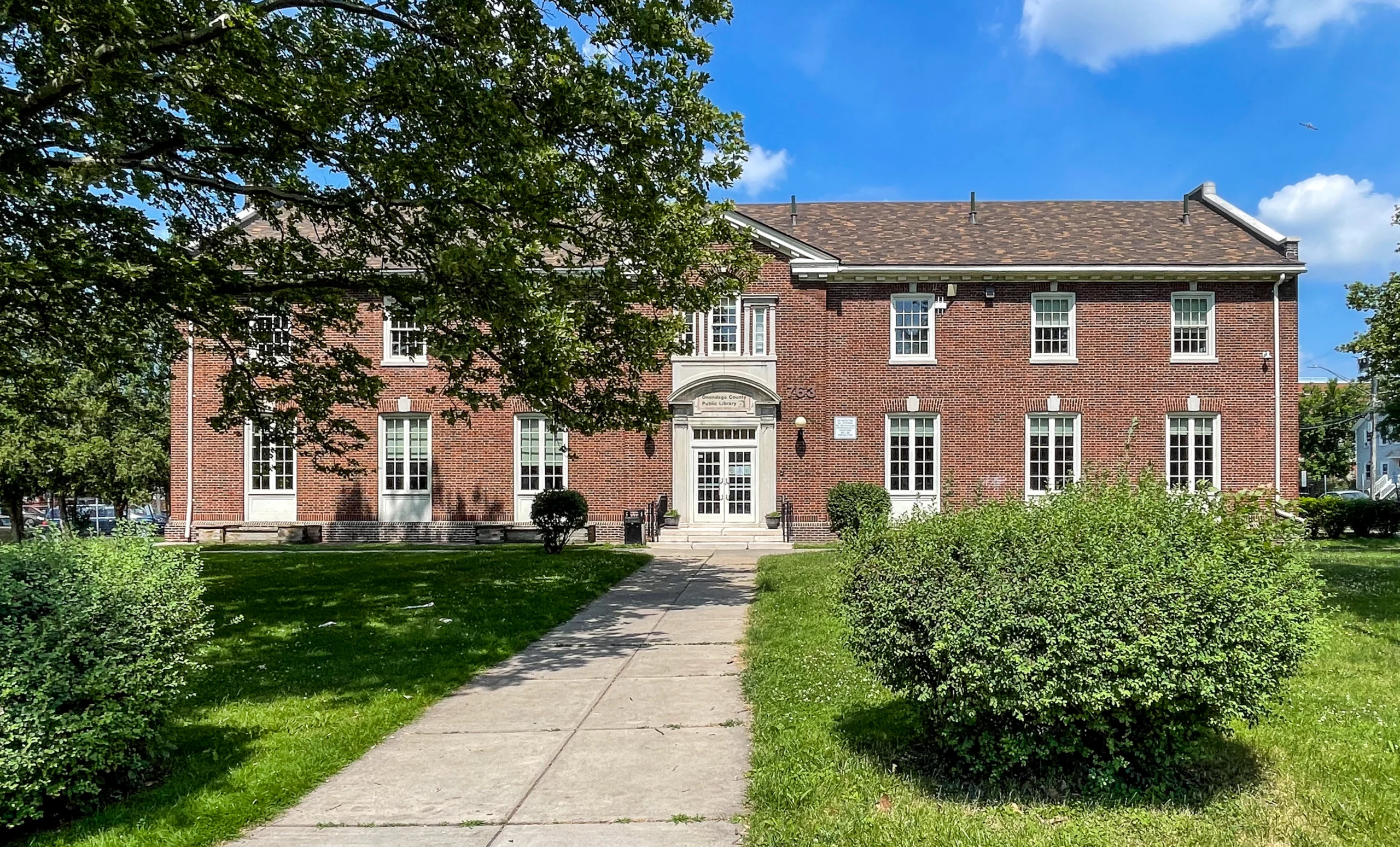
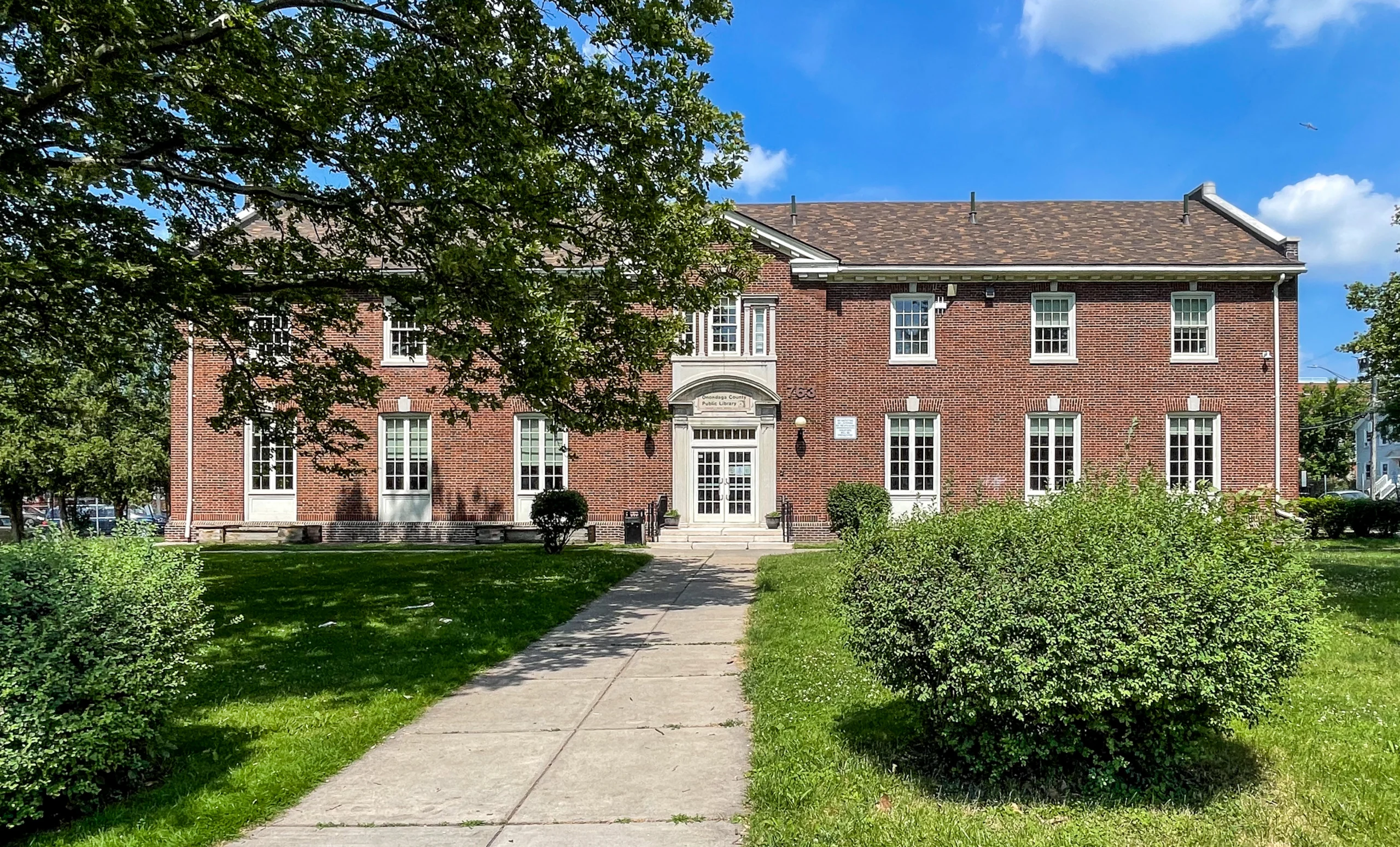
That building is the front door to the Onondaga County Public Library system: a federation of 32 libraries spread across Syracuse and the suburbs, governed under one charter, fed by three pots of public money, and used by more than a quarter of a million cardholders. By OCPL’s own count, the community locations get visited more than three million times a year. The county budgeted $15.5 million for it in 2024, a line that has grown roughly 2 percent since 2013 while the county’s overall budget has gained about 20 percent.
This is what a county library system actually looks like in 2026: stable, busy, structurally underfunded by the standards of its own peer set, and quietly remaking itself around digital media that did not exist when the system was chartered.
OCPL at a glance, 2024
How the system was built
The bones of OCPL go back further than the system itself. The Syracuse Public Library was founded in 1852 by the city Board of Education and lived first inside the old City Hall before moving to a high school on West Genesee Street in 1869. In 1901, Andrew Carnegie funded a new building on Montgomery Street; that Carnegie library opened on March 23, 1905, and stayed in use for 83 years.
The county piece arrived in 1962, when the Onondaga Library System was organized as a cooperative non-profit linking Syracuse Public Library with the small village libraries scattered across the county. On January 1, 1976, the city library and the county system formally merged into the Onondaga County Public Library, a single chartered entity. OCPL is one of 23 public library systems chartered by the New York State Board of Regents.
The Central Library moved one more time. In 1988 it left its Carnegie building and crossed downtown into the Galleries of Syracuse, the 440,000-square-foot mixed-use development on South Salina Street where it sits now. Today the library occupies one of the towers and shares the block with offices and retail tenants, an unusual arrangement for a Carnegie-era institution and a deliberate bet on downtown integration. About 1,200 people work in the Galleries property.
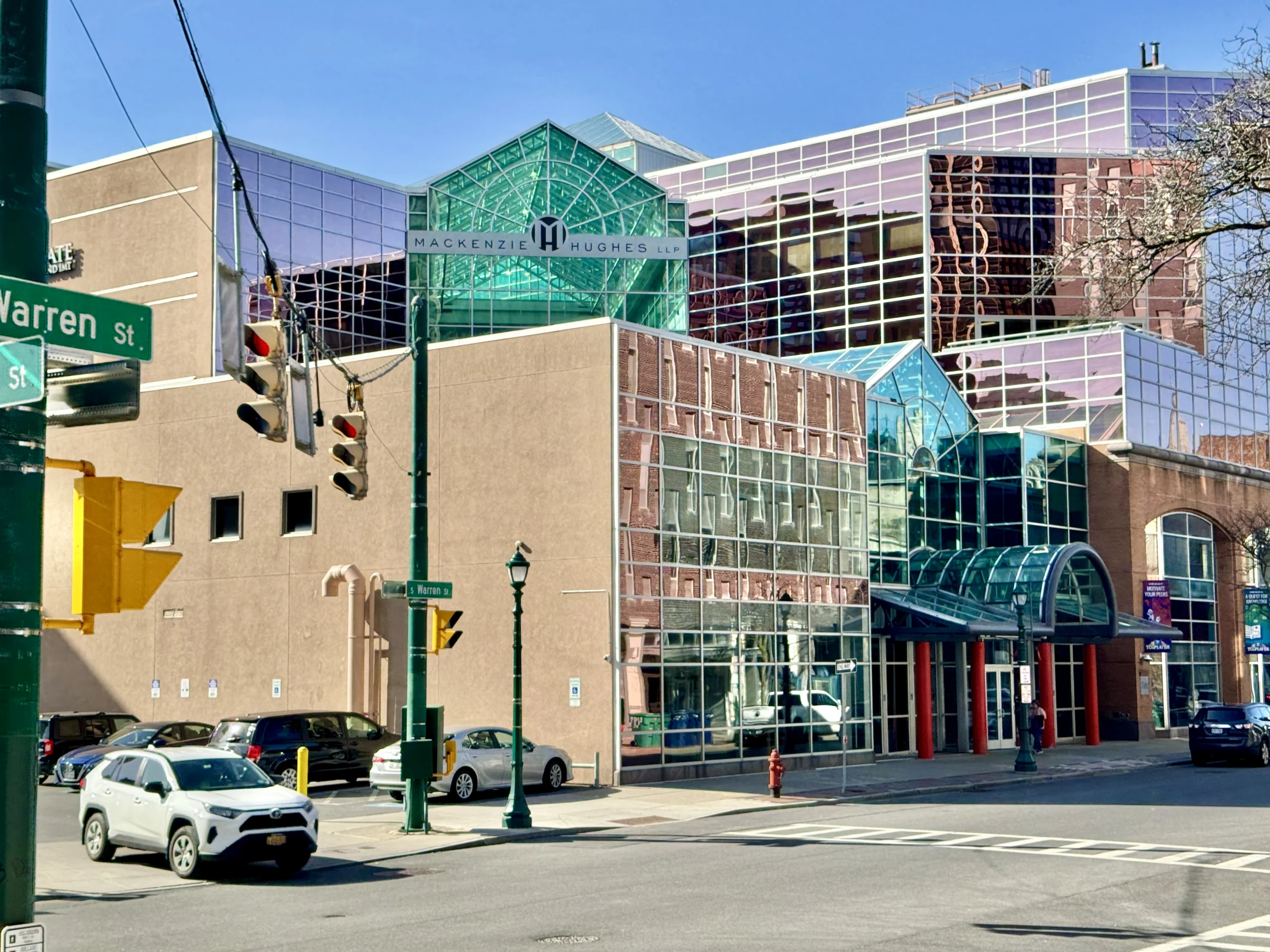
What the system actually runs, in 2026, breaks into three layers. The Central Library on Salina Street is the hub. Ten city branches sit in Syracuse: Beauchamp on South Salina, Mundy on the Near Westside at South Geddes, Petit on Victoria Place off Westcott Street, Soule in Salt Springs at Springfield Road, plus Betts, Hazard, Paine and White, with two satellite locations at Syracuse Community Connections and the Syracuse Northeast Community Center. Then there are 21 independent suburban member libraries that keep their own boards and tax bases: Liverpool, Fayetteville Free, Manlius, Baldwinsville, Skaneateles, DeWitt & Jamesville, Solvay, North Syracuse, Cicero, Brewerton, Marcellus, East Syracuse, Elbridge, Fairmount, Jordan-Bramley, LaFayette, Maxwell, Minoa, Onondaga Free, Salina, and Tully Free. One charter, 32 doors.

Print declines, digital climbs
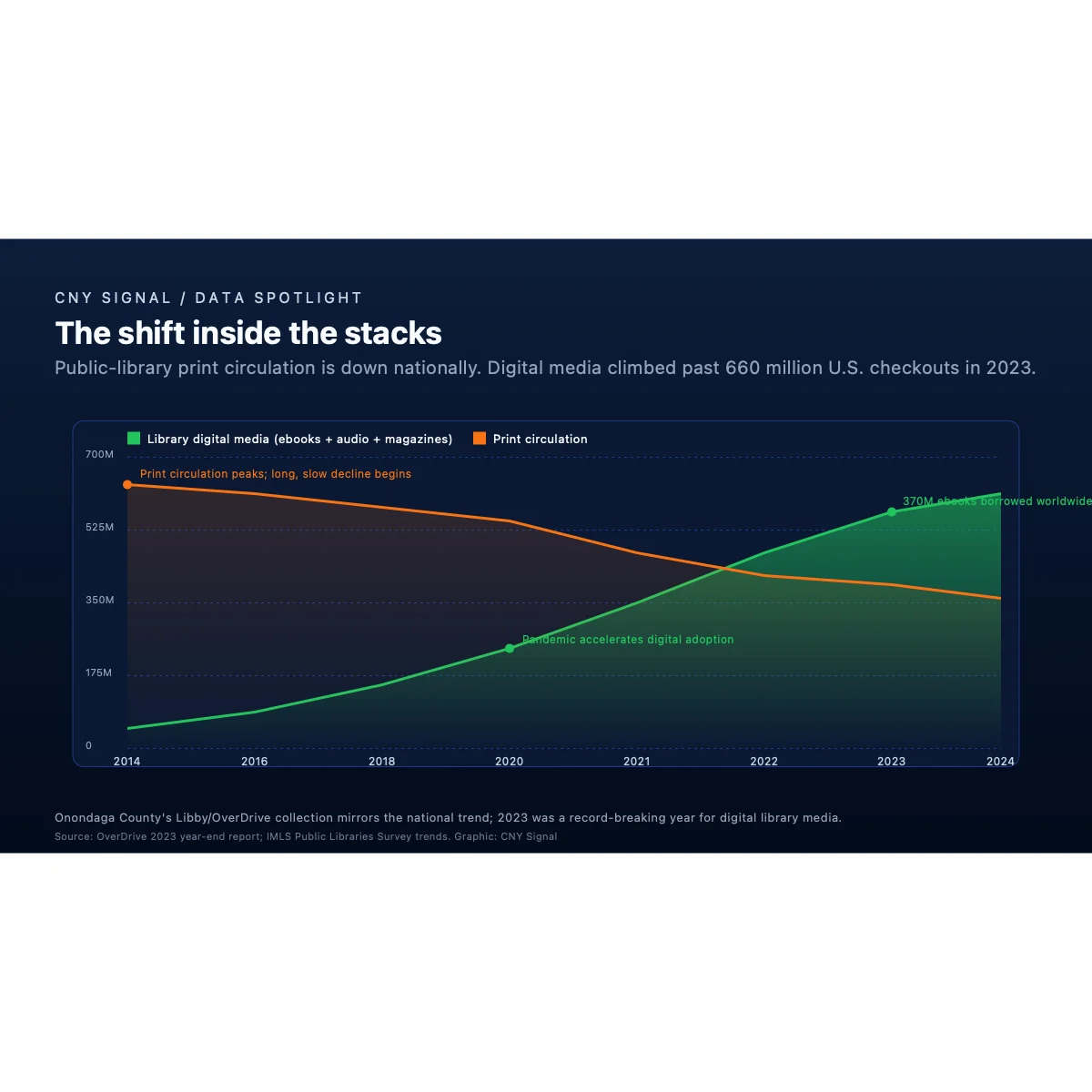
The biggest change inside that footprint is what people are checking out. Nationally, the Institute of Museum and Library Services has tracked a steady drift away from print and toward electronic materials at public libraries since the mid-2010s. OverDrive, the vendor behind the Libby app that powers OCPL’s e-book collection, reported a record-breaking 662 million digital checkouts worldwide in 2023, including 370 million e-books (up 12 percent year over year) and 235 million digital audiobooks (up 23 percent). E-magazines jumped 75 percent.
OCPL is squarely inside that wave. Any cardholder can log into Libby and borrow e-books, audiobooks, and digital magazines, with a default 14-day loan that stretches to 21 on request. The system also offers hoopla for streaming movies, music, and audiobooks, plus Kanopy for film, on top of public computers and Wi-Fi at every branch. Put another way, the 2023 digital growth did not happen to OCPL; it happened through the system’s licensed digital collection.
What it does to a single branch shows up clearly at Liverpool Public Library, which joined the county system in 1963. By 2020, even with COVID closures, Liverpool patrons checked out more than 250,000 physical and digital items in a year, nearly 5,000 used a curbside pickup service that didn’t exist a year earlier, and 9,000 attended 512 programs. The library’s website logged 152,000 visits.
The 2024 numbers
OCPL’s own published figures put the system’s usage at more than 3 million annual visits and more than 250,000 cardholders, a registration rate of about 54 percent of the county’s population. That is high. Nationally, the share of Americans who hold an active library card runs closer to a third.
The programming side of the house is busy in ways that don’t show up in circulation data. OCPL’s ESOL (English for Speakers of Other Languages) effort runs adult literacy programs at multiple branches in partnership with LiteracyCNY. Storytimes for ages 2 to 8 run weekly. The Central Library on Salina Street keeps a STAR Lab of adaptive technologies, a MakerSpace, a laptop lab, a notary public service, and a children’s area called KidSpace. Park passes can be checked out alongside books.
The most consequential single program of the last few years is harder to see. Onondaga County has a digital-divide gap that affects roughly one in six households countywide and about three in ten inside the city of Syracuse, and OCPL responded by launching Tech Packs, a checkout kit containing a Chromebook, an AT&T mobile hotspot with unlimited U.S. data, chargers, and a carrying case. Tech Packs are now stocked at all 32 OCPL locations, can be borrowed for three weeks at a time, and were funded by a $100,000 county investment. Put plainly, the library system became one of the largest distributors of home internet access in Onondaga County.
Tech Packs: a public library as ISP
OCPL’s response to Onondaga County’s digital divide
The bookmobile and the spaces in between
OCPL also runs an outreach layer that does not fit inside any building. Borrow By Mail serves any Onondaga County resident who cannot get to a branch because of disability or chronic illness; up to six items at a time arrive in a maroon canvas bag with a prepaid return label. NOPL, the Northern Onondaga Public Library co-op, runs a homebound delivery route on the third Friday of every month, and Manlius Library has its own Library by Mail service. Together, those programs function as a slow, distributed bookmobile: a fleet of mail trucks doing what one painted bus used to do.

The system’s spatial reach matters because Onondaga County is not just Syracuse. Skaneateles is 25 miles southwest. Tully Free Library is 22 miles south, on the edge of Cortland County. The Northern Onondaga Public Library co-op covers Cicero, Brewerton, and North Syracuse from three different rooms. A federated 32-library system can do that. A single municipal library can’t.
Budget pressure
Onondaga County funded OCPL at $15.5 million in its 2024 budget, up roughly $1 million from 2023 and about $3 million above 2021 levels. The City of Syracuse contributes another $6.2 million for the operation of its city branches, bringing the combined city-and-Central allocation to about $12.4 million. The 21 suburban member libraries fund themselves through local property tax levies. Fayetteville Free Library and Manlius Library together collect about $3.4 million from local taxes out of a combined $3.6 million budget, almost entirely locally raised.
The result is a per-resident gap. By Central Current’s reporting, the city-of-Syracuse and county money behind the city libraries works out to about $85.97 per resident. The same calculation in the Fayetteville-Manlius footprint comes to $133.44 per resident, roughly 55 percent more.
The per-resident gap
Combined public funding per resident in OCPL service areas
That gap is what county legislators have been arguing about. “It’s very important to make sure that the library is accessible,” Onondaga County Legislator Charles Garland told Central Current in 2024. Legislator Mary Kuhn pointed at meeting-room and program disparities: “They have huge spaces for meeting rooms…not available in White Branch or Beauchamp.” Legislator John Kinne was sharper: “I don’t think it’s fair to treat the libraries in the city as second-class tier.” Kinne also told Central Current, “I don’t think the county’s fulfilling their obligations.” Community advocate Jackie LaSonde, who has long worked on Syracuse’s Southside, framed the disparity in plainer terms: “Because surely in the suburbs, when I tell you, they have a great arts program, they have a great jazz program. You can see the investment walking in the door, you could just see it.”
What does a $47.47 per-resident gap actually buy? On a Fayetteville-Manlius footprint of roughly 28,000 residents, that delta translates to about $1.3 million a year of extra capacity inside the suburban branches alone, the equivalent of a full-time children’s librarian, a teen-services coordinator, a local-history archivist, and the materials budgets for two midsize collections, with money left over for programming. Across the city libraries’ roughly 145,000 service-area residents, the same $47.47 gap projects out to about $6.9 million in capacity that the central system does not have, and would have to find from somewhere else to match.
Garland was blunt about how that imbalance gets fixed inside the legislature. “The squeaky wheel gets the grease, unfortunately that’s how it is,” he told Central Current. The squeaky wheels in the Fayetteville-Manlius district have a budget vote and an active Friends-of-the-Library group; the Beauchamp branch on South Salina Street, by contrast, depends on the central OCPL administration to advocate for it inside the county budget process. The library system’s 2024 increase to $15.5 million, about a $1 million bump over 2023, recovered ground lost in the pandemic but did not change the per-resident ratio. Until that ratio narrows, branch hours, materials budgets, and programming inside the city stay tied to a smaller pool of money than the suburbs run on.
The structural problem is not that the county cut the library; it is that the county did not grow it. OCPL’s county appropriation has risen about 2 percent since 2013, while Onondaga County’s overall budget has gained roughly 20 percent in the same window. New York State aid, administered by the State Library through formula-based public-library system grants, covers part of the gap. Only a part. Construction grants from the state, including the 2017 round that funded eight Onondaga County library projects, are episodic.

How OCPL stacks up against the rest of Upstate
Compared to the other two big Upstate county systems, OCPL is mid-pack on infrastructure and ahead on traffic. Buffalo & Erie County Public Library, the system that includes Buffalo’s downtown library and 28 contract member outlets, reports about 2.35 million annual visitors across 37 facilities and circulated more than 7.4 million pages of physical and digital books in 2024, plus 9.3 million minutes of audiobook listening. The Buffalo system also publishes a return-on-investment figure: every $1 invested produced $4.24 in community benefits in 2025.
Monroe County Library System, the federation behind Rochester Public Library, runs 31 libraries countywide, with a Central Library funded by the county and 10 Rochester branches funded by the city. Its structure mirrors OCPL closely (one central, multiple city branches, a ring of independents) but sits inside a larger urban tax base.
The thing OCPL has that those peers don’t is its 54 percent cardholder penetration. That single number tells you Onondaga County residents use their libraries at a rate that’s nationally unusual.
New leadership, old building, same job
On February 24, 2025, the OCPL Board of Trustees named Amanda E. Perrine the system’s new executive director. Perrine started her library career at Marcellus Free Library in 2015, managed two Syracuse branches, and most recently served as coordinator of member services at the Central Library before being promoted internally. She inherits a 32-library system, a flat county appropriation, a digital collection that is growing faster than its budget, and 250,000 cardholders who walk through the door.
The Central Library’s third floor, home to the Local History & Genealogy Department with its city directories, microfilm, and 24-million-record local archive, is the part of OCPL that looks most like 1905. Down on the first floor, with its Tech Packs and Chromebook checkouts, the same library looks most like next year. Both halves run off the same library card and get paid out of the same $15.5 million county appropriation.
That, more than any single statistic, is the story of a county library system in 2026: a 19th-century civic invention still doing the job, on a budget that has not kept pace with the county around it, in a building that shares a hallway with retail tenants. Add it up and the system runs three million visits a year, hands out about one canvas bag of books in the mail at a time, and lends out a Chromebook on a hotspot to whoever walks in next.
Sources and reporting notes: OCPL System Information page (onlib.org); OCPL Mission & History page; OCPL Reports archive; OCPL Locations page; Wikipedia, “Onondaga County Public Libraries”; Central Current, “Should Onondaga County spend more on its public library system?”; Newhouse School / NCC News, “County Library Budgets Create an Imbalance”; WAER, Feb. 24, 2025, on Amanda Perrine’s appointment; CNY Central, Feb. 2025; Liverpool Public Library, “Library History”; OverDrive 2023 record-breaking digital media report (Jan. 2024); IMLS Public Libraries Survey FY2023; Buffalo Rising / Buffalo & Erie County Public Library 2024 circulation highlights; Monroe County Library System (libraryweb.org); Onondaga County Adopted 2024 Budget. Hero photograph by Kenneth C. Zirkel, Wikimedia Commons (CC BY-SA 4.0).
{“@context”: “https://schema.org”, “@graph”: [{“@type”: “NewsArticle”, “headline”: “Inside the Onondaga County Library System: 32 Branches, 3 Million Visits, and a $15.5M Civic Backbone”, “description”: “Onondaga County’s federated library system runs 32 libraries across Syracuse and the suburbs, fields more than 3 million annual visits, and is quietly remaking itself around digital media on a county appropriation that has grown only 2% since 2013.”, “image”: “https://cnysignal.com/wp-content/uploads/2026/05/ocpl-central-library-hero-1-scaled.webp”, “author”: {“@type”: “Person”, “name”: “Charles Shack”, “jobTitle”: “Senior Reporter”}, “publisher”: {“@type”: “Organization”, “name”: “CNY Signal”, “logo”: {“@type”: “ImageObject”, “url”: “https://cnysignal.com/wp-content/uploads/2025/03/cny-signal-logo.png”}}, “datePublished”: “2026-05-02”, “articleSection”: “Civic Infrastructure”}, {“@type”: “GovernmentOrganization”, “name”: “Onondaga County Public Libraries”, “alternateName”: “OCPL”, “url”: “https://www.onlib.org/”, “foundingDate”: “1976-01-01”, “address”: {“@type”: “PostalAddress”, “streetAddress”: “447 South Salina Street”, “addressLocality”: “Syracuse”, “addressRegion”: “NY”, “postalCode”: “13202”}, “telephone”: “+1-315-435-1900”, “department”: [{“@type”: “Library”, “name”: “Central Library”}]}, {“@type”: “Place”, “name”: “Central Library at the Galleries of Syracuse”, “address”: {“@type”: “PostalAddress”, “streetAddress”: “447 South Salina Street”, “addressLocality”: “Syracuse”, “addressRegion”: “NY”, “postalCode”: “13202”, “addressCountry”: “US”}, “geo”: {“@type”: “GeoCoordinates”, “latitude”: 43.0481, “longitude”: -76.1503}}, {“@type”: “FAQPage”, “mainEntity”: [{“@type”: “Question”, “name”: “How many libraries are in the Onondaga County Public Library system?”, “acceptedAnswer”: {“@type”: “Answer”, “text”: “OCPL is a federation of 32 libraries: the Central Library, 11 city libraries in Syracuse, and 21 suburban member libraries.”}}, {“@type”: “Question”, “name”: “When was OCPL founded?”, “acceptedAnswer”: {“@type”: “Answer”, “text”: “The Onondaga County Public Library was chartered on January 1, 1976, when the Syracuse Public Library and the Onondaga Library System merged.”}}, {“@type”: “Question”, “name”: “Who runs OCPL?”, “acceptedAnswer”: {“@type”: “Answer”, “text”: “Amanda E. Perrine has served as Executive Director since February 24, 2025.”}}, {“@type”: “Question”, “name”: “How is OCPL funded?”, “acceptedAnswer”: {“@type”: “Answer”, “text”: “The 2024 Onondaga County budget allocated $15.5 million to OCPL, with the City of Syracuse contributing an additional $6.2 million for city branches. Suburban member libraries fund themselves through local property tax levies, supplemented by New York State aid.”}}]}]}
Further reporting
The OCPL Board of Trustees announced Amanda E. Perrine as the system’s new executive director on February 24, 2025, effective immediately. Perrine joined OCPL in 2015 at Marcellus Free Library, then moved to branch manager at Betts and Soule before a stint at Central Library as Coordinator for Member Services. She holds an undergraduate degree from SUNY Oneonta and a master’s in library and information science from Syracuse University.
“We have a long history of service here in Onondaga County, and I want to find more ways that we can help the community,” Perrine told CNY Central in a March 1, 2025 interview. “I just want to hear what our amazing staff think and then work to make that a reality. We’re just really excited to get people in the library. Whatever you are looking for, I think we can help you.”
Friends of the Central Library (FOCL), the volunteer fundraising arm founded in 1997, has donated more than $700,000 to the system since its inception. Its 2024 IRS Form 990 (filed October 15, 2025) reported $77,524 in revenue against $110,061 in expenses, with $1,068,253 in total assets. Executive Director Sara Tucker drew zero compensation. The Author Series FOCL has run for 32 seasons is, by the group’s own description, the longest library-related lecture series in the country.
FOCL’s officer slate as of 2025: Angela Bernat (President), Martha Mulroy (Vice President), Heather Smith (Treasurer), Elana Van Patten (Secretary), and Sara Tucker (Executive Director). The group’s published mission language captures the institutional reach: “Libraries afford residents opportunities to job search, research historical and genealogy records, educate, and entertain.”
Perrine has invited residents to contact her directly at [email protected] and asked that they tell her what they want from the system before she sets formal priorities, signaling a listening-tour approach.