Lysander Voted Down a Farmland Rezone 4 to 0 After the County Warned It Clashed With the Town’s Own Plan
CNY Crops Plainville, LLC asked to move 22.98 acres at Oswego and Lamson roads out of agricultural zoning. The Onondaga County Planning Board said the proposal appeared to conflict with Lysander’s comprehensive plan. On July 16 the town board rejected it unanimously.
Zone change applications in Central New York rarely fail outright. They get adjourned, conditioned, scaled back or quietly withdrawn.
This story came from public records we pulled ourselves
Get the next one, plus overnight incidents, in your inbox at 6 AM. Free, no spam.
On July 16, the Town of Lysander did the unusual thing. It voted one down, and not narrowly.
The application came from CNY Crops Plainville, LLC for property at Oswego Road and Lamson Road, identified in town records as Tax Map Number 017.-03-30.1. The company sought to move the land out of Agricultural zoning and into a commercial classification.
Councilor Ed Schmitt moved to approve the zone change petition. Councilor Jeff Kudarauskas seconded it. Then the roll was called.
Supervisor Kevin Rode, no. Councilor Kudarauskas, no. Councilor Vince Mangan, no. Councilor Schmitt, no.
The minutes record the outcome in four words: all voted no, motion did not pass.
The two board members who put the motion on the floor voted against their own motion. That is not a contradiction. Moving and seconding an item is how a board gets a matter to a vote at all, and on a zone change petition a board is generally obliged to act rather than let it sit.
### What the county told them first
Three weeks before that vote, the Onondaga County Planning Board had already weighed in, and its language was pointed.
Under General Municipal Law Section 239-m, certain local zoning decisions must be referred to the county planning board for review. The trigger here was proximity: the site sits within 500 feet of Oswego Road, which is Route 48 and a state highway, and Lamson Road, which is Route 29 and a county highway.
The county board took the referral up on June 24, 2026, as OCPB Case #Z-26-153. Its resolution describes the request as a zone change on a 22.98 acre parcel from Agricultural to General Business.
Formally, the county found that the referral would have no significant adverse inter-community or county-wide implications. That is the finding that matters legally, and it left the decision squarely with Lysander.
Then it offered comments, and the comments are the story.
The county wrote that the site contains regionally important agricultural lands, that it is segmented from the urbanized area by a large wildlife management area, and that it is a significant distance from public drinking water and sewer infrastructure and other services.
It observed that the submitted environmental review does not assess the impacts of buildout of the parcel for commercial purposes, which is what a zone change application would normally be expected to address. A rezone is judged on what the new district permits, not on what an applicant currently intends.
It warned that unrestrained development in this area may cumulatively lead to significant new service demands and government spending, and encouraged the town to establish a plan articulating development goals, expectations and constraints along the corridor before or alongside any rezone to potentially intensive commercial use.
And then the line that carries the most weight: the proposal appears to be in conflict with the town’s goals for this corridor as expressed in the Comprehensive Land Use Plan.
The county closed by suggesting Lysander may wish to consider creating a more rural development zoning district, one that would allow lower impact uses compatible with agriculture and open space protection.
### Why a 239-m referral matters
The county review that shaped this decision is not optional, and it is worth understanding because it applies across Onondaga County.
Under General Municipal Law Section 239-m, a municipality must refer certain zoning actions to the county planning agency when the affected land sits within 500 feet of a state or county road, a municipal boundary, a public park, or state or county owned land. The idea is that decisions with effects crossing municipal lines should get a look from someone whose jurisdiction crosses those lines.
The county’s response carries real procedural weight. If the county board recommends against an action or attaches modifications, the referring municipality can still approve it, but only by a supermajority vote of the full body, and it must state its reasons on the record.
Here the county stopped short of a formal recommendation against the rezone. It issued a finding of no significant inter-community impact and then attached comments that read as a clear warning. That combination left Lysander free to approve the change by simple majority if it wanted to.
It did not want to.
### A hearing that actually was one
The public hearing on the application opened at 6:32 p.m. on July 16 and closed at 6:44 p.m.
Twelve minutes is not a long hearing by the standards of a contested project in a larger town. It is a great deal longer than most of what a town board does, and it is worth putting next to another Lysander hearing from two weeks later.
On July 31, at a special meeting called for 4:00 p.m. on a Friday afternoon, the board opened a public hearing on forming the Cold Springs Sewer District No. 1 at 4:01 p.m. and closed it at 4:02 p.m. The minutes record the reason plainly: hearing no comments.
That district carries a $3,170,000 project fund and serves hundreds of homes. It drew nobody. A farmland rezone drew twelve minutes.
The contrast is not a criticism of anyone. It is a fair description of how public attention actually distributes itself in local government, and it is useful for residents to see. Sewer districts show up on tax bills for decades. Rezones change what the view out the window looks like. People turn out for the second one.
### The item they deliberately did not vote on
Immediately after rejecting the zone change, the board took a second action that is easy to skip past.
Councilor Schmitt moved, and Councilor Kudarauskas seconded, to strike agenda item B from the agenda. The minutes then state directly that the town board did not vote on the environmental significance of the proposed zone change from CNY Crops Plainville, LLC. That motion carried unanimously.
Agenda item B would have been the SEQR determination, the finding on whether the proposed action would have a significant environmental impact.
Striking it is the procedurally clean move. Environmental review under SEQR exists to inform a decision to approve an action. Once the board declined to approve the rezone, there was no action left to review. Making an environmental finding on a rejected application would have created a record about a project that is not going forward.
It is also the kind of detail that matters if the applicant returns. The board has not made any environmental determination about this parcel, in either direction.
### One wording difference worth noting
The two documents describe the requested district slightly differently, and CNY Signal is reporting both rather than picking one.
The Onondaga County Planning Board resolution describes the request as a change from Agricultural (A) to General Business (GB). The Town of Lysander resolution describes it as a change from Agricultural to a General Commercial District (GC-D).
Both refer to the same application on the same parcel. Differences of this kind usually reflect a county board summarizing a request in general terms while the town uses the exact district name from its own zoning code. Anyone tracking the parcel should search on the tax map number, 017.-03-30.1, which does not change.
### What happened to the other rezone that night
A second zone change petition was on the same agenda and was handled very differently.
Leo R. Duger petitioned on property at 8075 Plainville Road, Tax Map Number 034.-01-01.2, currently zoned Neighborhood Residential. Rather than voting the petition up or down, the board moved to designate itself lead agency for the review.
That is the normal opening move on a rezone: claim the environmental review, then work through it. Setting the two applications side by side on one night shows a board that was not reflexively hostile to rezoning. It moved one forward through process and stopped the other.
### Who was in the room
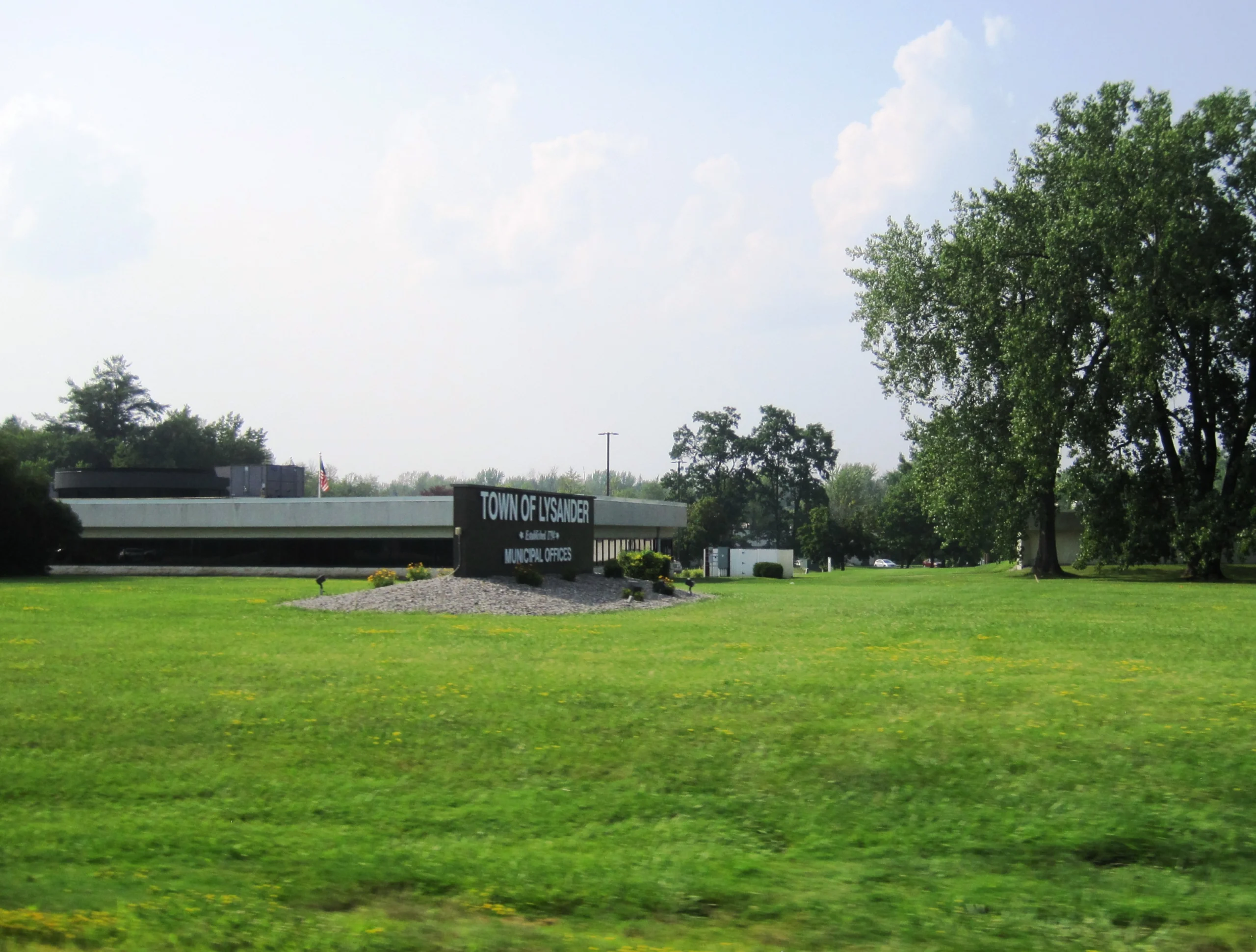
The July 16 meeting was held at Lysander Town Hall, 8220 Loop Road in Baldwinsville. Supervisor Kevin Rode and Councilors Vince Mangan, Ed Schmitt and Jeff Kudarauskas were present. Dina Falcone is town clerk.
At the July 31 special meeting, Councilor Kudarauskas was absent and David Herkala, Esq. attended along with several guests and residents.
Agendas, minutes and referral documents are posted on the town website, including the full Onondaga County Planning Board resolution quoted above. Anyone who wants the county’s reasoning in its own words can read it there rather than take ours for it.
For a town on the edge of the growth pressure now reshaping northern Onondaga County, a 4 to 0 vote against commercial rezoning of farmland is a statement about direction. Whether it holds is a question for the next application.