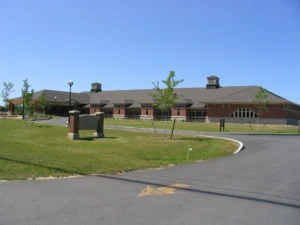
Both town districts are debt free and bills stay the same. The board wants one budget, one map, and a wider base under the next broken pump.
Town Clerk Rosemary Tozzi signed a legal notice on July 15 that starts the clock on the biggest housekeeping change Marcellus sewer customers have seen in decades. The Town Board will hold a public hearing at 6:30 p.m. on August 5 at Town Hall, 22 East Main Street, on a plan to merge the town’s two sewer districts, 283 tax parcels in all, into a single new entity called the Town of Marcellus Consolidated Sewer District. Households in both districts currently pay the same charge, $750.60 a year, and the town says that will not change.
This story came from public records we pulled ourselves
Get the next one, plus overnight incidents, in your inbox at 6 AM. Free, no spam.
The merger has been moving quietly through Town Hall since early June, and it has not taken much oxygen. The June 3 board meeting that set it in motion opened at 6:30 p.m. and adjourned at 7:14, a 44 minute session that also signed off on a Camillus comprehensive plan form and picked the CNY SPCA as the town’s designated animal shelter for dog license donations. In between, the sewer item moved without a single vote against it. At that meeting, Councilor Jeff Berwald told colleagues he had discussed the idea with Highway Superintendent Mike Ossit and that both felt it would be “a smart move,” according to the meeting minutes. Councilor Karen Pollard made the motion to have the town’s counsel pursue the consolidation, Councilor Terry Hoey seconded it, and the vote carried 4 to 0 with Supervisor Jane Attley, Berwald, Hoey and Pollard in favor. Councilor Percy Clarke was absent that night.
Two weeks later, at the June 17 workshop meeting, town counsel reported that the documents to move the process forward were being prepared. The formal notice went up on the town website on July 15, setting the August 5 hearing date and opening a written comment window that closes at noon on July 29.
Two districts, one bill, zero debt
The two districts on the table are the Marcellus Knolls Sewer District, carried on county records as SX071, and the Marcellus Sewer District Extension No. 2, listed as SX072. Together they cover the sewered neighborhoods outside the village line, in the areas of Antoinette Drive, Aqua Drive, Candlewick Lane, Cranapple Drive, Goldrush Drive, Roman Avenue, Scotch Hill Road, Dublin Road, Dublin Court, East Maple Street, East Maple Terrace, Limerick Street and West Seneca Turnpike.
A CNY Signal count of the parcel schedule attached to the hearing notice shows 115 parcels listed in Sewer District One and 168 in Sewer District Two, 283 in total. Each parcel is identified by tax map number and owner name in the notice’s Schedule A, which runs five pages.
Both districts are debt free, a point the town makes in the legal notice and one Berwald stressed at the June 3 meeting. Because neither district carries bonds, no debt gets shifted from one group of homeowners to another. The practical effect of the merger, as Berwald described it in June, is that the cost of any future repairs and regular maintenance gets spread over the larger combined group of members instead of falling on whichever small district owns the broken pipe.
The math behind that logic is straightforward. The town’s activities report through May 28 shows the sewer district fund had collected $216,035.47 in revenue against $71,549.48 in expenses for the first five months of the 2026 fiscal year. A pump failure or a collapsed main in a district of 115 parcels lands hard on 115 bills. In a district of 283 parcels, the same repair costs each household less than half as much.
What changes and what does not
According to the descriptive summary the board approved for publication, the consolidated district will take over the full job list of the districts it replaces: setting standards for sewer infrastructure, approving and overseeing construction by third parties and homeowners, managing replacement and upgrade contracts, performing maintenance, monitoring system condition, setting budget priorities, hiring operators and contractors, keeping the system compliant with environmental permits, and developing the district’s operating and capital budget alongside the town budget.
The notice is direct about what residents should not expect to notice. The new district “will provide sewer delivery and management services to the same geographical areas currently served by the existing sewer districts,” and all flows will continue to be transported exactly as the system was designed and built. The Town Board will act as the governing body, as it does now for both districts. The administrative structure, in the notice’s words, “will mirror that of the former existing sewer districts but will be more streamlined and unified.” The town states there are no anticipated increases to capital and maintenance costs resulting from the consolidation.
Town counsel Jim Gascon laid out the mechanics at the June 3 meeting. Both districts were already mapped, he told the board, but the maps need to be combined into a new one, and a new local law combining the districts has to be adopted through the standard procedure. When Pollard asked whether residents of the two districts would be notified and told there would be no financial impact, Gascon confirmed they would, and offered to have his office draft the correspondence.

The legal clock is running
The consolidation runs under Article 17-A of New York General Municipal Law, the state’s government reorganization statute, and the hearing notice was published under Section 754 of that law. The statute requires that any interested person get a reasonable opportunity to be heard on any aspect of the proposed consolidation, and it sets tight procedural windows around the whole exercise. Hearings must be held no less than 35 and no more than 90 days after consolidation proceedings begin. Notice has to run in a newspaper with local circulation and on the municipal website ahead of the hearing. If the board amends the agreement afterward, the revised version must be posted publicly within five business days. After the final hearing closes, the law gives the board up to 180 days to approve a final version of the joint consolidation agreement, amend it and republish, or decline to proceed.
Residents who cannot make the August 5 hearing have a second lane. Written comments will be accepted until noon on July 29 by mail to Town Hall at 22 East Main Street, Marcellus, NY 13108, or by email to [email protected]. The full joint consolidation agreement and the descriptive summary are available for inspection at the Town Clerk’s office during business hours and on the town website.
Aging hardware raises the stakes
The repair risk the merger is designed to spread is not hypothetical. At the June 17 workshop, Ossit relayed an assessment from the engineering firm W2O of the Platt Road pump station, one of the stations that keeps sewage moving through the town system. The verdict: the cost to repair the old pump is the same as the cost of a new one, and W2O strongly suggested making the station a priority in the near future, warning that emergency call outs will most likely become more frequent and that projects of this nature only get more expensive with time.
Under the current two district structure, the bill for that kind of project would fall on whichever district the failing hardware serves. Under a consolidated district, all 283 parcels would share it.
Where the waste actually goes
Both town districts exist to do one thing: carry sanitary waste from homes outside the village to the Village of Marcellus Water Pollution Control Plant for treatment. That plant has its own long ledger of shared costs. The village built it in 1958 as a primary treatment facility at a cost of more than $100,000, aided by a federal grant. In 1967 the village authorized a secondary treatment upgrade costing more than $300,000, which brought the plant to a 350,000 gallon capacity able to serve about 3,500 people. A clarifier installation in 1986 cost more than $80,000, and the largest upgrade, a belt dewatering sludge system finished in the 1999 to 2000 project, totaled $1.25 million with $720,000 covered by state Environmental Bond Act funding.
The village history page notes the system’s roots go back further still. Frank Knapp and Edmund Reed built the first sewer line in the village in 1912, and village voters approved a $75,000 bond in 1931, under Mayor Michael J. Thornton, to construct a municipal sanitary sewer system. Today the village operates one of only four municipal treatment systems in Onondaga County.
A small town with a lot of pipe per person
The Town of Marcellus counts 6,018 residents and 2,789 housing units, according to the Census Bureau’s 2024 American Community Survey five year estimates, with 1,894 of those residents inside the village. The 283 parcels in the two consolidating districts represent roughly one in ten housing units in the town, the sewered pocket of a community where most properties outside the village still run on private septic systems.
That small base is exactly why the board is bothering with paperwork that changes nothing on anyone’s bill. Two separate districts mean two separate budgets adopted every year, two sets of books, and two small pools of ratepayers each carrying full exposure to their own section of pipe. The town’s summary calls out the administrative burden directly, citing “challenges with the administration of the multiple districts over the years” and “the complications of adopting separate budgets for each of the districts.”
For a town government whose total bank balances stood at $6,037,764.62 in April, the sewer funds are small line items with outsized failure modes. Consolidation is the cheap insurance version of infrastructure policy: no construction, no borrowing, no rate change, just a wider base under the next broken pump.
Marcellus residents in the two districts will get their say first in writing, by noon on July 29, and then in person at Town Hall on August 5 at 6:30 p.m. After that, the board has up to 180 days under state law to make the Town of Marcellus Consolidated Sewer District official.
Sources & Verification
Town of Marcellus, Notice of Public Hearing on the Proposed Joint Consolidation Agreement, dated July 15, 2026, signed by Town Clerk Rosemary Tozzi: https://townofmarcellusny.gov/wp-content/uploads/Public-Hearing-Notice-Sewer-District-Consolidation.pdf
Town of Marcellus News and Announcements, hearing listing for August 5, 2026: https://townofmarcellusny.gov/news-announcements/notice-of-public-hearing-sewer-district-consolidation-august-5-2026-at-630pm/
Marcellus Town Board meeting minutes, June 3, 2026: https://townofmarcellusny.gov/wp-content/uploads/2026-6-3-.pdf
Marcellus Town Board workshop minutes, June 17, 2026: https://townofmarcellusny.gov/wp-content/uploads/2026-6-17-workshop.pdf
Village of Marcellus, Waste Control History and Upgrades: https://www.villageofmarcellusny.gov/waste-control-historyupgrades.html
New York General Municipal Law Article 17-A, Section 754: https://www.nysenate.gov/legislation/laws/GMU/754
US Census Bureau, American Community Survey 2024 five year estimates for Marcellus town and Marcellus village, Onondaga County, NY (tables B01003, B25001).
Reporter: Matt Keenan. Edited by: the CNY Signal news team. Published: July 16, 2026.