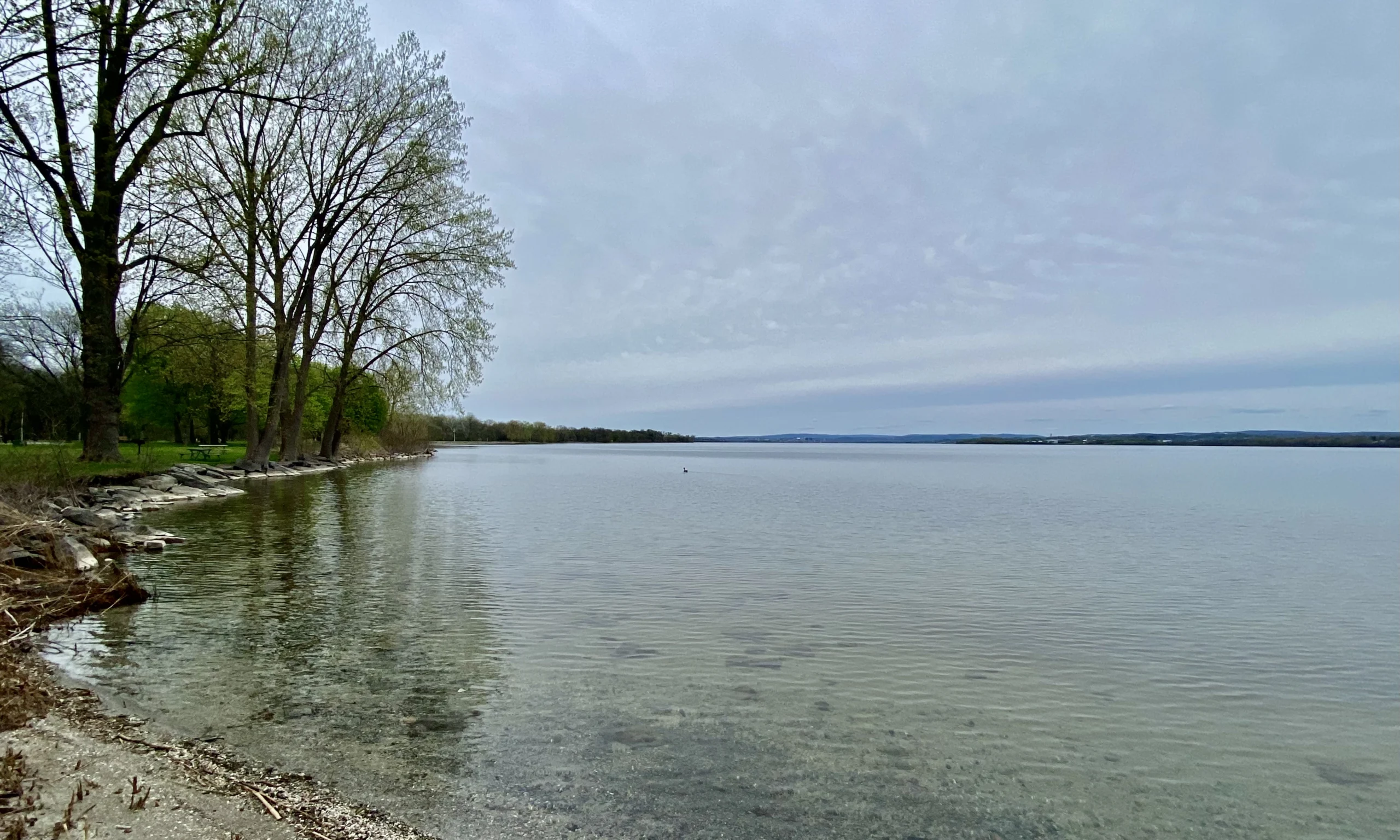
The water clarity is the best in a century, the bass have come back, and the trails draw 1.5 million visits a year. So why is swimming still off the menu, and where can a CNY family actually wade in this summer?
A paddler launching a kayak from Willow Bay this June will glide over water that is, by almost every measure, the clearest Onondaga Lake has been since the 1920s. The Syracuse skyline reflects off a surface that three decades ago was choked by industrial sludge and capped by a fishing ban that ran from 1972 to 1986.
Know before your neighbors do
The Morning Signal hits your inbox at 6 AM with everything that happened overnight. Real incidents, real data, zero fluff.
And yet, on the same June morning, the County still posts the same blunt sign at the trailhead: no swimming. The closest open beach for a CNY family who wants to actually swim is Oneida Shores Park, 14 miles north on Oneida Lake, not Onondaga Lake.
That is the contradiction at the center of summer 2026 in Syracuse: a recovery so dramatic that 65 fish species have returned and bald eagles roost above the western shore, paired with a public-health record that still warns women under 50 and children under 15 to eat zero fish caught from these waters.
What the 2026 monitoring data actually says
NYSDEC ended its routine ambient monitoring at Onondaga Lake in 2018, when Honeywell completed the contracted dredge-and-cap remedy. Since 2022, the closest thing to a continuous public record has come from the Upstate Freshwater Institute’s Onondaga Lake Guardian program, a pro bono effort launched after government sampling ended. The Guardian buoy reports real-time temperature and dissolved oxygen, and the institute pulls surface and deep samples on a roughly monthly summer cadence.
Honeywell separately runs a Monitoring and Maintenance Plan required under the federal consent decree, with results filed to NYSDEC and the EPA. The headline finding from the most recent full-summer Guardian data set: dissolved mercury in the upper water column has fallen more than 98 percent since 2009, according to UFI’s published tracking. Ammonia, the chemical that historically drove oxygen crashes during fall mixing, was effectively eliminated as a problem after Onondaga County’s $540 million Metro wastewater treatment plant upgrade finished in 2005.
Two cautions, both important. The Guardian program is one nonprofit’s pro bono effort, not a state monitoring backbone. And the surface improvement does not mean the sediment is clean. Mercury and PCBs remain locked under the 1.1-million-cubic-yard isolation cap that Honeywell installed in 2014 to 2016, and disturbing that cap is what swim restrictions and shoreline-use rules are designed to prevent.
Summer 2026 water quality snapshot
The fish are back. The fish advisory is still strict.
The most current New York State Department of Health waterbody-specific advice for Onondaga Lake, last refreshed by the agency on May 29, 2025, draws a sharp line between general adult anglers and sensitive populations.
For most adults, the advisory permits up to one meal a month of most species. It bars consumption entirely of largemouth and smallmouth bass over 15 inches, walleye, carp, channel catfish, and white perch. It permits up to four meals a month of brown bullhead and pumpkinseed sunfish, the two species that have most successfully purged mercury and PCBs from their tissue.
For women under 50 and children under 15, the advice is simpler: do not eat any fish from Onondaga Lake. The contaminants of concern listed in the 2025 advisory are mercury, dioxin, and PCBs, all of which persist in lake sediments under the cap and which can re-enter the food chain through the deep-water forage fish that larger gamefish consume.
The advisory matters for a CNY-specific reason boilerplate does not name. Refugee and immigrant communities resettled in Syracuse, including Karen, Burmese, Nepali, and Somali populations on the North Side, fish Onondaga Creek and the lake shoreline at higher rates than the general population. The Atlantic States Legal Foundation has produced translated, illustrated advisory materials for over a decade because the standard NY DOH pamphlet does not reach the people most at risk.
So where can you actually swim?
The answer most Syracuse residents do not know: Onondaga County operates two designated swim beaches, and neither is on Onondaga Lake.
The closest legal swim beach is at Oneida Shores Park, located off Bartel Road in Brewerton, where the Oneida River exits Oneida Lake. The county-operated beach typically opens for weekends on Memorial Day weekend and shifts to daily operation in mid-June. Daily vehicle admission ran $7 in the 2024 season, with annual passes available at $50 for county residents and $100 for non-residents. Lifeguards are on duty during posted swim hours.
The second option is Jamesville Beach Park, on Apulia Road in DeWitt, on the man-made Jamesville Reservoir. Both Oneida Shores and Jamesville have had occasional E. coli-related closures during heat waves in past summers, including a 2024 Oneida Shores closure that drew local news coverage, so the county health department’s beach status page is the only reliable same-day source.
Onondaga Lake Park itself, the 7.5-mile linear park that wraps the eastern and western shoreline of the lake, offers nearly every form of warm-weather recreation except swimming. The park draws roughly 1.5 million visits a year, according to county parks figures, and added a universally accessible kayak launch, fishing jetty, and fishing pier in restoration work announced in March 2024. The shoreline trail, two miles of paved path along the eastern shore, has distance markers every quarter mile for runners.
HAB watch: what to expect this summer
Onondaga Lake has not had a confirmed harmful algal bloom event reported to NYSDEC’s public HAB notification system in recent years, a fact that surprises many CNY residents who associate the lake with green water. Neighbor Skaneateles Lake, by contrast, recorded a confirmed bloom in mid-September 2025 that the Onondaga County Health Department flagged as a public-contact advisory, with Microcystin toxins detected in raw lake water (though not in the city’s treated drinking water supply).
Why has Onondaga Lake stayed out of the HAB headlines? Two reasons, neither of them a guarantee for 2026. First, the Metro plant upgrade slashed the ammonia and phosphorus loading that algal blooms depend on. Second, the lake’s industrial-era turbidity and salinity historically limited cyanobacteria. Both of those conditions are changing as the lake clears, which means HAB risk is not zero, especially in the warm, shallow southern basin near Nine Mile Creek.
The two public-facing tools that matter for a recreator this summer: the NYSDEC HABs Notifications page, refreshed weekly during the June through October bloom season, and the Onondaga County Health Department’s beach status feed for Oneida Shores and Jamesville. Both list waterbody-specific status in plain English.
Honeywell Phase 2: what is still on the work plan
The Honeywell remedy has two halves. The first, in-lake dredge-and-cap, finished in 2016 with the placement of 1.1 million cubic yards of cap material after the removal of 2.2 million cubic yards of contaminated sediment between 2012 and 2014. The second half is the upland subsites, the waste-disposal areas around the lake that historically leaked mercury, chlorobenzene, and Solvay slurry into the watershed.
For summer 2026, the active work centers on three things. Honeywell’s mercury treatability study, contractually expected to be completed in 2025, was running on schedule as of the latest public updates from NYSDEC Region 7. The workplan derived from that study and the actual mercury cleanup at the Geddes Brook/Nine Mile Creek and lower groundwater zones is anticipated to follow.
The Wastebed B/Harbor Brook subsite, where NYSDEC and EPA selected the cleanup plan for the SYW-12 site in March 2023, is in design-and-construction negotiation. Wastebeds 1 through 8, the largest visible Solvay waste deposit on the western shore, completed soil capping in 2022, which is what permitted the western shoreline trail extension that walkers now use.
For a CNY paddler this summer, the practical impact of Phase 2 is mostly invisible. The active dredge zones are gone. What remains is a long horizon of upland soil remediation, groundwater monitoring, and an in-lake cap that Honeywell is contractually obligated to maintain in perpetuity.
The Onondaga Nation perspective the headlines often miss
Onondaga Lake is the sacred site at the founding of the Haudenosaunee Confederacy, and the Onondaga Nation has been consistent in its position that the federal remedy left contaminated sediment in place rather than removing it. The Nation argued throughout the consent-decree process that capping is containment, not restoration.
That perspective is not a side note. It is one of the reasons the swim ban remains: a recreational swim beach would create a public-health expectation that New York is unwilling to underwrite while the cap is the primary defense and the fish advisories are unchanged. The cleanup, in the Nation’s framing, is not finished.
What to do this summer: a practical checklist
For a CNY family planning around the lake this June, July, and August, the operating rules are straightforward.
Walk, run, bike, or skate the seven-and-a-half-mile loop of Onondaga Lake Park. Launch a kayak or canoe from the universally accessible launch at Long Branch or the Onondaga Lake Park Marina. Cast a line from the new ADA fishing pier. Photograph the bald eagles that now nest in the cottonwoods along the western shore.
Catch and release any fish that the advisory bars (the bass over 15 inches, the walleye, the carp). If you eat what you catch, stick with brown bullhead and pumpkinseed, follow the meal limits, and follow the women-and-children advisory without exception.
For an actual swim, drive 14 miles north to Oneida Shores, or south to Jamesville Beach. Check the county health department beach status feed the morning of, especially after a heat wave or a heavy rain.
And if a green scum forms on any shoreline this season, do not let kids or dogs near it. Report it to NYSDEC’s HAB notifications portal. The lake is the cleanest it has been in a century. It is not yet the lake your grandparents could swim in, and the gap between those two facts is the story of summer 2026 on Onondaga Lake.

Sources
- New York State Department of Environmental Conservation, Onondaga Lake watershed management page, dec.ny.gov
- U.S. Environmental Protection Agency, Onondaga Lake Superfund Site Profile, cumulis.epa.gov
- New York State Department of Health, Updated Waterbody-Specific Advice for Eating Fish You Catch, press release dated May 29, 2025
- New York State Department of Health, Fish Consumption Advisories by County, health.ny.gov
- Upstate Freshwater Institute, Onondaga Lake Guardian monitoring program and real-time buoy data, upstatefreshwater.org
- Onondaga Lake Cleanup project (Honeywell), Lake Improvement and Progress and News pages, lakecleanup.com
- NYSDEC Region 7 Environmental Remediation Project Information, dec.ny.gov
- Onondaga County Office of the Environment, Onondaga Lake Restoration page, onondaga.gov/environment
- Onondaga County Department of Water Environment Protection, Save the Rain program, onondaga.gov/wep
- Onondaga County Parks, Onondaga Lake Park and Oneida Shores Park pages, onondagacountyparks.com
- Atlantic States Legal Foundation, Consuming Fish from Onondaga Lake report, aslf.org
- U.S. Fish and Wildlife Service, Onondaga Lake Natural Resource Damage Assessment Restoration Plan, fws.gov
- Onondaga Nation, The Onondaga Lake Cleanup Plan statement, onondaganation.org
- NYSDEC Harmful Algal Blooms Notifications page, dec.ny.gov
- Spectrum Local News and LocalSYR coverage of 2025 Skaneateles Lake HAB advisory (referenced for regional HAB context)