The longest of the Finger Lakes heads into Memorial Day weekend with 16 active wineries on the Cayuga Lake Wine Trail, a state park drawing roughly one million visitors a year to Taughannock Falls, and an empty 168-year-old college campus that nobody has yet figured out how to refill.
Drive north on Route 89 from Ithaca on a clear May morning and the first thing you notice is the water. Cayuga Lake runs about 38 miles from Ithaca at the south end to Mud Lock near the village of Cayuga at the north end, and on a windless day the surface holds the same gray-blue sheen the glaciers left behind when they carved the trough roughly 10,000 years ago. It is the longest of the eleven Finger Lakes, the second largest by surface area after Seneca, and arguably the most economically dense waterfront in upstate New York.
This story came from public records we pulled ourselves
Get the next one, plus overnight incidents, in your inbox at 6 AM. Free, no spam.
This summer, that density faces three intersecting pressures at once. Harmful algal blooms have not gone away. The wine trail is rebuilding visitor traffic after a slow shoulder season. And the shuttering of Wells College in 2024 left the village of Aurora, midway up the east shore, without its largest employer and without its biggest reason for the average tourist to stop.
How those three threads play out between Memorial Day and Labor Day will determine whether Cayuga Lake has a normal summer or a turning-point one.
The Water: Cleaner Than 2017, Not Yet Clean
The Cayuga Lake Watershed Network and the state Department of Environmental Conservation have tracked harmful algal blooms, known as HABs, since the cyanobacteria outbreaks of the mid-2010s. The 2017 season was the inflection point: dozens of confirmed blooms ringed the lake, the Bolton Point water intake serving roughly 30,000 customers across Ithaca, Lansing, Dryden, and Cayuga Heights had to add carbon filtration, and Cornell University began a multi-year monitoring program out of its Stewart Park boathouse.
Nine years on, the picture has improved without resolving. The DEC’s statewide HABs Notification System logged Cayuga Lake bloom reports in every season from 2017 through 2024, with confirmed sightings clustered most heavily at the south end shallows near Stewart Park and along the warmer east shore between Aurora and Sheldrake. The largest single 2024 event closed swimming at Taughannock Falls State Park’s lake beach for parts of two August weekends, according to the park’s posted advisories.
Going into 2026, the early signs are mixed. Surface water temperatures at the south end were running about two degrees Fahrenheit cooler than the five-year May average as of mid-month, a function of a wet, slow spring across the Northeast. Cooler water at the start of the season buys time. Cyanobacteria need warmth above roughly 68 degrees, calm conditions, and a surplus of phosphorus to bloom in dense, visible mats. Take any one of those away and the math changes.
What has not changed is the phosphorus load coming off the watershed. The Cayuga Lake watershed drains roughly 785 square miles across Tompkins, Cayuga, Seneca, Schuyler, Tioga, and Cortland counties, with the majority of that area in active agricultural use. Corn, soybeans, dairy, and increasingly grapes all contribute nutrients. Whether the lake gets a quiet bloom year or a heavy one will be decided in July and August by rainfall timing more than by anything the state can do on a Memorial Day timeline.
The Wine Trail: Sixteen Members, Two Counties, One Identity Question
The Cayuga Lake Wine Trail, founded in 1983, is one of the oldest organized wine trails in the country. It currently lists 16 member wineries and one member distillery, spread between the west shore in Seneca County and the east shore in Cayuga and Tompkins counties. The trail’s defining product remains Riesling, but the membership has diversified meaningfully in the past five years toward cool-climate reds, dry rieslings, and sparkling wines made in the traditional method.
The 2026 season opened the second weekend of May with the trail’s annual Spring Wine and Cheese Weekend. Owners contacted for this piece described foot traffic as steady but not record-setting, with the average tasting-room party running smaller than the pre-2020 norm. A 2024 New York Wine and Grape Foundation economic impact study put the statewide wine industry’s annual contribution at roughly $14.5 billion, with the Finger Lakes region the largest production area by volume.
Cayuga Lake Wine Trail Members by County, 2026 Season
The trail’s identity question is more interesting than its membership count. For decades, Cayuga Lake was the budget option compared to Seneca Lake’s wider trail and bigger wineries. That positioning has eroded. Three new tasting rooms have opened on the lake’s west shore in Seneca County in the past three years, all charging Seneca-comparable tasting fees, and the average bottle price across the trail has climbed into the same range as Keuka Lake and lower Seneca. The trade-off is real: Cayuga’s smaller production wineries can offer a more direct conversation with the winemaker, which is exactly what the post-pandemic agritourism customer says she wants.
Taughannock Falls: The Headline Park
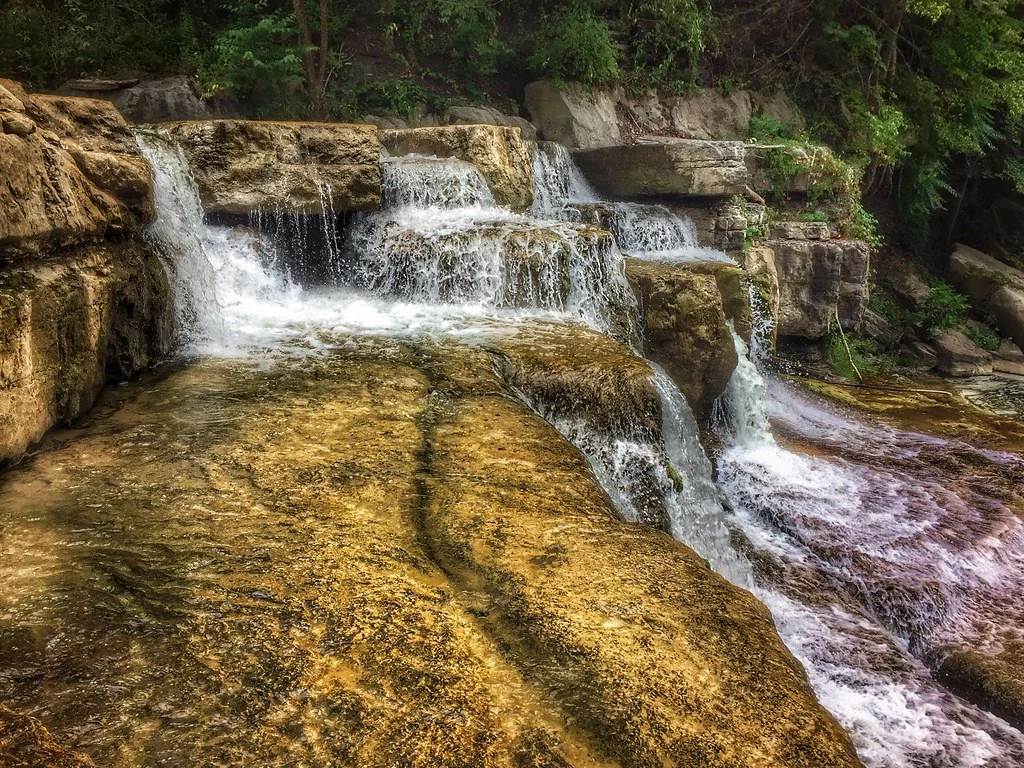
If the wine trail is Cayuga Lake’s commercial spine, Taughannock Falls State Park is its visual anchor. The falls drop 215 feet from the gorge rim to the plunge pool, making them 33 feet taller than Niagara Falls in vertical drop, a comparison the park’s interpretive signage does not let visitors forget. The park sits on the west shore in the town of Ulysses, about ten miles north of Ithaca, and operates a lake-level day-use area, a swimming beach, a small marina, hiking trails on both rims, and a year-round cabin and campground complex.
State Parks does not publish weekly attendance figures, but the park has consistently ranked among the most-visited in the Finger Lakes region. The most recent state parks annual report credited the Finger Lakes region with 5.4 million visitors in 2023, with Taughannock, Watkins Glen, and Robert H. Treman accounting for the largest individual shares. The 2026 season opened the first weekend of May with all rim and gorge trails accessible and the cabin loop already booked into October.
Two changes shape this season at the park. First, the gorge trail underwent partial rock-scaling work over the winter following a small slab failure in late 2024, and the lower viewing platform was rebuilt with composite decking. Second, the park’s evening summer concert series, which typically runs Saturday evenings from late June into August at the natural amphitheater near the falls overlook, is expanding from six to eight dates this year. The series is free with the standard park entry fee.
Aurora And The Wells College Vacancy
The most consequential change anywhere on Cayuga Lake heading into summer 2026 is the one nobody on the east shore wanted. Wells College closed at the end of the 2023 to 2024 academic year after 156 years of operation, ending a presence in the village of Aurora that long predated the modern tourism economy. The college’s roughly 350 undergraduate students and 80 faculty and staff were the village’s economic floor. Their disappearance has reshaped Aurora’s Main Street in ways that are still resolving.
The Aurora Inn, the village’s anchor hotel and restaurant, remains open under the ownership of the Pleasant Rowland Foundation, which also still owns the broader Inns of Aurora hospitality cluster. The Inns of Aurora portfolio comprises five historic properties along a half-mile stretch of Aurora’s Main Street, including the Aurora Inn, the Rowland House, the E. B. Morgan House, the Wallcourt Hall property, and the original Taylor House. Visitor activity at the inns has held steadier than many feared in 2024. The properties draw a weekend-leisure customer base that was never primarily dependent on Wells College.
The campus itself sits at the south end of the village, intact and largely empty. A successor entity called Wells College of New York announced in fall 2024 that it was working with state regulators and the Manuel Bros. development firm on a long-term reuse plan for the buildings, with conference and continuing-education programming as the likely first phase. As of mid-May 2026, no public reuse program had begun on the campus, and the largest of the academic buildings remained shuttered. Aurora’s two coffee shops, three restaurants, and small handful of retail storefronts have absorbed a shift toward weekend-leisure customers and away from the steady weekday traffic that a residential college supplied.
Route 89 And Route 90: The Lake’s Two Personalities
Cayuga Lake has two shore roads, and they offer markedly different versions of the same lake. Route 89 runs the west shore from Ithaca through Trumansburg, Sheldrake, Romulus, and on toward the village of Cayuga. The west shore corridor concentrates the majority of the lake’s wineries, distilleries, and creameries, partly because the limestone-derived soils on that side drain well for grapevines and partly because the gentler topography supports the slope-oriented vineyards that Riesling needs.
Route 90 runs the east shore from the village of Cayuga south through Union Springs, Aurora, Long Point State Park, King Ferry, and into Lansing before terminating at the Ithaca city line. The east shore is shorter on wineries and longer on farm stands, working dairy operations, and orchard country. Long Point State Park, between Aurora and Ledyard, is one of two state park beaches on the lake alongside Taughannock and offers a smaller, less-trafficked alternative when the west-shore beach is at capacity.
Finger Lakes Region Visitor Traffic, 2019 to 2023
Agritourism on the east shore has grown faster than wine tourism in the past three years. King Ferry Winery’s Treleaven label has been on Route 90 since the early 1990s and remains the east shore’s most-visited wine stop. Around it, a cluster of smaller producers, farm-to-table cafes, and roadside stands now anchors the corridor between Aurora and Lansing. The Cayuga County Office of Tourism reported in its 2024 annual summary that lodging tax collections rose 8 percent year-over-year in 2024, driven primarily by short-term rental growth on the lake’s east shore.
What To Watch Between Now And Labor Day
Three indicators will tell the story of Cayuga Lake’s 2026 season as it unfolds. The first is the timing of the first confirmed HAB. A late July or August onset is the historical norm. An earlier appearance, particularly at the south end near Stewart Park or at the public swimming beach at Taughannock, would suggest a higher-than-average phosphorus loading and a tougher second half. The DEC’s HABs map updates throughout the summer.
The second is what happens with the Wells College campus. The Pleasant Rowland Foundation has made one of the largest single-donor investments in upstate New York hospitality through the Inns of Aurora portfolio, and any reuse program for the college is likely to come either through that orbit or in close coordination with it. A summer announcement on conference programming would change the village’s economic outlook by Labor Day.
The third is occupancy at the wineries. The Cayuga Lake Wine Trail does not publish individual member sales data, but trail-wide signature events provide a reasonable proxy. The trail runs four ticketed weekend events per year, including the Wine and Herb Festival in April, the Spring Wine and Cheese Weekend in May, the Cayuga Sangria Trail in July, and the Holiday Shopping Spree in November. Ticket sales for the July event, which traditionally draws the largest single-weekend visitor count, will be the cleanest read on whether the agritourism summer is rebuilding or stalling.
For now, the lake is doing what it always does at this time of year. The water is cold, the birds are noisy, the gravel beach at Taughannock is open, and the Route 89 tasting rooms are pouring 2024 Rieslings. The geography is unchanged. The questions are about what people do with it.
Sources
- New York State Office of Parks, Recreation and Historic Preservation. Taughannock Falls State Park page. parks.ny.gov.
- Cayuga Lake Wine Trail. Member directory and 2026 event calendar. cayugalakewinetrail.com.
- Inns of Aurora and Aurora Inn. Property pages. aurora-inn.com and innsofaurora.com.
- New York State Department of Environmental Conservation. Harmful Algal Blooms Notification System. dec.ny.gov.
- Cayuga Lake Watershed Network. State of the Lake reporting. cayugalake.org.
- Cornell University, Department of Natural Resources and the Environment. Cayuga Lake monitoring program publications.
- Cayuga County Office of Tourism. 2024 annual lodging report. tourcayuga.com.
- Tompkins County Tourism Program. Annual report archive. visitithaca.com.
- Seneca County Chamber of Commerce. Tourism statistics page. senecachamber.org.
- New York Wine and Grape Foundation. 2024 economic impact study summary. newyorkwines.org.
- NY State Office of Parks, Recreation and Historic Preservation. 2023 annual visitation report.
- Wells College. Closure announcement and successor entity statements, 2024. wells.edu.
- Pleasant Rowland Foundation publicly filed materials. Inns of Aurora portfolio history.
- U.S. Geological Survey Cayuga Lake hydrologic data. usgs.gov.