CNY Recap
Back to live boardCentral New York Dispatch Briefing, Tuesday, March 31, 2026
Central New York emergency dispatchers put 621 calls over the air on Tuesday, March 31, 2026, according to the running log CNY Signal keeps of every transmission it captures from public safety radio across Onondaga County and the counties around it. The 28-day median for this log is 428 calls a day, but that median is a measure of what the receivers heard, not of how much happened. Coverage on this network has changed over the period: the number of distinct talkgroups reaching the log rose from 37 in the spring to 55 in July 2026, and ingest outages have removed whole blocks of hours. A day above or below the median can therefore reflect the equipment as easily as the county. The community-level column further down is adjusted for the size of the day and is the more reliable comparison.
Syracuse accounted for the largest single share of the located calls with 137, and Police traffic was the most common category on the day at 232 calls. 458 of the 621 logged transmissions carried a town or city label, and the rest were regional channels or calls where dispatchers never named a place on the air.
By the numbers
Where the calls came from
These are the 15 communities that appeared most often in the day's radio traffic. The share column is measured against the 458 calls that carried a place name, not against the full day, so the column adds up to the located calls rather than to everything logged.
The last column is adjusted for how busy the whole day was. A community is only called busier or quieter than usual if it moved against the day around it, so a day when every antenna heard more traffic does not read as every town having a bad day. Expected volume is that community's recent daily average scaled by 1.45, the ratio of this day's total to the recent median.
| Community | Calls | Share of located calls | Against a normal day this size |
|---|---|---|---|
| Syracuse | 137 | 29.9 percent | 91 percent below |
| Onondaga County | 80 | 17.5 percent | 98 percent below |
| Clay | 33 | 7.2 percent | 44 percent above |
| Camillus | 26 | 5.7 percent | 258 percent above |
| DeWitt | 25 | 5.5 percent | 43 percent below |
| Cicero | 24 | 5.2 percent | 178 percent above |
| Geddes | 21 | 4.6 percent | 502 percent above |
| Manlius | 21 | 4.6 percent | 31 percent below |
| Salina | 18 | 3.9 percent | 45 percent below |
| Onondaga | 14 | 3.1 percent | 24 percent below |
| North Syracuse | 7 | 1.5 percent | 72 percent above |
| null | 6 | 1.3 percent | Too few calls to compare |
| Van Buren | 6 | 1.3 percent | 44 percent above |
| Marcellus | 5 | 1.1 percent | Too few calls to compare |
| East Syracuse | 4 | 0.9 percent | 99 percent below |
What kind of calls they were
| Category | Calls | Share of the day | Against a normal day this size |
|---|---|---|---|
| Police | 232 | 37.4 percent | 95 percent below |
| General | 161 | 25.9 percent | 51 percent above |
| Fire | 117 | 18.8 percent | 90 percent below |
| EMS | 109 | 17.6 percent | 93 percent below |
| Service | 2 | 0.3 percent | 85 percent below |
Priority grading for the day broke down as 2 graded critical, 306 graded high, 231 graded medium and 82 graded low. The grade is assigned automatically from the language of the dispatch, so it reflects how the call was toned out, not how it ended.
The calls that repeat
Ranked by how often the same kind of call went out. Routine radio housekeeping such as channel checks and dispatch tones is excluded from this table, though it is still counted in the day total above.
| Call type | Times dispatched |
|---|---|
| AMR Dispatch (American Medical Response) traffic | 47 |
| OCFC Fire Control (Dispatch) traffic | 35 |
| Motor Vehicle Collision Damage Only, J/O | 26 |
| Motor Vehicle Collision Injuries Presented | 25 |
| Hazardous Condition | 23 |
| Assist | 20 |
| Vehicle Complaint Disabled | 19 |
| Medical Emergency | 18 |
| Alarm Fire | 17 |
| SFD Machine Alert (Automated Dispatch) traffic | 16 |
How the day ran, hour by hour
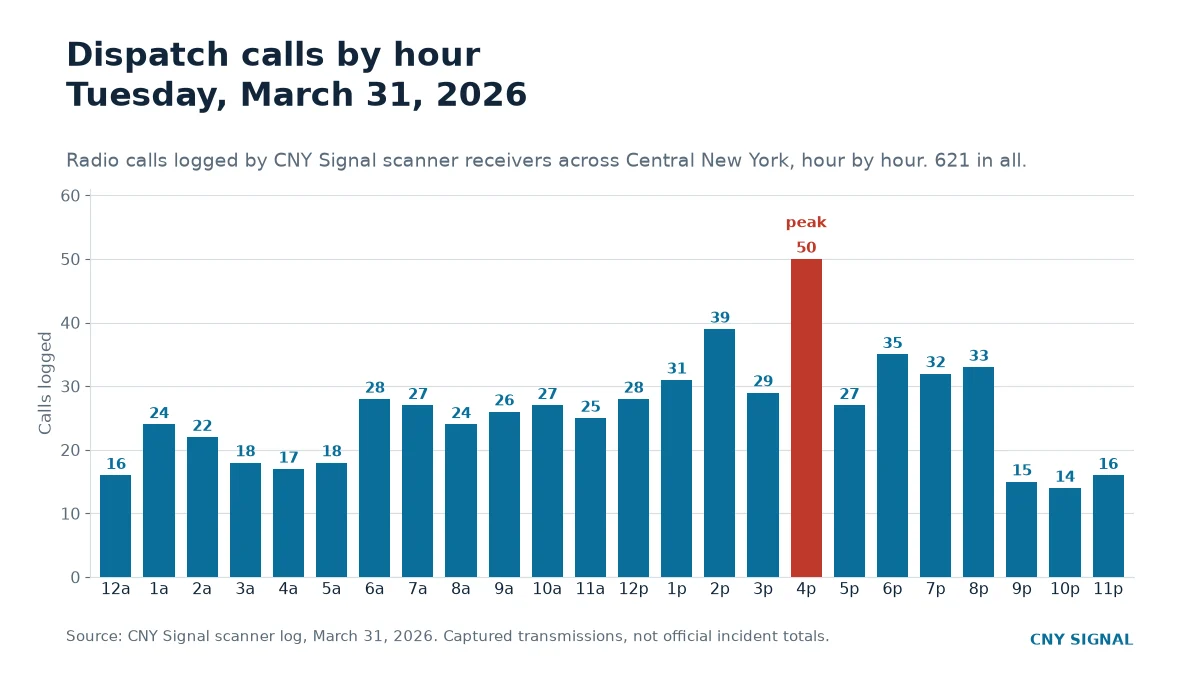
Radio volume peaked at 4 p.m. with 50 calls and bottomed out at 10 p.m. with 14. The six overnight hours from midnight to 6 a.m. carried 115 calls between them, 18.5 percent of the day, against 506 across the other eighteen hours.
Calls per hour, midnight at the left through 11 p.m. at the right. Hover or tap a bar for its count.
Calls that stood out
A cross section of the highest priority calls of the day, one per call type so the list is not twelve of the same thing. Each links to the transcript record for that dispatch.
- Working Structure Fire
- Shooting Reported
- OCFC Fire Control (Dispatch) traffic
- AMR Dispatch (American Medical Response) traffic
- SFD Machine Alert (Automated Dispatch) traffic
- Medical Emergency: Delta Response
- Call
- Alarm Carbon Monoxide
- Motor Vehicle Collision Injuries Presented
- Suspicious
- Rescue Response
- Assault
How this day compared
Busier than the day around them: Clay, 33 calls against the 23 a day this size would normally bring, Camillus, 26 calls against the 7 a day this size would normally bring and Cicero, 24 calls against the 9 a day this size would normally bring. Quieter than the day around them: Syracuse, 137 calls against the 1,485 a day this size would normally bring, Onondaga County, 80 calls against the 3,653 a day this size would normally bring, DeWitt, 25 calls against the 44 a day this size would normally bring, Salina, 18 calls against the 33 a day this size would normally bring and East Syracuse, 4 calls against the 604 a day this size would normally bring.
Only communities averaging at least five calls a day are compared, because a town that normally sees one call can double its own volume without anything happening. The baseline is drawn from 15 usable days inside the past 28.
How this page is built
CNY Signal runs software defined radio receivers on public safety frequencies across Central New York. Transmissions are recorded, transcribed by an automatic speech recognition model, classified by service and priority, and matched to a community when dispatchers name one on the air. Everything on this page is counted from that log for the calendar day named in the headline. Nothing here is estimated.
One caveat governs every comparison on this page. The number of receivers and the frequencies they cover have changed as this network was built out, so a day with more logged calls than last month is partly a day the antennas could hear more. That is why the totals here are always described against what this log has recorded and never against emergency activity in the abstract, and why the community and category comparisons are scaled to the size of the day rather than quoted raw. What those columns measure is whether a place moved against the day around it, which coverage changes do not affect.
Two further limits are worth stating plainly. First, scanner traffic is not an official incident count. Agencies do not tone out every call over the air, encrypted channels are not captured, and a single incident can generate a dozen transmissions, which is why distinct incidents are reported separately from calls logged. Second, automatic transcription makes mistakes, particularly with street names and unit numbers, so a call type here reflects what the transcription understood, not a verified record. Anything that looks wrong can be reported through the corrections page and it will be checked against the audio.
Comparisons on this page exclude 13 of the past 28 days, where receiver or ingest downtime meant the log captured less than half a normal day. Leaving those days in would make the following day look like a spike when nothing had changed on the street.
Keep reading
Daily recap
How this recap was built
For advertisers
A quiet fit beside useful local pages
CNY Signal can work for brands that want a calm presence beside alerts, weather, outages, and local follow-up.
Homepage, weather, and outage pages
Best for calm visibility during weather spikes, outage checks, breaking traffic, and urgent local decisions.
History and recap pages
Best for local services that benefit from repeat discovery over time.