By Matt Russo, Staff Reporter
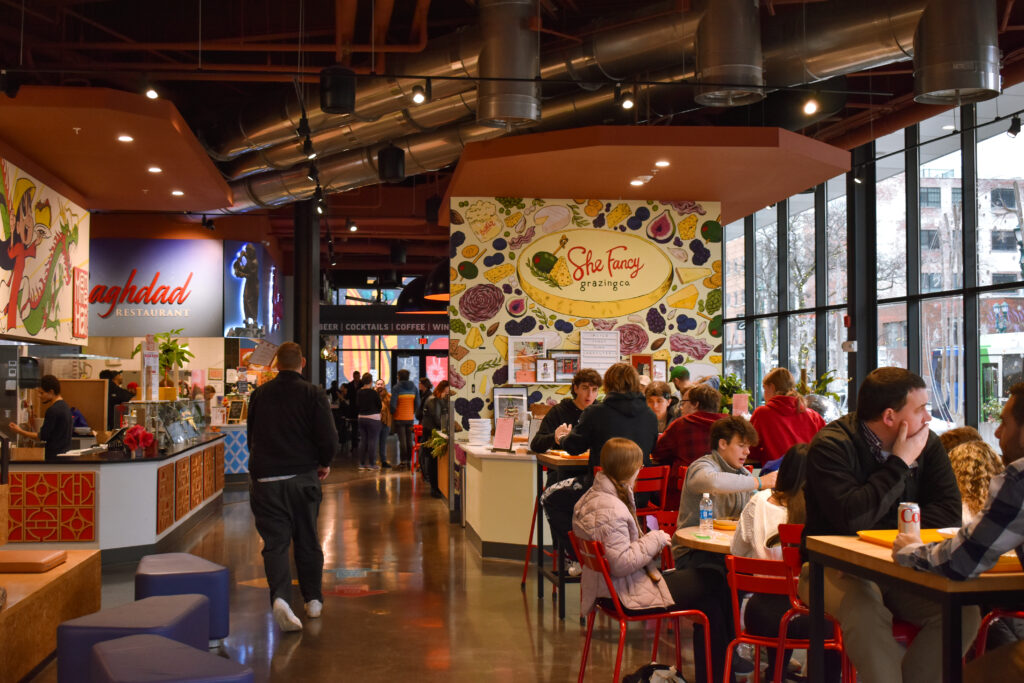
Five years ago on a frigid January morning, a line stretched down South Salina Street. People stamped their feet in the cold, waiting for a ribbon to be cut on a building that did not yet have a track record. Today that same building moves around 350,000 people a year through its doors, and the question that felt so open in 2021, whether Syracuse could sustain a 78,000 square foot food hall built by refugees, first time restaurant owners, and a family foundation betting on downtown, has a clearer answer.
Salt City Market turned five on January 29, 2026. The staff marked it with a Soup Flight Night on January 29 from 5 to 8 p.m., inviting guests to sample a stew or soup from every stall, a small ceremony for a building that has quietly become one of the most visited rooms in Central New York.
The Bet the Allyn Foundation Made
The project started a decade before anyone ate a bite of injera inside it. Community organizers in the mid 2000s kicked around the idea of a public market that would put Syracuse’s immigrant and refugee cooking on the same floor as a grocery store and a coffee counter. The Allyn Family Foundation, the charitable arm of the Welch Allyn medical device family from Skaneateles, picked up the concept and committed roughly $25 million to build it. The foundation spun up a nonprofit, Syracuse Urban Partnership, to run the place, and looked at Minneapolis for inspiration: the Midtown Global Market run by the Neighborhood Development Center served as the operating model.
Meg O’Connell, the foundation’s longtime executive director and a Dartmouth graduate married into the Allyn family, led the build from the conceptual stage through opening night. She stepped down at the end of 2025. Maarten Jacobs, who had served as the foundation’s director of community prosperity since 2019 and oversaw the Salt City Market design and construction, took over as executive director on January 1, 2026.
JPMorgan Chase served as the investor on an $18.01 million New Markets Tax Credit allocation, with $16.01 million coming through the Rose Urban Green Fund and $2 million through Chase New Markets Corporation. The New York State Regional Economic Development Council added a $1 million grant, and a $350,000 HUD HOME subsidy supported six of the affordable apartment units. Ground broke in August 2019 on a vacant lot at the corner of Salina, Onondaga, and Harrison. Construction continued straight through the first winter of COVID. The doors opened on January 29, 2021, during the pandemic, which was not the opening anyone had planned for.
Then-mayor Ben Walsh and Onondaga County Executive Ryan McMahon cut the ribbon alongside the vendors. Walsh called the project one of the most important downtown investments of his administration in later interviews. The market sits on what used to be considered the dividing line between the South Side, the West Side, and downtown proper.
By The Numbers
What Is Actually In The Building
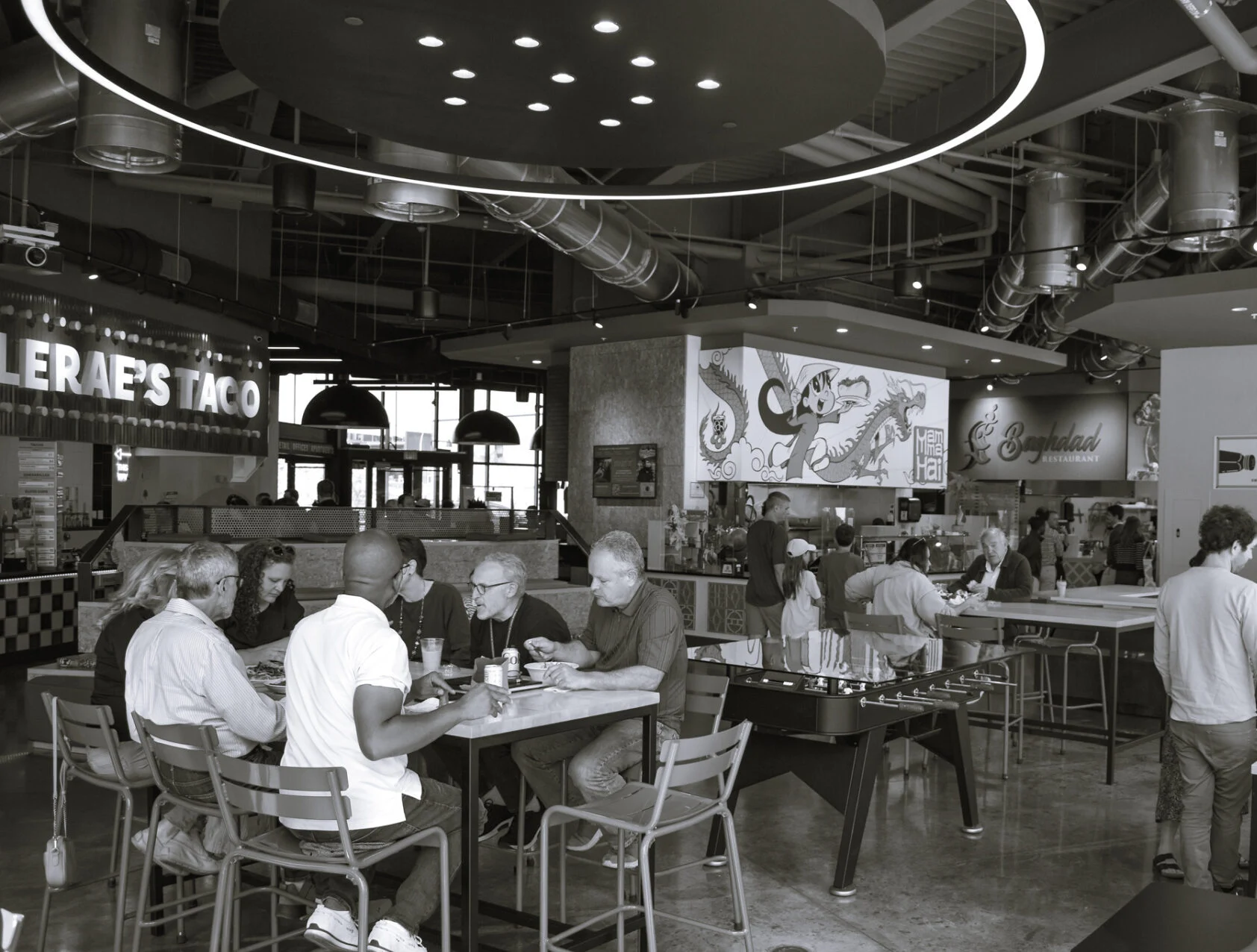
The layout is easy to miss if you only come for lunch. The ground floor holds the food hall itself, the Salt City Bar, the Salt City Coffee counter, the Penny “Pearl” Allyn Teaching Kitchen, and a Syracuse Cooperative Market grocery branch, which is still the only full service grocery store in downtown Syracuse. The 24,000 square foot market floor was designed to hold ten food stalls. The teaching kitchen carries the name of Penny Allyn, the late family matriarch who championed civic causes and pushed the family toward downtown. It runs nutrition and cooking classes at cost for community partners.
The second floor holds 9,600 square feet of nonprofit office space, anchored by the Allyn Foundation and Syracuse Urban Partnership themselves, plus a community room with seating for 60 that runs yoga sessions, book clubs, movie nights, and children’s reading time. Floors three and four hold 26 apartments. Roughly 31 percent are priced for low income households under 80 percent of area median income, 31 percent are workforce housing set between 80 and 120 percent, and 38 percent are at market rate. The units are one and two bedroom. VIP Structures, the Syracuse design build firm founded by architect Dave Nutting in 1975 and now led by CEO Meg Tidd, served as the Design-CM on the job and employs more than 150 people. The architecture was a collaboration between VIP Architectural Associates, Minneapolis based Snow Kreilich Architects, and New York City based ICRAVE. The exterior uses a charcoal Dekton Domoos cladding on part of the facade. The project won the AIA Central New York Award of Excellence in 2022.
There is a 30 space private parking lot behind the building along with street parking on Salina and Onondaga. The food hall is open Monday through Saturday from 11 a.m. to 9 p.m., and Sunday from 11 a.m. to 5 p.m. The bar runs longer, from 8 a.m. until 11 p.m. on weekdays and midnight on weekends.
The Ten Original Vendors, Five Years Later
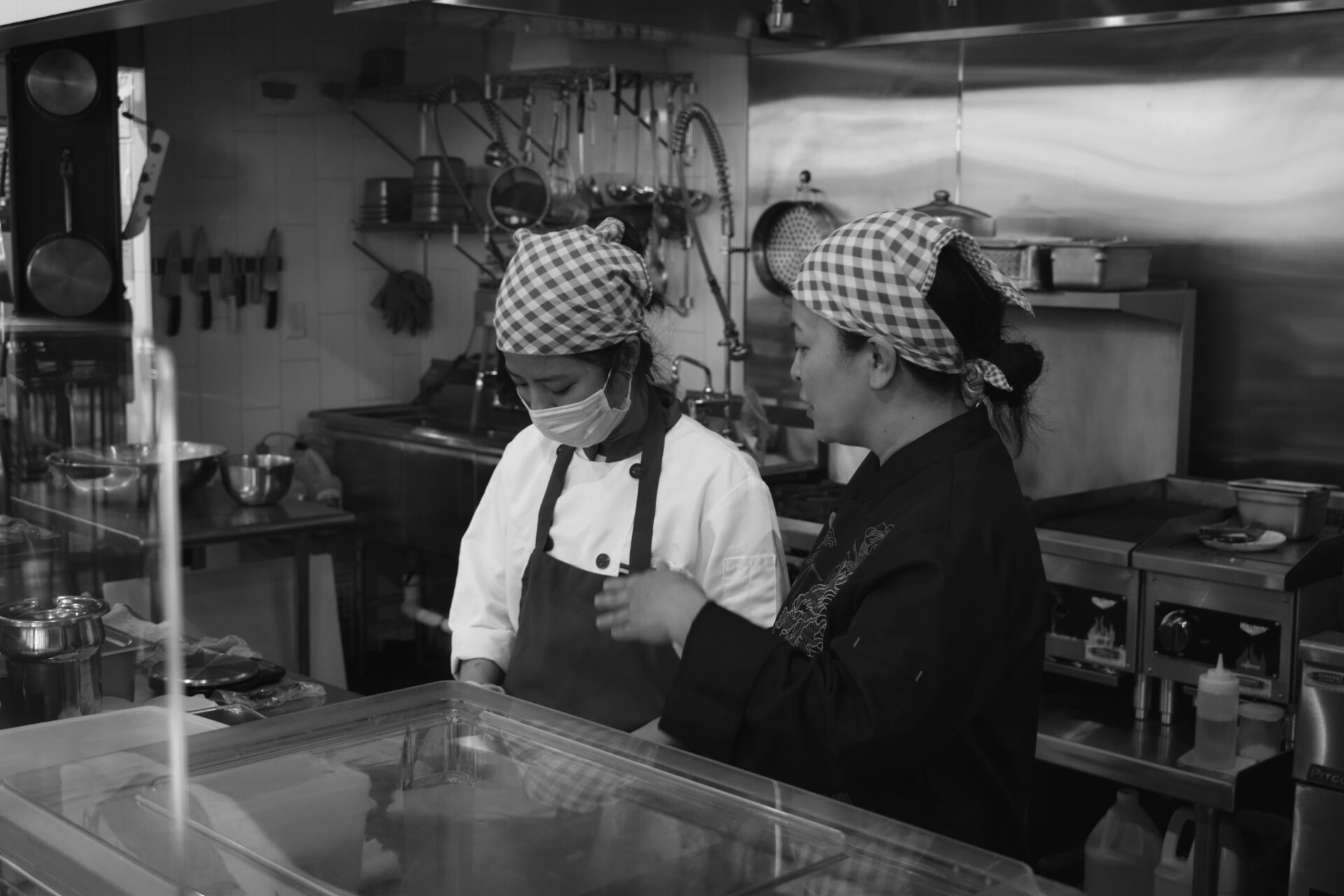
Of the ten food vendors who opened on day one in 2021, five are still on the floor: Baghdad Restaurant, Mamma Hai, Erma’s Island, Cake Bar, and Soulutions. Salt City Coffee and Salt City Bar, the two anchor operations, have both stayed put. The original opening lineup was Baghdad Restaurant, Big in Burma, Cake Bar, Erma’s Island, Firecracker Thai Kitchen, Farm Girl Juicery, Mamma Hai, Miss Prissy’s, Pie’s the Limit, and Soulutions.
The vendors who have moved on did not all leave for bad reasons. Dreamer Glen and Cyrus Thornton, the couple behind Miss Prissy’s, closed their stall in 2023 and are building out a 3,000 square foot standalone restaurant with 70 seats at 431 S. Warren Street. Onondaga County put a $100,000 grant toward the renovation. Opening has slipped repeatedly because National Grid has not yet completed the back of house electrical connection. Big in Burma, co-run by Syracuse University chemical engineering graduate Hein San and his parents, outgrew its stall as well. Pie’s the Limit relocated to the Central New York Regional Market. Firecracker Thai Kitchen and Farm Girl Juicery have also left the market floor.
Three of the remaining original vendors have opened separate restaurants around the city while keeping their market stalls: Baghdad, Cake Bar, and Erma’s. Cake Bar, which makes tea and desserts, now employs 30 people across its two locations, according to JPMorgan Chase’s community development reporting.
Current Vendors And What They Serve
Counts include the 12 permanent businesses on the floor, with weekly pop-ups rotating through an incubator stall.
Three Stories From The Floor
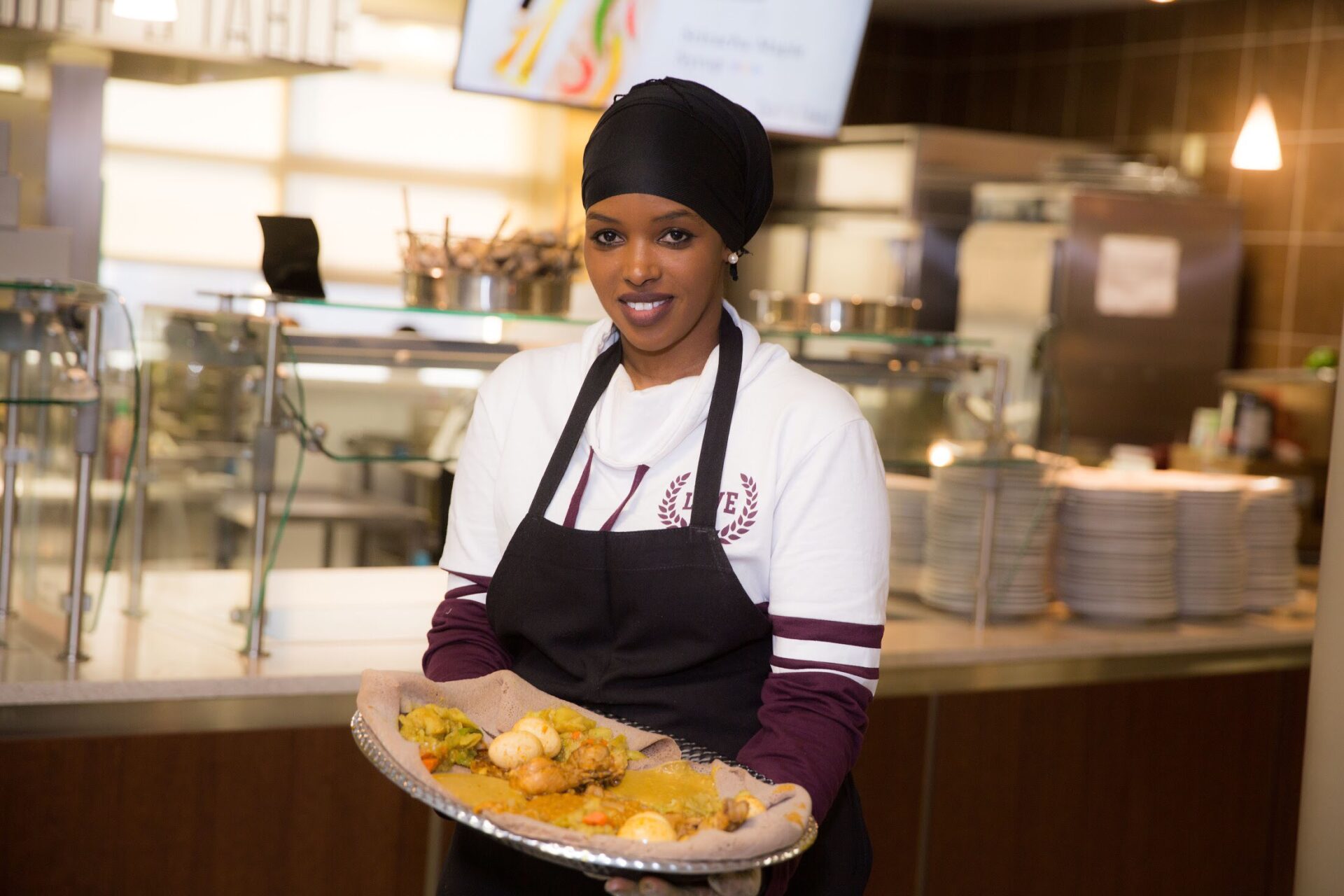
Habiba Boru runs Habiba’s Ethiopian Kitchen in the stall that used to belong to Pie’s the Limit, located between Erma’s Island and the Syracuse Cooperative Market on the southern end of the building. Boru left Ethiopia at age four during wartime and spent ten years in one of the largest refugee camps in Kenya, where her mother sold meals out of a mud and stick hut she called “Habiba’s Hotel.” Boru arrived in Syracuse as a refugee in 2000. She ran a standalone Ethiopian restaurant at 656 N. Salina Street starting in 2018, then closed that location and moved her kitchen into Salt City Market in September 2022. Her injera and misir recipes are the ones she learned from her mother in the camp, when there was not always money for meat.
Laytoya Ricks of Erma’s Island has taken the biggest leap since opening. Her Jamaican stall has been one of the busiest at the market from day one, and in January 2026 she opened Erma’s Bistro at 325 S. Clinton Street, the Armory Square space that housed Modern Malt for a decade until its January 2025 closing. The new restaurant serves oxtail, jerk chicken, and a section of items that do not fit the market’s fast casual format, like oxtail tacos and jerk chicken burritos. Ricks has said the standalone restaurant was always the dream, and the sit down format makes Erma’s Bistro the first dedicated Jamaican restaurant in the city. The market stall continues to operate while the bistro ramps up.
Gary Singh, a Punjab native who runs the Masala Heaven on Wheels food truck and a separate buffet location in Cicero, brought a pared down version of his menu to Salt City Market in October 2025. He took over the stall that Firecracker Thai Kitchen had vacated in August. He calls the stall Masala Heaven Express. The menu runs from butter chicken and tikka masala to Sarson ka Saag, a mustard greens dish from his home region, and he employs a South Indian cook specifically to keep the masala dosa recipe honest. Masala Heaven is the first Indian restaurant on the Salt City Market floor. The Cicero buffet opened in January 2025 and already carries a 4.9 star Google rating across almost 500 reviews.
An Incubator That Is Actually Incubating
The term “business incubator” gets tossed around a lot. In Salt City Market’s case the numbers back it up. Fifteen small businesses have started, operated, or both under the market’s roof in five years. Most of the owners had no prior experience running a food business. Baghdad Restaurant, Cake Bar, and Erma’s have all graduated to separate brick and mortar locations while keeping a foothold on the floor. Big in Burma used the stall as a launchpad and then moved on entirely. The NMTC filing for the project projected 59 full time equivalent jobs at capacity and 106 construction jobs during the build, and the market has cleared both thresholds.
Syracuse Urban Partnership works alongside CenterState CEO on the support side, offering help with business planning, financing, and finding a second location when a vendor is ready to scale. Several business owners have reported buying their first home using income earned at their Salt City Market stall. The foundation picked the original ten vendors through an open call it branded the “Fab 10,” reviewing applications from more than 80 aspiring entrepreneurs, most of them women and people of color.
What The Market Is Still Working On
The floor is not without its rough edges. Ngoc Huynh, who runs Mamma Hai, told This Is CNY earlier this year that her Vietnamese stall has “reached a plateau” after the first few years of growth. Sleyrow Mason of Soulutions described herself as “terrified at first,” and said that even now, running a stall has moments that keep her up at night. The foundation has doubled its security presence in response to issues on and around Dickerson Street. A fence along the Rescue Mission property edge drew public debate. Students from the Syracuse STEAM High School across the street have been a periodic source of friction during lunch hours.
Tariff pressure on food imports has also squeezed margins, particularly on spices and specialty ingredients that several of the stalls depend on. That is not a problem unique to Salt City Market, but a food hall running on immigrant cooking feels it faster than most kitchens.
From Vacant Lot To Food Hall
What Comes Next
The Allyn Family Foundation has already moved onto the next block. Under new executive director Maarten Jacobs, the foundation, through its nonprofit affiliate SEED Syracuse, bought the 152,000 square foot Chimes Building at 500 S. Salina Street in August 2023 and is converting the upper ten floors into 152 mixed income apartments, 51 of them with no income restrictions. Five commercial tenants will fill the ground floor. The estimated cost runs between $35 million and $40 million, with recent filings putting the total closer to $48 million once the purchase price is counted. JPMorgan Chase has committed an $11.8 million Historic Tax Credit equity investment. Leasing is expected to begin in March 2026. The building, designed by Shreve, Lamb and Harmon, opened in 1929 two years before the same firm finished the Empire State Building.
For the market itself, the next chapter looks less about proving the concept and more about holding the line. Keeping vendors profitable, keeping spice costs from crushing margins, keeping the neighborhood safe enough that families with strollers still want to come on Sundays. The hard part of year five is not the opening, it is the staying open.
On a Tuesday afternoon this week, the Vietnamese pho line at Mamma Hai had six people in it. The grocery store in the back had a few downtown workers grabbing groceries. Two tables over, a pair of Syracuse University students split a plate of Habiba’s misir stew with injera. None of them looked like they were visiting a project. They looked like they were visiting a restaurant. That is probably the best way to measure a food hall at five.
Sources: Salt City Market (saltcitymarket.com), Allyn Family Foundation (allynfoundation.org), This Is CNY, The Daily Orange, WAER, Central New York Business Journal, CNYCentral, JPMorgan Chase community development reporting, NMTC Coalition project file, Rose Urban Green Fund closing summary, CenterState CEO, VIP Structures project summary, and Snow Kreilich Architects.