By Jen Okafor, Staff Reporter
Walk into the L. & J.G. Stickley plant on Stickley Drive in Manlius, four miles east of Fayetteville and 14 miles east of downtown Syracuse, and the first sound is not a saw. It is a person, palm-down, working the inside corner of a drawer with a folded sheet of sandpaper. The drawer is dovetailed. The dovetails are tight enough that a thumbnail catches on the seam. A worker named on a stamp on the bottom is going to sign that drawer before it ships.
The company has been doing this for 125 years. It is the family business Leopold and John George Stickley founded in 1900, nearly folded in 1974, and that the Audi family has now run longer than the Stickleys ever did. The Stickley brothers are gone. The Mission style they helped popularize is everywhere, on Pottery Barn floors and in millennial first-apartment Pinterest boards. And one of the company’s early Mission cabinets, made in 1904 in Eastwood, has been in the White House collection ever since the U.S. Government bought it that same year.
This story came from public records we pulled ourselves
Get the next one, plus overnight incidents, in your inbox at 6 AM. Free, no spam.
L. & J.G. Stickley: 125 years
| 1898 | Gustav Stickley sets up Craftsman Workshops in Eastwood, Syracuse |
| 1900 | Mission style debut at Craftsman Workshops; L. & J.G. brothers found firm |
| 1902 | Leopold + John George open Onondaga Shops in Fayetteville |
| 1904 | L. & J.G. Stickley incorporated; U.S. government buys early Mission cabinet for White House |
| 1915 | Gustav Stickley files for bankruptcy, owing nearly $250,000 |
| 1922 | Leopold launches American Colonial line (Cherry Valley Collection) |
| 1956 | Editors of New Yorker, National Geographic, House Beautiful, and Fortune name Leopold “Revered Dean of Cabinet Makers” |
| 1974 | Audi family acquires firm from Louise Stickley; 25 employees, $235,000 annual sales |
| 1985 | Manlius plant opens with 121,000 sq ft of manufacturing space |
| April 1989 | Reissue of 33 historic Mission furniture pieces, the “million dollar gamble” |
| 2025 | L. & J.G. Stickley marks 125th anniversary |
This is the story of how a Central New York furniture maker outlasted two world wars, the collapse of Mission style in the 1920s, the death of its philosopher-founder Gustav in 1942, the company’s own near-bankruptcy in 1974, and a four-decade tide of cheap imports, and ended up celebrating its 125th still hand-sanding the edges of every drawer it ships.
The brothers (and the older brother)
There were five Stickley brothers. The famous one, the one design students learn about, was Gustav. The oldest. He set up his Craftsman Workshops in the Eastwood neighborhood of Syracuse by 1898 and in the summer of 1900 began producing what the trade press would call Mission furniture, though Gustav himself disliked the term as misleading.
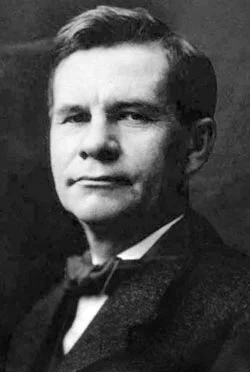
Leopold worked for Gustav as a foreman. In 1902 he left and went into business with his younger brother John George. They opened a small factory in Fayetteville, eight miles east of Gustav’s Eastwood Craftsman Workshops, and called it the Onondaga Shops after the county. They incorporated as L. & J.G. Stickley in 1904. By 1905 they showed their first furniture line at a Grand Rapids trade show, alongside Gustav’s. The brothers were now competitors.
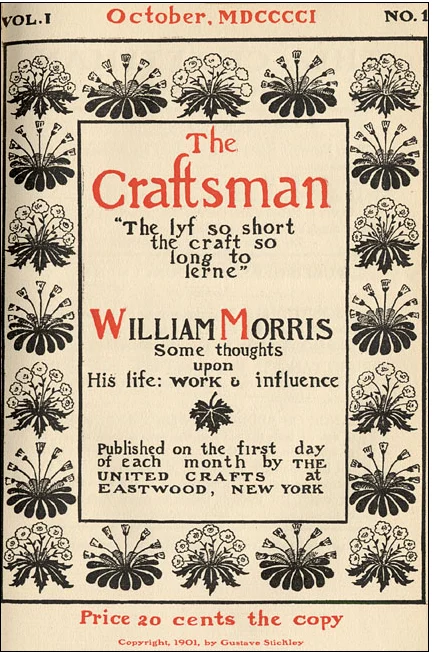
Gustav was the philosopher. He published The Craftsman magazine, sold a worldview, and tried to convince Americans they ought to live a more honest, less ornamented life. His brothers were the operators. They focused on the furniture. They built tighter joinery, leaner construction, and they kept the books straight.
Three Stickley companies, one family
That difference is the entire reason the company in Manlius still exists. Gustav filed for bankruptcy in 1915, owing nearly a quarter of a million dollars, ceased publication of The Craftsman by 1916, and was forced to sell his Craftsman Farms estate in 1917. Leopold and John George absorbed his Craftsman Workshops and kept manufacturing. When Mission style fell out of fashion through the 1920s, Leopold pivoted, traveling Europe and developing a successful American Colonial line called the Cherry Valley Collection in 1922.

John George died in 1921. Leopold ran the company for another four decades and was named “Revered Dean of Cabinet Makers” by the editors of The New Yorker, National Geographic, House Beautiful, and Fortune in 1956. When Leopold died, the company passed to his widow, Louise. By the early 1970s it was failing.
The phone call that saved the company
Louise Stickley faced a choice in 1974. Sell or shut down. The factory was running on fumes. There were 25 employees left and the company had booked just $235,000 in annual sales. She also owed money to the IRS.
She did not like the people offering to buy her. So she picked up the phone and called New York City. On the other end was Alfred Audi, whose father had run E.J. Audi, the largest Stickley dealer in Manhattan. The two families had known each other for years. According to a profile in the American Home Furnishings Hall of Fame archive, Alfred told Louise the same thing his father had once said about the company: “Having breakfast at a Stickley table is like having breakfast with a beautiful woman, it smiles at you.”
His wife, Aminy Inati Audi, was Lebanese-born, the third of nine children, a former Voice of America reporter who had married Alfred six months after meeting him on a campaign trail in Lebanon in the early 1960s. “Being the eternal optimist,” she has said of the moment they were asked to buy the company, “I said, ‘Of course you can.’”
They bought it.
The Audis came up to Fayetteville expecting a six-month stay. Aminy described the factory in interviews later as covered in cobwebs. They could not always make payroll. She has called those years their “Thursday Night Syndromes,” meaning can we meet the payroll tomorrow? When a customer order needed hardware that was not in stock, she has said she sometimes pulled it off her own bedroom dresser.
Alfred told the workers, on record, “If you stick with me, I’ll stick with you, and we’re going to make this place move.” By 1977, Congressman James Hanley read a recognition of the turnaround into the Congressional Record. In 1981, the company expanded the Fayetteville plant. In 1984 the Audis broke ground on a new facility in Manlius, two miles east. The new plant opened in 1985 with 121,000 square feet of manufacturing space.
Then in April 1989 they made what Aminy has called a “million dollar gamble.” They reissued 33 pieces of historic Mission furniture. Metropolitan Home magazine called it “the revival of the fittest.” Forbes wrote that “craftsmanship is not entirely dead in America as entrepreneurs like the Audis have proved.” The bet worked. Mission style came back. The company kept growing.
How a chair gets made today
The Manlius plant is over 400,000 square feet and employs about 225 workers on the case-goods side, in roles ranging from sanding and planing boards to assembly and finishing. The plant uses approximately 1.2 million board feet of solid wood per year.
The Manlius plant by the numbers
A piece of furniture moves through machine and hand work. Boards are sorted by grain. CNC routers cut the dovetail joinery. A UV finishing line sands, seals and applies a top coat to drawers in a single pass. The plant’s spray system reduces emissions by 10 to 15 percent compared with traditional spray lacquer.
But the parts of the chair you actually touch never see a machine for the last pass. Pre-staining is hand work, and so is the contour sanding on the curved back of a Mission dining chair, and so is the final surface where your fingertips will eventually rest on the arm of a Morris chair, smelling faintly of oak dust and shellac. Quality-control manager Tom Graham, on the Home News Now tour, said boards get chosen for grain match before they ever hit the line.
When a fit operator finishes a cabinet or table, they stamp their initials on the underside. One person owns the piece. They sign it. The plant runs that way on purpose.
The factory has run public tours every Tuesday at 10 a.m., free, for visitors 13 and older. A tour lasts an hour to two. Most weeks the room fills.
The dealers, the customers, the auctions
The Audi family has expanded the company nine times since the Manlius plant opened. They picked up Heirloom Upholstery in High Point, North Carolina in 1995, and over the years acquired Madison Square, John Widdicomb, Cibola Leather, and Nichols and Stone. They run 13 retail stores today, including a 77,000-square-foot flagship in Fayetteville that hosts dealer training and tests new products.
“This is a very successful showroom for us,” Jim Torres, the merchandise manager, told Home News Now last spring. The flagship has a 5,000-square-foot gallery for new introductions and bestselling collections.
Customers vary. Some buy a Highlands side chair as their first real piece of furniture and it stays in the house for the next 40 years. Some inherit a great-grandparent’s original L. & J.G. Stickley settle and bring it on Antiques Roadshow. The PBS appraisal record shows a Gustav Stickley oak bookcase from around 1915 that was originally valued at $4,500 to $6,500. A rare Gustav Stickley “Poppy” table sold at Sotheby’s in December 2020 for $60,480.
What lives in the White House is older still. The Smithsonian American Art Museum’s “Something of Splendor” exhibition catalog records a white oak cabinet, made in 1904 by Gustav Stickley in Eastwood, NY, listed as “U.S. Government Purchase, 1904.” A Stickley cabinet sat in the executive mansion before Manlius even had a Stickley factory.
The next generation
Alfred Audi died of cancer at his home in Fayetteville on September 30, 2007, at age 69. Aminy Audi has run the company since. She was inducted into the American Home Furnishings Hall of Fame in 2015. Edward, the eldest of three Audi children and now company president since 2012, came up through every department before taking over. Sister Andrea sits on the business as a partner; sister Carolyn served as Director of Communications.
Edward, looking back at the 1974 acquisition, has said: “I think Stickley likely would have gone the way of so many other fine names in our industry that while they had a wonderful run, came to an end.” Of his parents, he has said: “Stickley in Central New York was so lucky that Mom and Dad were there as a team.”
Aminy is direct about what the company is for. “Being profitable enables us to invest in our employees’ well-being. Making money is not the most important thing in my life,” she has said. The company has a full-time nurse practitioner, scholarships for employees’ children, and on-site health screenings, and the workforce represents about 23 nationalities.
The 125th anniversary year was its own argument. Stickley released a Floral Tile Collection with ceramic tiles from Motawi Tileworks, a Fireside Bench adapting a 1902 Stickley Brothers high-backed settle, and a 125th Anniversary Daffodil Chest in quartersawn white oak inspired by an Ernest Batchelder design. In April 2025 the company held a celebration at the American Home Furnishings Hall of Fame during the High Point spring market. At the end of the year, Furniture Today’s expert readers named Stickley the Best Luxury Furniture Company for the second year in a row.
The dovetail
Back on the floor on Stickley Drive, the worker is still on that drawer. The corner needs another half minute. The dovetail is hand-cut by machine and hand-fit by a person. It will go into a chest that will sit in someone’s bedroom for the next 50 years. The drawer will be opened and closed maybe 70,000 times. The seam will not move.
The worker will stamp her initials on the bottom of that drawer, and the chest will go to the next station for finishing.
So that is what 125 years of a family business in Manlius looks like up close, on a Tuesday morning, with the smell of sawn oak in the air: one drawer, one set of initials, repeated 1.2 million board feet a year.
Further reporting
The Manlius headquarters opened in 1985 with 121,000 square feet of manufacturing space and a 15,500-square-foot showroom. Seven expansions over the next four decades brought it to its current 400,000-plus square feet. Ground was broken in 1984 after the Fayetteville plant proved too small for the surge of work that followed the 1989 Mission reissue.
The Audi-led L. & J.G. Stickley now employs roughly 1,500 people across its operations, with more than 90 percent of products handcrafted in upstate New York or Archdale, North Carolina. The Manlius plant pieces are touched by craftspeople ranging from master cabinetmakers in their seventies down to young apprentices learning the joinery.
Stickley keeps a full-time nurse practitioner on staff at Manlius and a local physician makes a weekly visit to the plant. The company runs a “Fit for Life” wellness program that includes weight loss, an annual flu clinic, and on-site health fairs. Stickley was among the first companies in the U.S. to pay employees to quit smoking.
The Audis’ decision to buy the company drew formal congressional notice. U.S. Representative James Hanley of Syracuse honored the Audi acquisition in the Congressional Record on September 15, 1977, three years into the rescue, when the company’s recovery was still in question. Original Stickley pieces still circulate locally: dealers in Cazenovia, 18 miles southeast of the Manlius plant, and at the Antique Exchange of Skaneateles routinely list signed L. & J.G. Stickley early-1900s items at four-figure prices.
“I remember Alfred saying, ‘Oh, would I! It would be a dream come true if only I can afford it,'” Aminy Audi recalled in a Stickley anniversary post on February 5, 2024, of the moment in 1974 when she pushed her husband to take the call from Louise Stickley. “Being the eternal optimist, I said, ‘Of course you can.'” She added that taking on the bankrupt company “would take every ounce of energy we both had.”