New York’s weekly foliage tracker has not started its 2026 season as of September 7. The summer rain shortfall is real, Onondaga County is rated abnormally dry rather than in drought, and the experts who study dry-stressed trees do not all say the same thing about timing.
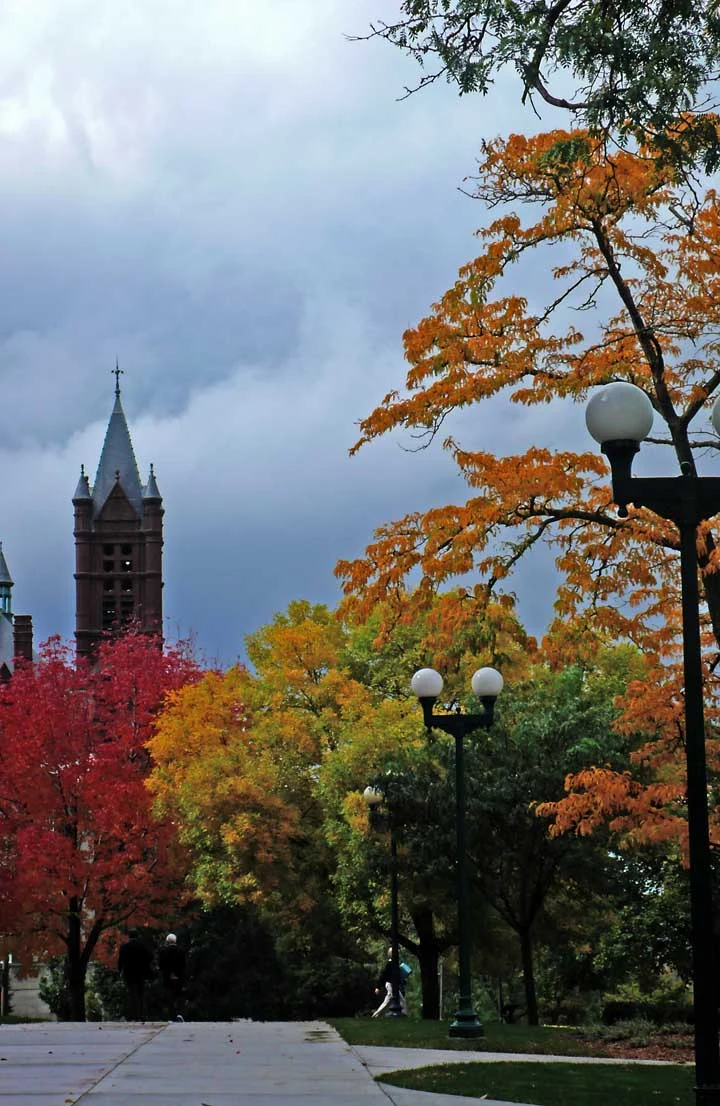
Leaves around Syracuse usually reach peak color in mid to late October. This summer, June through August 2026, brought 7.34 inches of rain to Syracuse Hancock International Airport, 3.78 inches below the 1991 to 2020 normal of 11.12 inches. As of September 7, 2026, New York’s weekly foliage report has not started its season, so there is no official color reading for the Syracuse area yet.
This story came from public records we pulled ourselves
Get the next one, plus overnight incidents, in your inbox at 6 AM. Free, no spam.
The timing comes from two sources. The SUNY College of Environmental Science and Forestry’s “CNY Fall Colors” guide, by Donald Leopold, says red maples “will often reach their maximum color intensity in mid to late September in the Adirondacks, but the third week of October in central New York,” and points readers to Green Lakes and Clark Reservation “in mid to late October.” I LOVE NY’s foliage planning page, updated August 7, 2026, lists the Finger Lakes region, where the state tourism office files Syracuse, at “mid-October through early November.”
What does the state foliage tracker say right now?
Nothing yet for 2026. On September 7, 2026, the I LOVE NY Fall Foliage Report page carried only preseason text: the season is “typically starting in late September and ending in November,” and a video shows “last year’s color-changing timeline.” No region has a percentage of change or a color call posted.
A September 3, 2025 release from Governor Kathy Hochul’s office said “more than 90 volunteers will track changes throughout the season,” and that their observations “will detail prevailing leaf colors, percentage of total transition, and total progression relative to peak conditions.” The 2025 reports returned on Wednesday, September 10, 2025, with updates every Wednesday. As of September 7, 2026, no 2026 start date appears on the report page, and the most recent launch announcement in the Governor’s newsroom is that 2025 release.
One detail for reading it: I LOVE NY’s Places to Go page lists Syracuse under the Finger Lakes, not under its separate Central New York region, so Syracuse-area readers should read the Finger Lakes line.
When is peak color, usually?
I LOVE NY’s planning page gives historical peak windows for its 11 regions, with the caveat that “Peak times are approximations based on prior years’ fall foliage reports, and fluctuations may occur.” It adds: “It takes about two weeks for the color to complete its cycle in any given area, with peak brilliance lasting three to four days in any one spot.” The regions closest to Syracuse:
| I LOVE NY region | Historical peak |
|---|---|
| Adirondacks | late September to mid-October |
| Thousand Islands-Seaway | mid- to late-October |
| Central New York | mid- to late-October |
| Finger Lakes (includes Syracuse) | mid-October through early November |
| Catskills | early to mid-October |
Leopold’s ESF guide is more specific about species around Syracuse. Under average weather, red maples peak in the third week of October; quaking aspen, Norway maple and larches “don’t reach their peak color until the last week of October or even later in central New York.” On what moves the dates, the guide says “weather is the primary factor that determines variation in fall color from year-to-year; latitude, elevation, local site conditions, and tree species determine the timing of fall color development within any year.”
How dry was summer 2026 in Syracuse?
The airport is the NOAA climate station for Syracuse (station SYR). The 3.78-inch shortfall is 34 percent below normal, and the summer ranks 14th driest of 77 complete summers on record there. July delivered 1.87 inches and August 1.46 inches, which by subtraction means June carried 4.01 inches. Temperature was close to normal: 70.95 degrees Fahrenheit against a normal of 70.00, the 17th warmest.
September has opened wetter. The station recorded 1.15 inches from September 1 through September 5, 2026, with 1.00 inch of that on September 2. The September 6 total had not been reported as of September 7.
Is Onondaga County in drought?
No, by the official measure. The U.S. Drought Monitor map dated September 1, 2026 (valid September 1 through September 7) puts 99.89 percent of Onondaga County in D0, “Abnormally Dry,” and 0.0 percent in any of the four drought categories, D1 through D4. The Monitor describes its scale this way: “abnormally dry (D0), showing areas that may be going into or are coming out of drought, and four levels of drought: moderate (D1), severe (D2), extreme (D3) and exceptional (D4).”
The county reached that reading fast. Every weekly map from May 26 through July 28, 2026 showed 0.0 percent of the county in D0. The August 4 map put 24.55 percent in D0, August 11 and 18 showed 24.05 percent, August 25 jumped to 85.4 percent, and September 1 reached 99.89 percent. So the accurate label is abnormally dry; drought on the Monitor’s scale starts at D1, and the county has not touched it on any map from May 26 through September 1, 2026.
What does dry stress do to fall leaves?
The authorities agree on the look and disagree on the timing.
On the look: Leopold’s guide says the “ideal weather” for color is “sunny and dry conditions, cool nights,” and the U.S. Forest Service pamphlet “Why Leaves Change Color” says brilliant red needs “warm sunny days followed by cool nights with temperatures below 45 F,” while “much warm, cloudy, rainy weather in the fall” can leave “less red coloration.” So dry weather during the fall itself is not the enemy of color. Summer dryness is different, because it stresses the tree before the season. Leopold writes: “Sugar maple and other species will develop much color in late summer if they are drought stressed, a common phenomenon for many tree species along streets of Syracuse where recent summer droughts and heavy salt loads gradually kill many sensitive tree species.”
Cornell University’s September 16, 2022 tip sheet, from a dry year, shows the split on timing. Arthur DeGaetano, director of the Northeast Regional Climate Center, is quoted saying “Such dry conditions, particularly if they extend into the fall, may delay the onset of fall colors,” and that trees “particularly hard hit by the dry conditions are likely to show only muted colors, with leaves dropping quickly.” Taryn Bauerle, a professor of plant science, is quoted saying “the lack of rain over most of the summer will cause many trees in dryer areas to start to change their leaves early.” Daniel Weitoish, an arborist at Cornell Botanic Gardens, wrote that trees “located in lawns, along roadways/sidewalks, and those with constricted root zones” were showing stress and “beginning to change color prematurely.”
Put together: individual stressed trees, especially street trees with cramped roots, tend to turn early, look duller and drop fast. Whether a whole region’s onset comes earlier or later depends on how the dryness carries into the fall, and the sources do not settle that. Nothing in this story predicts what the Syracuse area will look like in the third week of October 2026.
What to watch, and when
– The I LOVE NY weekly report. In 2025 and 2023 it published on Wednesdays. Read the Finger Lakes line for Syracuse.
– The U.S. Drought Monitor’s next county reading, on the map dated September 8, 2026.
Sources
- xmACIS climate summaries, NOAA Regional Climate Centers (ACIS), station SYR, Syracuse Hancock International Airport, summer 2026 (June through August) precipitation and temperature. https://xmacis.rcc-acis.org
- ACIS StnData API, station SYR, daily precipitation and temperature September 1 through 6, 2026, queried September 7, 2026. https://data.rcc-acis.org/StnData
- Fall Foliage Report (landing page as displayed September 7, 2026), I LOVE NY, New York State Department of Economic Development. https://www.iloveny.com/things-to-do/fall/foliage-report/
- Fall Foliage: When and Where to Go in New York State, I LOVE NY, originally published September 2, 2022, updated August 7, 2026. https://www.iloveny.com/blog/post/fall-foliage-when-and-where-to-go-in-new-york-state/
- Places to Go (Syracuse listed under the Finger Lakes region), I LOVE NY. https://www.iloveny.com/places-to-go/
- Falling for Foliage: Governor Hochul Welcomes Start of 2025 Autumn Travel Season, Office of Governor Kathy Hochul, September 3, 2025. https://www.governor.ny.gov/news/falling-foliage-governor-hochul-welcomes-start-2025-autumn-travel-season
- CNY Fall Colors, by Donald Leopold, Environmental Information Series, SUNY College of Environmental Science and Forestry. https://www.esf.edu/eis/eis-fall-colors.php
- Dry conditions may cause ‘patchy’ fall foliage season (tip sheet), Cornell Chronicle, Cornell University Media Relations, September 16, 2022. https://news.cornell.edu/media-relations/tip-sheets/dry-conditions-may-cause-patchy-fall-foliage-season
- Why Leaves Change Color (PDF), USDA Forest Service. https://www.fs.usda.gov/media/74087
- U.S. Drought Monitor county statistics, Onondaga County, N.Y. (FIPS 36067), percent of area by category, maps dated May 26 through September 1, 2026, queried September 7, 2026. https://usdmdataservices.unl.edu/api/CountyStatistics/GetDroughtSeverityStatisticsByAreaPercent?aoi=36067&startdate=6/1/2026&enddate=9/7/2026&statisticsType=1
- What is the USDM (category definitions), U.S. Drought Monitor, National Drought Mitigation Center. https://droughtmonitor.unl.edu/About/WhatistheUSDM.aspx
Every figure in this story is drawn from the records above. Links go to the primary documents.