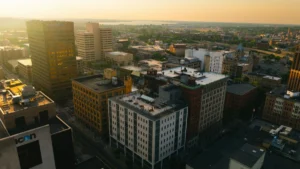
Syracuse Is Becoming a Different City. Here’s What’s Driving It.
A $100 billion chip factory, a highway coming down, an aquarium rising up, and a food scene that won’t quit — Central New York is in the middle of its biggest transformation in a generation.

Drive through Clay on a weekday morning and you’ll see something that would have been unthinkable five years ago: earthmovers and survey crews working a stretch of land north of Route 31 where Micron Technology is building the largest semiconductor facility in the United States. Swing south into downtown Syracuse and you’ll pass under the I-81 viaduct — or what’s left of it — where a $2.25 billion project is literally tearing down the highway that divided the city for 60 years. Keep going to the Inner Harbor and you’ll find the steel skeleton of an 80,000-square-foot aquarium rising from the shoreline.
Something is happening in Syracuse. Not the tentative, “wouldn’t it be nice” kind of optimism that has come and gone over the decades. This is steel in the ground, cranes in the air, and hundreds of people lining up for paid job training at a converted building on South Salina Street. The numbers are staggering, but what matters more is the texture: the new Vietnamese restaurant in Armory Square, the cheese bar opening in Eastwood, the 152 mixed-income apartments in a 1929 landmark designed by the same architects who drew up the Empire State Building.
Here’s what’s actually happening — and why this time feels different.
The Micron Effect: $100 Billion and Counting
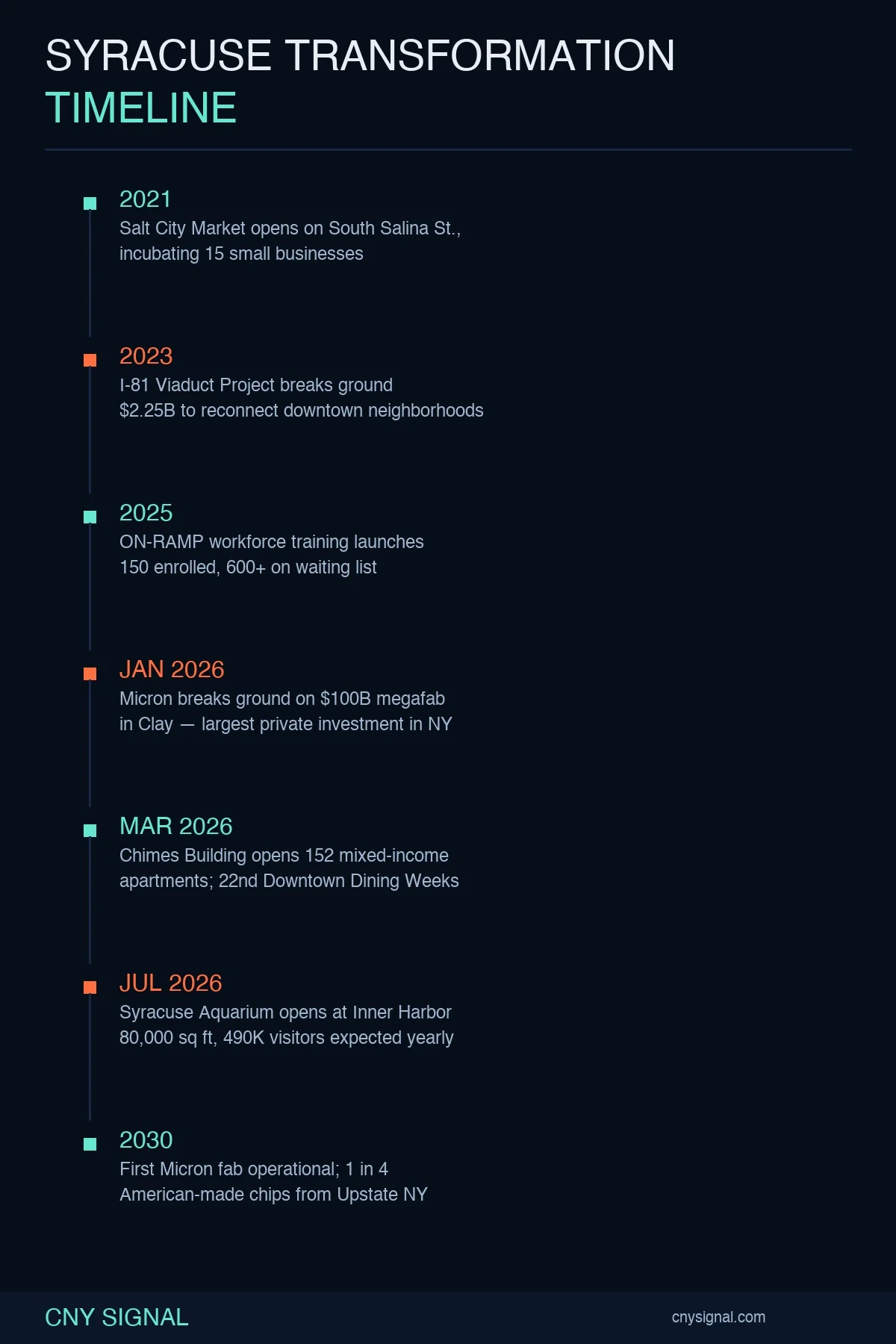
On January 16, 2026, Governor Kathy Hochul stood in a muddy field in the Town of Clay and broke ground on what Micron Technology calls its New York megafab — a campus of up to four semiconductor fabrication plants that represents the single largest private investment in New York State history.
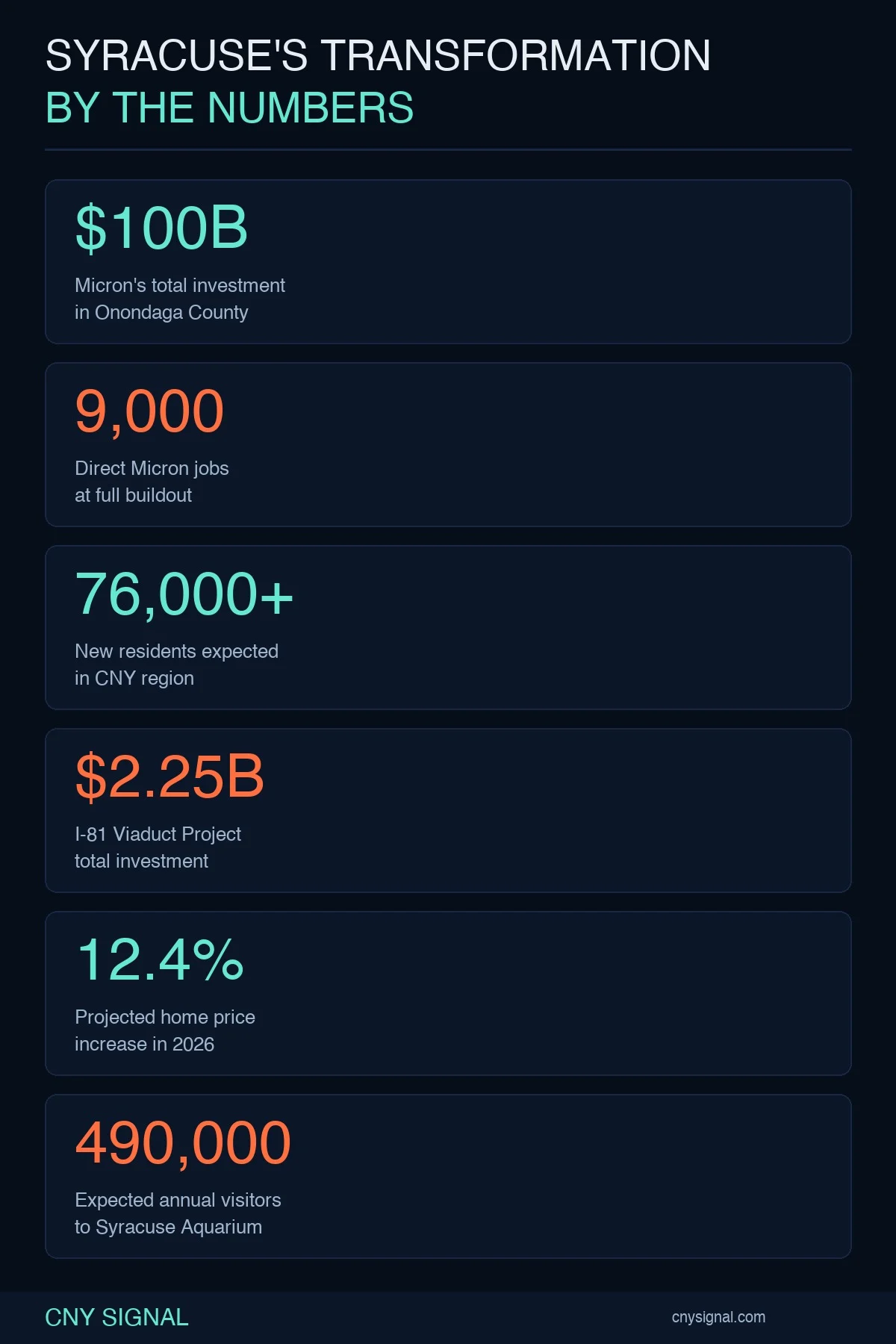
The scale is hard to comprehend. Micron has committed up to $100 billion over the next two decades. The first fab is expected to come online in the third quarter of 2030. At full buildout, the complex will employ 9,000 people directly — roughly the same headcount as Upstate Medical University, currently the region’s largest employer. But the downstream effects dwarf even that number: state projections estimate the project will attract 76,000 new residents to Central New York and create a total of 50,000 jobs across the supply chain, according to the Governor’s office.
The chips Micron will produce here — advanced DRAM and high-performance memory for AI systems and cloud data centers — are the kind of product that governments worldwide are competing to manufacture domestically. Micron is eligible for up to $6.165 billion in federal CHIPS Act funding to support the project, though the company has redirected approximately $1.2 billion of that to accelerate construction at its Boise, Idaho facility while the Clay timeline firms up.
By 2030, one in four American-made semiconductor chips will be manufactured in and around Upstate New York — no other region will account for a greater share of domestic production.
The ripple effects are already measurable. Realtor.com’s 2026 forecast ranked Syracuse second in the nation for projected home price increases, at 12.4 percent year-over-year — a figure driven largely by Micron-related anticipation, according to CNYCentral. Redfin separately named Syracuse one of the markets most likely to boom in 2026. And in a telling data point that speaks to the city’s emerging national profile: San Francisco homebuyers searched to move into Syracuse more than any other metro area in the country.
Tearing Down the Wall: I-81 Enters Its Most Visible Phase
If Micron is the region’s future, the I-81 Viaduct Project is the reckoning with its past. The 1.4-mile elevated highway that has bisected Syracuse since the 1960s — severing the historically Black 15th Ward from downtown, casting a literal shadow over South Salina Street — is coming down.
Phase Two of the $2.25 billion project began in earnest this year, and 2026 is when Syracuse drivers will start to see the most dramatic changes. The state is rebuilding the stretch from Leavenworth to Crouse Avenues, replacing aging water and sewer lines beneath Erie Boulevard and Salina Street, and constructing new interchange connections. A new entrance ramp from North Crouse Avenue to I-690 eastbound opened recently — the first of several new connections created by the street-level Community Grid that will replace the elevated highway.
The state plans to close part of the elevated highway by the end of 2026, with the rest expected to come down through 2027 and 2028. New renderings show the Inner Harbor and Northside transformed by the project’s third phase, with new sidewalks, landscaping, bike infrastructure, and rebuilt bridges reconnecting neighborhoods that the highway separated for generations.
“This is a once-in-a-lifetime infrastructure project,” Syracuse Common Councilor Jimmy Monto told CNYCentral. The construction headaches are real — lane shifts, detours, and the general chaos of tearing apart a city’s circulatory system. But the promise on the other side is a downtown that, for the first time in most residents’ lifetimes, is stitched together rather than sliced apart.
The Aquarium, the Apartments, and the Bet on Downtown
While the highway comes down and the chip factory goes up, a third megaproject is taking shape at the Inner Harbor. Onondaga County’s new aquarium — an 80,000-square-foot facility managed by ZoOceanarium Group, the same company that operates the St. Louis Aquarium — is about two-thirds complete and targeting a July 2026 opening, per CNYCentral reporting.
The project has grown from an $85 million initial estimate to over $100 million. County Executive Ryan McMahon has acknowledged a $2 million funding gap that he expects private donations and naming rights to close. The facility will employ 50 to 60 staff and is projected to draw 490,000 visitors annually — a number that, if achieved, would make it one of the most-visited attractions in Upstate New York. It’s also slated to become a filming location for “Emergen-Sea,” a children’s show focused on wildlife protection.
Three blocks south, the Chimes Building at 500 South Salina Street is finishing a $48 million renovation that tells a quieter but equally important story about who Syracuse is becoming. The 12-story landmark — designed in 1929 by Shreve, Lamb and Harmon, the same firm that designed the Empire State Building two years later — is reopening with 152 mixed-income apartments where two-thirds of units are priced below market rate. Every apartment, whether affordable or market-rate, is built to the same standard: same appliances, same finishes, same access to the fitness center, community room, and rooftop patio, according to the Allyn Family Foundation.
The Allyn Foundation, the nonprofit behind Salt City Market, funded the Chimes purchase through an affiliate called SEED Syracuse — Social Equity Economic Development. JPMorganChase contributed an $11.8 million Historic Tax Credit equity investment. Leasing began in March 2026.
A Food Scene That Reflects the City Syracuse Is Becoming
Walk through Salt City Market on a Saturday afternoon and you’ll hear Arabic spoken at Baghdad Restaurant, Vietnamese at Mamma Hai, patois at Erma’s Island. Five years after the market opened as a risky experiment in community-driven economic development, six of its 10 original vendors are still operating — and several have outgrown the space entirely. Cake Bar expanded to a second location and now employs 30 people. Baghdad opened a standalone restaurant. In its first four years, the market incubated 15 small businesses, most founded by Syracuse residents with no prior entrepreneurial experience.
The newest additions — Doomsday Pasta, with its stone-milled flour and regionally produced salt, and Masala Heaven, bringing Indian favorites like butter chicken and samosas to the food hall — reflect a city whose culinary ambitions are growing alongside its population.
Beyond the market, the 2026 restaurant scene reads like a love letter to Syracuse’s increasing diversity:
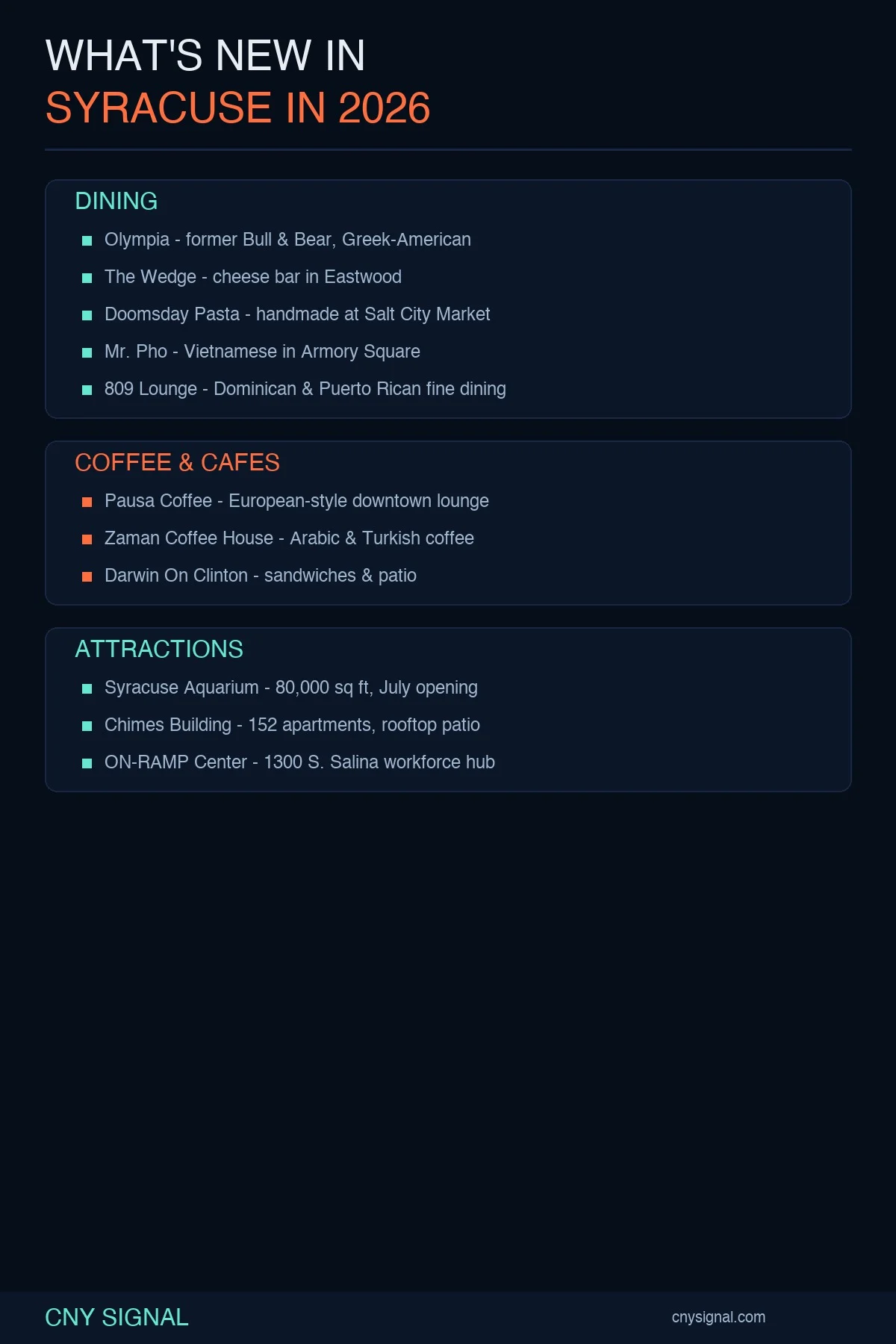
- Olympia — Nick and John Ioannidis, owners of the beloved Gardenview Diner near Liverpool, purchased the former Bull & Bear for $950,000 and spent months renovating it into a Greek-American restaurant with new windows, seating, and a remodeled kitchen.
- The Wedge — Sarah Simiele, owner of The Curd Nerd, is opening a cheese-centric bar and restaurant in Eastwood on Easter weekend, with curated boards, family-style shareables, and signature cocktails.
- Mr. Pho — Authentic Vietnamese in Armory Square, serving pho, banh mi, spring rolls, and stir-fried entrees.
- 809 Lounge and Restaurant — Fine dining with Dominican and Puerto Rican flavors on South Warren Street, bringing an NYC-caliber experience to the city’s core.
- Pausa Coffee — A European-style cafe and cocktail lounge downtown, named after the Italian word for “pause,” that transforms from specialty coffee house by day to refined lounge by night.
March’s 22nd annual Downtown Syracuse Dining Weeks drew more than 50 participating businesses — from Dinosaur Bar-B-Que to Funk ‘n Waffles to Pastabilities — a testament to a restaurant ecosystem that keeps deepening.
The Workforce Pipeline: 600 People on a Waiting List
Perhaps the most telling indicator of what’s shifted in Syracuse is what happened when New York State opened enrollment for the ON-RAMP workforce training program. The initiative — part of a $200 million statewide investment to build four advanced manufacturing workforce centers in Upstate New York — launched its first cohort in Syracuse in February 2026. The program pays students up to $20 an hour to attend 12-week certification courses in advanced manufacturing and construction trades.
One hundred fifty people enrolled in the first cohort. Six hundred more signed up for the waiting list, according to reporting from This Is CNY.
The flagship ON-RAMP facility is being built at 1300 South Salina Street — the former Sears Building — with an $8.5 million Phase 1 investment from Empire State Development. Until the permanent center opens, training is running out of a temporary location at 1224 Genesee Street with three technical partners: Jubilee Homes, Pathways to Apprenticeship, and SUNY Educational Opportunity Center. On Point for College handles career readiness. Community organizations CNY Works and RISE manage outreach.
Add in the $15 million Micron Cleanroom Simulation Lab at Onondaga Community College — where students can train on the same equipment they’ll operate in an actual fab — and you start to see the outline of a workforce pipeline that didn’t exist three years ago. A pipeline that leads, eventually, to jobs paying six figures in a city where the median household income is $47,819.
Climate Haven, College Town, Comeback City
There’s a quieter force pulling people toward Syracuse that has nothing to do with semiconductors or tax credits. As wildfires ravage the West Coast and hurricanes batter the Southeast, climate researchers have increasingly identified the Great Lakes region — and Syracuse specifically — as a climate haven. Joshua Cousins, an environmental studies professor at SUNY ESF, has noted that the region is positioned to receive both climate migrants (people choosing to relocate for a more resilient environment) and climate refugees (people displaced by disaster).
The metro area population hit an estimated 427,000 in 2025, up from 422,000 in 2023 — modest growth, but a reversal of decades of decline. Projections from MacroTrends put the metro at 464,000 by 2035. Syracuse also ranked sixth nationally among the best markets for first-time homebuyers in 2026, according to Realtor.com, with a median home price of $180,000 — 58 percent below the national average.
As of late March 2026, the city is finalizing its first-ever Climate Action Plan, with public comment open through April 21. It’s the kind of forward-looking planning that suggests Syracuse isn’t just passively benefiting from national trends — it’s positioning itself to catch them.
The Bottom Line
Syracuse has heard the “comeback” narrative before. The difference this time isn’t optimism — it’s concrete. It’s $100 billion in Clay, $2.25 billion through the center of the city, $100 million at the Inner Harbor, $48 million on South Salina Street. It’s 150 people getting paid to learn how to build semiconductors and 600 more who want in. It’s a cheese bar in Eastwood and a Dominican fine-dining spot on South Warren and a food hall where a cake business grew from a market stall into a 30-employee operation.
None of this is guaranteed to work. Micron’s timeline has already slipped. The aquarium is $2 million short. The I-81 construction will test every commuter’s patience for years. But for the first time in a long time, the question in Syracuse isn’t “What if something good happened here?” It’s “Can we keep up with everything that’s already happening?”
That’s a much better question to have.
Sources: Governor’s Office press releases; CNYCentral; This Is CNY; Realtor.com; Redfin; CenterState CEO; CNYBJ; Allyn Family Foundation; Spectrum News CNY; WSYR; LocalSYR; Onondaga County; Empire State Development; MacroTrends; Syracuse.com/Post-Standard; WAER
By the Numbers