The $100 Billion Neighbor: What Micron’s Clay Groundbreaking Actually Means for Everyday CNY Residents
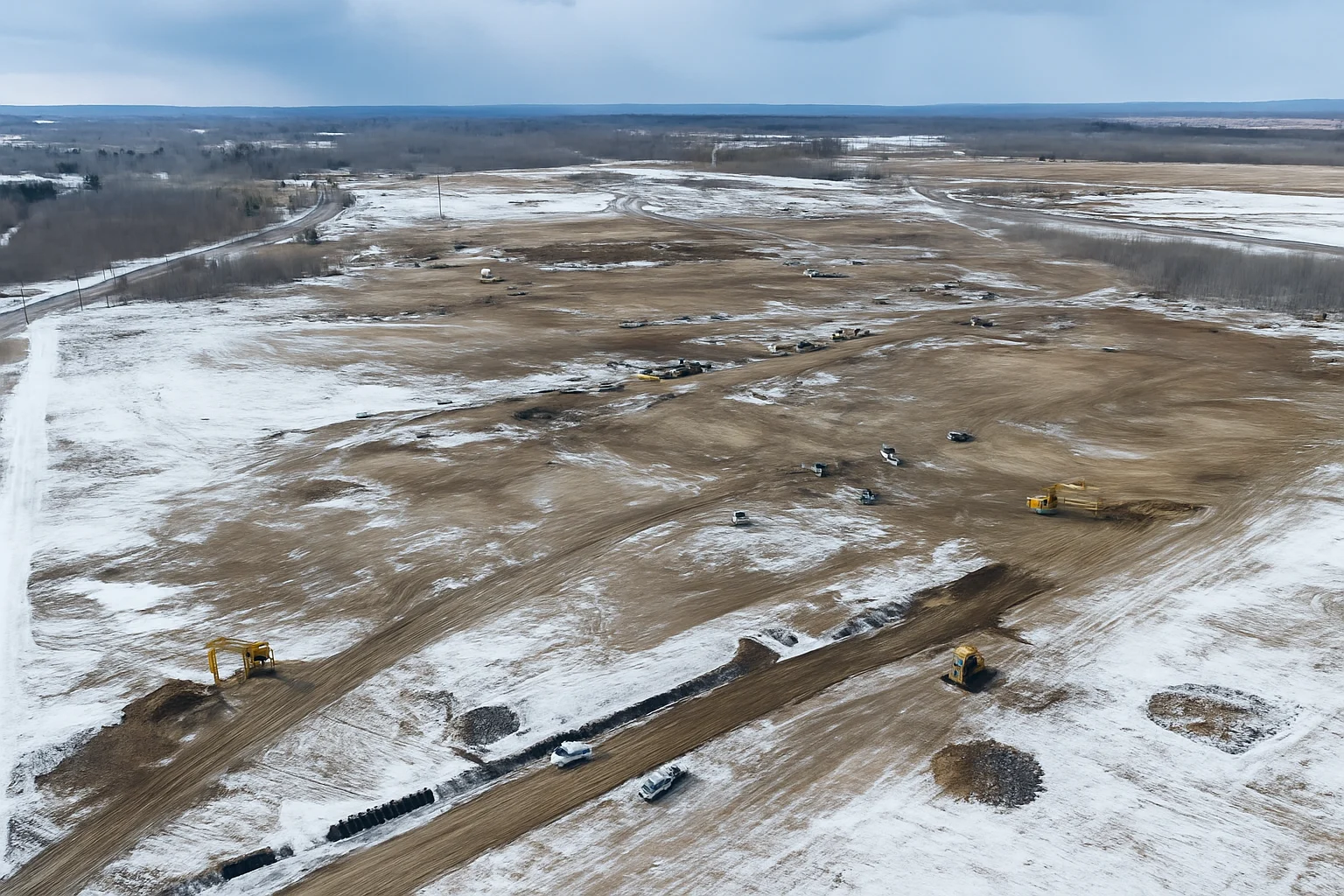
If you’ve driven Route 31 through Clay lately, you already know something enormous is happening. The farmland north of Caughdenoy Road — land that for decades grew nothing more remarkable than corn and soybeans — is now the site of the largest private investment in New York State history. Micron Technology is building a semiconductor fabrication complex here that, at full buildout, will represent more than $100 billion in capital spending. That number is not a typo.
For a region that watched Carrier leave, that saw Bristol-Myers Squibb scale back, that has spent a generation trying to redefine itself beyond “it snows a lot,” the Micron project is the kind of thing that doesn’t quite feel real yet. But the excavators are real. The traffic on Route 31 is real. And the ripple effects — on housing, schools, water, wages, and the daily texture of life in Clay, Cicero, North Syracuse, and well beyond — are already beginning.
The Numbers Behind the Dirt
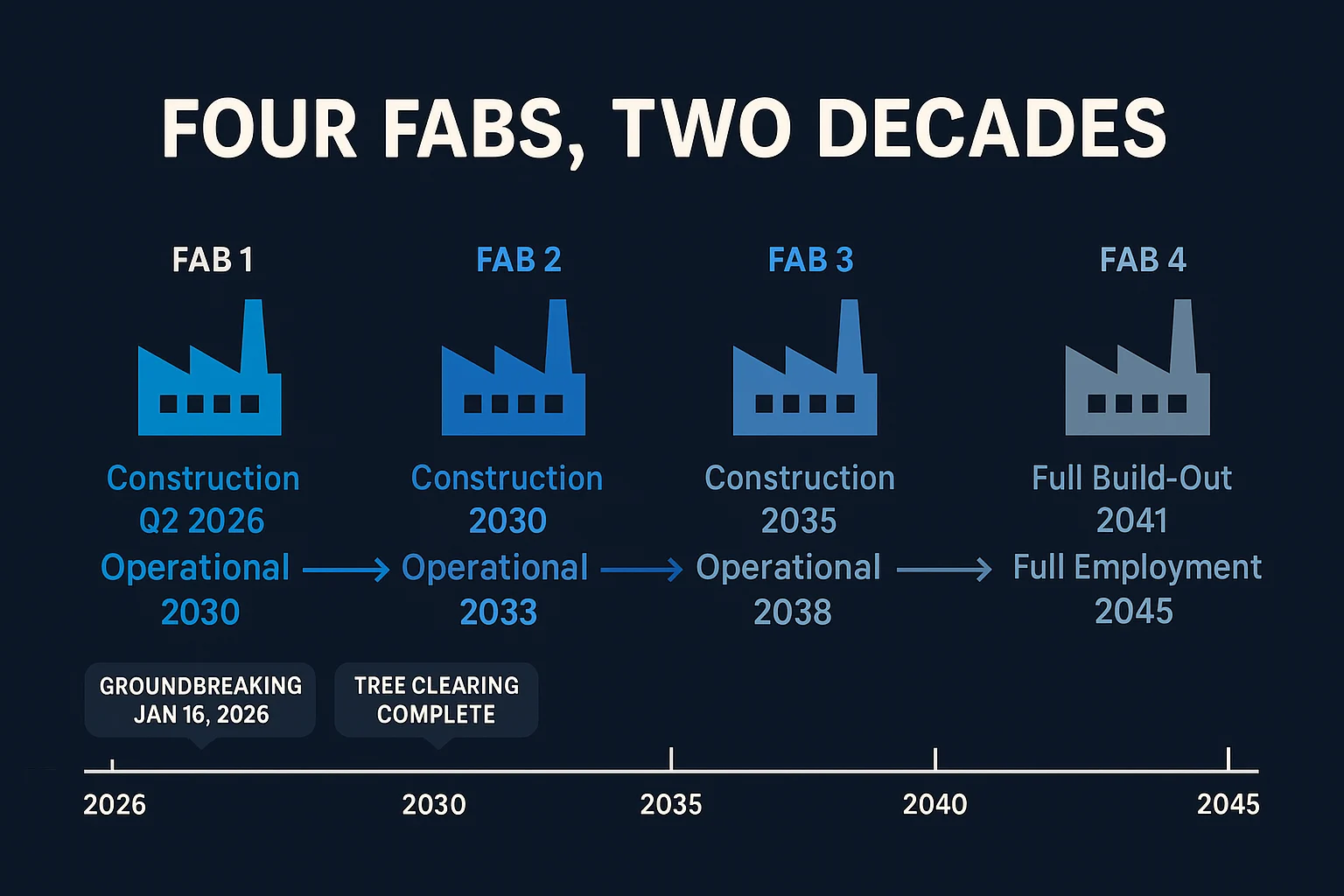
Here’s what Micron has committed to, and what federal and state governments have committed to Micron: the company plans to build four semiconductor fabrication plants on roughly 1,300 acres in the town of Clay. The first fab, known as Fab 1, broke ground in 2024 and is expected to begin producing advanced DRAM memory chips by 2028 or 2029. Each fab is a clean-room facility of extraordinary precision — the kind of place where a single speck of dust can ruin a chip worth thousands of dollars.
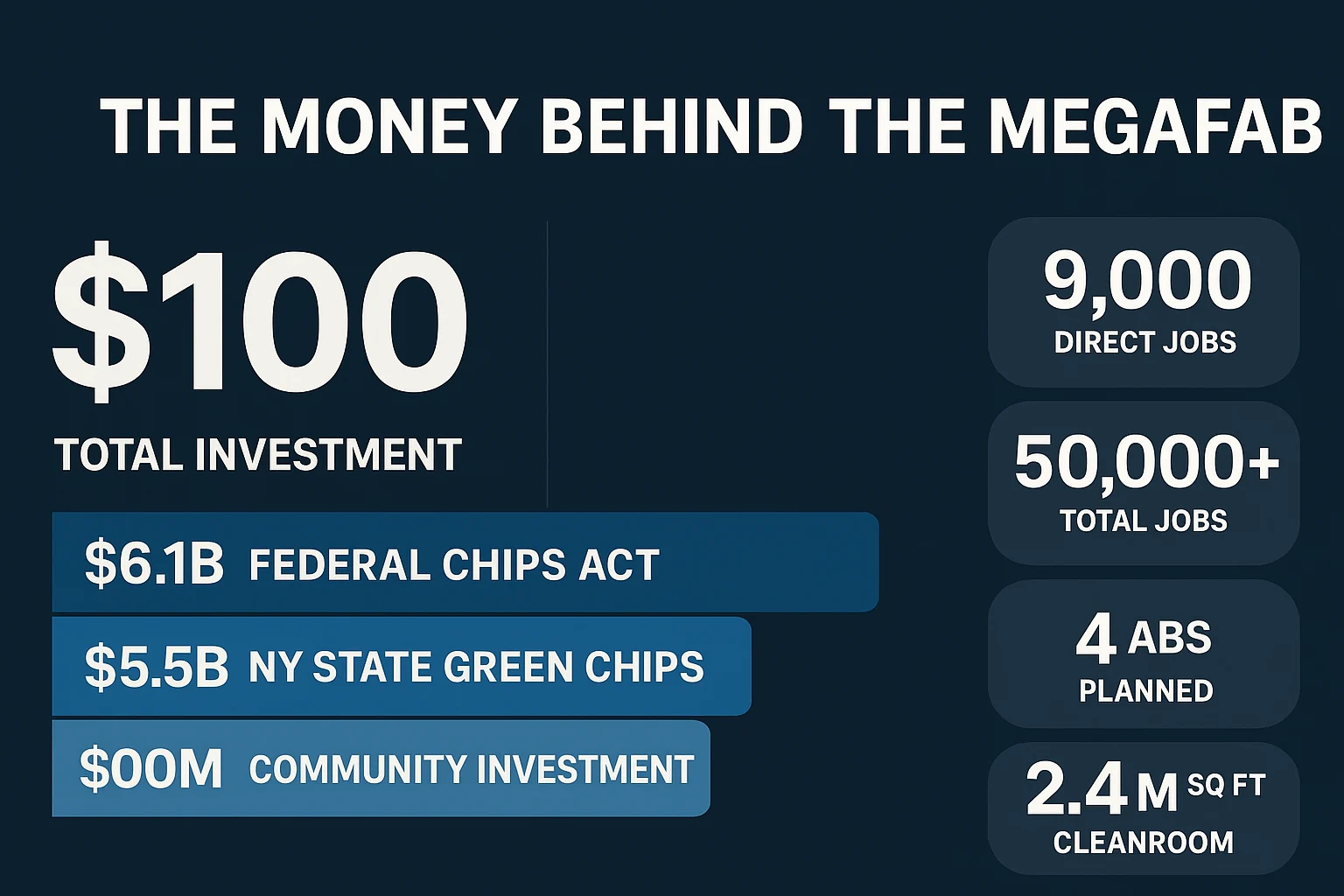
The federal government, through the CHIPS and Science Act, has pledged up to $6.1 billion in direct funding to Micron for its New York operations, plus up to $7.5 billion in federal loans. New York State added its own incentive package worth up to $5.5 billion in tax credits over 20 years through the Green CHIPS program — the largest state incentive deal in American history. In exchange, Micron has promised up to 9,000 direct manufacturing and engineering jobs at the Clay campus when all four fabs are running, with an average salary the company has projected at approximately $100,000.
But the direct jobs are only part of the equation. Micron’s own economic impact projections, echoed by analyses from the Onondaga County Industrial Development Agency, estimate that the project will generate more than 40,000 indirect and induced jobs across the region — construction workers, engineers, suppliers, restaurant staff, teachers, nurses, all the people who make a community function when 9,000 new high-paying workers show up.
What You’ll Actually Notice
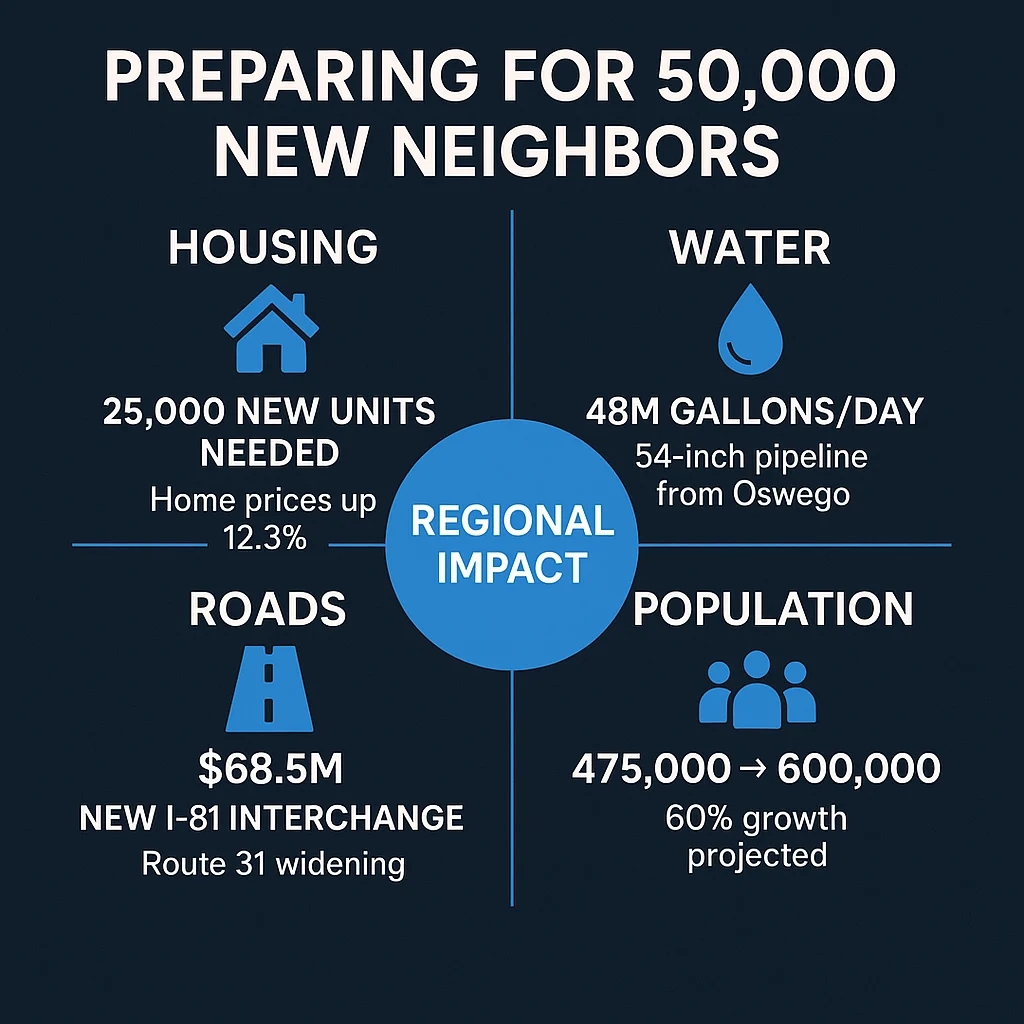
Let’s start with the obvious: traffic. Route 31 between Cicero and Clay was not designed for a megafab. The New York State Department of Transportation has identified more than $250 million in planned road improvements in the area surrounding the Micron site, including widening and interchange work along Route 31 and connections to I-81. During construction alone, Micron has estimated a peak workforce of approximately 9,000 construction workers on site. If you commute through Clay, plan accordingly for the next several years.
Then there’s housing. Onondaga County’s housing market was already tight before Micron, with vacancy rates hovering around 4 percent in the northern suburbs. The Central New York Regional Planning and Development Board has projected the region will need between 5,000 and 10,000 new housing units to accommodate the Micron-driven population growth. Home prices in Clay, Cicero, and Manlius have already ticked upward. For homeowners, that’s equity. For renters and first-time buyers, it’s a source of real anxiety.
Schools will feel it too. The North Syracuse Central School District, which serves much of the area closest to the fab site, currently enrolls roughly 8,500 students. District officials have been planning for enrollment increases as families move in, though the timeline depends heavily on how quickly Micron ramps hiring. Liverpool and Cicero-North Syracuse districts are watching the same trend lines.
The Concerns That Deserve Honest Answers
Semiconductor fabrication uses enormous quantities of ultrapure water. Micron’s environmental impact filings indicate that the Clay complex could require up to 7 million gallons of water per day at full buildout — a figure that has drawn scrutiny from environmental groups and residents alike. The Onondaga County Water Authority has said the region’s water supply, drawn primarily from Lake Ontario via the Oswego County system and from Skaneateles Lake, can accommodate the demand, but infrastructure upgrades will be necessary. Those upgrades carry public costs.
There are also questions about the chemical byproducts of chip manufacturing, including PFAS compounds, which have drawn increasing regulatory attention nationally. Micron has committed to what it calls “industry-leading” environmental standards at the Clay site and is subject to ongoing review by the New York State Department of Environmental Conservation. Community groups in Clay have pushed for transparent, continuous environmental monitoring — a reasonable ask given the scale of the operation and its proximity to residential neighborhoods.
And then there is the question that locals discuss most quietly: what if it doesn’t work out? The semiconductor industry is cyclical. Micron itself went through a round of layoffs in 2023. The four-fab buildout is projected to take 20-plus years, and each phase depends on market conditions, government funding, and global chip demand. Phase one is funded and moving. Phases two through four remain commitments, not guarantees.
What It Actually Means
Here is the plainest way to put it: Central New York is becoming a place where some of the most advanced technology on Earth will be manufactured, in a town where you can still get a decent breakfast at a diner and where people argue about Section III basketball. That contrast is going to define this region for the next decade.
The money is real. The jobs are coming, if not quite as fast as the headlines suggest. The disruptions — to traffic, housing costs, water infrastructure, and the rural character of towns like Clay — are also real and deserve sustained attention, not just ribbon-cutting applause.
For everyday CNY residents, the Micron project is neither a silver bullet nor a threat. It’s a massive, complicated, slow-moving transformation of the place we live. It deserves clear-eyed coverage, not hype — and that’s exactly what we intend to provide.
CNY Signal covers the economy, infrastructure, and public life of Central New York. Tips and corrections: [email protected]