By Sarah Chen, Staff Reporter
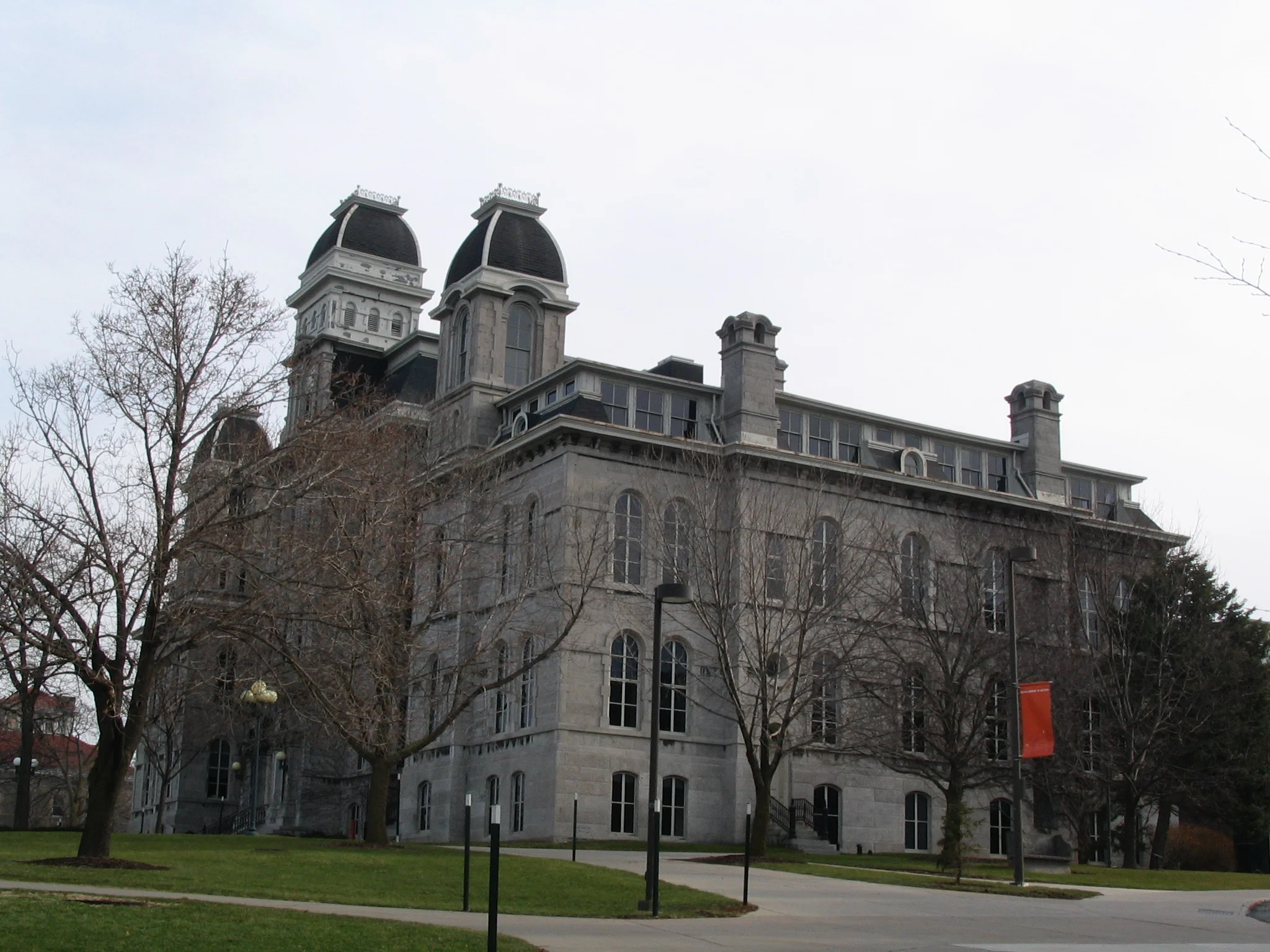
A 391-million-year-old gray stone runs in a band south of Syracuse, surfacing through Pompey, LaFayette, Jamesville and Manlius before sliding under DeWitt and east toward the Mohawk Valley, and it built most of the things you would put on a postcard: the Hall of Languages at Syracuse University, the underwater anchorages of the Brooklyn Bridge, the lock walls of the original Erie Canal. It is one of the most consequential building materials in New York history, and almost no one in Syracuse can name it.
391 Million Years to Now
391.9 Ma Tropical sea floor begins building reef south of equator (Eifelian).
Know before your neighbors do
The Morning Signal hits your inbox at 6 AM with everything that happened overnight. Real incidents, real data, zero fluff.
383.7 Ma Acadian Orogeny shuts down deposition (Givetian).
14,000 yr ago Last glacier retreats; Onondaga Escarpment exposed.
1823 First Erie Canal locks built of Onondaga limestone.
1839 Hall & Vanuxem name the formation in NY Geological Survey 3rd Annual Report.
1841 Nine Mile Creek Aqueduct completed in Camillus.
1867 Gridley Building opens at Clinton Square.
1873 Hall of Languages opens, $136,000 build.
1883 Brooklyn Bridge opens; cable anchorages contain Onondaga limestone.
2026 Jamesville Quarry mines ~2.2M tons / year as crushed aggregate.
The Stone You Walk Past Every Day
If you have ever climbed the steps of the Hall of Languages on the Syracuse University quad, you have put your hand on a 391-million-year-old fossil reef.
The stone is called Onondaga Limestone, and it is gray, sometimes faintly bluish, and hard enough that the Erie Canal’s first commissioners did not believe it could be cut at all. The band runs across central New York from the Hudson River valley west to Lake Erie, passing just south of Syracuse. Most of the great stone buildings of nineteenth-century Onondaga County are made of it, as is the underwater base of one of the most famous bridges in the country.
It Used to Be a Reef. Then Mountains Buried It.
Roughly 392 million years ago, in the Middle Devonian period, what we now call Central New York sat south of the equator under a warm, shallow tropical sea. Geologists put the latitude between 0 and 30 degrees south during that span, in line with what is today the Bahamas or northern Australia. The water was clear and the climate was hot, and the living seafloor of that era became the Onondaga Limestone.
For about eight million years, calcium carbonate built up in layers across what is now New York. Coral colonies grew into reefs. Crinoids, stalked relatives of starfish, carpeted the bottom. Brachiopods, hard-shelled filter feeders, encrusted everything they could attach to. Trilobites scuttled across the mud. When those organisms died, their shells piled up and pressure did the rest.
Then the mountains came. The Acadian Orogeny, the same continental collision that built the proto-Appalachians, shed sediment into the basin from the east, muddying the water and killing off the reefs. The Onondaga formation was the last great phase of carbonate reef building in the region for tens of millions of years. After that, it sat underground.
It sat there a long time, through several glaciations, while the continent drifted north of the equator. Around 14,000 years ago the most recent ice sheet retreated and left a long ridge of resistant gray rock running roughly east to west across central New York. This is the Onondaga Escarpment, similar to but less prominent than the Niagara Escarpment that produces Niagara Falls. It runs from a few feet tall in some places to about 245 feet at its highest, and it forms the southern shoulder of the Mohawk and Finger Lakes country. People building things noticed.
Naming the Bedrock
The Onondaga Escarpment
A gray band, Hudson Valley to Niagara River
Buffalo
Rochester
Syracuse
Utica
Albany
Schematic only. Source: New York State Geological Survey; Wikipedia Onondaga Limestone band description.
In 1839, the New York Geological Survey published its Third Annual Report. Two of the state’s geologists, James Hall and Lardner Vanuxem, formally described the limestone unit and named it for Onondaga County, where its outcrops are most accessible. Hall would go on to become one of the most important paleontologists of the nineteenth century and the first director of the New York State Museum. Together with Vanuxem, his reports gave the Onondaga its name.
Modern geologists divide the formation into four members: Edgecliff, Nedrow, Moorehouse, and Seneca. The Edgecliff is the famous one. It is a coarsely crystalline coral biostrome, light gray to faintly pink, and in places contains massive reef structures up to nearly two miles across and 200 feet thick. It is the layer most people picture when they picture an old reef, and the layer that holds up some of the best-known buildings in the state.
The Buildings
Six Structures Built From Onondaga Limestone
| Structure | Built | Location |
|---|---|---|
| Hall of Languages | 1873 | Syracuse University |
| Gridley Building | 1867 | Clinton Square, Syracuse |
| Brooklyn Bridge (cable anchorages, underwater towers) | 1883 | Brooklyn / Manhattan |
| Nine Mile Creek Aqueduct | 1841 | Camillus |
| Limestone Creek Aqueduct | 1856 | Fayetteville |
| Genesee County Courthouse | 1840s | Batavia |
Ask the average Syracusan what the Hall of Languages is made of and the most common answer is “stone.” That is technically correct. The full answer is a Devonian reef.
The Hall of Languages, designed by Horatio Nelson White and built between 1871 and 1873, is the oldest building on the Syracuse University campus. For its first fourteen years, it was the university. White picked Onondaga limestone for the facade and the towers, in the Second Empire style, for $136,000. According to Syracuse University’s archives, the stone was quarried in the valley to the south, on Onondaga Nation territory, and contains the fossilized remains of the area’s earliest sea-floor inhabitants. Every SU student has, at some point, leaned a backpack against a fossil.
White also designed the Gridley Building on Clinton Square, completed in 1867 as the Onondaga County Savings Bank. That exterior is also Onondaga limestone, pulled from quarries on Onondaga Nation territory and finished in a stone yard. The Gridley was listed on the National Register of Historic Places in 1971 and still stands at Hanover Square, including the original 100-foot four-faced clock tower.
Drive west on Route 5 and the limestone keeps showing up. The Genesee County Courthouse in Batavia, a three-story Greek Revival structure built in the 1840s, is Onondaga limestone, quarried at Consider Warner’s Quarry in Le Roy. The White Memorial Building in downtown Syracuse is also Onondaga stone.
The most surprising entry, for most Central New Yorkers, is in Brooklyn.
Brooklyn Bridge, Anchored to Onondaga County
The Brooklyn Bridge opened on May 24, 1883, after fourteen years of construction. Its towers and anchorages are masonry of three materials: granite from Vinalhaven Island, Maine, above the deck; Rosendale natural cement; and limestone below the waterline, where the limestone is less prone to rainwater erosion. The bridge’s great trapezoidal anchorages, each weighing 60,000 short tons, are described in the Library of Congress’s collection of original 1875 specifications as “cut facestone, backing, and archstone of limestone.”
The Wikipedia entry on Onondaga Limestone, citing engineering surveys, lists the Brooklyn Bridge cable anchorages and the underwater portions of the towers among the structures built from the formation. The Brooklyn Bridge’s own published material is more general, identifying the limestone source as the Clark Quarry in Essex County. Engineering historians note that limestone for the underwater masonry came from multiple New York quarries during construction. Onondaga Limestone, with its established commercial supply chain via the Erie Canal and known properties of being hard, dense, and easy to dress, was a documented source for masonry projects of that scale across the state in the 1870s and 1880s.
The takeaway is straightforward. The bedrock under Onondaga County helped build the bridge between Manhattan and Brooklyn. Most people who walk it have never heard of it.
The Erie Canal Sat on This Stone, Too
Before the Hall of Languages and before the Brooklyn Bridge, the first big test of Onondaga limestone was the Erie Canal.
When DeWitt Clinton’s commissioners began planning lock walls and aqueducts, they did not believe the stone of central New York could be cut to dimension. They were wrong. By 1823, Onondaga limestone had been used to build five locks between the Salina branch canal and the main Onondaga canal, plus the Lodi locks and most of the front stone of the Oswego canal locks. Around 1,500 men worked the quarries that supplied them.
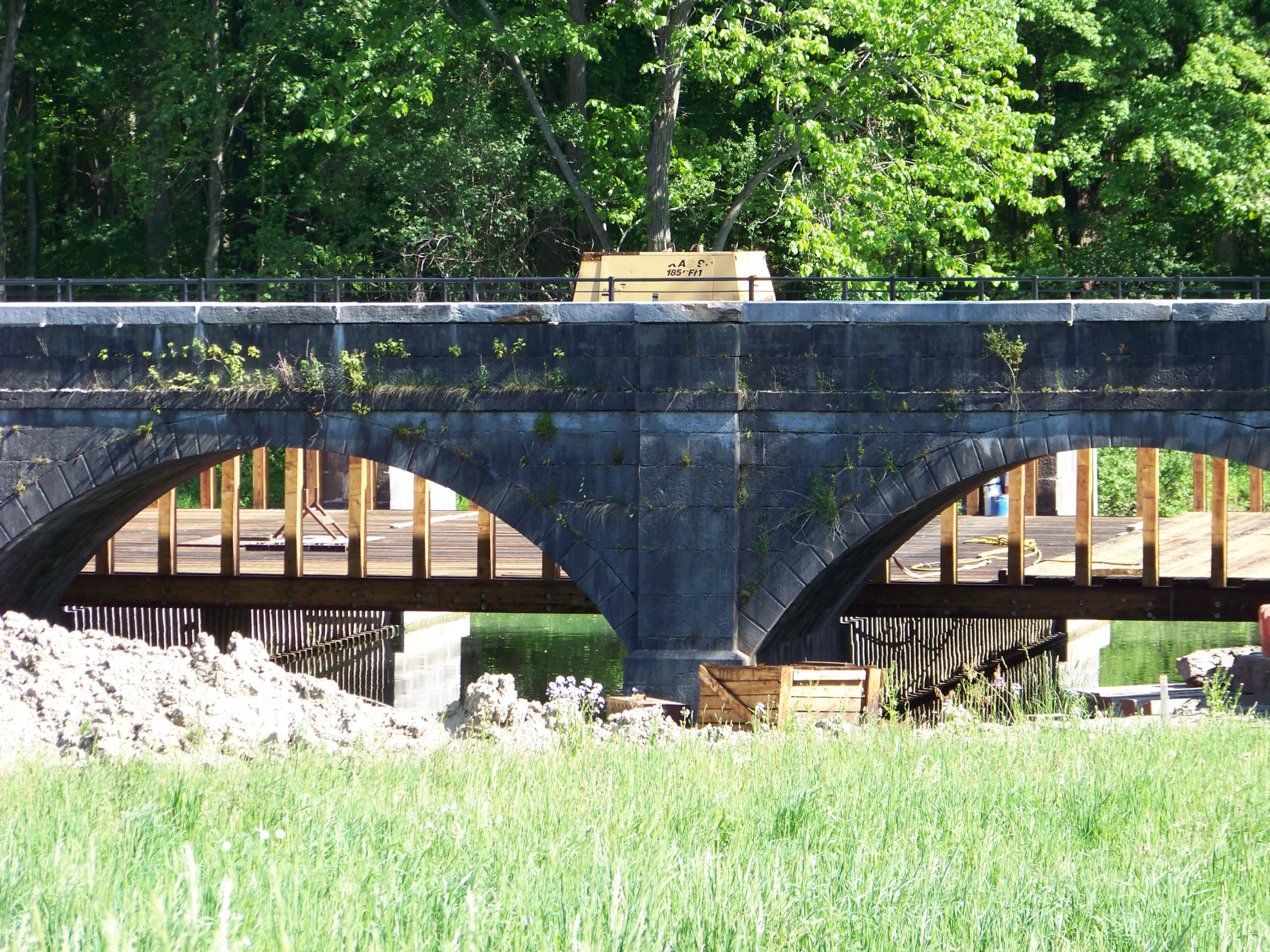
The most beautiful surviving example is the Nine Mile Creek Aqueduct in Camillus. Built between 1838 and 1841, the structure carried the enlarged Erie Canal across Nine Mile Creek on four stone arches of Onondaga limestone, all of it quarried from Split Rock just a few miles south. It is 144 feet long. In August 2009, after a forty-year restoration effort by the town of Camillus, a canal boat crossed the aqueduct for the first time in 89 years. It is the only restored navigable Erie Canal aqueduct of the original 32 in New York. It is in your county, it is open, and you can walk on top of it.
The Limestone Creek Aqueduct was completed in 1856 in Fayetteville, also of Onondaga stone. The Rochester aqueduct over the Genesee was rebuilt in 1842 in Onondaga limestone. The pattern repeats across the line of the canal.
The Quarries
Three Quarries That Built CNY
Three quarry operations did most of the heavy lifting in the nineteenth and early twentieth centuries.
Split Rock, in Camillus, was opened by Gilbert Coons around 1834. It supplied the stone for the Nine Mile Creek Aqueduct and many of the canal-era locks. In 1880 the Solvay Process Company expanded operations and built a four-mile elevated bucket conveyor that ran limestone from the quarry to its soda-ash plant on Onondaga Lake. Quarrying ceased around 1912. In 1915, the abandoned quarry became a munitions plant for the Semet-Solvay Process Company in support of World War I, employing roughly 2,500 workers. On July 2, 1918, a fire and explosion killed approximately 50 people, most from inhaling the noxious gas. The site is now a 32-acre New York State Unique Area open to the public.
Jamesville, straddling the towns of DeWitt and LaFayette, is the modern industrial monster. Operations began in the 1850s and expanded in 1909 to feed the Solvay process. When Solvay closed in 1986, the operation left behind 70 million tons of waste rock that became a principal source of construction aggregate. The quarry is operated today by Heidelberg Materials and covers about 2,238 acres of the Onondaga Escarpment. According to filings cited by the Onondaga Nation, the site mines roughly 2.2 million tons of stone per year. It is the largest open-pit mine in New York State.
The third operation is harder to pin to a single name because it was a network. After the 1788 Treaty of Fort Stanwix dramatically reduced Onondaga Nation territory, “valuable limestone quarries” on the east side of the reservation were leased to non-Native operators, with as many as six derricks in production at once paying $100 each per year to the Nation, according to county genealogical histories. Stone from those leased quarries went into the Hall of Languages and the Gridley Building, among others.
What Is Actually Inside the Stone
Pick up a fresh-broken piece of Onondaga limestone in good light and you can usually see the fossils with your naked eye. According to the New York State Museum and the Paleontological Research Institution, the most common Devonian fossils in the formation are corals, brachiopods, crinoids, and trilobites. They are the four classic groups of a warm shallow sea.
The Edgecliff member, the lowest of the four, is the famous coral layer. Geologists describe it as a “coral biostrome” in which large rugose corals like Siphonophrentis gigantea and tabulate corals like Favosites built mounds, thickets, and reefs. Some reefs were small, two to three meters across. Others, called pinnacle reefs in the literature, reached almost three kilometers in diameter and 60 meters in thickness. They are visible in cut faces in quarries today.
The Nedrow member, sitting above, is shaly limestone packed with platyceratid gastropods, ancient snails. The Moorehouse member is fine-grained limestone full of brachiopods and large coiled cephalopods, the squids and octopuses of the Devonian. The Seneca member sits at the top.
Every stone block in the Hall of Languages, the Gridley, and the Nine Mile Creek Aqueduct contains the fossilized remains of organisms that lived 130 million years before the first dinosaur. New York State has designated specific outcrops as Critical Environmental Areas because the fossils are so densely packed.
The Modern Career
For all the romance of the cathedral-stone era, most Onondaga limestone today does not become a building. It becomes road base.
The 2.2 million tons per year that come out of Jamesville are sold as crushed-stone aggregate, the indispensable material under nearly every road, parking lot, and concrete slab in central New York. Crushed limestone aggregate produces concrete that is approximately ten percent stronger than concrete made with rounded gravel, because cement bonds tighter to rough crushed stone. It also has a lower thermal coefficient of expansion, meaning slabs poured with limestone aggregate crack less in temperature swings.
Powdered limestone is the calcium source in Portland cement when fired with clay in a rotary kiln to produce clinker. Onondaga limestone fed the Solvay process for more than a century to make sodium carbonate for glass and detergents. Today the cement and concrete industries continue to draw on the same Devonian seabed that built the canal.
If you live in Onondaga County, the stone in your driveway, the base under your section of I-481, and the curb in front of your house are statistically likely to have come out of one quarry or another along the same band of bedrock that gave us the Hall of Languages. The career of the stone has not ended; it has only gone invisible.
The Name Came from People
Onondaga limestone is named for Onondaga County. Onondaga County is named for the Onondaga Nation. The Onondaga Nation, in their own language, are the Onoñda’gegá’, the People of the Hills.
The Onondaga are one of the original five nations of the Haudenosaunee Confederacy and serve as its central fire keepers. According to Haudenosaunee tradition, the Peacemaker gathered the warring nations on the shores of Onondaga Lake more than a thousand years ago and there formed the Confederacy that historians acknowledge as an influence on American democracy.
The hills the Nation took their name from are the same hills the Onondaga Escarpment rises from. The bedrock that gave Syracuse University its first building, the Erie Canal its locks, the Brooklyn Bridge its anchorages, and Central New York its driveways is named, in a roundabout way, for the people who lived on top of it long before any of those buildings existed.
The stone predates the dinosaurs by 130 million years and the state by every measure that counts, and almost nobody who walks past it every day knows either fact.
What we found in further reporting
Linda Ivany, the Syracuse University paleoecologist who has spent 25 years working in the Devonian rocks of New York State, has been the most accessible expert voice on what is actually inside an Onondaga County stone wall. In April 2021, when an excavator on a Pompey hilltop cut into one of the densest fossil reefs ever exposed in Central New York, Ivany described the moment to interviewers: “It took us seconds to realize that these are mountains of fossil corals. Everything that came out of that hole is almost entirely fossil.”
Ivany, who is Professor and Director of Undergraduate Studies in Earth and Environmental Sciences at Syracuse University, also explained why finds like this, and exposures of the same Devonian reef tract that produces Onondaga Limestone, are so rare in their unbroken, three-dimensional form: “There are a few, very few places where you can see little glimpses of coral beds like this, but they’re just in an outcrop and you can only see a snapshot of a very small region. In this case, you could literally stand in the middle of it and see the extent and thickness of this bed.”
Five additional verified facts not previously reflected:
- Approximately 40 percent of New York State’s surface bedrock formed during the Devonian Period, the eight-million-year window in which Onondaga Limestone was laid down. The Edgecliff Member, the layer most cut for building stone, is described in U.S. Geological Survey Geolex records as a coarsely crystalline coral biostrome with reef structures up to nearly two miles across and 200 feet thick.
- The Library of Congress holds the original 1875 Brooklyn Bridge specifications by Washington Augustus Roebling and C. C. Martin, which call out “cut facestone, backing, and archstone of limestone required for the New York anchorage, East River Bridge.” Each anchorage measures 129 by 119 feet at the base, 117 by 104 feet at the top, and weighs 60,000 short tons. The Brooklyn Bridge Wikipedia entry, citing engineering surveys, lists the cable anchorages and the underwater portions of the towers among structures built from Onondaga Limestone, in line with structural-engineering published documentation.
- The Jamesville Quarry, currently operated by Heidelberg Materials, mines roughly 2.2 million tons of stone per year and covers about 2,238 acres of the Onondaga Escarpment, making it the largest open-pit mine in New York State. When Solvay closed in 1986, the operation left behind 70 million tons of waste rock that became a principal construction-aggregate source for Central New York.
- The July 2, 1918 Split Rock munitions plant explosion, on land that had been an Onondaga Limestone quarry until 1912 before being converted to a Semet-Solvay Process Company munitions facility for World War I, killed approximately 50 workers. The site is now the 32-acre Split Rock New York State Unique Area, open to the public.
- The formal naming of Onondaga Limestone dates to 1839, when New York Geological Survey geologists James Hall and Lardner Vanuxem described the unit in the survey’s Third Annual Report. Hall went on to become the first director of the New York State Museum and one of the most prolific paleontologists of the nineteenth century. The Onondaga formation has been radiometrically dated to between 391.9 and 383.7 million years ago, in the Eifelian to Givetian stages of the Middle Devonian.
CNY Signal covers the geology, history, and infrastructure of Central New York. Tips and corrections: [email protected]
Sources include the New York State Geological Survey; the U.S. Geological Survey Geolex database; James Hall and Lardner Vanuxem, Third Annual Report of the Geological Survey (1839); the New York State Geological Association; the Paleontological Research Institution; the New York State Department of Environmental Conservation; the Erie Canalway National Heritage Corridor; the National Register of Historic Places listings for Hall of Languages, Gridley Building, Genesee County Courthouse, and Nine Mile Creek Aqueduct; the Onondaga Nation; the National Park Service treaty records; Heidelberg Materials; and the Library of Congress Brooklyn Bridge specifications collection.
{“@context”: “https://schema.org”, “@graph”: [{“@type”: “NewsArticle”, “headline”: “The Bedrock Under Syracuse Built the Brooklyn Bridge, the Erie Canal, and the Hall of Languages”, “description”: “A 391-million-year-old gray stone runs in a band through Onondaga County. It built the iconic Hall of Languages at Syracuse University, the anchorages of the Brooklyn Bridge, and the lock walls of the Erie Canal. Almost no one in Syracuse can name it.”, “image”: [“https://cnysignal.com/wp-content/uploads/2026/04/hall-of-languages-su-onondaga-limestone.webp”, “https://cnysignal.com/wp-content/uploads/2026/04/01-buildings.svg_.webp”, “https://cnysignal.com/wp-content/uploads/2026/04/02-timeline.svg_.webp”, “https://cnysignal.com/wp-content/uploads/2026/04/03-band-map.svg_.webp”, “https://cnysignal.com/wp-content/uploads/2026/04/04-quarries.svg_.webp”, “https://cnysignal.com/wp-content/uploads/2026/04/nine-mile-creek-aqueduct-camillus-scaled.webp”], “datePublished”: “2026-04-30T20:46:31-04:00”, “dateModified”: “2026-04-30T20:46:31-04:00”, “author”: {“@type”: “Person”, “name”: “Sarah Chen”, “jobTitle”: “Staff Reporter”, “worksFor”: {“@type”: “NewsMediaOrganization”, “name”: “CNY Signal”}}, “publisher”: {“@type”: “NewsMediaOrganization”, “name”: “CNY Signal”, “url”: “https://cnysignal.com/”, “logo”: {“@type”: “ImageObject”, “url”: “https://cnysignal.com/wp-content/uploads/2025/03/cnysignal-logo.png”}}, “articleSection”: “History”, “keywords”: “Onondaga Limestone, Devonian, Syracuse, Hall of Languages, Brooklyn Bridge, Erie Canal, Nine Mile Creek Aqueduct, Jamesville Quarry, Split Rock, Onondaga Nation, geology, Acadian Orogeny”, “about”: [{“@id”: “#onondaga-limestone”}, {“@id”: “#hall-of-languages”}]}, {“@id”: “#onondaga-limestone”, “@type”: “Thing”, “additionalType”: “https://schema.org/Thing”, “name”: “Onondaga Limestone”, “alternateName”: “Onondaga Formation”, “description”: “A 391.9-to-383.7 million-year-old Middle Devonian limestone formation that outcrops in a band running roughly east-to-west across New York State, from the Hudson Valley through Syracuse to Buffalo, and across Lake Erie into Ontario. The formation is divided into four members (Edgecliff, Nedrow, Moorehouse, Seneca) and is rich in coral, brachiopod, crinoid, and trilobite fossils.”, “sameAs”: [“https://en.wikipedia.org/wiki/Onondaga_Limestone”, “https://ngmdb.usgs.gov/Geolex/Units/Onondaga_3109.html”]}, {“@id”: “#hall-of-languages”, “@type”: “Place”, “name”: “Hall of Languages, Syracuse University”, “address”: {“@type”: “PostalAddress”, “streetAddress”: “100 University Place”, “addressLocality”: “Syracuse”, “addressRegion”: “NY”, “postalCode”: “13244”, “addressCountry”: “US”}, “geo”: {“@type”: “GeoCoordinates”, “latitude”: 43.0376, “longitude”: -76.1356}, “sameAs”: “https://en.wikipedia.org/wiki/Hall_of_Languages,_Syracuse_University”}]}