The Seneca Chief left Waterford on June 6 to retrace the canal west through Rome, Syracuse and Baldwinsville, and the newest state trail counts show a single DeWitt counter logged 144,000 visits in 2024, more than the entire 60 mile Champlain Canalway Trail. Here is what the bicentennial year delivered, and what the canal’s third century looks like from Central New York.
The Erie Canal’s bicentennial did not end when the calendar flipped past October 26, 2025. It is floating west toward Central New York right now. On Saturday morning, June 6, the Seneca Chief, the Buffalo Maritime Center’s hand-built replica of the packet boat that carried Governor DeWitt Clinton on the canal’s inaugural voyage in 1825, cast off from Waterford to begin its 22 day Back to Buffalo Tour. The boat is scheduled to tie up in Rome on June 11 and 12, reach Syracuse’s Inner Harbor area on June 15 and 16, and stop in Baldwinsville on June 17, with visits at Sylvan Beach and Brewerton in between.
This story came from public records we pulled ourselves
Get the next one, plus overnight incidents, in your inbox at 6 AM. Free, no spam.
The return trip is the closing act of a bicentennial year that put hard numbers behind a familiar piece of local scenery. Two hundred years after the canal opened, the towpath through Onondaga and Madison counties is not a museum piece. According to the 2024 Who’s on the Trail report from Parks & Trails New York and the New York State Canal Corporation, the electronic counter in DeWitt recorded about 144,000 visits, the highest of any counter location in the state. Camillus, at 100,000 visits, ranked third. Albany, at 139,000, was the only non Central New York location to crack the top three.
That means two of the three busiest measured stretches of canal trail in New York sit within a 20 minute drive of downtown Syracuse. As the state pivots from anniversary speeches to a second century of trail spending and canal tourism, the data says Central New York is where the customers already are.
What $7.1 million bought in 1825
The original numbers still read like a dare. When crews broke ground at Rome on July 4, 1817, the plan called for a channel 363 miles long, 40 feet wide at the surface and just 4 feet deep, stepping up 83 locks to cover a rise of roughly 560 feet between the Hudson River and Lake Erie, according to the New York State Canal Corporation and the state parks office. Skeptics called it Clinton’s Ditch. Eight years later, on October 26, 1825, it was finished, at a recorded construction cost of $7,143,789.
The payoff was immediate. Freight rates between Buffalo and New York City fell from roughly $100 a ton by wagon to about $10 a ton by canal boat, a 90 percent drop, according to histories compiled by History.com and the Erie Canalway National Heritage Corridor. Tolls repaid the construction debt within about a decade, and the canal was already too small for its own traffic. Between 1836 and 1862 the state rebuilt it as the Enlarged Erie Canal, 70 feet wide and 7 feet deep, per canal historian Frank Sadowski’s eriecanal.org reference site. It is that enlarged channel, not the 1825 original, that holds water today between DeWitt and Rome.
Commercial traffic left the old alignment when the modern Barge Canal opened in 1918, rerouted through Oneida Lake and the Seneca River north of Syracuse. The abandoned section east of Syracuse was in active use from 1825 until 1917, according to the Library of Congress, and by 1926 replacement low bridges had closed it to navigation for good.
What the bicentennial year actually delivered
New York spread its 200th birthday party across the full 2025 season. In late September, Buffalo hosted the 2025 World Canals Conference, cohosted by the New York Power Authority, the Canal Corporation, the Erie Canal Harbor Development Corporation, the Erie Canalway National Heritage Corridor and Visit Buffalo Niagara, drawing canal operators and scholars from around the world, according to Governor Kathy Hochul’s office.
The centerpiece was the Seneca Chief’s recreation of Clinton’s first through voyage. The boat departed Buffalo’s Commercial Slip on September 24, 2025 and spent 33 days working east, docking at 28 ports on the canal and the Hudson River before arriving at Pier 26 in Manhattan on October 26, the anniversary date, per the Buffalo Maritime Center. At each port the crew planted a white pine as a tribute to the Haudenosaunee and collected local water in a barrel for a modern Wedding of the Waters in New York Harbor, echoing Clinton’s 1825 gesture of pouring Lake Erie water into the Atlantic.
Central New York got its moment on Saturday, October 4, 2025, when the boat crossed Onondaga Lake and docked at Onondaga Lake Park near the Salt Museum, with a white pine planting, a water gathering ceremony and open deck tours until 6 p.m. The night before, the crew overnighted at Lock 24 and Paper Mill Island in Baldwinsville, where a 5 p.m. arrival ceremony drew crowds along the lock wall, according to event listings from the Erie Canalway National Heritage Corridor and coverage by CNY Central.
The Seneca Chief comes back through this month
The 2026 leg reverses the trip. The Back to Buffalo Tour runs June 6 to 27, visiting 16 ports over 22 days with a stated goal of reaching more than 5,000 students with curriculum aligned canal programming, per the Buffalo Maritime Center and reporting by Western New York Papers. After stops at Schenectady, Amsterdam and Little Falls, the Central New York swing lands in Rome on June 11 and 12, then Sylvan Beach, Brewerton, Syracuse on June 15 and 16, and Baldwinsville on June 17 before the boat continues west through Lyons, Fairport, Rochester, Holley, Medina and the Tonawandas to a June 27 homecoming in Buffalo.
Every stop is free, and the boat operates as a floating museum with boatbuilding demonstrations and exhibits on the canal’s environmental, economic and Indigenous history. For Syracuse families who missed the October visit, the June 15 and 16 dates are the last scheduled chance to board the boat locally before it goes home.
36 miles of the old ditch, DeWitt to Rome
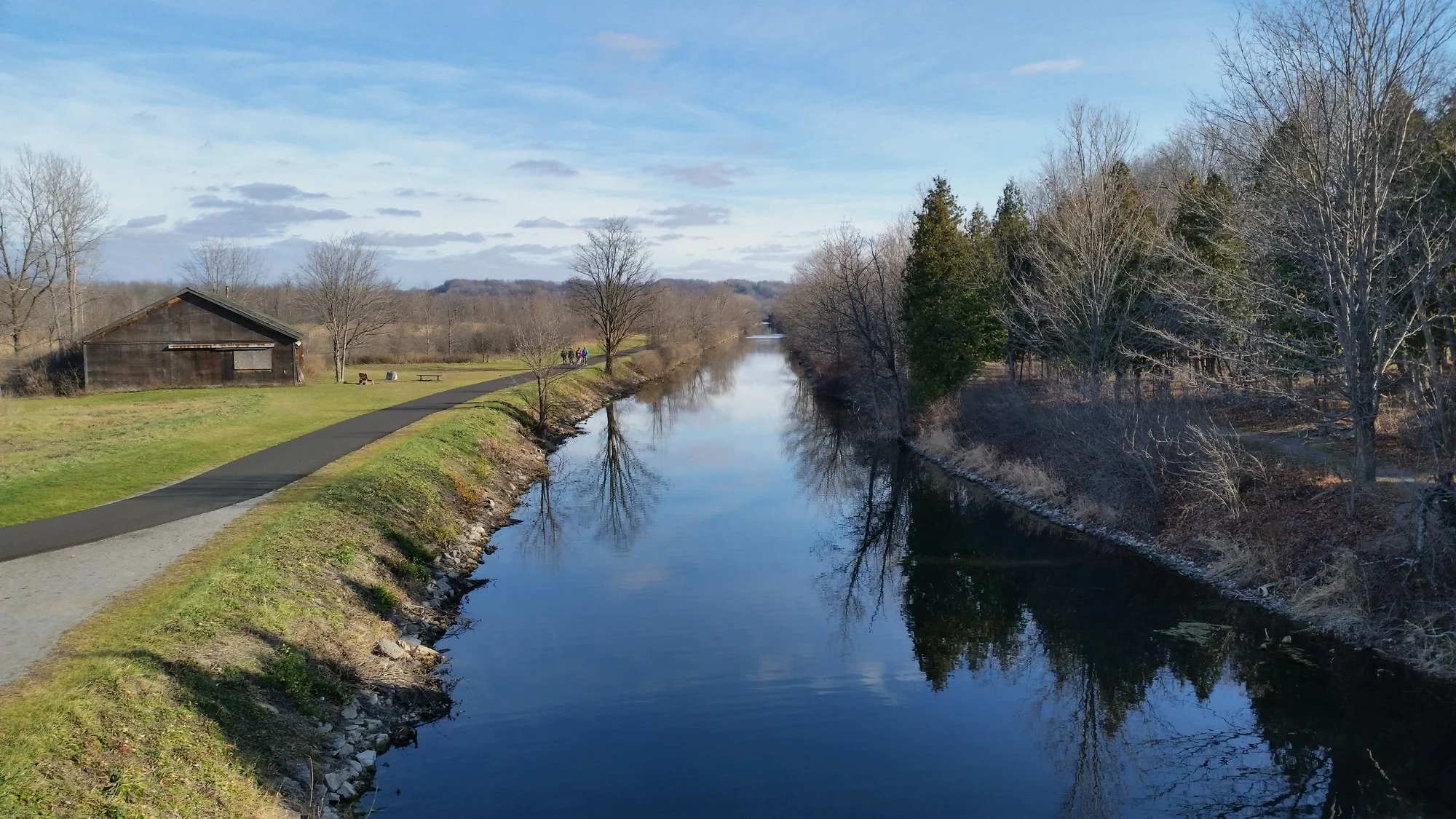
When the party boat leaves, the permanent bicentennial asset remains: Old Erie Canal State Historic Park, a 1,191 acre linear park that follows 36 miles of the watered Enlarged Erie Canal from Butternut Creek in DeWitt to the outskirts of Rome, according to state parks records. The route threads Fayetteville, Manlius Center, Kirkville, Chittenango, Canastota, Durhamville and New London, and the towpath carries the National Recreation Trail designation from the National Park Service. The broader New York State Canal System earned National Historic Landmark status in January 2017, a designation announced by then Interior Secretary Sally Jewell covering the Erie, Champlain, Oswego and Cayuga Seneca canals.
The park’s engineering inventory is dense for a free, sunrise to sunset facility. Paddlers and walkers pass the Butternut Creek Aqueduct in DeWitt, Cooper’s Tubular Arch Bridge at the Cedar Bay picnic area, the Limestone Creek Aqueduct near Fayetteville, the Chittenango Creek Aqueduct at Chittenango Landing, the Cowaselon Creek Aqueduct east of Canastota and the Oneida Creek Aqueduct at Durhamville, per the eriecanal.org survey of the park.
The count data: Onondaga County owns the towpath
The 2024 Who’s on the Trail report, the 20th edition of the annual count series from Parks & Trails New York and the Canal Corporation, drew on 39 electronic counter locations and five years of data. The systemwide estimate: roughly 3.98 million visits per year across the Canalway Trail network, with about 3.84 million on the 360 mile Erie Canalway Trail between Albany and Buffalo and about 139,000 on the 60 mile Champlain Canalway Trail.
The local standings are the story. DeWitt’s counter logged about 144,000 annual visits, first in the state. Camillus logged about 100,000, third in the state behind Albany’s 139,000. Put another way, one counter in DeWitt out-drew the entire Champlain Canalway Trail. Summer daily use more than doubled other seasons at most locations, and weekends beat weekdays, the classic signature of recreational rather than commuter traffic.
The counts also translate into cash. Parks & Trails New York’s 2024 Canalway Challenge drew more than 500 finishers from at least 36 states and one Canadian province, spending an average of $359 each; end to end riders covering the full 360 miles averaged five nights on the corridor and roughly $1,000 in spending. Statewide, the Erie Canalway National Heritage Corridor estimates canal related tourism, events, boat tours, rentals and museum visits generate about $1.5 billion a year, with more than 3.3 million visitors annually for events and tours, on top of $6.2 billion in non tourism economic activity the canal system supports.
Canal town economies: Chittenango, Canastota, Camillus
Three volunteer built sites anchor the canal economy between the suburbs and Rome. At Chittenango Landing Canal Boat Museum, the draw is an 1855 three bay dry dock where crews built and repaired 96 foot cargo boats until the site closed in 1917. Local volunteers rediscovered the buried complex in 1985 and excavated and rebuilt it with guidance from the state historic preservation office; the 2017 World Canals Conference put it on its official tour itinerary.
Two locks east, Canastota’s Canal Town Museum operates in an 1874 frame building that once housed a bakery, packed with artifacts of the village the canal built. Canastota’s Main Street still runs hard against the watered channel, one of the few places in the state where a working 19th century canal streetscape survives intact.
West of Syracuse, Camillus Erie Canal Park maintains seven miles of the enlarged canal and the park’s crown jewel: the Nine Mile Creek Aqueduct, an 1842 stone and timber structure that is the only restored, navigable aqueduct of the 32 built on the enlarged canal. Volunteers raised roughly $2 million and finished the restoration in August 2009, when a boat crossed the aqueduct for the first time in 89 years, according to the Erie Canalway National Heritage Corridor and the park’s own history. The Camillus counter’s 100,000 annual trail visits suggest the return on that volunteer investment keeps compounding.
The Empire State Trail effect
None of the 2024 traffic numbers happen without the pavement. The Empire State Trail, championed in the 2017 state budget with a $200 million commitment, was completed in December 2020: 750 miles linking New York City to Canada and Buffalo to Albany, the longest multiuse state trail network in the country, per the governor’s office. The DeWitt to Chittenango towpath segment through Old Erie Canal State Historic Park was folded into the route, which is a big reason a quiet linear park east of Syracuse now posts the top trail count in New York. Statewide, roughly 75 percent of Empire State Trail mileage is off road, and the Erie Canalway Trail forms its entire east to west spine.
Where to track this
The Seneca Chief’s live itinerary, port times and the digital tour guide are posted at buffalomaritimecenter.org/backtobuffalo. Trail count data and the full Who’s on the Trail 2024 report are at ptny.org, and the Canal Corporation posts navigation notices and the 2026 season schedule at canals.ny.gov. Old Erie Canal State Historic Park conditions and pavilion reservations are at parks.ny.gov, and the three canal town museums post seasonal hours at chittenangolanding.org, canastota-canal.com and eriecanalcamillus.org. CNY Signal will cover the Rome, Syracuse and Baldwinsville stops June 11 through 17.