By Sarah Chen, Staff Reporter
Premium Feature · Neighborhoods
Westcott Nation: How a half-square-mile of Syracuse became the city’s bohemian benchmark
A half-mile from Syracuse University, two blocks of Westcott Street anchor a neighborhood the state just designated New York’s second-largest historic district. Inside the eclectic spine that calls itself a nation.
If you stand on the corner of Westcott and Euclid on a Sunday in late September, you do not need to be told you are somewhere specific. Roughly 10,000 people press into two blocks of pavement. Six music stages overlap. Vendors sell empanadas next to Tibetan momos next to vegan baklava. A noon parade winds past Munjed’s, past Alto Cinco, past the Westcott Theater marquee. The neighbors call it the Westcott Street Cultural Fair. They have been calling it that since 1991.
They call the neighborhood itself something else: Westcott Nation.
The nickname is half-joke and half-manifesto, dating to the 1960s, when the streets between East Genesee and Euclid became the heart of Syracuse’s counter-culture. Sixty years later, the joke has hardened into civic identity. In December 2024, the New York State Board of Historic Preservation voted unanimously to designate the Westcott-University neighborhood as a state historic district, with more than 2,600 contributing structures spread across roughly 2,000 properties. The federal listing on the National Register followed as a formality. Only one historic district in New York is larger.
This is what a working bohemia looks like in 2026: a Mediterranean restaurant a Jordanian family has run since 1984, a coffee roaster two friends bought after a half-joking conversation, a 1919 movie house reopened by two locals tired of driving to Ithaca for shows, a public library that opened in 1912 inside a corner drug store, and a 76-acre park the city forgot for a decade and then remembered.
The geography of a nation
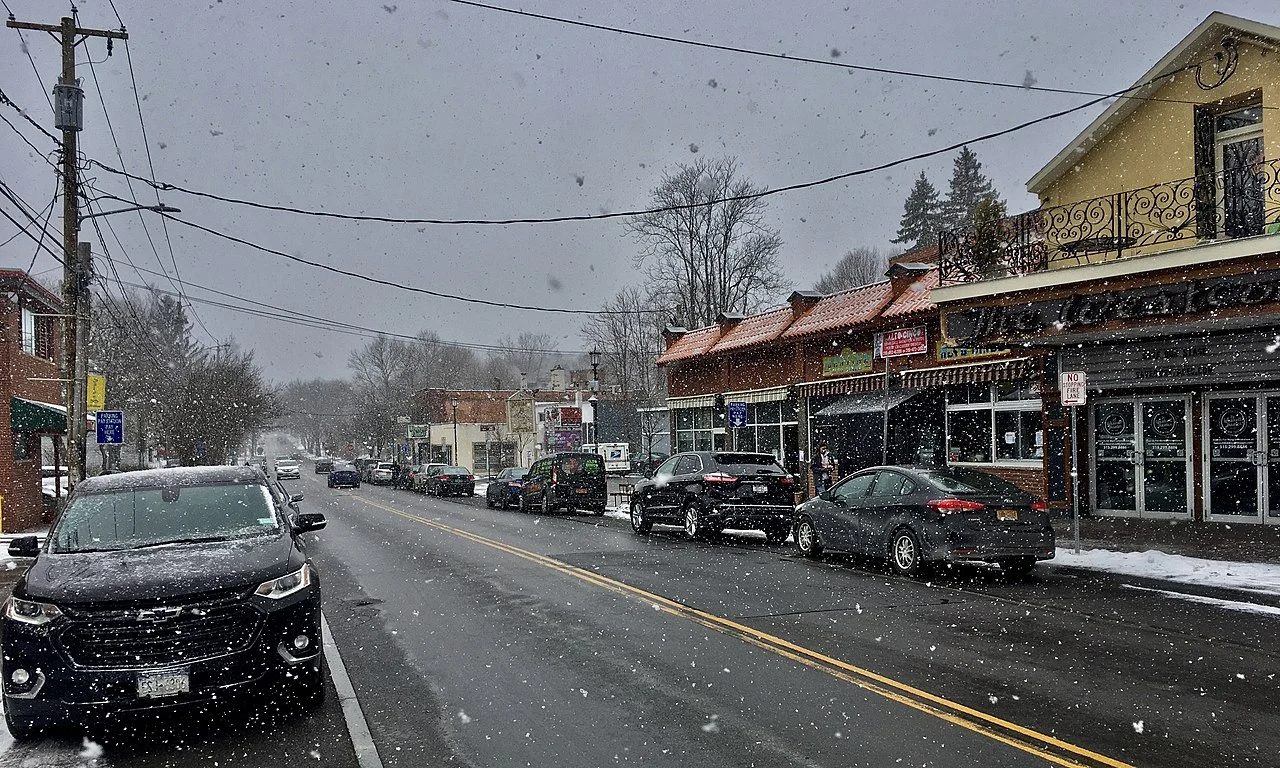
Westcott is small. The commercial district, the part that does the cultural lifting, is two blocks of Westcott Street between Euclid Avenue and Harvard Place. The residential ring around it stretches roughly from East Genesee Street on the north to the edges of Syracuse University on the south, with Thornden Park forming a 76-acre green spine on the western boundary. Thornden is the second-largest park in the city, behind only Burnet, and it borders Westcott directly.
The neighborhood is half a mile from the SU campus. It is, in real estate language, a renter’s neighborhood: 75.4 percent of the 7,493 occupied housing units are rented, against 24.6 percent owner-occupied. The median age is 21.2, skewed hard by the student population. Median household income is $33,346.
And yet, somehow, the housing market has turned. As of December 2025, Westcott home prices were up 6.6 percent year-over-year, with a median sale price of $275,000. The 12-month median sat at $280,000, up 12 percent. For a neighborhood the city was writing off in the 1980s, that is a vertical line on a chart.
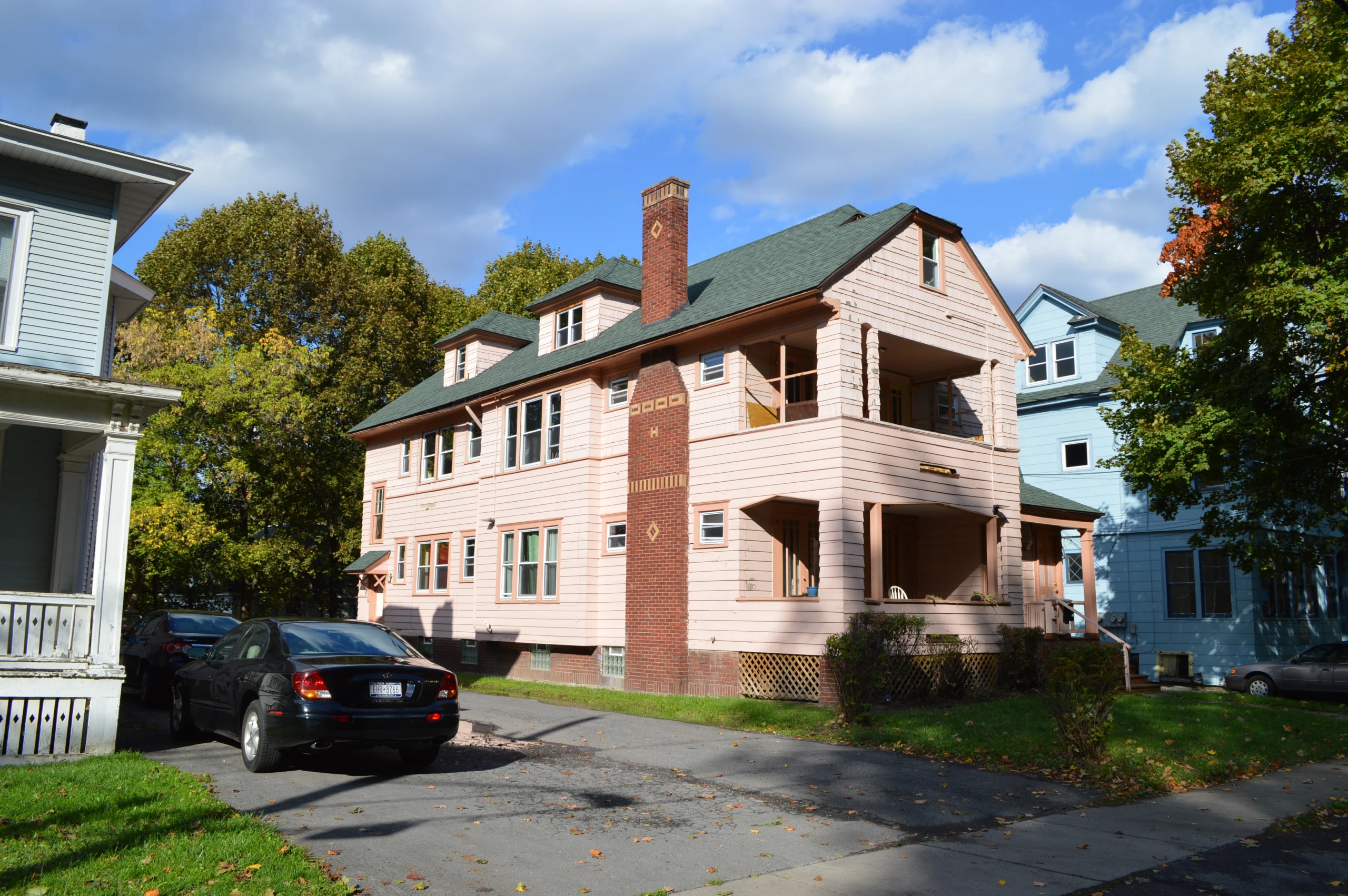
Westcott by the numbers
A theater that refused to die
The single most visible building in Westcott is the Westcott Theater, at 524 Westcott Street. The structure went up in 1919. It opened on April 11, 1926, as the Harvard Theater, with 1,000 seats. For most of the 20th century it was a single-screen cinema, cycling through identities: the Harvard, the Studio, the Westcott Cinema. In 1993, Manlius Art Cinema’s Nat Tobin took over the lease and ran it as an arthouse cinema for fourteen years. It closed on October 18, 2007.
It should have stayed closed. Instead, two Syracuse music fans, Sam Levey and Dan Mastronardi, talked to building owner Ray Duplain about a different plan. They were tired of driving to Ithaca and Rochester to see the bands they wanted to see. In 2008, after a renovation that gutted the cinema seats and screen and added a small bar, they reopened the building as a concert hall. The first shows ran in September 2008, with an official opening in November of that year.
The current capacity is 700. The Westcott Theater is now a regular stop on the national touring circuit, a venue that lets a city of Syracuse’s size catch acts that would otherwise skip from Buffalo to Albany without slowing down. The 2026 spring and summer calendar includes Jadakiss on May 2, Samantha Fish on May 28, Yung Bleu on June 21, Live Dead ’69 on June 28, and Eggy on August 7. That is a non-trivial municipal asset, hidden inside a brick building on a side street.
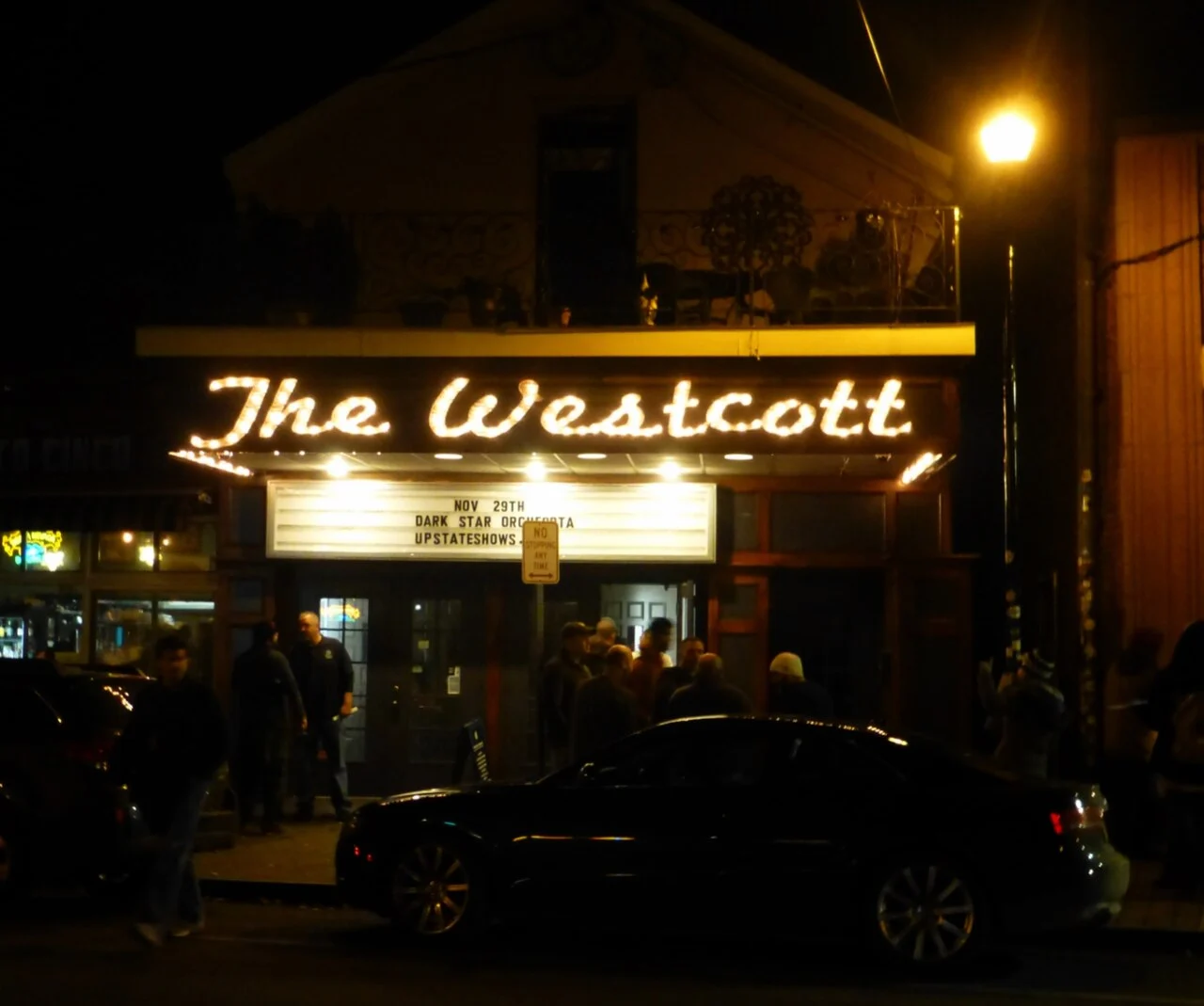
Where to eat in two blocks
The Westcott commercial district packs more restaurants per linear foot than any other comparable stretch in Syracuse. The roster reads like the demographics of the neighborhood itself.
Alto Cinco, at 526 Westcott Street, opened in 1995 as a small takeout spot, expanded in 1999 into a full-service dining room with a wine bar, and added a full liquor license in 2014. Its mission, on paper, is fresh handmade Mexican with extensive gluten-free and vegan options. In practice, it is the neighborhood’s living room. Munjed’s Mediterranean Restaurant & Lounge, at 505 Westcott, is run by a Jordanian family that has been on the block since 1984. The kitchen turns out Greek and Middle Eastern dishes seven days a week. Mom’s Diner, at 501 Westcott, was named a Nextdoor Neighborhood Favorite in both 2023 and 2024 and is still open for breakfast and lunch.
Rocco’s Pizza, at 534 Westcott Street, has been in business for more than three decades. Westcott Grocery, at 477 Westcott, doubles as a halal butcher and Middle Eastern grocery. Recess Coffee House & Roastery, just off Westcott at 110 Harvard Place, started in 2007 when two Central Square High School friends bought an existing cafe on Harvard Place. Adam Williams was working at the food co-op down the street and stopped at Recess for coffee; when he heard the owner was selling, he half-jokingly told Jesse Daino he would buy it. They did. Daino runs roasting and wholesale; Williams runs operations. Recess now wholesales to more than 65 cafes, restaurants, grocers and breweries across Central New York and operates three Syracuse cafes. the Westcott flagship, a Tipperary Hill location at 429 Ulster Street, and a downtown shop at 110 Montgomery. The Westcott cafe, with students, scholars, parents with strollers and freelancers in the corner booths, is the neighborhood’s de facto morning meeting room.
The Syracuse Cooperative Market, on Kensington Road on the edge of Westcott, has operated as a member-owned grocery since 1972. The store anchors the eastside food landscape and stocks regional growers and producers. In 2021, the co-op opened a second location inside Salt City Market downtown, but the Kensington store remains the original.
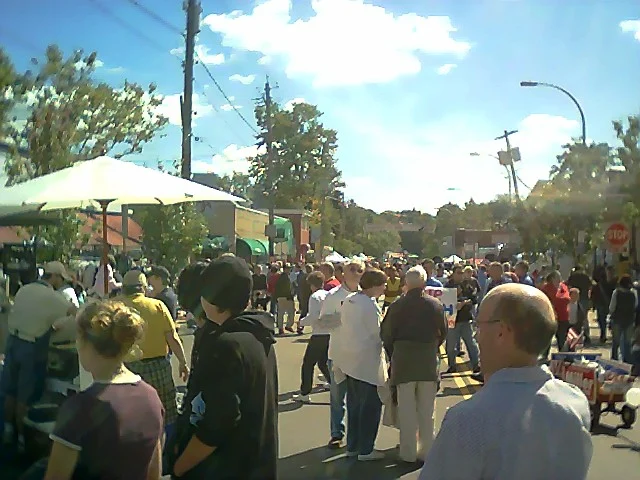
Anchor addresses on the strip
| Westcott Theater | 524 Westcott St | 700-cap concert hall |
| Alto Cinco | 526 Westcott St | Mexican, est. 1995 |
| Munjed’s | 505 Westcott St | Mediterranean & lounge |
| Mom’s Diner | 501 Westcott St | Family-run breakfast/lunch |
| Rocco’s Pizza | 534 Westcott St | 36 years on the block |
| Recess Coffee | 110 Harvard Pl | Roasting since 2007 |
| Westcott Grocery | 477 Westcott St | Halal market |
| Petit Branch Library | 105 Victoria Pl | Onondaga County system |
Civic infrastructure on a residential block
The Westcott Community Center, at 826 Euclid Avenue, occupies a converted school building and serves as the operations base for most of the neighborhood’s organized activity. The 501(c)(3) nonprofit serves more than 600 older adults a year through its Senior Day Services, which include hot lunches Monday through Thursday, exercise and wellness programs, a Senior Companion volunteer program and trained Neighborhood Advisors who connect residents to outside services. Programming also runs the gamut from after-school youth care to the building’s role as the booking office for the Cultural Fair.
From June through October, the parking lot on Euclid hosts the Syracuse Eastside Farmers Market every Wednesday from two to six, with farmers, bakers and prepared-food vendors. It is one of the better farm markets in the city and one of the few that runs in a true neighborhood setting rather than a parking deck.
The Petit Branch Library, at 105 Victoria Place just off Westcott Street, is part of the Onondaga County Public Library system. The branch first opened in 1912 inside the Lawrence Drug Store at the corner of Westcott and Dell, when it was still called Westcott Station. It is named for Douglas E. Petit, who served as president of the Syracuse Public Library board until his death in 1926. Today the branch opens at nine: Mondays and Thursdays it stays open until 7:30 in the evening; Tuesday, Wednesday, Friday and Saturday it closes at five; Sunday is dark. Its own listing describes its setting as “an eclectic area known as the University Neighborhood and the Westcott Nation.” The library, in other words, uses the joke.
Two blocks west of the strip, Thornden Park covers 76 acres and includes the E.M. Mills Memorial Rose Garden, established in the 1920s on two acres at the southwest entrance across Ostrom Avenue from Syracuse University. The garden now holds more than 3,800 plants representing roughly 360 varieties around a central gazebo, maintained largely by volunteers from the Syracuse Rose Society. The park’s stone amphitheater, built in 1933, is still the home stage for the annual Syracuse Shakespeare Festival.
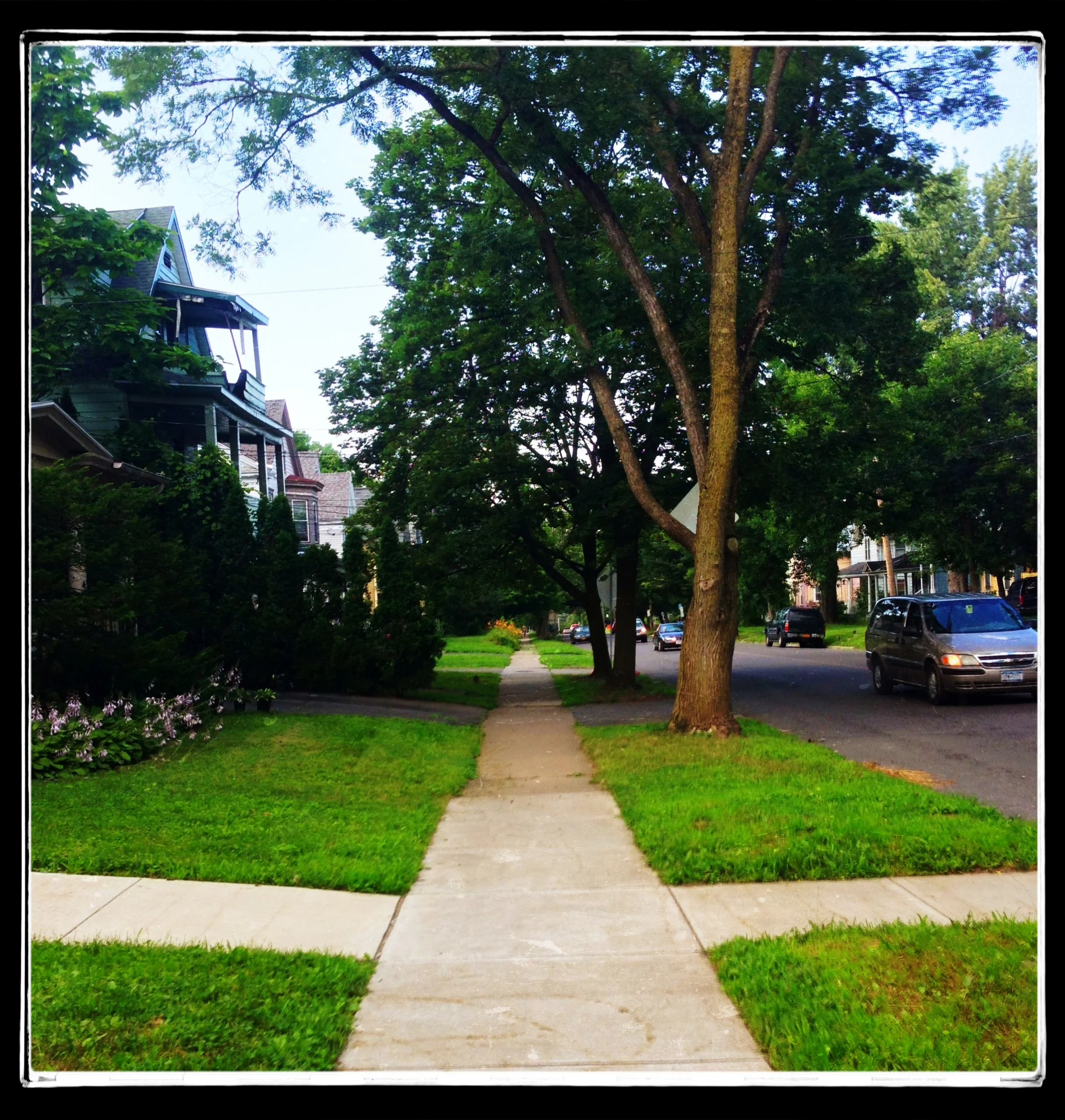
The fair, and what it actually is
The Westcott Street Cultural Fair started in 1991 as a neighborhood project organized by a handful of arts-minded residents who wanted to do something visible together. It has run every year since, on the last Sunday in September, between Concord Place and Dell Street. The 2026 edition, the 35th annual, is set for Sunday, September 27. The parade kicks off at noon. The festival itself runs from 12:30 to 6:30. There are six performance stages, more than 140 booths, and free admission.
The 2025 edition gives a sense of the lineup: SAMMY-winning local acts including Sophistafunk, Joe Driscoll, Mark Hoffmann & the Hoffmann Family Band and The Blacklites, alongside multicultural acts such as Grupo Pagan, Wacheva African Dance and Drum Group and the Syracuse Gay and Lesbian Chorus. Sponsors that year included Recess Coffee, Alto Cinco, the Syracuse Cooperative Market, Westcott Barber Shop, WAER, Tops Friendly Market, Upstate Medical University, Kinney Drugs and the ESF College Foundation. The fair pays its bills the way the neighborhood does. by recruiting most of the people on the strip to chip in.
The numbers are not what is interesting about it. What is interesting is the way the fair functions as a kind of annual zoning meeting in disguise. Long-time residents, current students, immigrant restaurateurs, the public library, the community center and roughly every nonprofit operating in the eastside of Syracuse all set up tables next to each other for a single day. It is the moment the neighborhood looks itself in the eye.
Westcott Cultural Fair 2026 at a glance
How a farm became a nation
Westcott is the product of two forces: the founding of Syracuse University in 1870 and the streetcar. The land had been farmland (the Westcott Tract, the Bastable Farm, the Stanton Farm) served by a former Indian trail along South Beech Street. The Genesee & Water Street Railway Company first reached Westcott Street by the 1880s. In 1889, the line was pushed south down Westcott Street to the gates of the old Syracuse Driving Park, with a streetcar making the half-mile run every thirty minutes. By 1893, an electric streetcar loop ran along Walnut, Euclid, Westcott and East Genesee, knitting the new district to downtown. Houses followed the streetcar.
By the 1920s, modest commercial buildings had replaced houses on two blocks of Westcott Street, creating the commercial spine that still exists today. The architectural inventory the state used to justify the historic district designation lists Italianate, Queen Anne, Colonial Revival, Craftsman cottage and bungalow styles, most of it built between 1870 and 1930. That is the bones of the place.
The bohemian overlay came later. The 1960s turned Westcott into the city’s counter-cultural center, and the nickname “Westcott Nation” stuck. What is striking now, sixty years on, is how much of that identity has survived gentrification, depopulation, the arc of any number of co-ops and bookstores and music venues that opened and closed. The Cultural Fair is older than most of the businesses on the strip. The community center is older still. The Petit Branch Library, which opened in a corner drug store in 1912 and is named for the man who chaired the city’s library board until 1926, is older than the streetlights.
What the historic-district status actually does
The state designation, finalized in December 2024, has two practical effects. First, property owners inside the district can now access state and federal historic-renovation tax credits. For owners of older homes (which is most of them) that lowers the real cost of preserving original details. Second, unlike a local landmark district, a National Register listing does not subject homeowners to mandatory exterior-modification review by the Syracuse Landmark Preservation Board. The protection is incentive-driven, not regulatory.
That distinction is important. It is why the designation passed without serious neighborhood opposition. Residents get the carrot of tax credits without the stick of a design review board telling them what color to paint the trim. Whether that translates into measurable preservation outcomes over the next decade is the open question.
A walking guide to two blocks
- Start at the corner of Westcott and Euclid, in front of the Community Center at 826 Euclid Ave.
- Head south along the strip. Note Westcott Grocery (477) on your right.
- Pass Mom’s Diner at 501 and Munjed’s at 505 on the same side.
- The Westcott Theater marquee at 524 marks the heart of the commercial block.
- Cross the street to Alto Cinco at 526 and Rocco’s Pizza at 534.
- Cut down Harvard Place to Recess Coffee at 110.
- Continue to Petit Branch Library at 105 Victoria Pl, two blocks west.
- Loop back via Thornden Park for the 76-acre green walk-off.
The thing about a small place
Westcott is not a destination neighborhood the way Armory Square is. It is not on the cover of the visitors’ bureau brochure. It is, rather, the place a city like Syracuse needs in order to keep being interesting to the people who already live in it. A bohemia, in any city, is a place where the rent is low enough and the streets are dense enough that an idea can be tried out without a business plan. Most cities have lost theirs. Westcott still has its.
That is what the historic-district designation actually protects. Not the brick. Not the bungalows. The capacity of two blocks to keep absorbing new arrivals (the new restaurant, the new musician, the new student, the new neighbor) without losing the shape of itself.
The next test of that capacity is on Sunday, September 27. The parade starts at noon.
Sources: Wikipedia, Westcott Community Association, City of Syracuse Department of Planning and Sustainability, Onondaga County Public Libraries, Visit Syracuse, Syracuse Cooperative Market, Westcott Street Cultural Fair, Daily Orange, Syracuse New Times, Spectrum Local News, This Is CNY, Redfin, NeighborhoodScout, Point2Homes, Wikimedia Commons. All photos from Wikimedia Commons (public license).
Related on CNY Signal: Tipperary Hill, another Syracuse neighborhood with a story, Onondaga Lake Park, the regional 7-mile greenway, and more CNY Signal community coverage.
Frequently Asked Questions
Where is the Westcott neighborhood in Syracuse?
Westcott sits half a mile from Syracuse University, with a commercial district on two blocks of Westcott Street between Euclid Avenue and Harvard Place. The residential ring stretches from East Genesee Street on the north to the edges of Syracuse University on the south, with the 76-acre Thornden Park forming a green spine on the western boundary.
Why is Westcott a historic district?
In December 2024, the New York State Board of Historic Preservation voted unanimously to designate the Westcott-University neighborhood as a state historic district, with more than 2,600 contributing structures spread across roughly 2,000 properties. The federal listing on the National Register followed. Only one historic district in New York is larger.
What is the Westcott Street Cultural Fair?
The Westcott Street Cultural Fair has run since 1991 and draws roughly 10,000 people to two blocks of Westcott Street on a Sunday in late September. It features six music stages, food vendors with cuisines from empanadas to Tibetan momos, and a noon parade that winds past Munjed’s, Alto Cinco and the Westcott Theater.
What is the Westcott Theater?
The Westcott Theater at 524 Westcott Street opened on April 11, 1926 as the Harvard Theater with 1,000 seats. After closing as an arthouse cinema in 2007, Sam Levey and Dan Mastronardi reopened it as a 700-capacity concert hall in September 2008. The 2026 calendar includes Jadakiss on May 2, Samantha Fish on May 28 and Yung Bleu on June 21.
What are home prices like in Westcott?
As of December 2025, Westcott home prices were up 6.6 percent year-over-year with a median sale price of $275,000. The 12-month median sat at $280,000, up 12 percent. About 75.4 percent of the 7,493 occupied housing units are rented and the median age is 21.2, skewed by the student population.