From the Thompson A.M.E. Zion Church on Parker Street to the Auburn water intake on the north end of Owasco Lake, the season ahead carries an unusual mix of celebration and vigilance. Cayuga County will measure 2026 by how many tourists it pulls into Harriet Tubman’s hometown, and by how few harmful algal blooms slip past the new treatment system at the city’s pumping station.
Truth-check: Frank Mahoney, Editor-in-Chief.
Know before your neighbors do
The Morning Signal hits your inbox at 6 AM with everything that happened overnight. Real incidents, real data, zero fluff.
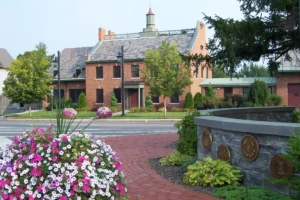
On a mid-May morning along the Owasco Lake outlet, the shoreline carried no trace of the pea-green ribbon that ruined the summer of 2024. The lake looked clear. It is only May, and the watershed inspection team that walks this perimeter every week of the warm season was already on rotation. Jesse Lloyd serves as Lead Watershed Inspector for the Owasco Lake Watershed Inspection and Protection Division, the field unit that monitors the watercourses feeding the lake that supplies Auburn’s drinking water. Across town on Parker Street, contractors were finishing detail work on the Thompson Memorial A.M.E. Zion Church, the centerpiece of Harriet Tubman National Historical Park, which opened to the public on June 22, 2024 after a 2019 lightning-strike steeple fire and a COVID-era delay. Together those two scenes set the agenda for Cayuga County this summer: a lake that has to stay drinkable and a county seat that has to stay on the national tourist map.
Auburn at 25,791: a small city with an outsized civil-rights footprint
Cayuga County had about 74,600 residents in 2024, and the city of Auburn alone accounts for roughly a third of that, with a 2024 population of 25,791 according to the Census Bureau’s most recent vintage estimate. For a city that size, the cultural footprint is unusually heavy. Auburn holds a federal national historical park (Harriet Tubman NHP, which includes the Tubman home and the Thompson church), the privately operated Seward House Museum at 33 South Street, and the New York State Equal Rights Heritage Center on State Street, a NYS Office of Parks, Recreation and Historic Preservation site that opened in 2018. Park Superintendent Ahna Wilson told the National Park Service in advance of the 2024 community opening that park staff were “incredibly excited to open this site to the public” and share Tubman’s Auburn legacy.
That legacy now drives a measurable share of regional visitation. Auburn sits on the I-90 Thruway corridor between Rochester and Syracuse, and the Tubman park has become a stop for travelers who would otherwise blow past Cayuga County entirely. Tour buses parked along Parker Street were a routine sight last summer. The city’s Summer Homecoming Weekend, the rebranded Founders Day festival, is scheduled for August 7, 8, and 9, 2026, anchoring the late-season tourism push with live music, walking tours, and vendor markets along Genesee Street.
Owasco Lake: the drinking water question that will not go away
Auburn does not have Syracuse’s luxury. Skaneateles Lake, the source of Syracuse’s drinking water, operates under a filtration avoidance waiver granted in June 2004 by the New York State Department of Health and is one of a small number of large surface-water systems in the country allowed to deliver unfiltered water. Owasco Lake has no such waiver. Roughly 45,000 New Yorkers rely on Owasco as their drinking-water source, and the City of Auburn installed a powdered activated carbon, or PAC, treatment system at its water intake pumping station in early August 2017 to handle the toxins that follow a harmful algal bloom.
That distinction defines the 2026 calendar for Cayuga County’s environmental staff. Adam Effler, executive director of the Owasco Lake Watershed Management Council, told Fingerlakes1 in March 2026 that “there is an increasing trend with regards to harmful algal blooms,” with climate-driven warming as a major contributing factor. Effler also noted that 2025 blooms appeared earlier than usual in some areas of the region, though timing varied between lakes.
The Owasco Lake Watershed Inspection and Protection Division inspects watercourses and the watershed for compliance with the Rules and Regulations of the Owasco Lake Watershed and provides education outreach to the watershed community. The division monitors residential drainage, construction projects, septic systems, nutrient application from farms and homes, and streambank erosion. The OLWIPD was established in August 2007 through an agreement among the City of Auburn, the Town of Owasco, Cayuga County agencies, and other Owasco Lake advocates, with State Senator Mike Nozzolio cited by the organization as a key figure in securing the initial state funding that made the program possible. Nineteen years later, Lloyd’s team is the working memory of the lake’s day-to-day risks.

What 2024 taught Cayuga County, and what 2026 has to manage
The 2024 season set a record across the region. Seneca, Canandaigua, Skaneateles, and Cayuga lakes each saw more than 100 reports of harmful algal blooms in 2024. On Owasco specifically, 27 blooms were reported within a single two-week stretch in late August and early September of 2024. The Auburn Citizen documented microcystin measurements of 0.23 micrograms per liter in Auburn’s water and 0.26 micrograms per liter in Owasco’s, both below the U.S. Environmental Protection Agency’s 10-day health advisory threshold of 0.3 micrograms per liter. The toxins were present and the PAC system did its job, but the margin is thin.
The 2025 season opened with a clearer warning shot. The first suspected blooms of 2025 were reported in July at the north and northwest ends of Owasco Lake, prompting a beach closure. Inspectors expect 2026 to follow a similar pattern: localized early-season blooms, larger late-summer flare-ups, and a treatment plant running PAC seasonally whenever lake samples turn.
The Thompson A.M.E. Zion Church one year on
Two years ago last June, on a Saturday morning at 11 a.m., the National Park Service opened the doors of the restored Thompson Memorial A.M.E. Zion Church at 33 Parker Street to the public for the first time. NPS had owned the property since 2017, and the 2019 lightning strike that started a steeple fire and caused water damage, combined with COVID-19, pushed the opening years past its original schedule. Following the June 22, 2024 community opening, the church and parsonage now operate on Fridays and Saturdays, with the parsonage serving as a visitor-contact station.
The site joins the Harriet Tubman Home for the Aged and the Harriet Tubman Residence in Fleming as the three components of the national historical park. The summer 2026 visitor season for the park runs alongside Auburn’s Juneteenth weekend, which the City of Auburn promotes as a civic celebration at Tubman’s hometown’s historic and cultural sites and at the Booker T. Washington Community Center.
The Doubledays open, the Field Days run, the textiles arrive
Auburn’s other summer rhythms are also locked in. The Auburn Doubledays, the city’s collegiate-summer team that joined the Perfect Game Collegiate Baseball League in 2021 after Major League Baseball reorganized the minor leagues, play at Falcon Park at 130 N. Division Street, a 2,800-seat ballpark whose current facility opened in 1995 on a site that has hosted Auburn baseball since 1927. The Doubledays’ published 2026 schedule lists weeknight first pitches at 6:30 p.m. and Sunday games at 5 p.m., with gates opening one hour before first pitch, and the 2026 schedule extends into July with home games at Falcon Park against PGCBL opponents including the Geneva RedWings.

To the north in Weedsport, the Weedsport Fire Department’s annual Fireman’s Field Days will run May 28 through May 30, 2026, with the grand parade Friday at 7 p.m. and a chicken barbecue Saturday at noon. Live music includes Mike Farrar and the Houserockers on Friday from 8 p.m. to midnight and Southbound Train on Saturday evening. The Field Days double as one of the larger volunteer-firefighter fundraisers in the county each year and draw families from across Cayuga and western Onondaga.
A few miles south on Genesee Street, the Schweinfurth Memorial Art Center at 205 Genesee Street, which opened June 28, 1981 from the bequest of Auburn-born Boston architect Julius A. Schweinfurth, stages its summer fiber-arts show. “Textiles: The Language of Fiber” runs from May 30 through August 15, 2026, with juried work from artists whose pieces engage the grammar of textiles and the vocabulary of fiber. The Schweinfurth’s other anchor show, Quilts=Art=Quilts, ran October 25, 2025 through January 4, 2026, so its slot is now held by the textile-language exhibit through midsummer.
The Seward House, an underrated Auburn anchor
Auburn’s other downtown statesman-history landmark is the Seward House Museum at 33 South Street, a privately operated historic-house museum. The home of William H. Seward, born May 16, 1801, and named Secretary of State by Abraham Lincoln on the eve of the Civil War in March 1861, sits a few blocks from the Tubman home. Seward died at his Auburn house on October 10, 1872, after a career that included two terms as governor of New York and the 1867 negotiation of the Alaska Purchase. The museum runs Tuesday through Saturday from 10 a.m. to 5 p.m. with guided tours on the hour, and adds Sunday hours from June through August. Visitors who plan a single-day Auburn loop now have a tight 1.2-mile walking route between the Seward House, the Equal Rights Heritage Center on State Street, and the Tubman home and church on South Street and Parker Street, respectively.
The lake-quality comparison no one wants to draw
If you stand at the Owasco outlet in Emerson Park and look south down the lake, the view is identical in feel to Skaneateles, the next finger to the east. The water is not. The two lakes sit roughly 12 miles apart by air but have ended up on opposite sides of one of the most consequential lines in New York drinking-water policy.
Skaneateles is one of the only large surface-water systems in the country approved by the New York State Department of Health to treat and use its water for drinking without a filtration plant, and the Skaneateles Lake Watershed Agricultural Program was founded in 1994 as a more cost-effective solution to the 1986 Safe Drinking Water Act amendments. Owasco never got that path. It has to filter, and when toxins appear, it has to dose PAC. That single divergence is the most consequential public-policy difference between Onondaga County and Cayuga County, and it sets the financial stakes on every Owasco bloom alert.
Cayuga Lake, the longer finger to the immediate west of Owasco, has its own pressures. The 2024 Cayuga Lake season opened with a confirmed widespread bloom in the northwest section of the lake in early June, well ahead of the typical August-September window, and feeds drinking-water systems serving Bolton Point and the City of Ithaca downstream.
Aurelius, Moravia, Union Springs, Cato: the county outside Auburn
Auburn dominates the headlines but Cayuga County is bigger than its county seat. Aurelius sits immediately west of Auburn along Route 5. Cayuga County has roughly 74,600 residents according to USAFacts and U.S. Census vintage data, with Auburn the largest share. Moravia, at the south end of Owasco Lake, is the birthplace of Millard Fillmore, the 13th president of the United States, born January 7, 1800 in a log cabin in what is now Moravia, and the entry point for Fillmore Glen State Park, a 941-acre state park adjacent to the village of Moravia. Union Springs anchors the Cayuga Lake side of the county with a small downtown, a working marina, and the Frontenac Historical Society Museum. Cato sits in the northern corn-and-soy belt, and the Weedsport Speedway, a half-mile dirt oval on the Cayuga County Fairgrounds in Weedsport, runs its regional dirt-track schedule each summer.
Cayuga County’s economic identity is not the Adirondack tourism model that defines Hamilton or Essex counties to the northeast, and it is not the suburban-bedroom pattern of Onondaga County’s southern towns. It is closer in feel to Madison County: small-city anchor, agricultural perimeter, and a tourism economy built around water and history. Madison County has Colgate and Cazenovia. Cayuga County has Tubman and Owasco.
What to watch as summer 2026 unfolds
Three indicators will tell the story of Cayuga County by Labor Day. The first is the NYSDEC bloom-report count for Owasco. A 2026 season that mirrors 2024, with double-digit bloom reports in a two-week window, would push the PAC system to its operational limits. A quieter season would justify the bet that watershed inspection plus PAC dosing can hold the line.
The second is Tubman park visitor traffic in its second full summer with the Thompson church open. The 2026 count will be the first apples-to-apples annual measurement of the restored church’s contribution to Auburn tourism. The August 7-9 Summer Homecoming Weekend will be the cross-check on whether the city’s tourism rebrand pulls additional visitor-nights into the local lodging market.
The third is the comparison every Auburn resident makes when they read a Syracuse paper about Skaneateles. Skaneateles drinks unfiltered. Auburn pays to filter. The next time a Skaneateles bloom report runs in the Syracuse press, the City of Auburn’s water department will already be running PAC on Owasco. Both lakes are warming. Only one has a restored A.M.E. Zion church anchoring its county seat.
Cayuga County enters summer 2026 with the kind of agenda that makes a local newsroom busy. The county seat has a national historical park, a state heritage center, and a privately operated statesman’s house museum within walking distance of each other, and a drinking-water lake that demands a season of attention. Both can be true at once.
Primary sources: National Park Service, City of Auburn, Auburn Citizen, Cayuga County Government, NYSDEC, Owasco Lake Watershed Management Council, Owasco Lake Watershed Inspection Program, Schweinfurth Memorial Art Center, Fingerlakes1, Inside Climate News, Environmental Policy Innovation Center, U.S. Census Bureau, Britannica.