By Sarah Chen, Staff Reporter
Harriet Tubman put 54 of her 90-odd years into a single piece of land on South Street in Auburn. The deed went to her in early 1859: 7 acres bought from Frances Adeline Seward, wife of U.S. Senator William H. Seward, for $1,200. Her parents came down from Canada that same summer. Pneumonia killed her on March 10, 1913, inside the Home for the Aged she had founded on the property next door. She rests on West Lawn C of Fort Hill Cemetery, under a large tree about half a mile from the brick house she rebuilt in 1882.
Most of what she left behind in Auburn is still standing: the brick residence at 182 South Street, the Home for the Aged next door at 180, the Thompson Memorial A.M.E. Zion Church up on Parker Street where she pledged $500 toward construction in 1891 and where her funeral was held 22 years later, and the grave itself. Those four locations were bundled into Harriet Tubman National Historical Park on January 10, 2017, when Interior Secretary Sally Jewell signed the order. The park turned 8 this past January.
Know before your neighbors do
The Morning Signal hits your inbox at 6 AM with everything that happened overnight. Real incidents, real data, zero fluff.
Tubman in Auburn: 1859 to 1913
| 1859 | Buys 7-acre farm from Frances Seward for $1,200; brings parents from Canada |
| 1869 | Marries Nelson Davis, a Civil War veteran 22 years younger |
| 1880 | Wood-frame house destroyed by accidental fire on February 10 |
| 1881-82 | Brick house built on the old fieldstone foundation by Tubman’s relatives and friends |
| 1891 | Pledges $500 toward Thompson A.M.E. Zion Church on Parker Street |
| 1896 | At age 74, buys 25 adjacent acres at auction for $1,450 |
| 1903 | Donates the 25 acres to the A.M.E. Zion Church to run a home for the aged |
| 1908 | Harriet Tubman Home for the Aged dedicates John Brown Hall and opens to residents |
| 1911 | Tubman, in declining health, becomes a resident of her own home |
| March 10, 1913 | Dies of pneumonia at the Home for the Aged; buried at Fort Hill Cemetery on March 13 |

The Seward purchase
Tubman had passed through Auburn on the Underground Railroad before she ever lived there. The Sewards’ house on South Street, two miles from where she would settle, was a stop. Auburn sat at the western anchor of an abolitionist corridor that ran 28 miles east through Skaneateles and Syracuse to the Gerrit Smith homestead at Peterboro and the Cazenovia convention grounds in Madison County, where Frederick Douglass chaired the August 1850 Fugitive Slave Law Convention and 2,000 attendees, including roughly 50 self-emancipated people, drafted an open letter advocating immediate abolition. By the late 1850s she was looking for a place to bring her aging parents, Ben and Rit Ross, who had been living in St. Catharines, Ontario, since the Fugitive Slave Act of 1850 made any Black household in the United States vulnerable to seizure.
Frances Seward sold her the 7-acre parcel in early 1859. She held the mortgage on flexible terms and accepted payments as Tubman could make them. The transaction was illegal under federal law. Tubman was a self-emancipated person, and the Fugitive Slave Act forbade the sale of land to her. Frances Seward took the risk anyway, betting that her husband’s standing as a U.S. senator from New York would deter prosecution.
Tubman moved her parents into the wood-frame farmhouse that summer. She would live on that piece of land, in one form or another, for the next 54 years.
The work in Auburn
The Auburn years are not the years Tubman is best remembered for. They came after the famous ones. She was already in her late 30s when she bought the farm. The Underground Railroad rescues, the Combahee Ferry Raid in South Carolina, the years as a Union scout and nurse, were behind her. What followed was 54 years of work in Auburn that was small in scale and easy to overlook.
She married Nelson Davis, a Civil War veteran roughly 22 years younger, at the Central Presbyterian Church in Auburn in March 1869. The Auburn she had moved into a decade earlier was already a node in the Underground Railroad’s central New York network. Twenty-eight miles east, on October 1, 1851, a biracial Syracuse mob stormed the police office at Clinton Square and freed William “Jerry” Henry, a Missouri cooper apprehended that morning under the Fugitive Slave Act; he was hidden in the city for days before being run north to Kingston, Ontario. Tubman watched that network harden around her. She took in boarders, sold produce and butter, raised pigs, and built up a circle of relatives, formerly enslaved people, and elderly Black neighbors who needed shelter.
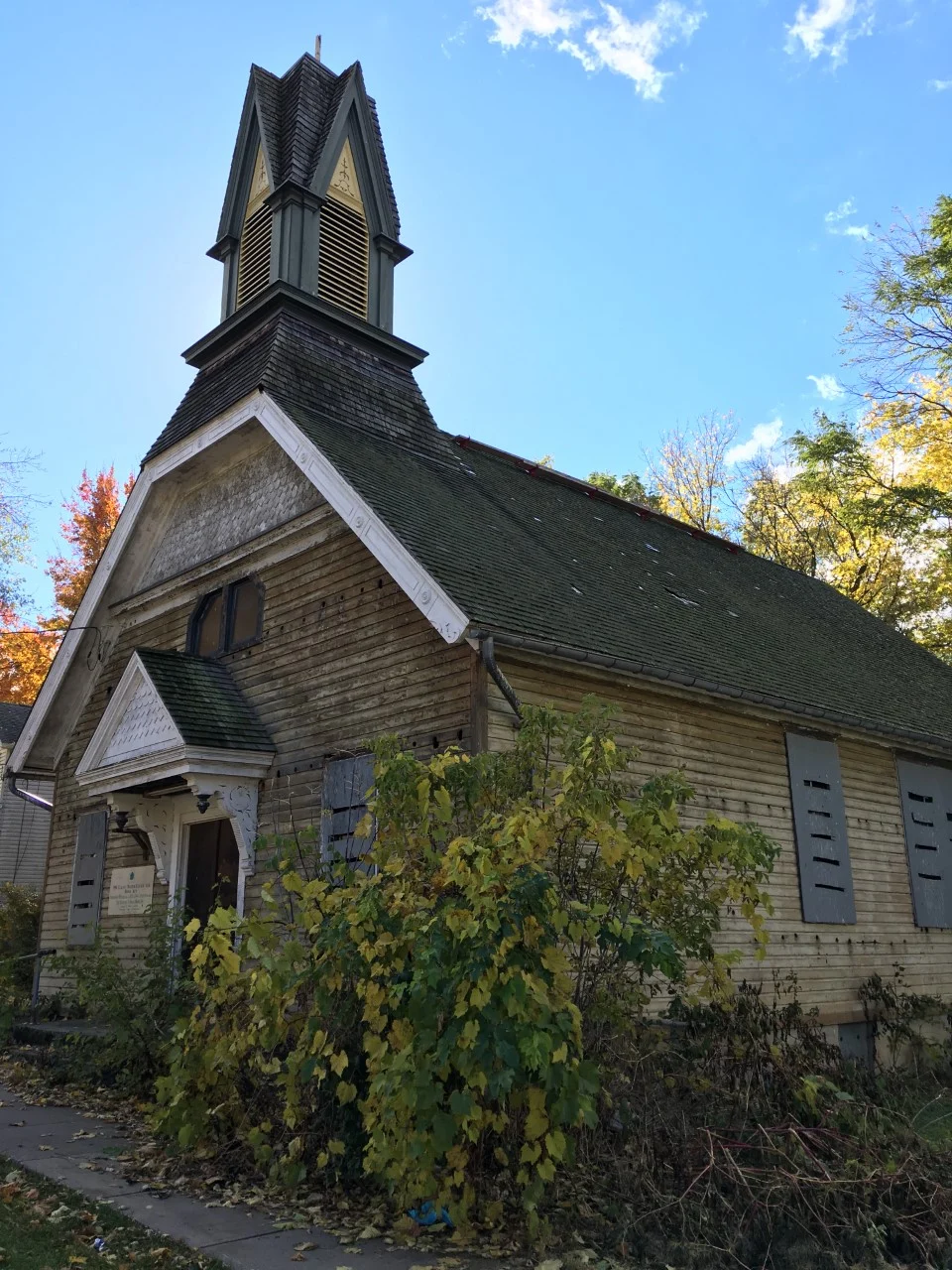
She joined the Thompson A.M.E. Zion congregation, which had incorporated in Auburn in 1846 and was meeting in members’ homes. When the congregation began raising money for a permanent church on Parker Street in 1891, Tubman pledged $500. Construction began that year, and the building was renamed Thompson Memorial in honor of an early pastor, Joseph P. Thompson, who had become a bishop. She worshipped there until her death.
She also turned to women’s suffrage. Tubman attended suffrage meetings in Geneva and elsewhere in upstate New York. She had known Susan B. Anthony for decades; an entry in Anthony’s diary from 1861 reads, “Fitted out a fugitive slave for Canada with the help of Harriet Tubman.” Anthony introduced her at the 1904 meeting of the National American Woman Suffrage Association in New York. Tubman did not live to see the 19th Amendment ratified in 1920.
The brick house and the home she built
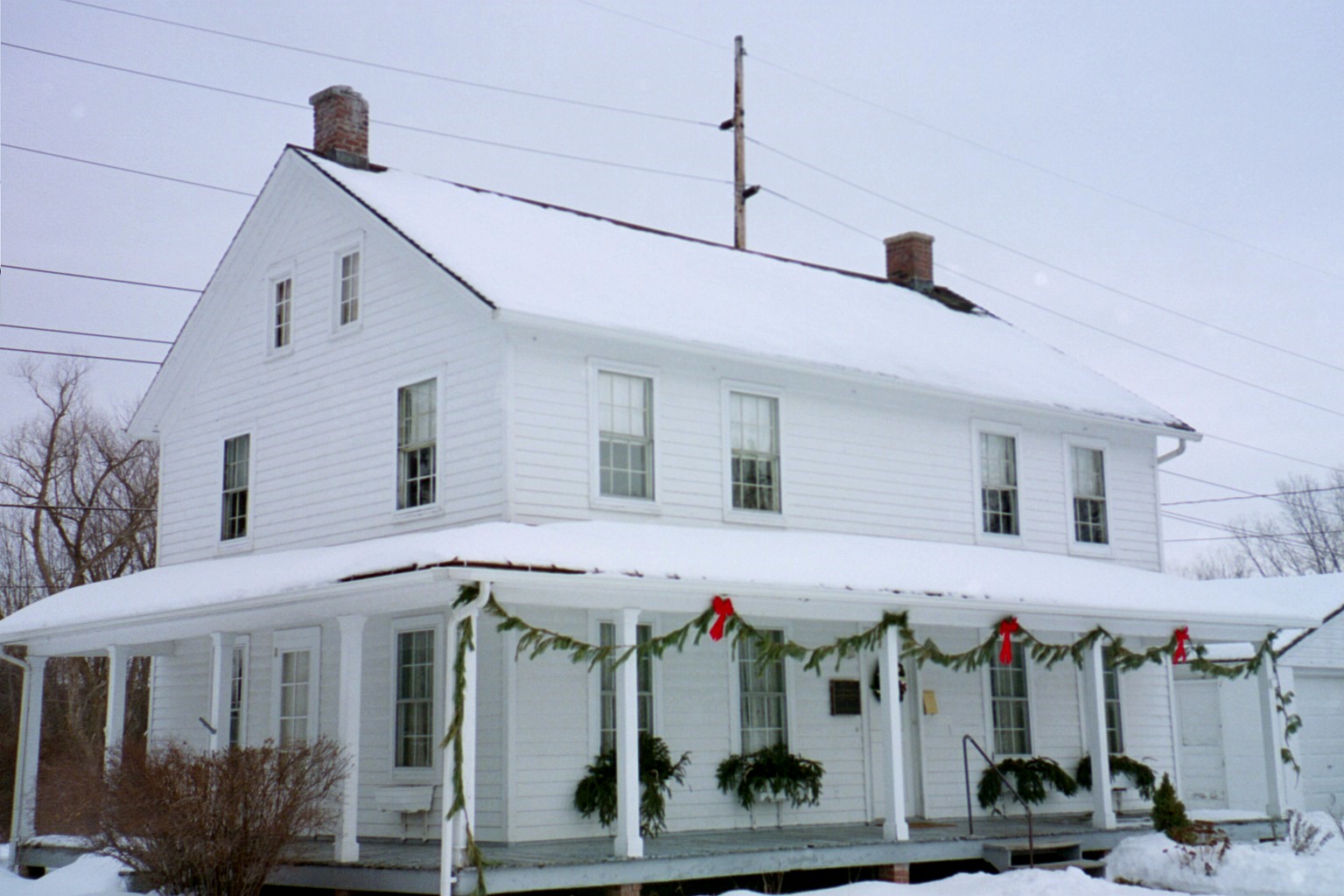
On February 10, 1880, an accidental fire destroyed the wood-frame house. Tubman rebuilt. The new structure went up between 1881 and 1882, two stories with an attic, about 1,200 square feet of finished living space, brick on a foundation of cut Onondaga limestone laid over the rubble stone footing of the old house. The house, the National Park Service notes, “was entirely designed and built by African Americans, most likely Tubman’s second husband, Nelson Davis, and Tubman’s relatives and friends.”
That brick house is the one tourists see today. It is on the Fleming side of the city line, at 182 South Street.

In 1896, when she was 74, Tubman bought the 25-acre parcel next door at auction for $1,450. The property included a wood-frame structure she rechristened John Brown Hall, after her old abolitionist ally. She had the certificate of incorporation for a charity drawn up on December 3, 1895: a home “for the shelter, care and maintenance of worthy indigent colored people.”
Funding the home was the harder problem. By 1903, Tubman concluded she could not run it alone. She deeded the 25-acre property to the African Methodist Episcopal Zion Church on the condition that the congregation continue the home she had founded. The Home for the Aged formally opened with the dedication of John Brown Hall in 1908. Tubman became a resident herself in 1911. She died there two years later.
Karen V. Hill, who served as president and chief executive of Harriet Tubman Home, Inc. for nearly two decades and led the campaign to make the property a National Park, told Ms. Magazine in March 2022 that the home was an extension of how Tubman had always operated. “Harriet left eight women in charge as the managers for the Home for the Aged,” Hill said. “She didn’t leave the women out.” In the same interview, on Tubman’s relationship to land and capital, Hill said: “She understood why it was important for women to be able to acquire credit, why it was important to have home ownership.” Hill died on November 24, 2025, at age 72.
The death and the burial
Tubman died of pneumonia at the Home for the Aged on March 10, 1913. She was somewhere between 88 and 91 years old; her exact birth year was never recorded. Friends and family in the room reported her last words as a paraphrase of the Gospel of John: “I go to prepare a place for you.”
Her funeral was held three days later at the Thompson Memorial A.M.E. Zion Church on Parker Street. She was buried with semi-military honors by the local Grand Army of the Republic post in Fort Hill Cemetery, half a mile from her house.
That granite headstone is not the original. A first marker went in two years after the funeral, placed in 1915 by the Harriet Tubman Neighborhood Club of New York; the Empire State Federation of Women’s Clubs replaced it with the current stone in 1937. On the back, the inscription reads, “Servant of God, Well Done.” The grave was added to the National Register of Historic Places in 1999.

From private property to federal park: 1908 to today
| 1908 | Home for the Aged opens; A.M.E. Zion Church operates the property |
| early 1920s | Home for the Aged closes; buildings sit largely vacant |
| 1944 | City of Auburn orders the deteriorating frame building demolished |
| April 13, 1953 | Restored Home dedicated as a memorial museum after Bishop William J. Walls leads $30,000 fund drive |
| May 30, 1974 | Designated National Historic Landmark and added to the National Register of Historic Places |
| January 3, 2001 | National Register listing expanded to include adjacent properties |
| January 10, 2017 | Secretary Jewell formally establishes Harriet Tubman National Historical Park, the 414th unit in the National Park System |
| June 22, 2024 | Thompson Memorial A.M.E. Zion Church and parsonage reopen to the public after a multiyear NPS restoration |
| January 10, 2025 | Park marks its 8th anniversary as a federal unit |
How the park got built
The federal park did not exist for the first 104 years after Tubman’s death. The property was held privately by Harriet Tubman Home, Inc., the nonprofit chartered by the A.M.E. Zion Church to manage the bequest, and run as a memorial museum starting with the 1953 dedication. Bishop William J. Walls of the A.M.E. Zion Church led that restoration, raising $30,000 to rebuild the structure the city had ordered torn down nine years earlier.
The push to make the homestead a federal site began in earnest in the 2000s. Karen Hill came on as president and CEO of Harriet Tubman Home, Inc. after a career in affordable housing and federal court work, including the Yonkers desegregation order. She and the A.M.E. Zion Church spent more than a decade lobbying Congress. The authorizing legislation passed in 2014. The formal establishment came on January 10, 2017, at a signing ceremony at the U.S. Department of the Interior in Washington. It was the first national park honoring an African American woman.
The arrangement is unusual. The Thompson Memorial A.M.E. Zion Church and parsonage on Parker Street are owned and managed by the National Park Service. The Harriet Tubman Home for the Aged and the residence on South Street remain owned by Harriet Tubman Home, Inc. and are jointly operated with NPS staff. Two organizations, one park.
What is open right now
Biggest change since 2017 has been the $5 million Thompson restoration. Both the church and the parsonage next door were structurally unsafe when NPS took the deed; work was held up first by a 2019 lightning strike (the steeple caught fire, water poured in for hours), then by the pandemic. Both buildings reopened to the public on June 22, 2024, on a limited Friday-and-Saturday schedule.
NPS work on the church included plaster repair, original stencil restoration, refinishing the floors, reinstalling historic light fixtures and the altar rail, rebuilding a chimney, replacing parsonage windows, painting the exterior, and installing a 13-foot spire. Archeologists excavated portions of the parsonage grounds during the work; some of the finds are now on display.
Ahna Wilson, who serves as superintendent of both Harriet Tubman National Historical Park and Women’s Rights National Historical Park in Seneca Falls, said in the NPS announcement of the church reopening: “Park staff are incredibly excited to open this site to the public and share just a portion of Harriet Tubman’s expansive legacy.”
The four Auburn Tubman sites
Brick house Tubman built in 1881-82 after the original wood-frame house burned. Stands on the original 1859 fieldstone foundation. Owned by Harriet Tubman Home, Inc.
Charity Tubman founded in 1908 on land she donated to the A.M.E. Zion Church in 1903. Tubman died here on March 10, 1913. Restored in 1953. Owned by Harriet Tubman Home, Inc., jointly operated with NPS.
Built 1891 with a $500 pledge from Tubman. Her funeral was held here on March 13, 1913. Owned by NPS since 2017. Restored and reopened June 22, 2024.
Tubman’s grave on West Lawn C, under a large tree. 1937 granite gravestone reads on the back “Servant of God, Well Done.” Listed on the National Register of Historic Places in 1999. Owned by the cemetery, not by NPS.
What’s still being preserved
The Thompson restoration is finished, but the rest of the park is still being worked on. Cultural Resource Specialist Jessica Bowes told NPS in 2024 that “the process of meticulously researching a building’s construction and history can take years, even without delays.” Archaeologists working on the South Street property over the last several years have been recovering buried foundation lines, cellar fill, and household objects from the wood-frame house that burned in 1880, layered beneath the brick house Tubman rebuilt over it.
The park sits inside a wider preservation effort in Auburn. The New York State Equal Rights Heritage Center, a $10 million state-funded visitor and interpretation building at 25 South Street, opened on November 13, 2018, and pulled together the Tubman, Seward, and women’s suffrage stories under one roof a mile from the Tubman Home. In its first 14 months it drew 22,500 visitors.
By the numbers
What you can see, hour by hour
The Harriet Tubman Home for the Aged is open by appointment through Harriet Tubman Home, Inc. The Thompson Memorial Church and parsonage are open Fridays and Saturdays under NPS staffing, with seasonal expansions for events such as Harriet Tubman Day on March 10 each year. Both sites are free. The grave at Fort Hill is always accessible during cemetery hours and requires no ticket. The cemetery itself, founded in 1851 on the site of a former Cayuga Nation fort, holds Tubman, William and Frances Seward, the women’s rights organizer Martha Coffin Wright, and Civil War cavalry officer Myles Keogh, among others.
The park’s 8th anniversary in January 2025 was quiet. Park rangers held a Harriet Tubman Day program on March 10, 2026, jointly with Women’s Rights National Historical Park in Seneca Falls. The next major joint event is Suffrage and Science Week, April 17 through April 22, 2026.
One concrete detail
The brick house at 182 South Street sits on cut Onondaga limestone laid over rubble stone. The Onondaga Escarpment, a 550-million-year-old Devonian limestone ledge that runs west under Auburn and out through Jamesville and DeWitt, supplied quarries within a few miles of the property. Tubman’s relatives and friends, working the property in 1881, set the new foundation by hand on top of the burnt footprint of the wood-frame house her parents had walked into 22 years earlier. Those stones are still down there, under the floorboards of the house tourists walk through.
Sources for this article: National Park Service Harriet Tubman National Historical Park (nps.gov/hart); U.S. Department of the Interior; Library of Congress; Ms. Magazine; auburnpub.com; Cayuga County; Fingerlakes1.com; Wikipedia; harriet-tubman.org; Cayuga Museum of History and Art; Tour Cayuga; The Pittsburgh Courier (1953).
Further reporting
According to its most recent IRS Form 990 filed November 3, 2025, Harriet Tubman Home Inc. reported $237,460 in annual revenue against $246,054 in expenses for fiscal year 2024, a net loss of $8,594. Total assets stood at $714,319. Contributions made up 86.5 percent of revenue at $205,439, and Karen V. Hill drew a $50,000 salary as president and CEO.
The Tubman site was the first honoree in the U.S. Postal Service’s Black Heritage stamp series, launched February 1, 1978, with a 13-cent stamp issued in Washington, D.C. Tubman was the first African-American woman ever to appear on a U.S. postage stamp.
“This is the part of her story that tells the real Harriet Tubman,” Rev. Paul Gordon Carter, manager of the Harriet Tubman Home for the National Park Service and the second-highest-paid employee at Harriet Tubman Home Inc. with $40,824 in compensation per the 2024 Form 990, told The Washington Post in March 2022. “In Maryland, they talk more of her enslaved life. Here we try to enlighten people about her free life.”
The bicentennial of Tubman’s birth in 2022 brought a seven-month run of programming to Auburn, kicked off March 12, 2022 by the City of Auburn, the NYS Equal Rights Heritage Center and the National Park Service. The walking-and-civic group GirlTrek mobilized its million members for the largest “moving tribute” to Tubman in history on March 10, 2022, and sculptor Wesley Wofford’s traveling exhibition “Harriet Tubman: The Journey to Freedom” was on display at the Tubman Home from July 1 to August 31, 2022.
The “Travel with Tubman” trip-planning tool the NPS unveiled during the bicentennial year guides visitors through 13 sites tied to Tubman’s life, including the South Street homestead and Fort Hill Cemetery in Auburn.
Further reporting
Rev. Paul Gordon Carter, who manages the Harriet Tubman Home for the National Park Service, has framed why Auburn matters separately from the underground-railroad chapters that get the textbook treatment. “This is the part of her story that tells the real Harriet Tubman,” Carter told The Washington Post during the 2022 bicentennial. “In Maryland, they talk more of her enslaved life. Here we try to enlighten people about her free life.”
The nonprofit Tubman Home that holds the parcel before the federal park ran on $237,460 in revenue against $246,054 in expenses in calendar year 2024, ending the year with $714,319 in assets and an $8,594 net loss, according to its IRS Form 990. Karen V. Hill drew a $50,000 salary as president and CEO; Rev. Carter drew $40,824.
Tubman was the first honoree of the U.S. Postal Service’s Black Heritage stamp series, on a 13-cent stamp issued in Washington on Feb. 1, 1978. The 2022 bicentennial drew GirlTrek, which mobilized one million members on March 10, 2022 in what it called the largest “moving tribute” of any single American figure, and brought sculptor Wesley Wofford’s “Journey to Freedom” exhibit to Auburn from July 1 through Aug. 31 of that year. The National Park Service’s “Travel with Tubman” web tool now strings together 13 sites tied to her life.