By Matt Russo, Staff Reporter
Drive twenty miles southeast of Syracuse on Route 20 and the road bends toward a mile-wide stretch of glacial water that locals have been organizing their summers around for two centuries. Cazenovia village sits at the south end of that lake, a community of 2,767 people built on a trust set up by a Dutch land agent in 1794. It is older than the state university system and younger than the United States by about a decade, and on any given Saturday in spring its sidewalks fill with people from as far as Manhattan looking for what the algorithm cannot deliver: a place where the buildings still know their own names.
This is a working town that learned long ago how to hold its history without becoming a museum. Lorenzo, the Federal-style mansion finished in 1809, sits half a mile down the lake under New York State stewardship. The Brewster Inn, built in 1890 by a Standard Oil trustee whose ancestor came over on the Mayflower, still serves dinner with a Wine Spectator-recognized cellar and a DiRoNA award. And the public library at 100 Albany Street has occupied the same Greek Revival house since 1890, the year a local benefactor named Robert J. Hubbard handed it to the community.
The man who drew the map
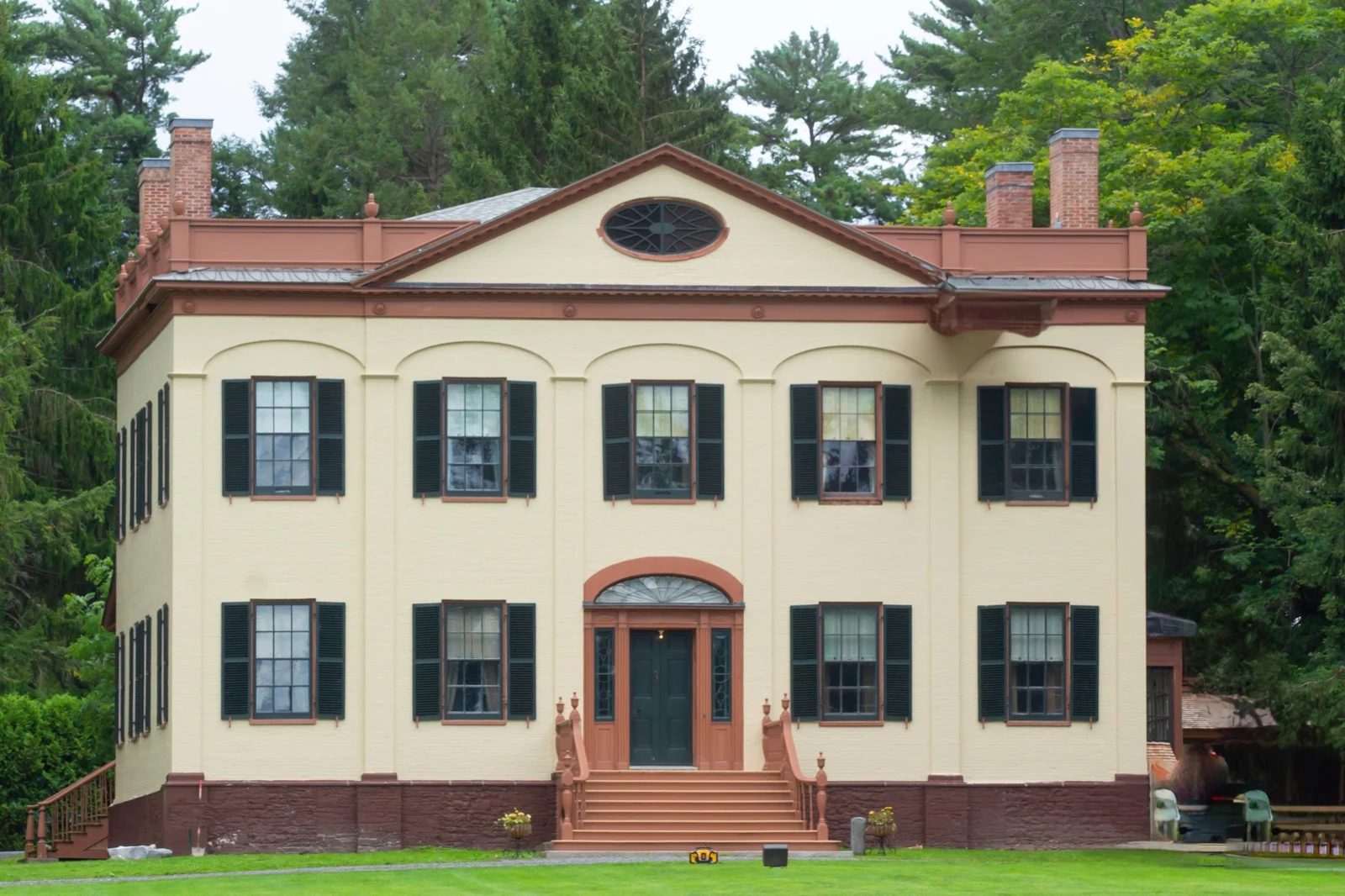
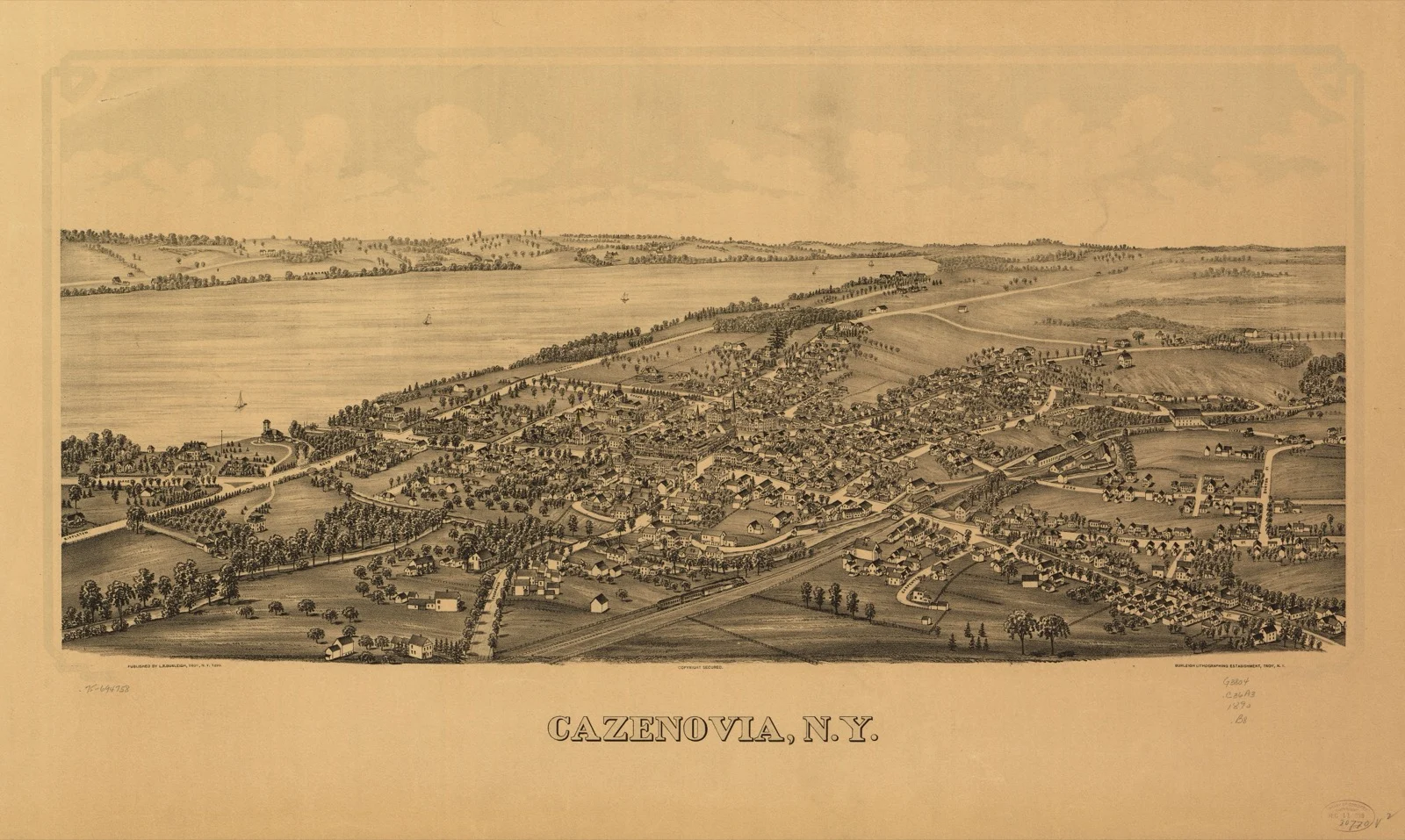
Cazenovia owes its grid to John Lincklaen, a former Dutch naval officer working as a land agent for the Holland Land Company. Lincklaen surveyed the area in 1792 and named the place for Theophile Cazenove, the company’s general agent in the United States. He laid out the village two years later and built Lorenzo on the lake’s southern shore between 1807 and 1809. The painted brick mansion stayed in the Lincklaen and Ledyard family for six generations before the property was conveyed to New York State in 1968 with its furniture, books and papers intact. Long before Lincklaen arrived, the Oneida nation knew the lake as O-wah-ge-ha-ga, a phrase translated as “where the yellow perch swim.”
What sets Lorenzo apart from most of the state’s historic sites is the survival rate of its original contents. The 80-plus-acre grounds include the Ellen Shipman formal garden and the Dark Aisle Arboretum, a stand of mature trees that has been continuously cultivated since the early 1800s. The mansion opens for guided tours Wednesday through Sunday and Monday holidays from 10 a.m. to 4:30 p.m. once the season starts in mid-May, with adult admission at $5. Charles Stebbins Fairchild, who served as United States Secretary of the Treasury under Grover Cleveland from 1887 to 1889, was born in Cazenovia in 1842 and married into the Lincklaen family. He is buried in the village’s Evergreen Cemetery. Few small towns can claim a treasury secretary in the ground, or a folkloric ghost in their state historic site. Visitors over the years have reported sightings of a figure in gentlemanly dress on the upper floors of the mansion.
A four-mile lake with a 178-foot bottom
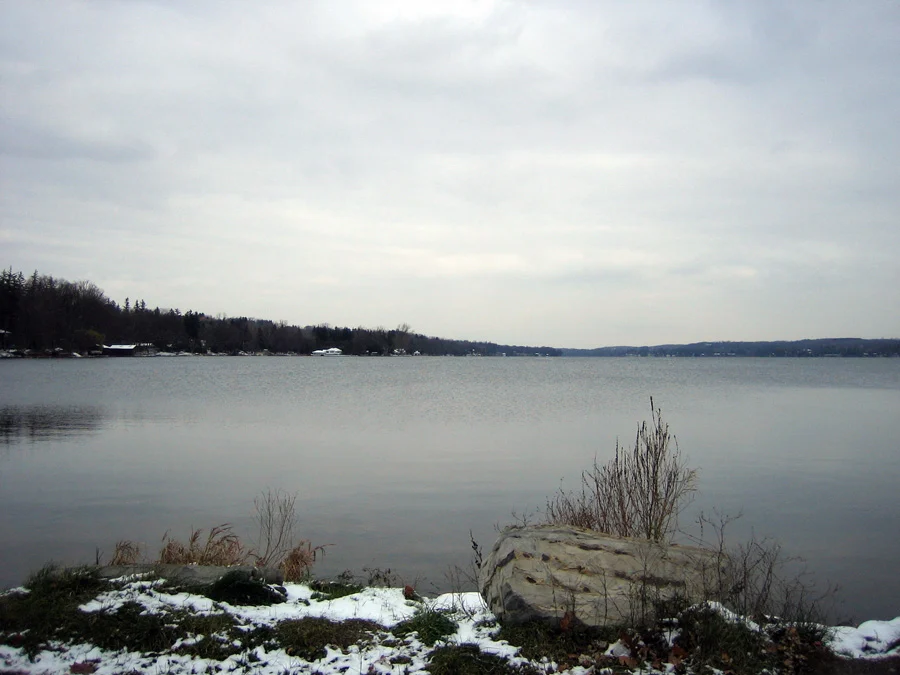
Cazenovia Lake runs roughly four miles north to south, sitting in a glacially carved trough that bottoms out at 178 feet. The state Department of Environmental Conservation classifies it as mesotrophic, a category that means moderate clarity, moderate algae and moderate nutrient loading. That status is hard-won. The Cazenovia Lake Association has spent more than a decade managing Eurasian milfoil, an invasive aquatic plant that arrived decades ago and threatened to choke recreational use. Crews treated portions of the lake with the herbicide ProcellaCOR EC in 2021 and again in 2024 across the 190 acres permitted by the state for a single application. The 2024 treatment ran roughly $200,000, or about $1,053 per acre, paid out of lake-association funds and special assessments. The association runs annual rake-toss surveys to track how native plants are recovering and volunteers pull water samples every two weeks for the state’s Citizens Statewide Lake Assessment Program.
The Cazenovia Lake Watershed Council held its 18th annual lake summit in late 2025, an unbroken streak of public meetings about a body of water that supports drinking-water draws, agriculture and a tourism economy that the village leans on every July and August. The lake also enforces a 5 mile-per-hour speed cap whenever a boat is within 100 feet of a dock, raft or anchored vessel, and the town moved in 2025 to amend its code regulating wake-enhancing watercraft to protect the shoreline. Lakeland Park, at the foot of Albany Street, is the village’s free public access point. The 14-acre town park has a sandy beach with lifeguards, a stone-masonry pier, a canoe launch, changing rooms, a bandstand and free electric-vehicle charging. The Fourth of July fireworks at Lakeland are a regional draw.
Albany Street, the spine of the village
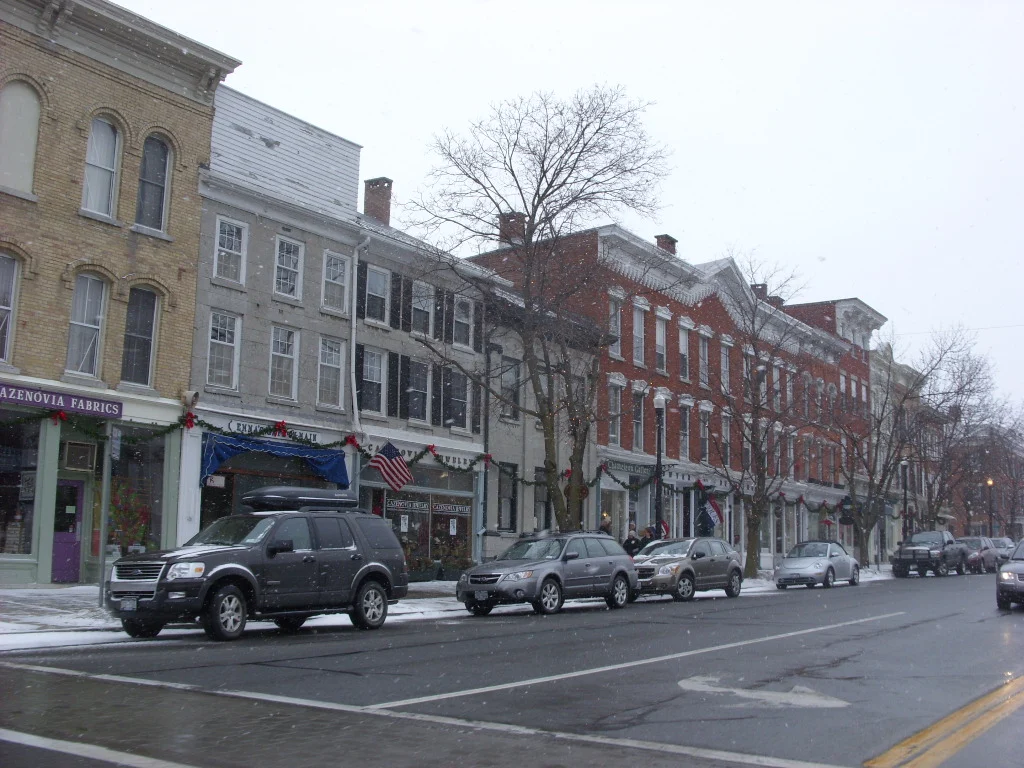
Albany Street is where the village does its public life. The historic district along the corridor was added to the National Register of Historic Places in 1985, and the buildings along it tell a continuous architectural story from Federal through Greek Revival, Italianate and Queen Anne. The Cazenovia Public Library at 100 Albany sits in a Greek Revival house built in the mid-1830s for John Williams, a manufacturer and merchant. Hubbard, who acquired the building in 1890, also brought back from a Grand Tour of Egypt in 1894 a complete mummy and case, which is on display in the library’s upstairs museum gallery alongside a collection of natural history specimens. It is, as far as anyone can verify, the only mummy in a Madison County library. The mummy is named Hen and is roughly 2,000 years old. Hubbard’s collection has been on continuous display since 1894. In December 2017 the library partnered with Crouse Hospital and Upstate Medical University to put Hen through a second CT scan, more than a decade after a first scan in 2006. Dr. E. Mark Levinsohn, associate radiologist emeritus at Crouse, led the imaging team and Dr. Stuart Singer, a radiologist who lives in Cazenovia, performed minimally invasive biopsies the same day. The work identified a malignant bone tumor in the fibula of Hen’s right leg, the first time a malignant bone tumor has been identified in an ancient mummy both histologically and radiographically. Dr. Anthony Shrimpton, who runs molecular diagnostics at Upstate, ran follow-up DNA work on the biopsy fragments.
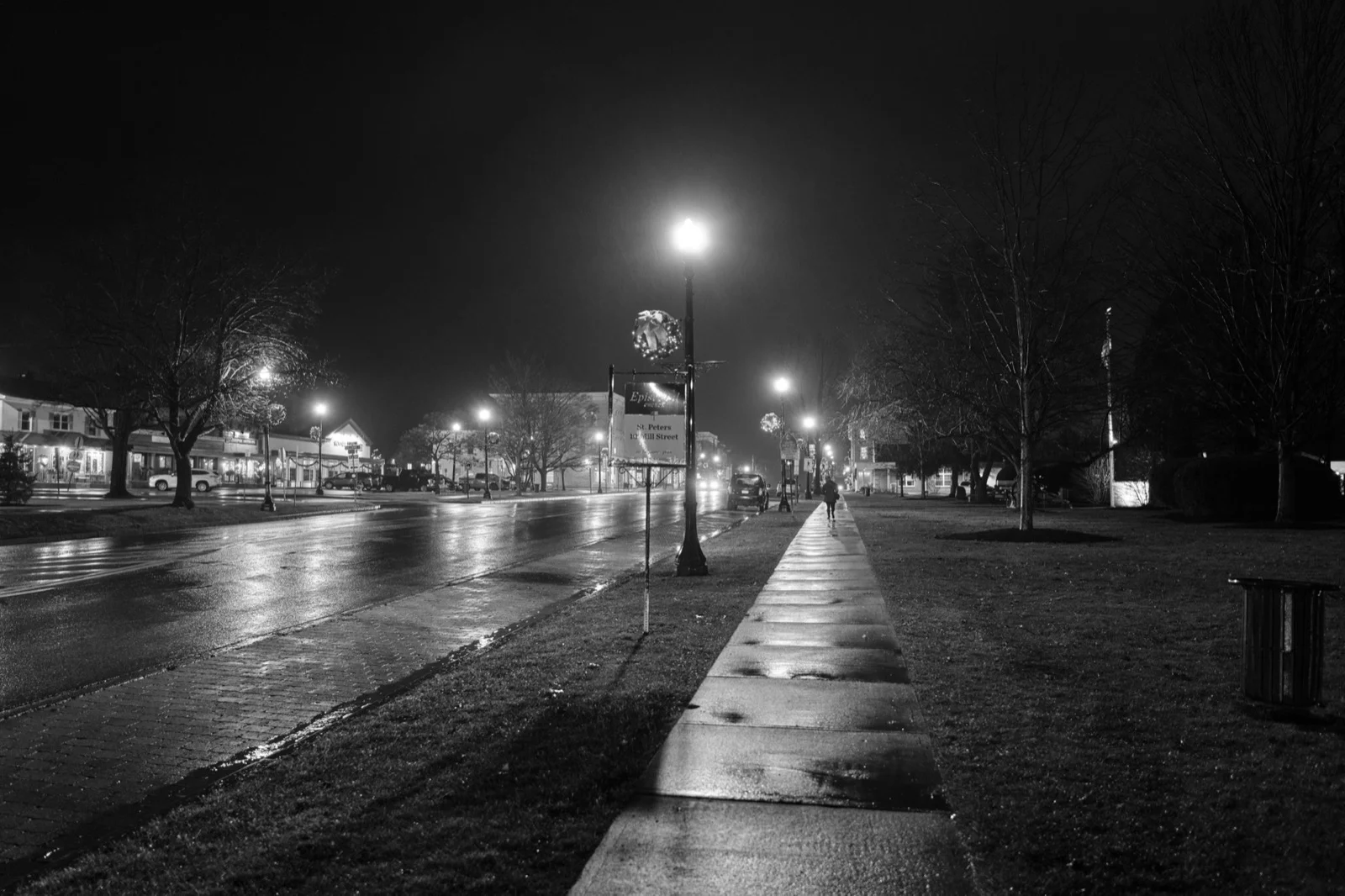
Walk a block south and you reach the corner block at 37 Albany Street, which longtime developer Bob Hood ran for years as a community anchor before closing on the sale to another Cazenovia resident on September 3, 2025. Hood declined to name the buyer publicly. Common Grounds, the substance-free coffeehouse and gathering space that opened in December 1998 thanks to a group of Cazenovia High School students, was reopened in the building in 2022 as Purpose Coffee Co. by Bill and Debbie Tilison, who also own Dave’s Diner next door. Dave’s serves all-day breakfast Wednesday through Sunday from 7 a.m. to 2:30 p.m. and ranks consistently in the village’s top five restaurants on Tripadvisor.
The new owner has signaled plans to convert former dorm rooms above the storefronts into about 10 walkable apartments in 2026, part of a wider housing push happening in the village that also includes the 99 and 103 Albany Street project, slated to deliver 30 residential units and new ground-floor retail this year.
The Brewster Inn and the lake-house era
Benjamin Brewster bought lakefront land at the southern tip of Cazenovia Lake and finished his summer house in 1890. Brewster was a Standard Oil trustee and a fourth great-grandson of Mayflower passenger William Brewster, and he named the place Scrooby after the English manor where his ancestor lived before the 1620 voyage. It was used roughly two months a year. The inn today operates four dining rooms, 17 guest rooms and a wine cellar that has been recognized by Wine Spectator. Nightly rates run from about $168 to $433 depending on the room and date, according to listings on Hotels.com and the inn’s own booking page. The dining room also holds a DiRoNA award (Distinguished Restaurants of North America), one of the more selective hospitality designations in the industry. Richard and Patty Hubbard owned and ran the Brewster Inn for more than 33 years before announcing a new ownership team in 2018. The current operating group includes Executive Chef Jason Wright, Sous Chef Stephen Franks, Wine Specialist Kirk Gibson and Marketing and Public Relations Director Caitlin Gambee. The Brewster Inn was added to New York State’s Historic Business Preservation Registry, a designation reserved for businesses operating at the same site for more than 50 years and contributing to the historical character of the community. Brewster died at the property in September 1897.
What happened to the college
Cazenovia College closed on June 30, 2023, after 199 years of operation. The institution had been founded in 1824 as the Genesee Seminary, became Methodist-affiliated in 1894, dropped that affiliation in 1942 and operated as a private four-year college from there. Peak enrollment hit 800 students in fall 2020, then collapsed under post-pandemic demographics and what trustees described as poor finances. The campus did not sit idle for long. The New York State Police took over Hubbard Hall and the surrounding buildings in fall 2023 to run a state police training academy, a temporary use scheduled to end in August 2025.
The full disposition closed on December 19, 2025 in a multi-party transaction totaling $9.5 million. Local investor group 9Fresh, led by Kate Brodock, took the bulk of the campus through Matta Fresca LLC, including the main quad, the equestrian property and the athletic center. Concurrent closings split off two key parcels: Madison County paid roughly $1.9 million for Reisman Hall at 6 Sullivan Street and Sigety Hall at 10 Seminary Street, and the Town of Cazenovia paid $1,050,000 for the Jephson Campus to use as its new town hall. According to Bloomberg’s July 2025 reporting on the bankruptcy proceedings, the combined sale recovers roughly 50 percent for the bondholders who put up about $25 million in 2019. Original campus appraisal was $24 million.
9Fresh has now filed a Phase I plan that the village board moved into formal review on March 2, 2026, with a public hearing on the rezoning to a Planned Development District set for April 5, 2026 at 6:15 p.m. Phase I covers the western campus: Shove Hall and Shove Suites would become age-restricted housing for residents 22 and over, Farber Hall and Park Hall would become market-rate apartments, and Joy Hall would become office space. Adam O’Neill, a 9Fresh partner, oversees the Catherine Cummings Theatre and the athletic center. Mayor Kurt Wheeler, who was reelected June 17, 2025 by a 500 to 294 vote over challenger Jen Marotto Lutter, told the board that a “flexible” approach to the new PDD zone is part of how the village plans to handle the largest redevelopment in its modern history. The full college property covers about 27 acres of main campus across 14 parcels plus a 244-acre equestrian center, with more than 500,000 square feet of buildings constructed between the late 1800s and 2015.
Working farms, working breweries
Critz Farms at 3232 Rippleton Road has been farming the same land since 1985, when Matthew and Juanita Critz bought a 325-acre former dairy operation and became farmers for the first time. The operation grows pick-your-own apples, blueberries and pumpkins, runs a Christmas tree cut-your-own in December, taps maple in March for its Maple Weekend pancake breakfast and tours, and has produced handcrafted hard ciders and farm beers under the Harvest Moon Cidery and Critz Farms Brewing labels since launching the cidery in 2011. The farm sits about three miles south of the village on Route 13. A few miles further down the road, the former Empire Farm Brewery facility on 22 acres of barley and hops, opened in 2016 by Empire Brewing Company founder David Katleski, sat empty after a 2019 closure and ownership change before reopening efforts began.
The L. and J.G. Stickley furniture company, the Mission Oak builder founded in 1900 in Fayetteville, moved its main plant to a 400,000-square-foot facility in Manlius in 1985. The Manlius operation runs free public factory tours every Tuesday at 10 a.m., open to anyone over the age of 13, and pairs with the Stickley Museum housed inside the original factory building above the Fayetteville Free Library. Manlius sits about 10 miles northwest of Cazenovia, and Stickley furniture remains one of the few American hardwood operations still building cabinetry by traditional methods within an hour’s drive of the village.
School quality is part of the real estate equation
Cazenovia Central School District serves 1,331 students across three buildings under Superintendent Chris DiFulvio, whose office sits at 31 Emory Avenue. The district scores 65 percent math proficiency against a 52 percent state average and 59 percent reading proficiency against a 49 percent state average, according to Public School Review’s 2026 figures. Cazenovia High School ranks in the top five percent of New York’s 4,346 schools and 102nd statewide on the U.S. News list, with a national rank of 1,032. That academic record drives demand from Syracuse-area families willing to commute for the schools.
The district’s 2025 to 2026 budget tested how much that demand can absorb. Trustees proposed a 6.77 percent tax levy increase against a calculated state cap of 3.14 percent, a margin that under New York law required a 60 percent voter supermajority on the May 20 ballot. Most surrounding districts asked for far less, and Cazenovia’s tax rate ranks among the lowest in Madison County before the increase, but the budget vote sharpened a debate over how much premium the school district can ride before lakefront and in-village buyers start pricing it in.
Median home sale price in Cazenovia hit $445,000 in April 2026, with average sale prices reaching $512,131 across the year, according to Homes.com. Houses sit on the market a median 44 days, well below the national 56-day figure. Listing inventories have ranged from $335,000 to $3,749,500 over the last 12 months, a spread that captures both the in-village starter colonials and the lakefront estates with private docks.
The summer calendar and the people who put it on
Cazenovia Counterpoint, the Society for New Music’s annual arts festival, has been running for more than four decades and now occupies most of July with concerts, a juried art show, plein air events, a poetry round-robin and a Young Composers Corner workshop for middle and high school students. The festival folds music into the Fourth of July parade and the Cazenovia Farmers Market. The market itself has historically opened in early May at Memorial Park and runs Saturday mornings through October with regional growers, bakers and makers. The Christmas in Caz Walk in early December turns Albany Street into a candlelit corridor of open shops and carolers, a tradition that has run for decades.
Sailing is older than the modern festival calendar. The Willow Bank Yacht Club, founded in 1948 on the western shore of Cazenovia Lake, traces an organized regatta tradition back to the Preston Cup of September 6, 1886, when two sloops, three cat boats and two cat-rigged rowing boats raced for what is now the longest-running cup on the lake. Twelve Cape Cod Knockabouts brought to the lake around 1926 by members of the original Cazenovia Club seeded the racing fleets that still launch from Willow Bank every weekend in summer. The village also produced one of the Food Network’s most recognizable chefs, Anne W. Burrell, born in Cazenovia on September 21, 1969. Burrell graduated from Cazenovia High School in 1987, earned a bachelor’s in English and Communications from Canisius College in Buffalo in 1991 and finished her Associate in Occupational Studies at the Culinary Institute of America in 1996 on the Dean’s List. She co-hosted “Worst Cooks in America” for 27 seasons from 2010 to 2024 alongside her run on “Secrets of a Restaurant Chef.” Burrell was found unresponsive in her Brooklyn home on June 17, 2025 and died at age 55. Tributes ran from Tyler Florence to Alex Guarnaschelli.
What makes the place hold
The lake works because the lake association works. The streetscape works because the historic district was protected in 1985, before a generation of demolition could undo it. The school district works because the village is small enough that parent involvement still moves the needle on a board vote. None of this is preserved by accident. The Cazenovia Preservation Foundation has documented and published research tools for owners of historic homes, and the watershed council meets every year to put numbers on what is happening to the water. The result is a village of 2,767 people that punches well above its size on the number of working institutions per capita.
That is the answer to why people drive in from Manhattan on a Saturday in April. They come for a place that still functions. The lake is still mesotrophic. The library still has the mummy. The inn still has the wine cellar and the DiRoNA award. The schools still test 12 points above the state average. And John Lincklaen’s grid, drawn before the second president of the United States took office, still organizes the streets.
Quick reference
- Lorenzo State Historic Site: 17 Rippleton Road. Grounds open dawn to dusk year-round; mansion tours Wednesday through Sunday, 10 a.m. to 4:30 p.m. seasonally; $5 adult admission.
- Cazenovia Public Library and Museum: 100 Albany Street.
- Lakeland Park: Foot of Albany Street, 14 acres; waterfront 9 a.m. to 8 p.m. weekdays in season; free EV charging.
- The Brewster Inn: 6 Ledyard Avenue. Wine Spectator and DiRoNA awards.
- Critz Farms: 3232 Rippleton Road; spring through Christmas seasons; Maple Weekend in March.
- Common Grounds and Purpose Coffee Co.: 35 Albany Street.
- Dave’s Diner: 35 Albany Street; Wednesday through Sunday, 7 a.m. to 2:30 p.m.
- Stickley factory tour: Manlius, every Tuesday 10 a.m., free, ages 13 and up.
- Cazenovia Central School District: 31 Emory Avenue, Superintendent Chris DiFulvio, 315.655.1317.
Reporting verified through U.S. Census 2020, NYS Office of Parks Recreation and Historic Preservation, NYS Department of Environmental Conservation, U.S. News, Public School Review, Homes.com, the Cazenovia Lake Association, Eagle News Online, the Brewster Inn historical record, Bloomberg, the Friends of Lorenzo, Willow Bank Yacht Club records, the Cazenovia Central School District and Wikipedia source pages on Cazenovia village, Cazenovia Lake, Lorenzo State Historic Site, Cazenovia College, Charles S. Fairchild, Anne Burrell and L. and J.G. Stickley. Photographs sourced from Wikimedia Commons and the Library of Congress.
Related on CNY Signal: CNY Signal’s coverage of every Central New York town, how Skaneateles Lake supplies Syracuse, and Auburn and the South Street Historic District.
Frequently Asked Questions
Who founded Cazenovia, New York?
Cazenovia owes its grid to John Lincklaen, a former Dutch naval officer working as a land agent for the Holland Land Company. Lincklaen surveyed the area in 1792 and named the place for Theophile Cazenove, the company’s general agent in the United States. He laid out the village two years later and built the Federal-style Lorenzo mansion on the lake’s southern shore between 1807 and 1809.
How deep is Cazenovia Lake?
Cazenovia Lake runs roughly four miles north to south, sitting in a glacially carved trough that bottoms out at 178 feet. The state Department of Environmental Conservation classifies it as mesotrophic, meaning moderate clarity, moderate algae and moderate nutrient loading. The Cazenovia Lake Association manages Eurasian milfoil with ProcellaCOR EC treatments in 2021 and 2024 and runs annual rake-toss surveys.
What is the Lorenzo State Historic Site?
Lorenzo is a Federal-style painted brick mansion built between 1807 and 1809 by John Lincklaen on the south shore of Cazenovia Lake. The home stayed in the Lincklaen and Ledyard family for six generations before being conveyed to New York State in 1968 with its furniture, books and papers intact. The 80-plus-acre grounds include the Ellen Shipman formal garden and the Dark Aisle Arboretum.
Can the public visit Lorenzo mansion?
Lorenzo opens for guided tours Wednesday through Sunday and Monday holidays from 10 a.m. to 4:30 p.m. once the season starts in mid-May, with adult admission at $5. Charles Stebbins Fairchild, who served as United States Secretary of the Treasury under Grover Cleveland from 1887 to 1889, was born in Cazenovia in 1842 and is buried in the village’s Evergreen Cemetery.
Where is Cazenovia and how big is it?
Cazenovia village sits about twenty miles southeast of Syracuse on Route 20, at the south end of Cazenovia Lake. The community has 2,767 people and was built on a trust set up by a Dutch land agent in 1794. The Albany Street historic district was added to the National Register of Historic Places in 1985, and the public library at 100 Albany Street has occupied the same Greek Revival house since 1890.