By Matt Russo, Staff Reporter
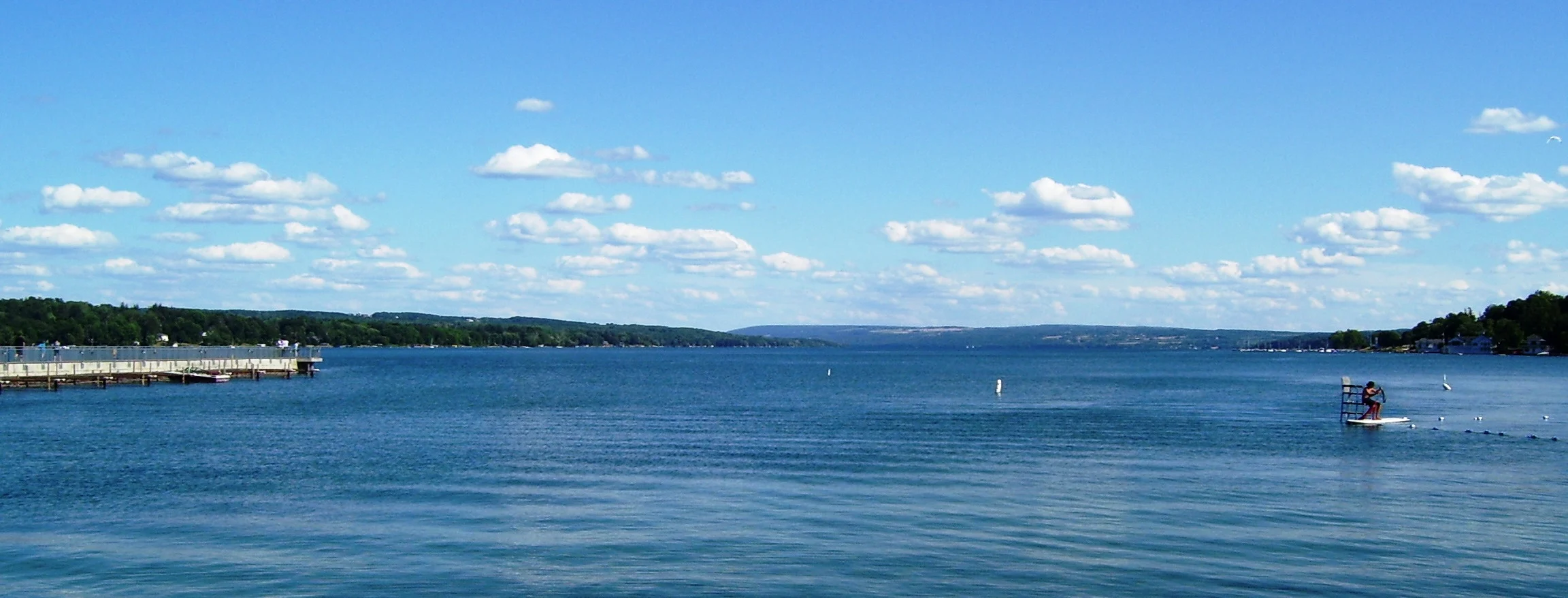
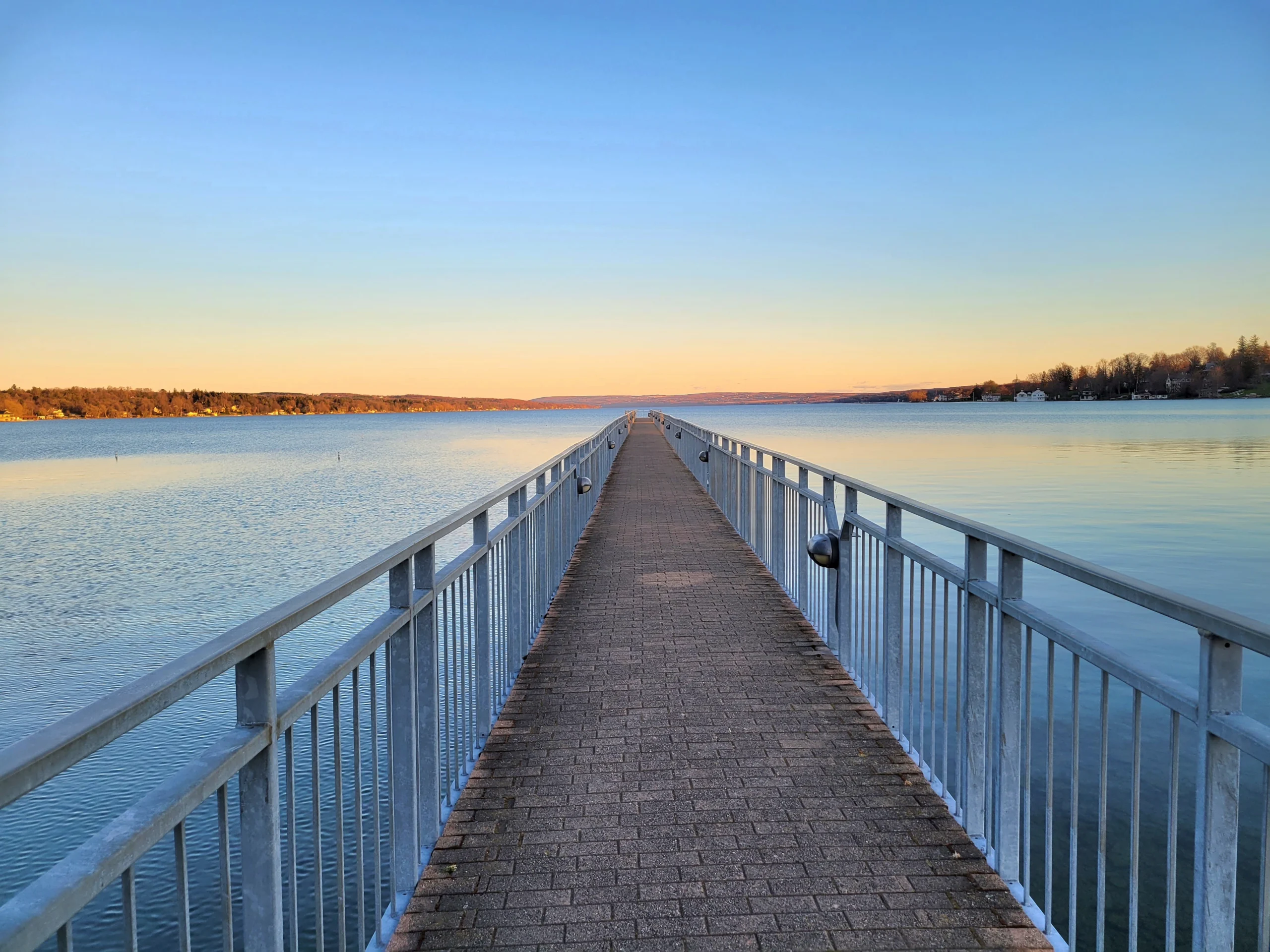
SKANEATELES, N.Y. Drive 22 miles southwest of downtown Syracuse and the road bends, the trees thin, and a sheet of water 16 miles long opens in front of you. Locals lean against the railing at Clift Park, lift their phones, and try to capture something the camera never quite gets. The water is too clear. The light is too clean. The pier is too perfect against the hills.
Skaneateles Lake is the smallest in surface area of the major Finger Lakes and arguably the most consequential. Every glass of tap water in the City of Syracuse, every sip from a fountain at Destiny USA, every cup of coffee brewed in 220,000 Central New York homes starts here, on a lake so clean it is one of only six surface water supplies in the United States permitted to skip filtration entirely.
This is a feature about the lake, the village at its head, and what it costs to keep both of them this way.
The lake, by the numbers
Skaneateles Lake stretches 16 miles north to south through the eastern Finger Lakes, sitting at an elevation of 863 feet, the highest of the major Finger Lakes and the source of its old nickname, the Roof Garden of the Lakes. Its maximum depth is 315 feet near the southern third, and its average depth is 148 feet, deep enough that the bottom of the water column never warms much past 40 degrees even in August. The lake holds roughly 413 billion gallons of water, or 0.385 cubic miles. It would take about 18 years to fully replace that volume through natural inflow and outflow.
The basin itself is glacial. The Laurentide Ice Sheet, up to two miles thick at its peak, scoured a north-south stream valley into a U-shaped trough during the last glaciation, retreating from this part of New York roughly 11,000 years ago. The southward-dipping Onondaga Limestone bedrock under the Finger Lakes capped how deep the ice could cut, which is why Skaneateles bottoms out at 315 feet while neighboring Cayuga Lake reaches 435.
SKANEATELES LAKE BY THE NUMBERS
The watershed itself is unusually compact. Roughly 37,724 acres of land drain into 8,800 acres of water, a ratio of about 4.3 acres of watershed for every acre of lake. Lakes with much larger drainage basins per surface acre are more vulnerable to nutrient runoff and algae outbreaks. Skaneateles is structurally protected, then guarded further by a watershed agriculture program that the City of Syracuse funds to the tune of about $2.3 million a year.
The result is a lake the U.S. Geological Survey ranks as the second cleanest in the country by dissolved nitrogen, behind only Crater Lake in Oregon. Crater Lake remains the optical benchmark, with a typical summer Secchi disk reading of about 30 meters of visibility, where Skaneateles averages closer to 7.8 meters and tops out near 10.5 meters in early summer. By the nutrient measure that limits algae growth, though, Skaneateles is in a tier of its own among populated drinking water supplies. The lake is classified as oligotrophic, meaning low nutrients and high oxygen, and supports a coldwater fishery the New York State Department of Environmental Conservation stocks every spring with about 20,000 rainbow trout and 9,000 Atlantic landlocked salmon. Lake trout reproduce naturally here, one of only two Finger Lakes where that is still true. To keep walleye from preying on the native trout, the DEC removed the daily possession limit on walleye in 2022 and set only a 12 inch minimum.
2017 turned the lake green, and 2025 made it official
For decades, scientists thought Skaneateles was structurally immune to harmful algal outbreaks. That assumption ended in September 2017, when the lake recorded four confirmed bloom events, two of them widespread enough to turn the open water visibly green. The City of Syracuse never lost the EPA filtration waiver, but the response was immediate. The Skaneateles Lake Association built a HAB Response Plan, and a coalition that now includes Cornell Cooperative Extension, the Onondaga County Soil and Water Conservation District, the state DEC, Syracuse University, SUNY-ESF and the Finger Lakes Institute meets regularly on remediation, conservation easements and landowner outreach. Climate change, degraded tributaries and zebra mussels are all suspected drivers. More than 35 trained shoreline volunteers now sample the lake weekly under the DEC HAB surveillance program.
The threat returned on September 12, 2025, when the Onondaga County Health Department issued a blue green algae advisory after the state DEC confirmed a bloom and the City of Syracuse detected microcystin toxin in raw, untreated lake water. The treated public supply was unaffected. Three months earlier, on June 5, 2025, the state DEC and Department of State finalized the Skaneateles Lake Watershed Nine Element Plan for Phosphorus, the regulatory document that governs the next generation of remediation work on failing septic systems, stormwater runoff and farm best management practices. Behind it sits roughly $42 million in Clean Water, Clean Air and Green Jobs Bond Act funding directed at the Eastern Finger Lakes, $14.7 million already spent by the City of Syracuse on its own watershed program, and another $6.3 million in matching grants. The Skaneateles Lake Watershed Agricultural Program, founded in 1994 and run out of the Onondaga County Soil and Water Conservation District, writes a Whole Farm Plan for each working farm in the basin.
Onondaga County added roughly $100,000 in 2025 toward expanded water quality monitoring, and U.S. Geological Survey buoys feeding near real time data on temperature and chlorophyll have started to be deployed across Skaneateles, Owasco and Seneca lakes.
The 1894 pipeline that built modern Syracuse
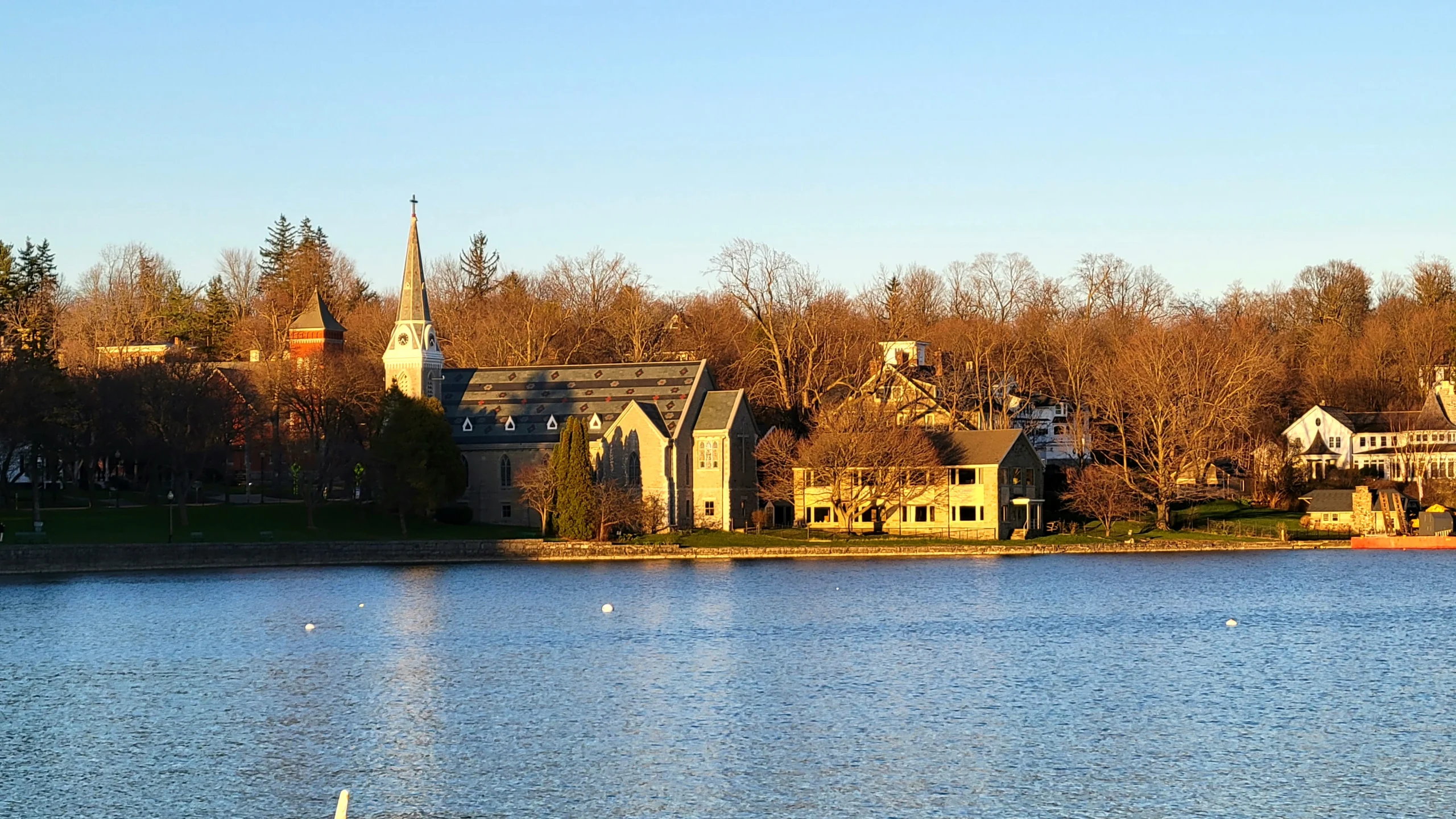
On June 29, 1894, after a two hour train ride from Syracuse, a party of city officials walked down to the lake outlet, opened a set of gates, and watched water from Skaneateles Lake start flowing toward Syracuse for the first time. Construction had begun the year before under City Engineer William R. Hill, with about 500 Italian, Polish and Black migrant workers laying 19.75 miles of pipe, including a 30-inch gravity conduit that ran through Marcellus and Camillus to the new Woodland Reservoir on the city’s western edge. No pumps were required. The lake sits roughly 200 feet higher than downtown Syracuse, so the water still arrives by gravity 132 years later, taking about six and a half to seven hours to make the trip from the lake intake to the reservoirs. A 100-gun salute marked the formal opening on July 3, 1894.
Today, Skaneateles Lake delivers unfiltered drinking water to the City of Syracuse and a string of suburban towns, serving more than 220,000 people. The City of Syracuse Department of Water pulls roughly 40 million gallons a day on an average summer day. In 2024, the outlet released an average of 49.94 million gallons a day to maintain lake level and minimum flow in Skaneateles Creek. The treatment regimen is striking in its simplicity. Coarse screens. Chlorine. Fluoride. That is it. There is no rapid sand filter, no granular activated carbon, no membrane. The Environmental Protection Agency permits this only when raw water meets a strict set of quality criteria. Just six surface water systems in the United States qualify, including New York City and Boston. Skaneateles is the smallest in the group by population served.
That status is not a given. It is renewed every year on the strength of watershed monitoring and conservation easements bought up over decades. When village leaders talk about lakefront development, septic upgrades, or shoreline tree cover, that is the conversation they are actually having: keep the water clean enough that the EPA waiver renews, or face a treatment plant that residents and city budget planners would rather never see. The City of Syracuse posts a public weekly lake data sheet through the spring runoff. The April 17, 2026 reading recorded the lake at 863.45 feet on Syracuse Datum, a hair above the 863.27 figure the city sets as the maximum safe operating level before downstream flooding becomes a concern.
A village built around water power, then around water
The town of Skaneateles separated from the larger Marcellus township on February 26, 1830. The village at the head of the lake was incorporated three years later, on April 19, 1833, and re-incorporated under New York’s general village law in 1855. The earliest white settlement here, dating to the 1790s, was built around the simple fact that the lake outlet provided usable water power for grist mills and carriage works. Genesee Street, the village’s main commercial spine, took its present shape in the middle of the 19th century.
The 2020 Census put the village population at 2,533, packed into 1.74 square miles. The surrounding town of Skaneateles holds 7,112 residents across 48.83 square miles. The Skaneateles ZIP code, 13152, covers a stretch of lakefront that real estate brokers describe in the same breath as the Hamptons, only quieter and 250 miles north.
The Skaneateles Historic District, 17 contiguous acres at the village center, is on the National Register of Historic Places. It contains buildings from as early as 1796 alongside Greek Revival, Federal, Italianate and Romanesque Revival commercial blocks from the 1840s through the 1890s. Roosevelt Hall, a 25-room Greek Revival mansion built starting in 1839 by retired canal engineer Richard L. DeZeng for $18,000 in construction and another $11,000 in furnishings, faces the lake from East Genesee Street. The Reuel E. Smith House, a Gothic Revival from 1852 attributed to the Town and Davis architectural firm, is on the National Register in its own right. The Fuller House, dating to 1815, was an Underground Railroad station before the Civil War. In 1899, the painter Samuel Montgomery Roosevelt, a second cousin of President Theodore Roosevelt, bought the DeZeng mansion and gave it the name it still carries.
The Sherwood Inn, since 1807
Isaac Sherwood ran the most prosperous stagecoach line in upstate New York. In 1807 he had a tavern built at the edge of a cedar swamp at the head of Skaneateles Lake to serve as the headquarters of that operation. The building has been continuously open as some form of inn or hotel ever since, through 16 ownership changes, multiple name changes, the rise and fall of the railroad, and a near collapse in the early 1970s.
William Eberhardt bought it in 1974 when the property was failing and the hot water did not always work. He spent four decades restoring it. The Sherwood Inn, at 26 West Genesee Street, now keeps 25 rooms above its tavern dining room and is a member of the Select Registry of Distinguished Inns, one of the oldest continuously operating inns in New York. The Eberhardt family also bought Mid-Lakes Navigation, the local cruise and mail boat company, in 2020.
VILLAGE LANDMARKS, BY THE YEAR
A short walk west, at 53 West Genesee, is The Krebs. Fred and Cora Krebs began serving meals to neighbors in the summer of 1899. The dining room ran for 111 consecutive years before closing after the 2010 death of co-owner Jan Loveless. Adam and Kim Weitsman, the Skaneateles couple behind Upstate Shredding, bought the building for a little more than $1 million in 2010, then poured a reported $5 million into a four year restoration that preserved the original woodwork. Executive chef Dan Kennedy now runs the farm to table kitchen, with a fixed price seven course tasting menu in addition to a la carte. The Weitsmans now own four restaurants in the village, The Krebs, Elephant and the Dove, Hidden Fish and Clover’s Cafe, and the net profits from all four go to women and children’s charities in Central New York. The couple also runs CNY Tuesdays, a weekly $2,000 grant to a different small Central New York nonprofit. Hidden Fish, the sushi room at 7 Fennell Street that the Weitsmans built with Jeff Knauss and Noah Lobdell after three years of planning, opened in March 2024 and brought in chef Masayori Adachi, formerly of Manhattan, as executive chef in December 2025. Up the street at 11 West Genesee, Bluewater Grill anchors the lakeside dining scene with sushi, lobster rolls and the only on-water bar in the village.
The most beloved address in town is also the most casual. Doug’s Fish Fry, opened in 1982 at 8 Jordan Street by founder Doug Clark, is the kind of place locals send their out-of-town guests on the first night of a visit. Clark, a New Jersey transplant, ran the original 20 years before retiring. He died in September 2019 at 76. The line is the line. The fish is the fish. A second Doug’s opened in Cortland, and the chain’s mobile fryer trucks now anchor more than a hundred Central New York nonprofit fundraisers a year.
The painter who built his own gallery
Tucked behind the Skaneateles Library at 49 East Genesee is one of the more unusual museums in the state. The John D. Barrow Art Gallery, opened in 1900, is the only gallery in the world dedicated entirely to a single artist that the artist himself designed and built. Barrow, born in New York City in 1824, was a Quaker landscape painter who made Skaneateles his home base for most of his life and spent decades painting the lake and the Adirondacks. The collection runs to about 300 works. Admission is free.
The mail still arrives by boat
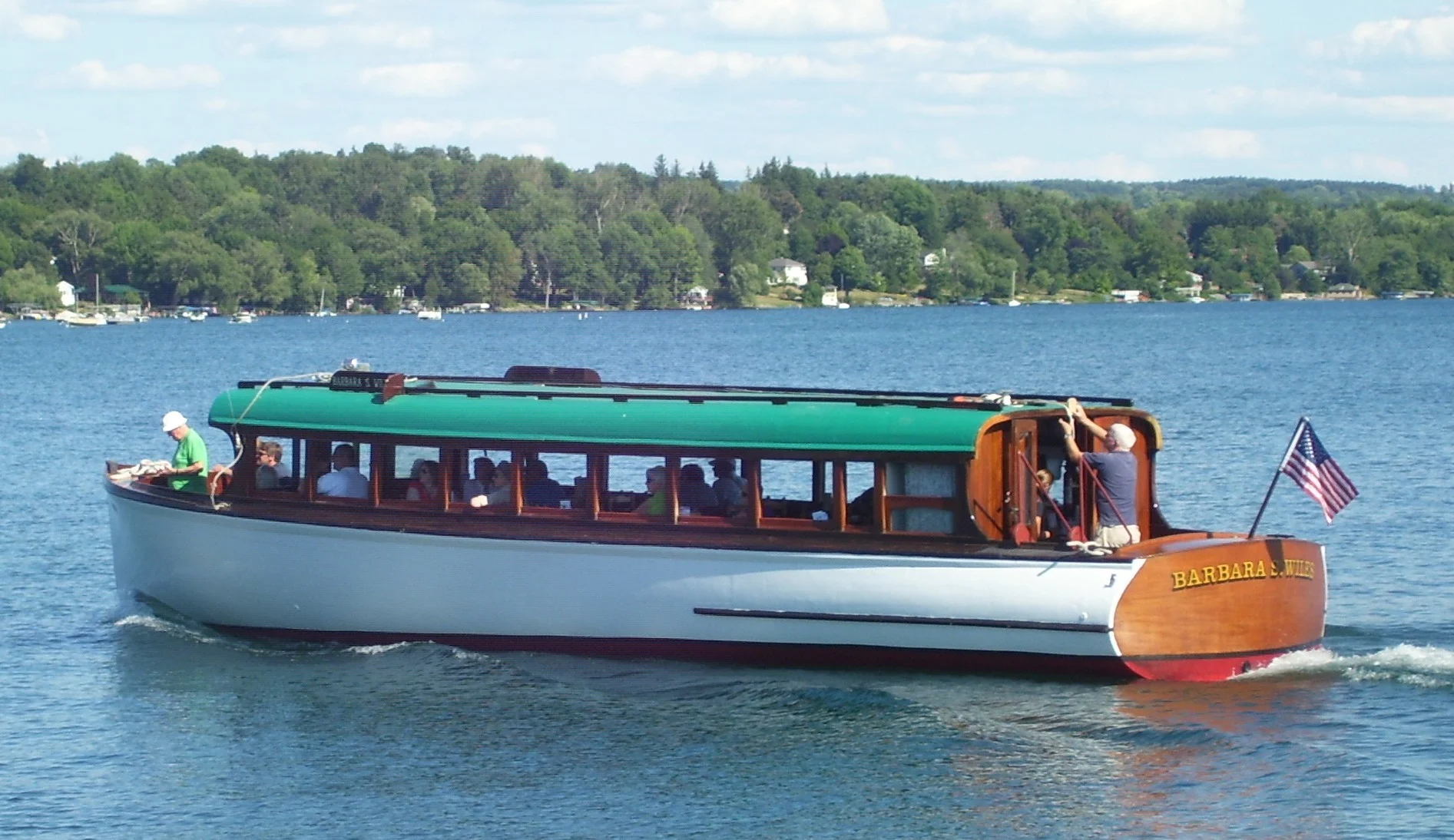
In the summer of 1968, Peter Wiles Sr. bought a 26 passenger antique boat called the Pat II and signed a contract with the United States Postal Service to deliver mail to the lakefront homes that had no road access. He started taking paying passengers along for the ride almost immediately. That trip, more than half a century later, is still one of only a few waterborne mail routes left in the country.
Mid-Lakes Navigation grew from there. The Barbara S. Wiles, named for Peter Sr.’s mother, launched in 1981. The 65 foot Judge Ben Wiles, named for his father, was built at Borodino Boatworks in Spafford and trucked to the lake in a single dramatic day in 1985. The Eberhardt family, of Sherwood Inn, took over the company from the Wiles family in 2020. Mail and dinner cruises still depart from the village pier seven days a week from mid-May through mid-October.
A summer calendar that fills the village
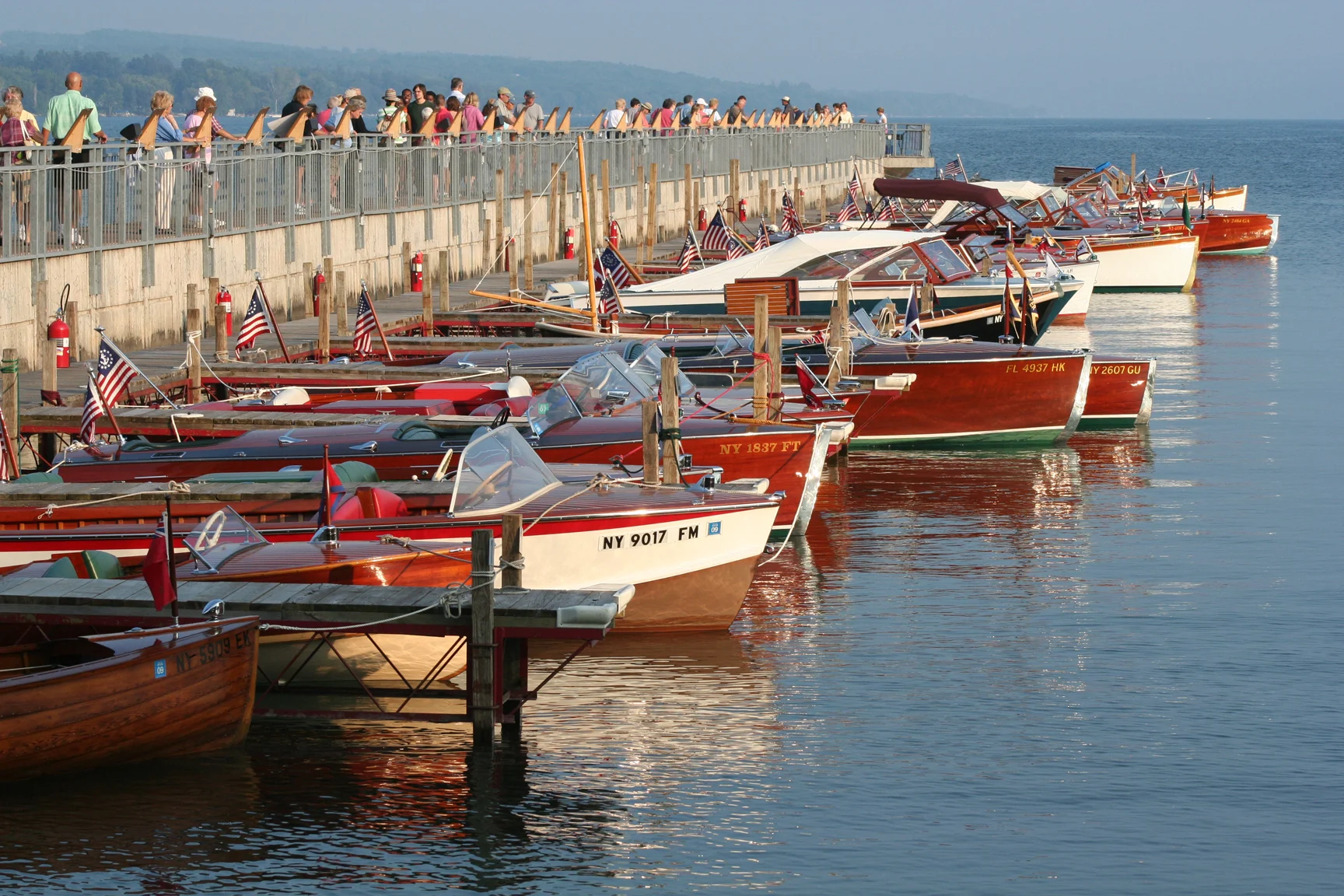
Three events do most of the heavy lifting in turning a 2,533 person village into a regional summer destination.
The Skaneateles Festival, founded in 1980 by cellist Lindsay Groves with residents Beth Boudreau and Louise Robinson, started as a two week run of concerts in Library Hall. It now runs from late July into August at Brook Farm, two and a half miles south of the village on Route 41A, and the 2026 season, July 30 through August 22, brings 13 main series concerts and a roster that includes jazz vocalist Cécile McLorin Salvant, pianist Garrick Ohlsson, the Silkroad Ensemble with Rhiannon Giddens, and the Grammy winning Imani Winds. Adult tickets run $35 to $70 depending on seating, youth under 18 sit free in Section B, and college students can buy $10 seats at the door. Thursday and Friday chamber concerts now play at First Presbyterian Church in the village; Saturday concerts moved to the Robinson Pavilion at Anyela’s Vineyards.
The Skaneateles Antique & Classic Boat Show, hosted by the Finger Lakes Chapter of the Antique and Classic Boat Society and the Skaneateles Area Chamber, returns July 24 through 26, 2026, for its 48th annual edition. Roughly 35 to 40 antique and classic wooden boats float at the Clift Park docks while another 35 to 40 sit on land for inspection. Chris Crafts and Hacker Crafts and Garwoods come from as far as Florida and California for it, and the show typically draws around 10,000 visitors across the weekend.
The Curbstone Festival, the village sidewalk sale and street fair that occupies Genesee, Jordan and Fennell streets every July, hit its 50th year in 2024 and ran its 51st in 2025 from July 10 through 12 with more than 50 merchants on the curb. Mid-Lakes runs sightseeing cruises every day. The Skaneateles Community Band plays Friday night at 7:30. Magicians work the kids.
Winter has its own headline act. Winterfest, held the last Friday and Saturday of January, includes the Polar Bear Plunge, the Fire Tower bonfire, the Taste of Skaneateles tasting walk, and an ice sculpture trail. The 2026 plunge ran on Saturday, January 31, with more than 100 spectators along the rail at Clift Park. The water in late January is roughly 36 degrees.
The village does not give up the spotlight in December either. Dickens Christmas, now in its 31st year, draws more than 20,000 visitors across the four weekends between Thanksgiving and Christmas, when costumed Charles Dickens characters roam Genesee Street, horse-drawn wagons run on a loop, and Tops Friendly Markets supplies free roasted chestnuts. The festival is funded by sponsorships from more than 130 local businesses.
The hospitality economy
The Sherwood Inn keeps 25 rooms above its tavern dining room. Across the village at Mirbeau Inn & Spa, a 12 acre French country property modeled on a Provence estate, room rates start around $504 a night and climb sharply for spa packages. Linda and Gary Dower opened the 34-room Mirbeau in 2000 as the first of what is now a small chain with sister properties in Plymouth, Massachusetts and Albany, and it has been the village’s flagship luxury address ever since. Smaller bed and breakfasts, several within walking distance of the pier, fill in around the two anchors.
The Skaneateles Country Club, founded in 1915, sits on the western shore. Its course, originally laid out by Hal Purdy and updated by Stephen Kay in 2010, runs along the lake on a piece of land that, at current market values, would be one of the most expensive private golf properties in the state if anyone tried to put a price on it. Initiation fees, which the club does not advertise, are reported by club management to be among the second highest in Central New York.
A real estate market unlike any other in Central New York
The Skaneateles housing market is now operating on a different curve from the rest of Onondaga County. The Redfin median list price in March 2026 was $1.23 million, with a median value of about $412 per square foot. That figure is up from a $974,000 median in January 2025, an annual gain of more than 11 percent during a year when most of upstate New York was flat or modestly up.
Lakefront properties go higher still. Listings on the East Lake Road and West Lake Road shorelines routinely cross $3 million, and a handful have crossed $5 million in the last 24 months. The price floor is supply. There is, simply, no more lakefront to make.
The county record changed hands in 2025. The Bruce Kenan estate on Skaneateles Lake, an 1867 home with 11 bedrooms, 12 bathrooms and more than 10,000 square feet, plus a carriage house connected to a three car garage by an underground tunnel, sold for just under $18 million to Samuel Nappi and his son Justin, the Hollywood film producer whose credits include All Is Lost, Arbitrage and 99 Homes. The previous record on the same property, $13.1 million, was set in 2021 when Adam Weitsman bought it from Kenan, the longtime business partner of Destiny USA founder Robert Congel. The deal, public records show, closed in 2024 and surfaced in 2025 reporting. A second Skaneateles Lake property a few doors down sold for $5.3 million to Villa Dovest LLC the same year. According to local market reporting, the top ten Onondaga County home sales of 2025 were all in Skaneateles or in Spafford, on the lake’s western shore.
SKANEATELES IN 2026
The schools as growth engine
Schools are part of the story. Skaneateles Senior High School ranks #35 out of 4,377 public schools in New York State, putting it in the top one percent. Math proficiency runs between 90 and 94 percent, against a state average of 52 percent. Reading proficiency is at or above 95 percent, against a state average of 49. The graduation rate is 95 percent. The New York State Department of Education has named three Skaneateles schools, Waterman Elementary, Skaneateles Middle School and Skaneateles High School, as Recognition Schools for high achievement and progress under the federal Every Student Succeeds Act.
Buyers from New York City, Boston and Washington, D.C. now treat the Skaneateles school district as a feature of the lakefront listing. The school numbers function as a price floor.
Who runs the village, and who calls it home
Mayor Mary Sennett, who took office April 1, 2021, leads a four trustee village board: Tyde Richards, Josh Kemp, Ed Evans and Kathleen Zapata. Trustees pull double duty as the Village of Skaneateles Fire Commissioners. Election day for the village board is the second Tuesday in March. Terms run four years.
The 13152 ZIP code has long been a quiet address for high profile residents. Bill and Hillary Clinton kept a vacation home here through Mr. Clinton’s post presidency. Tim Green, the former Atlanta Falcons defensive end the team drafted in the first round in 1986 and a 2002 inductee in the College Football Hall of Fame, raised a family on the lake and became a best selling author of more than 25 books across three genres. Green disclosed in 2018 that he had been living with a slow progressing form of ALS since 2016, and he has used his Skaneateles platform since to fund research and youth football safety work. Adam Weitsman, the Skaneateles based scrap metal executive who runs Upstate Shredding out of Owego, is the most public modern figure attached to the village, both for his restaurant portfolio and for his weekly philanthropy.
Beyond the village line
South of the village, the lake narrows between two state highways, Route 41 on the east and Route 41A on the west. About eleven miles down 41A is Carpenter Falls, a 90-foot single-drop waterfall on Bear Swamp Creek that the state DEC owns as a Unique Area. A 630-foot accessible boardwalk, completed in 2022, leads from the parking lot on Appletree Point Road to a viewing platform at the brink of the falls. The trail then continues another half mile down the gorge and out to the Skaneateles Lake shoreline. The 90-acre Bahar Nature Preserve, donated to the Finger Lakes Land Trust, sits adjacent.
The full lake loop, on Routes 41 and 41A with a connector at the southern end near Glen Haven, runs about 42 miles. Cyclists who do it counterclockwise get a long downhill from New Hope Mills, then have to earn it back on the climb out of the south end.
A name older than the road that brought you here
The word Skaneateles comes from one of the local Iroquoian languages, where it meant, more or less, “long lake.” The Onondaga Nation, the central firekeepers of the Haudenosaunee Confederacy, held stewardship over the northern portion of the lake well before any of the names on the historic district plaques showed up in colonial records. Joel Thayer, who arrived in 1835 and rose to serve two terms as village president, built the mansard-roofed estate that still faces the lake from East Genesee Street. His granddaughters donated the lakefront garden in front of the house to the village in 1922, where it remains as Thayer Park.
Two centuries of business decisions, one creation story, and a watershed full of conservation easements all roll together into one body of water. The pier railing in front of you is the same one Joel Thayer might have leaned on. The water below it is the same water that will be in your tap tomorrow morning if you live in Syracuse, Camillus, Geddes, DeWitt or any of a dozen other places that drink from the lake.
If you go
The drive from downtown Syracuse is about 35 minutes, traffic depending. Free parking is on the street and in the village municipal lot off Genesee Street. Mid-Lakes Navigation runs cruises from the village pier from mid-May through mid-October. The Sherwood Inn is at 26 West Genesee Street; the Krebs is at 53 West Genesee; Bluewater Grill is at 11 West Genesee; Doug’s Fish Fry is at 8 Jordan Street, two blocks north. The John D. Barrow Art Gallery sits behind the Skaneateles Library at 49 East Genesee. The Skaneateles Festival runs late July through August. The Curbstone Festival is the second weekend in July. Winterfest, including the Polar Bear Plunge, is the last weekend in January. Dickens Christmas runs every weekend between Thanksgiving and Christmas Eve.
Bring a coat in any season. The wind off the lake reads colder than the forecast.
Sources include the Skaneateles Lake Association, the City of Syracuse Department of Water 2024 Consumer Confidence Report and weekly lake data sheets (April 17, 2026), the U.S. Geological Survey monitoring station at Skaneateles Lake, the Onondaga County Health Department September 2025 blue green algae advisory, the New York State Department of Environmental Conservation finalized 2025 Skaneateles Lake Watershed Nine Element Plan for Phosphorus, the Onondaga County Water Authority, the Onondaga County Soil and Water Conservation District, U.S. Census Bureau 2020 Decennial Census, the National Register of Historic Places, the Skaneateles Historical Society, Mid-Lakes Navigation, the Skaneateles Festival, the Finger Lakes Chapter of the Antique and Classic Boat Society, the Skaneateles Area Chamber of Commerce, the Village of Skaneateles, the Skaneateles Central School District, U.S. News & World Report school rankings, Syracuse.com and ThisIsCNY real estate market reporting, Redfin housing data, the Finger Lakes Land Trust, and reporting at CNYCentral, Auburn Citizen, FingerLakes1.com and Wikipedia. Photos via Wikimedia Commons under Creative Commons licenses.
Related on CNY Signal: Auburn at the head of Owasco Lake, our feature on Onondaga Lake Park, and our look at Cazenovia village.
Frequently Asked Questions
How long and deep is Skaneateles Lake?
Skaneateles Lake stretches 16 miles north to south through the eastern Finger Lakes at an elevation of 863 feet, the highest of the major Finger Lakes. Its maximum depth is 315 feet near the southern third, and its average depth is 148 feet. The lake holds roughly 413 billion gallons of water, with an 18-year residence time.
Where does Syracuse get its drinking water?
Syracuse and a string of suburban towns, serving more than 220,000 people, draw unfiltered drinking water from Skaneateles Lake. Construction began in 1893 under City Engineer William R. Hill with about 500 Italian, Polish and Black migrant workers laying 19.75 miles of pipe. The lake sits roughly 200 feet higher than downtown Syracuse, so the water still arrives by gravity 132 years later. The City of Syracuse Department of Water pulls about 40 million gallons a day on an average summer day, and water takes roughly six and a half to seven hours to travel from the lake intake to city reservoirs.
Why doesn’t Skaneateles water need to be filtered?
Skaneateles is one of only six surface water supplies in the United States permitted to skip filtration entirely. The U.S. Geological Survey ranks it as the second cleanest lake in the country by dissolved nitrogen, behind only Crater Lake in Oregon. The lake is oligotrophic, meaning low nutrients and high oxygen, and is structurally protected by an unusually compact 4.3-to-1 watershed-to-surface-area ratio.
Did Skaneateles Lake have an algae bloom?
Yes. In September 2017 the lake recorded four confirmed harmful algal bloom events, two of them widespread enough to turn open water visibly green. The threat returned on September 12, 2025, when the Onondaga County Health Department issued a blue green algae advisory after the state DEC confirmed a bloom and the City of Syracuse detected microcystin in raw, untreated lake water. The treated public supply was unaffected. Syracuse has not lost the EPA filtration waiver. The state DEC and Department of State finalized the Skaneateles Lake Watershed Nine Element Plan for Phosphorus on June 5, 2025, with about $42 million in Bond Act funding directed at the Eastern Finger Lakes.
How much does Syracuse spend protecting Skaneateles Lake?
The City of Syracuse funds a watershed agriculture program at roughly $2.3 million a year. The state Department of Environmental Conservation stocks the lake every spring with about 20,000 rainbow trout and 9,000 Atlantic landlocked salmon. Lake trout reproduce naturally here, one of only two Finger Lakes where that is still true.