By Jen Okafor, Staff Reporter
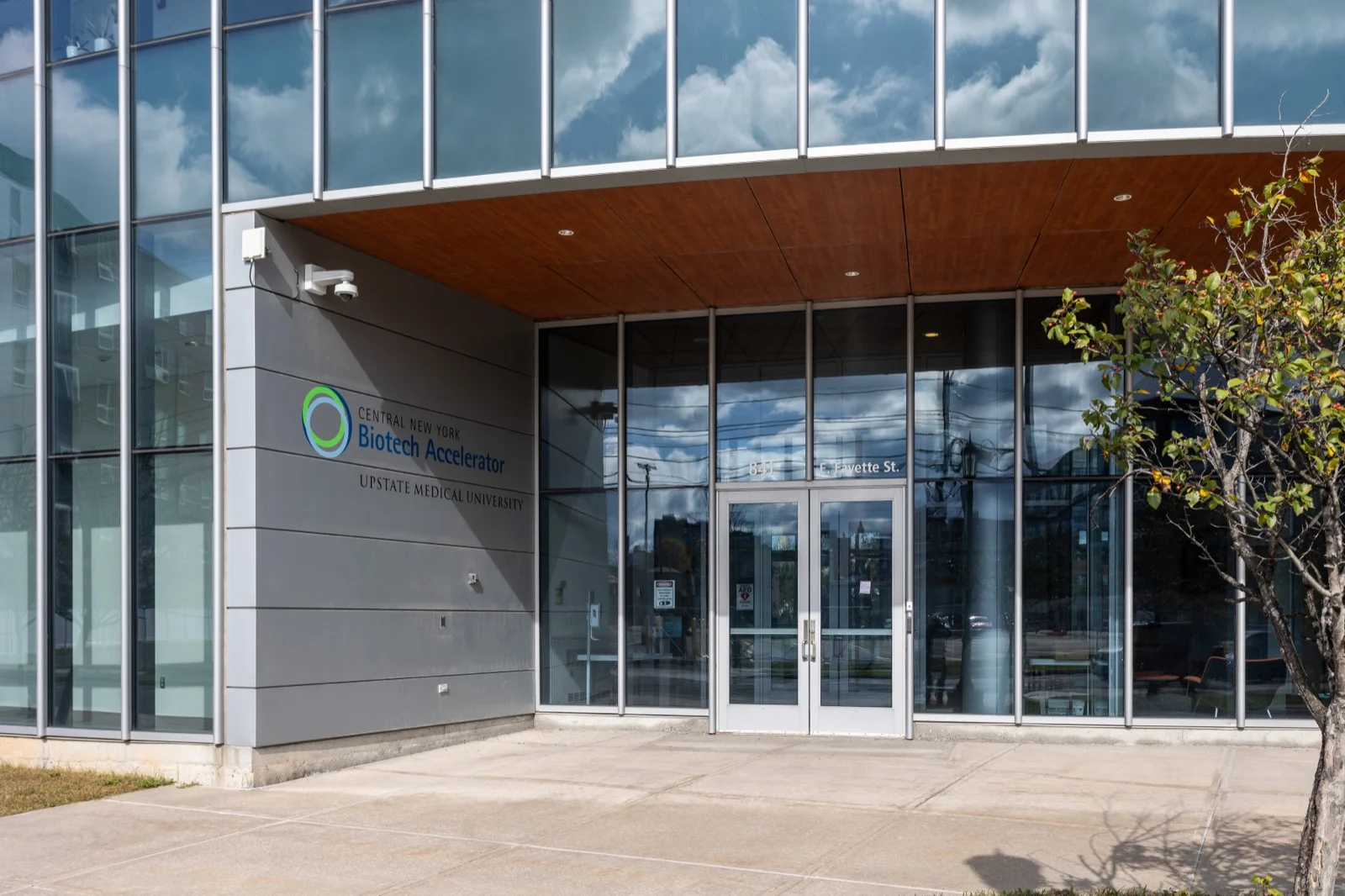
Inside a 60,000 square foot brick building at 841 East Fayette Street in Syracuse, a team of four is testing eye drops they say can do what no approved siRNA drug has done before: silence a single gene in the cornea, and stop the human eye from scarring itself shut.
The company is DUB Therapeutics. It was incorporated in 2022 by Audrey Bernstein, a tenured professor of ophthalmology at SUNY Upstate Medical University, and Tere Williams, a former Bernstein lab researcher with a PhD in immunology and vaccinology from Albert Einstein College of Medicine. Their working space is a leased lab inside the Central New York Biotech Accelerator, an Upstate Medical incubator that says its tenants have generated $65 million in regional economic impact and 82 jobs over the past two years.
The science traces back to a 2017 patent, US 9,714,424, filed by Bernstein at the Icahn School of Medicine at Mount Sinai before she moved to Syracuse, granted in July 2017, and titled “RNAi inhibition of USP10 to treat ocular disorders.” DUB Therapeutics has since secured a method-use license and a pending composition-of-matter patent on the human USP10 sequence, according to a profile published by Upstate Research.
What the company actually has is a single-dose eye drop, called DUB-001, that turns down a gene called USP10. The drug is preclinical. Clinical trials are projected to begin in 2027. None of this is approved by the Food and Drug Administration. None of it has been tested in a human eye.
And yet, since fall 2025, DUB has assembled roughly $5 million in disclosed funding from the National Institutes of Health, a state-backed venture fund, and a handful of pitch competitions. That is a small number in biotech terms. But for a four-person team in a city 250 miles from Boston’s Kendall Square, working on a class of drug that has never been approved for use in the eye, it is enough to keep the lights on long enough to find out whether the science works.
The science, and why it might matter
The cornea is the clear dome at the front of the eye. When it is wounded, by an infection, a chemical burn, a botched surgery, or a stubborn ulcer that refuses to close, the body lays down scar tissue. That scar tissue is what blinds people.
Bernstein’s lab spent more than a decade chasing a single observation: a deubiquitinating enzyme called USP10 is what tells the cell to keep its scar-building machinery on the surface, where the machinery can do damage. Knock down USP10, and in animal models the cornea heals without scarring.
The way DUB delivers that knockdown is the unusual part. Most RNA interference drugs require a lipid nanoparticle or a viral vector to carry the genetic payload into a cell. DUB’s molecule, a self-delivering siRNA licensed from the underlying chemistry, walks itself across the cell membrane in a single drop. According to the company’s website, the dose is stable at room temperature, lasts more than 90 days from a single application, and uses no AAV and no lipid nanoparticle.
If that holds up in trials, it is a different kind of medicine. Every siRNA drug currently approved by the FDA targets the liver, where bloodstream-delivered nanoparticles concentrate naturally. The eye has been a graveyard for siRNA programs. Sylentis, a Spanish biotech, ran two ophthalmic siRNAs through Phase II in dry eye and glaucoma; one missed its endpoint. The major problem, as the field summarizes it, is delivery. DUB is betting that walking siRNA through the cornea as an eye drop solves the problem the field has been stuck on for fifteen years.
The two indications, and the bigger market behind them
DUB is pursuing two preclinical programs. The first is persistent corneal epithelial defect, or PCED, a wound that fails to close in 10 to 14 days. The annual incidence in the United States runs between 25 and 38 cases per 100,000, by Upstate’s own published account. Exactly one drug, Dompe’s cenegermin, sold as Oxervate, is FDA-approved for PCED treatment. Most patients still cycle through bandage contact lenses, autologous serum, and amniotic membrane grafts.
The second indication is the one with bigger numbers behind it: scarring after trabeculectomy, the standard surgical procedure for advanced glaucoma. The American Academy of Ophthalmology and multiple peer-reviewed cohort studies put the five-year failure rate of trabeculectomy at 23 to 51 percent, and the failure mechanism is, almost always, scar tissue growing over the new drainage site the surgeon created. The drug surgeons currently use to suppress that scarring is mitomycin C, a chemotherapy agent first developed in the 1950s.
About 4.22 million American adults have glaucoma, according to a 2022 study published in JAMA Ophthalmology, with a vision-affecting subset of about 1.49 million. The U.S. glaucoma treatment market was valued at $2.45 billion in 2024, with a projected 4.92 percent compound annual growth rate through 2034. Trabeculectomy and the related tube-shunt procedures are not the largest line item in that market, but they are the surgeries that fail the most, and the market for an antifibrotic that works better than mitomycin C is real. DUB is one of the few companies attacking it directly.
The founder’s path
Bernstein built her lab at Mount Sinai in New York City and joined Upstate in summer 2017, taking a tenured appointment in the Department of Ophthalmology and Visual Sciences with secondary appointments in Biochemistry and Molecular Biology and Cell and Developmental Biology. She is also a research health scientist at the Syracuse VA Medical Center. Her academic funding before DUB included a $1.7 million National Eye Institute grant and a VA Merit Award worth $1 million in direct lab funding, according to Upstate’s investigator profile.
Williams holds a master’s in biomedical sciences and a doctorate in immunology and vaccinology from Albert Einstein College of Medicine. Before joining Bernstein’s lab, she co-authored a COVID-19 vaccine review published in Science Translational Medicine and ran a life-sciences consultancy called SIMON|PETRK CO. Her LinkedIn profile cites more than 20 years of experience leading early-stage biotech programs.
The two split the company along familiar lines. Bernstein is chief scientific officer. Williams is chief executive officer. The team behind them, per the company’s public footprint, is four people total.
The money
DUB’s disclosed funding, assembled from federal databases and announcements by SUNY Upstate, currently totals roughly $5 million. None of it came from a traditional venture round. All of it came from one of three places: a federal grant, a state-affiliated fund, or a pitch contest.
The largest checks are two NIH Small Business Innovation Research Phase II awards listed in the federal SBIR portfolio. The first, awarded in 2023, was for $1,799,926 to develop a corneal scarring therapy. The second, awarded in 2025, was for $1,009,285 to develop DUB-001 for trabeculectomy scarring. The two SBIR awards together are worth $2,809,211. Both are publicly listed.
In July 2025, SUNY announced that Upstate Biotech Ventures, a fund managed by Rochester-based Excell Partners and capitalized by Upstate Medical University, Empire State Development, and SUNY, had grown to $10 million. UBV’s first round of investments, announced the same month, totaled more than $1.8 million across three companies. DUB Therapeutics received $1 million. MimiVax, a Buffalo-based brain cancer vaccine company, received $500,000. sayhii, a workplace engagement platform, received $350,000. Excell Partners, founded in 2005, has $40 million under management and a portfolio of 38 active companies.
The company has also won a series of smaller awards: a $50,000 prize at the SUNY Start Up Summer School Demo Day in 2023, a $50,000 FuzeHub commercialization grant later that same year, and the $10,000 Alan W. Rothschild Innovation Award at the CNY Biotech Accelerator’s pitch contest in November 2024. The American Academy of Ophthalmology recognized DUB’s sdRNA platform at its EyeCelerator innovation challenge.
DUB’s website cites “$5M+ in recent funding secured.” The company has not, in publicly accessible records, filed an SEC Form D for a priced equity round. That is consistent with a company at this stage; SBIR awards, pitch winnings, and a state venture check do not automatically trigger Form D obligations. It is also why the size of any private investor base, beyond UBV, is not visible from the outside.
The FDA gauntlet
The road from a working preclinical mouse model to an approved eye drop is long, and most candidates do not finish it. DUB’s stated 2027 clinical-trial start would put the company at the front edge of the trip, not the end of it.
For an eye drop targeting a novel mechanism, the standard path is an Investigational New Drug application, or IND, followed by a Phase 1 safety trial in a small healthy or patient cohort, then Phase 2 efficacy and dose-finding, then a Phase 3 confirmatory trial. Even an aggressively run program at a small sponsor typically takes six to ten years from IND filing to FDA approval. The first siRNA drug approved by the FDA, Alnylam’s Onpattro, took the company seventeen years from founding to approval. None of the siRNA drugs currently on the market are dosed into the eye.
A glaucoma surgical adjunct may have a faster regulatory profile than a primary disease drug, because the population is well defined and the existing standard of care, mitomycin C, is decades old and imperfect. But it is still a drug, not a device, and the FDA does not grant biotech companies a hometown discount for being headquartered in Syracuse instead of Cambridge.
Why Syracuse
The shortest answer is that the science was already in Syracuse. Bernstein’s lab is at Upstate. The Center for Vision Research is at Upstate. The Syracuse VA, where Bernstein also holds an appointment, is a block away. The intellectual property is jointly entangled with two universities. Moving the company would have meant unwinding all of that.
The longer answer is that New York State has spent the last decade trying to manufacture the conditions for biotech outside New York City. Governor Kathy Hochul announced a $3 million renovation of the CNY Biotech Accelerator in January 2026, with $2.25 million coming from Empire State Development through the Central New York Rising Upstate Revitalization Initiative. That renovation is expected to add capacity for ten more early-stage biotech tenants per year and finish in summer 2028. Upstate Biotech Ventures, the fund that wrote DUB its $1 million check, exists for the same reason. The state wants the kind of biotech corridor Boston and Cambridge built without state help, and it is willing to seed capital to get one.
The track record from the accelerator is mixed but real. Biospherix, a CNYBAC graduate that made cell-incubation systems, was acquired by Contained Air Solutions. MimiVax, a Buffalo Roswell Park spinoff that is also a UBV portfolio company, has raised close to $25 million across investors including Buffalo Capital Partners, Varia Ventures, and Fosun Pharma, with its lead candidate, SurVaxM, in a Phase 2B glioblastoma trial. None of that proves DUB will succeed. It does suggest the surrounding apparatus is not theoretical.
The next milestone
What DUB has to deliver next, on its own stated timeline, is an Investigational New Drug application supported by enough preclinical safety data to convince the FDA to let the company put DUB-001 into a human eye. That work is what the second NIH SBIR award, the $1,009,285 trabeculectomy program awarded in 2025, is meant to fund. The 2027 clinical-trial target is the company’s, not the FDA’s.
Bernstein’s lab has been working on USP10 for more than a decade. The patent that anchors the company is nine years old. The first SBIR Phase II award is two years old. The state-backed venture check is less than a year old. Most early-stage biotechs that get this far do not get any further. A few of them do.
The team is at 841 East Fayette Street. The next answer comes from an animal model, then from a regulator, then, eventually, from a human cornea.