Griffiss Institute Passes Pentagon Cyber Audit July 13, Clearing Rome’s Tech Campus for Sensitive Drone and Quantum Work
CMMC Level 2 certification lets the institute handle controlled unclassified information, the paperwork key to the $21.1 million quantum network project and the 50 mile drone corridor that both run through Griffiss.
Heather Hage runs a nonprofit at 592 Hangar Road in Rome that sits in the middle of one of the busiest defense technology campuses in the Northeast. On July 13, her organization, Griffiss Institute, passed a Department of Defense cybersecurity audit that most small nonprofits never attempt: Cybersecurity Maturity Model Certification Level 2, the credential a company now needs before the Pentagon will let it touch Controlled Unclassified Information.
Know before your neighbors do
The Morning Signal hits your inbox at 6 AM with everything that happened overnight. Real incidents, real data, zero fluff.
“CMMC Level 2 certification represents a significant milestone for Griffiss Institute,” Hage, the institute’s president and CEO, said in the July 15 announcement.
The certification was issued after an independent assessment by Sentar, Inc., an Authorized Third Party Assessment Organization accredited to evaluate compliance with the Defense Department’s CMMC framework. Level 2 validates that an organization has implemented the security practices in NIST Special Publication 800-171, the federal standard for protecting sensitive but unclassified defense data. Griffiss Institute worked with managed service provider Simple Helix on technical controls and security operations center monitoring to prepare for the audit.
“Griffiss Institute has demonstrated that their security practices meet the requirements for CMMC Level 2,” said Stephen Pratt, chief information security officer and lead certified CMMC assessor at Sentar, in the same announcement. The Rome Daily Sentinel confirmed the July 13 certification date in its July 16 report.
Why a cyber audit matters at an airport
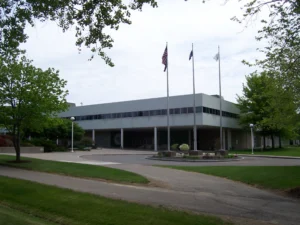
On paper this is a paperwork story. In practice it is an admission ticket. Griffiss Institute is the talent and technology partner that sits alongside the Air Force Research Laboratory Information Directorate, known locally as Rome Lab, at the Griffiss Business and Technology Park, the redeveloped Air Force base that also hosts Griffiss International Airport. The park employed nearly 6,000 people as of the state’s 2022 count. Defense work at that campus increasingly runs through data that the Pentagon classifies as Controlled Unclassified Information, and organizations without CMMC Level 2 are shut out of those contracts. The certification positions the institute to compete for and execute exactly that class of work.
The timing matters because of how much sensitive flight technology money is now pointed at Rome. In the Fiscal Year 2026 National Defense Authorization Act, announced December 10, 2025, Senators Charles Schumer and Kirsten Gillibrand secured a $224.5 million authorization for Rome Lab, $37.5 million above the President’s Budget request. The line items read like a preview of the next decade at Griffiss: $10 million for a Distributed Quantum Networking Testbed and Quantum Cloud Computing Environment, $5 million for a Counter UAS Advanced Detection Systems Pilot Program, and $5 million for an autonomous battle management network accelerator.
Rome Lab has carried the Air Force’s “Superlab” designation since 1997 and was named the Quantum Information Science Research Center for the Air Force and Space Force in 2021. Griffiss Institute is the connective tissue between that federal lab and the private companies and universities that want to work with it. In May, the institute announced $550,000 awarded through its HUSTLE defense accelerator to advance Air Force command and control technology, and in June it was selected to lead strategic outreach for an Army STEM education consortium.
The drone corridor next door
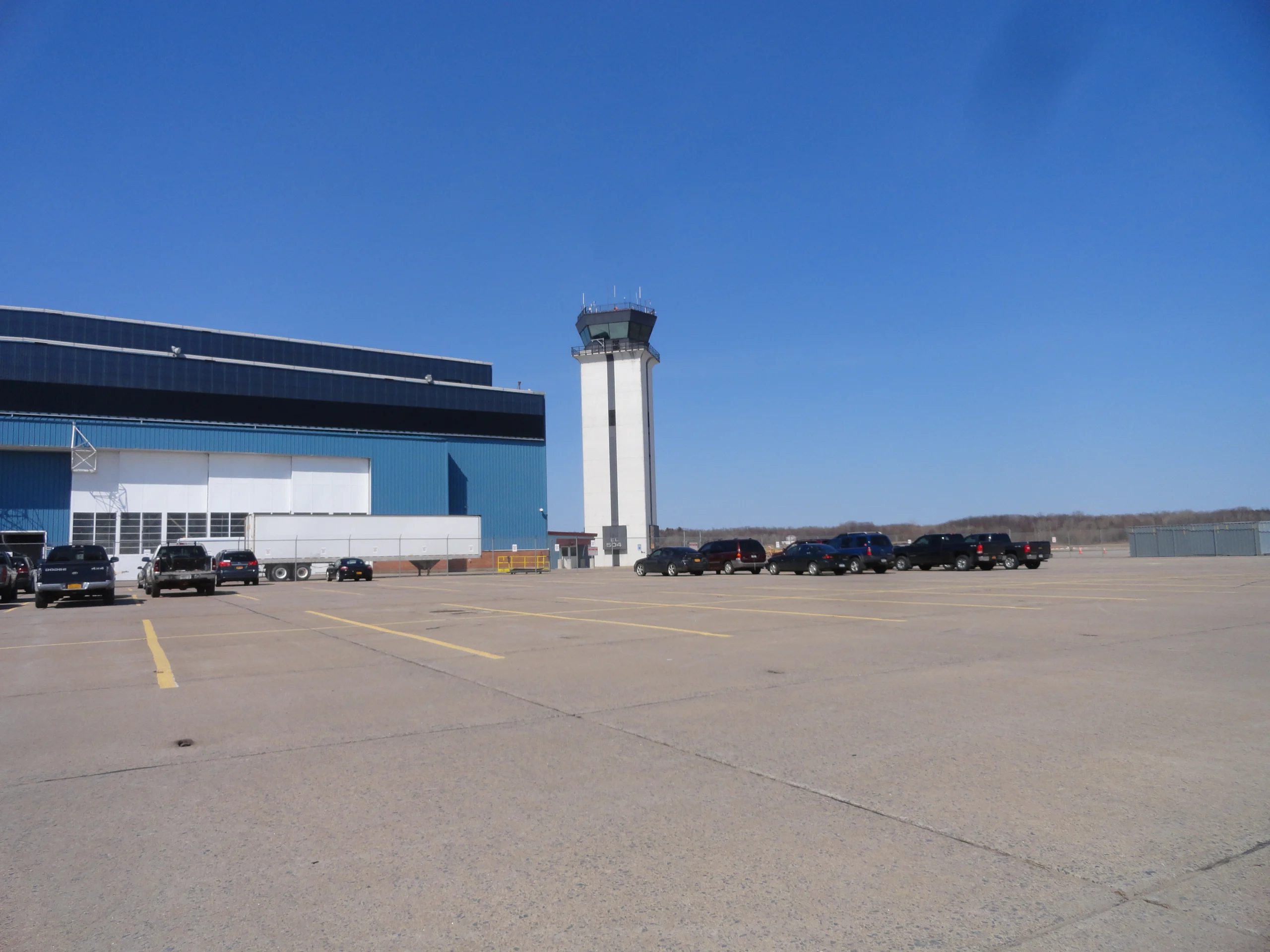
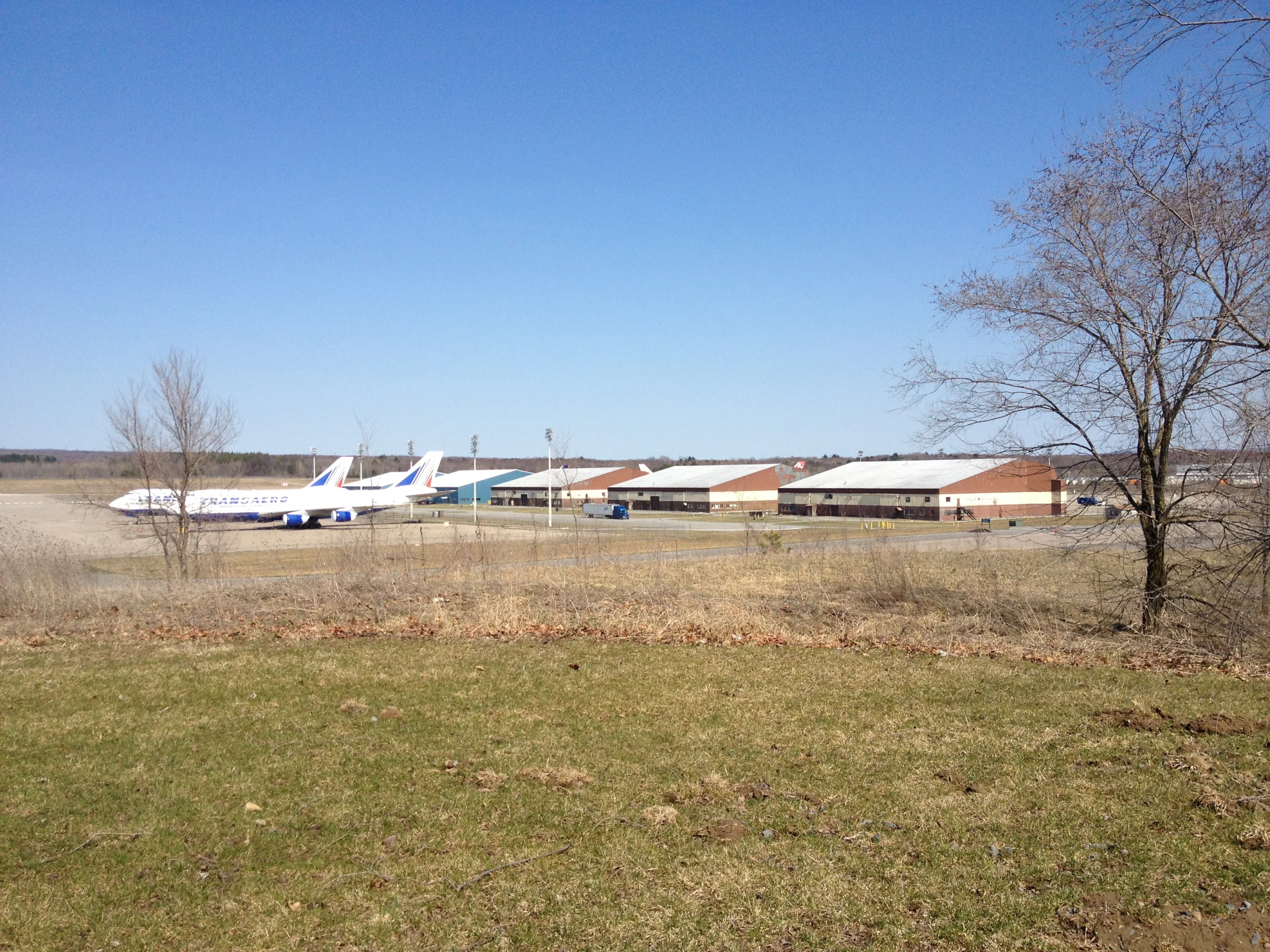
The certification lands at the center of New York’s drone testing economy. Griffiss International Airport is home base for the New York UAS Test Site, which NUAIR manages on behalf of Oneida County, and the anchor of the state’s 50 mile drone corridor running west to Syracuse Hancock International Airport.
The corridor’s legal footing took a decade to build. In April 2023, the Federal Aviation Administration granted the test site a civil flight authority known as the Charlie Waiver, which let the site operate drones weighing under 300 pounds throughout the full corridor and, for the first time, charge commercial clients for those flights. The facility had operated under public aircraft authority for a decade before the civil designation arrived, which meant a government sponsor was required for nearly every flight. “Our test site is already the global leader for UAS research and development,” Oneida County Executive Anthony J. Picente Jr. said at the time. Ken Stewart, NUAIR’s chief executive then, put the business case plainly: “This new civil authority will help draw more clients to the Test Site.”
The physical plant kept pace. In July 2022 the state completed the $13 million Skydome inside a former airplane hangar at the park, the nation’s largest indoor anechoic chambered drone experimentation facility, built for year round testing of autonomous flight controls and drone swarms. Oneida County put in $4 million, with $4.5 million each from the CNY Rising and Mohawk Valley Upstate Revitalization Initiatives. All told, the state says it has invested nearly $70 million to make New York the country’s premier drone testing destination.
The county is staffing up to match. On June 11, Picente appointed Paul Rayhill as Oneida County’s first Director of UAS Operations. Rayhill is a Naval Academy graduate and former Navy pilot with more than 1,500 military flight hours and 7,700 total hours, a licensed commercial pilot who owns FAA certified Aviation Services Unlimited and previously led the Keystone Med Flight helicopter ambulance service. “The opportunities being created through UAS technology are transforming industries and creating jobs,” Rayhill said in the county’s announcement.
The airport itself picked up a safety upgrade this spring. On May 21, Gillibrand and Schumer announced $617,500 for Griffiss to replace a Class V aircraft rescue and firefighting vehicle and buy new fire extinguishers, handheld tools and three sets of personal protective equipment, part of nearly $20 million in airport infrastructure funding across the state.
Where quantum meets the flight line
The most consequential tenant story at Griffiss right now belongs to IonQ, the College Park, Maryland quantum computing company that has built two laboratories inside the Innovare Advancement Center at the edge of the airfield. In January 2025, IonQ announced a $21.1 million project with the Air Force Research Laboratory to develop secure quantum networking infrastructure in Rome, following a $54.5 million agreement signed with AFRL in September 2024.
Buried in that January announcement is the detail that ties the quantum lab to the drone corridor: the project includes developing free space optical links from ground stations to uncrewed aerial systems. In plain terms, the same campus that flies drones through a 50 mile test corridor is now building the technology to connect those aircraft to quantum secured networks through the open air. “Advancing quantum technology is crucial for maintaining our nation’s technological leadership,” Michael Hayduk, deputy director of the AFRL Information Directorate, said when the project was announced.
The buildout has been fast. IonQ commissioned a trapped ion quantum networking system for AFRL in Rome in March 2025. According to a May 4, 2026 report published by Griffiss Institute, IonQ’s first Rome lab, Quantum North, houses that trapped ion machine, while its second, Quantum East, was built to host a quantum network that the company expected to bring online around the end of March 2026. IonQ says the architecture could eventually deliver network performance 50 to 100 times faster than conventional networks, a claim that will get its first public test in Rome.
“It’s kind of like being able to play with fire for the first time,” Denny Dahl, IonQ’s senior director of field engineering, said of the research now under way at the Griffiss campus, in the same Griffiss Institute report. Mihir Bhaskar, IonQ’s senior vice president for global research and development, oversees the program from the company’s side.
The Rome operation is already reaching past defense customers. According to the Griffiss Institute report, IonQ is working on quantum key distribution, a method of exchanging encryption keys that reveals any eavesdropping attempt, with a large bank, developing quantum applications with pharmaceutical maker AstraZeneca, and has signed a consortium agreement in regenerative medicine. The company’s network design links stationary qubits inside the labs to photon based qubits traveling over optical fiber, the same basic architecture the AFRL project would extend through open air to aircraft overhead.
What it means west of Oneida County
For Syracuse area readers, the Rome campus is not a distant curiosity. The drone corridor’s western terminus is Syracuse Hancock International Airport, which means every expansion of flight authority, every new detection system and every quantum networking experiment at Griffiss extends along a line that ends in Onondaga County. CNY Signal reported July 16 on Upstate Medical’s request to expand its drone delivery pad in East Syracuse, one sign that corridor adjacent aviation projects are already crossing into the Syracuse suburbs.
The pieces assembled in Rome over the past 18 months follow a pattern: federal authorization in December, a county UAS director in June, a Pentagon cyber credential in July. Each one removes a different barrier, legal, operational, or contractual, between the campus and classified adjacent flight research.
The next milestone already has a date attached. Two barium based trapped ion quantum computers, now being built at IonQ’s Bothell, Washington facility, are scheduled to arrive in Rome by the end of 2026.
Sources & Verification
- Griffiss Institute, “Griffiss Institute Achieves CMMC Level 2 Certification,” news release, July 15, 2026, https://www.griffissinstitute.org/news/griffiss-institute-achieves-cmmc-level-2-certification/
- Rome Daily Sentinel, “Griffiss Institute in Rome certified for sensitive data,” July 16, 2026, https://www.romesentinel.com/news/griffiss-institute-rome-cybersecurity/article_85f9802c-fc23-4df5-84e1-8e2525b9cb9b.html
- Office of Sen. Kirsten Gillibrand, “$224.5 Million Authorization For Rome Air Force Research Lab In National Defense Bill,” December 10, 2025, https://www.gillibrand.senate.gov/news/press/release/schumer-gillibrand-secure-224-5-million-authorization-for-rome-air-force-research-lab-in-national-defense-bill/
- IonQ, “$21.1 Million Project with United States Air Force Research Lab,” January 13, 2025, https://ionq.com/news/ionq-announces-new-usd21-1-million-project-with-united-states-air-force
- Griffiss Institute, “Industry Advances Quantum Networking, Cloud and Application Development,” May 4, 2026, https://www.griffissinstitute.org/news/quantum-innovation-rome-ny-griffiss-institute-ionq/
- Commercial Drone Alliance, “New York UAS Test Site Receives Civil Flight Authority,” April 4, 2023, https://www.commercialdronealliance.org/news/nytestsite
- Office of Gov. Kathy Hochul, “$13 Million Skydome” completion release, July 14, 2022, https://www.governor.ny.gov/news/governor-hochul-announces-completion-13-million-skydome-nations-largest-indoor-uas-testing
- Oneida County, “Picente Appoints Directors of Veterans Services & UAS Operations,” June 11, 2026, https://oneidacountyny.gov/news/picente-appoints-directors-of-veterans-services-and-uas-operations/
- WKTV, “Griffiss International Airport in Oneida County Gets $617,500 for Safety Equipment,” May 21, 2026, https://www.wktv.com/news/local/griffiss-international-airport-in-oneida-county-gets-617-500-for-safety-equipment/article_f5573475-f7e8-41b7-aacc-4fc7317f84c9.html
Reporter: Mike Rivera. Edited by: Frank Mahoney. Published: July 16, 2026.