By Matt Russo, Staff Reporter
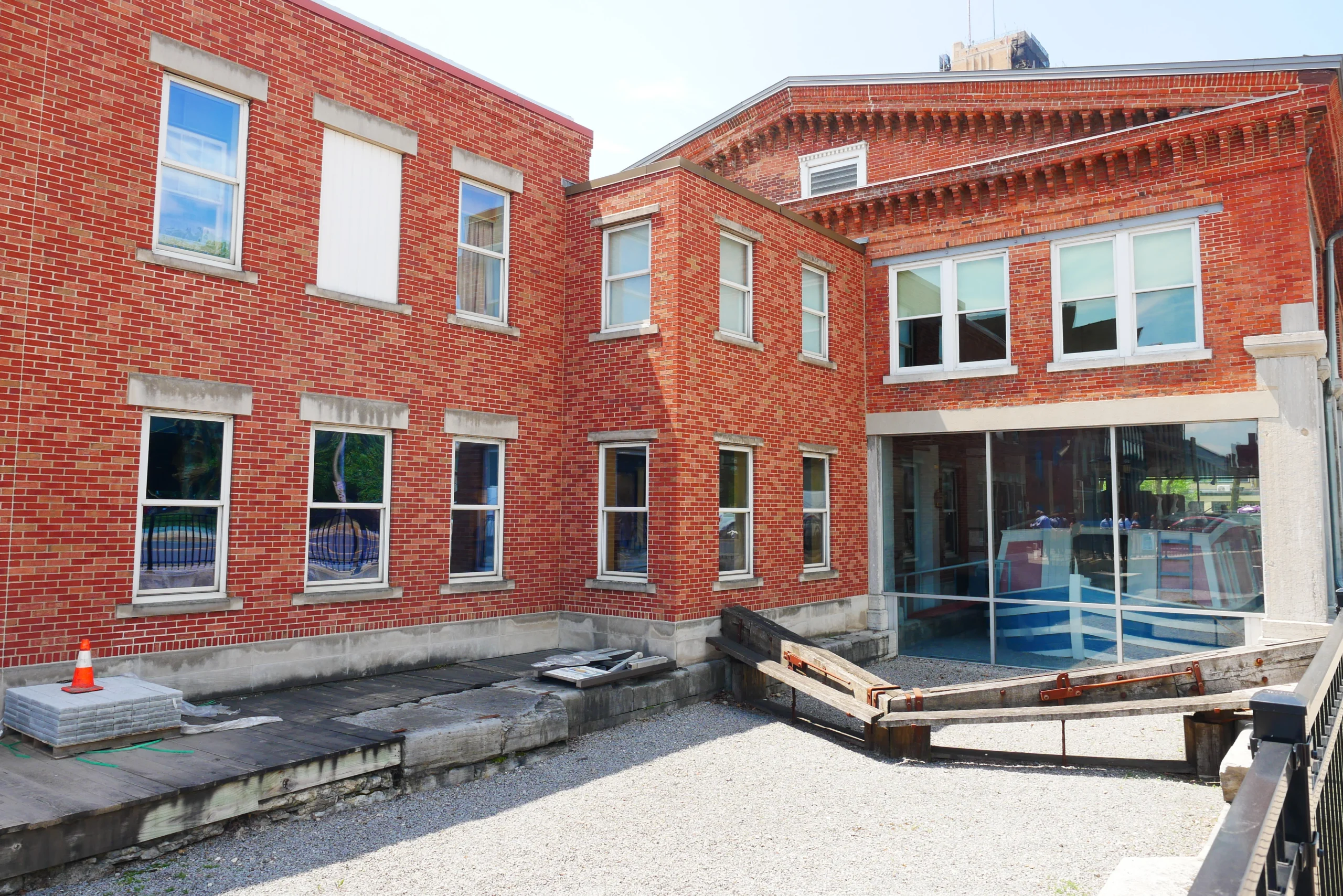
Stand on the corner of Erie Boulevard East and Montgomery Street in downtown Syracuse and you are standing on top of a filled-in canal bed. Look across at the squat stone-and-brick building with the arched bay on its south face. That is the 1850 Weighlock Building, the only surviving canal weighlock in the United States, and it has been the home of the Erie Canal Museum since October 25, 1962.
Two years after the 200th anniversary of the canal’s 1825 completion, the museum at 318 Erie Boulevard East is rolling its programming forward into the America 250 observances that run through 2026 and into 2027. The Sloan Lecture Series continues. A traveling exhibit produced by the New York State Museum, Enterprising Waters, is installed in the main gallery. And a full size replica line boat named the Frank Buchanan Thomson still sits in the old lock chamber where canal boats once pulled up to be weighed for tolls.
A weighlock, explained
When the building opened in 1850, the state was charging tolls on every boat moving cargo on the Erie Canal. To collect accurately, the canal commission needed to know the weight of each load. The solution at Syracuse was a hydraulic lock sitting on a giant scale. A boat floated in through the open gates off what is now Clinton Square. The lock gates closed, the water drained out, and the boat settled onto a cradle connected to a massive balance. The loaded weight was read off the scale, the empty weight listed on the boat’s certificate was subtracted, and the cargo toll was calculated on the spot.
Syracuse operated as a weighlock from 1850 through 1883. That year the state ended canal tolls. The building went through a series of state Department of Public Works uses for most of the next eighty years before a group of Syracuse preservationists stepped in to save it from demolition in 1962 and turn it into a museum. The Weighlock Building was added to the National Register of Historic Places on February 18, 1971, reference number 71000552.
The only one left
Why Syracuse is here in the first place
Central New York would not look like Central New York without the canal. Governor DeWitt Clinton broke ground on the Erie Canal in Rome on July 4, 1817. The finished ditch ran 363 miles from Albany on the Hudson River to Buffalo on Lake Erie, opening on October 26, 1825. It was four feet deep, forty feet wide at the surface, and it cut the cost of moving a ton of freight between New York City and the Great Lakes from about one hundred dollars overland to around ten dollars by boat.
Syracuse sat directly on the route. The village incorporated in 1825, the same year the canal opened, and the local salt industry detonated. The brine springs under Onondaga Lake had been boiled for salt since the 1790s, but once the canal gave producers a cheap way to move barrels to the east and west, Syracuse earned the nickname “Salt City.” By the 1860s, the Onondaga salt works were producing more than eight million bushels a year. Much of that salt rode out of town on boats that tied up, two blocks from the weighlock, on the stretch of canal that is now Clinton Square.
What is on the floor in 2026
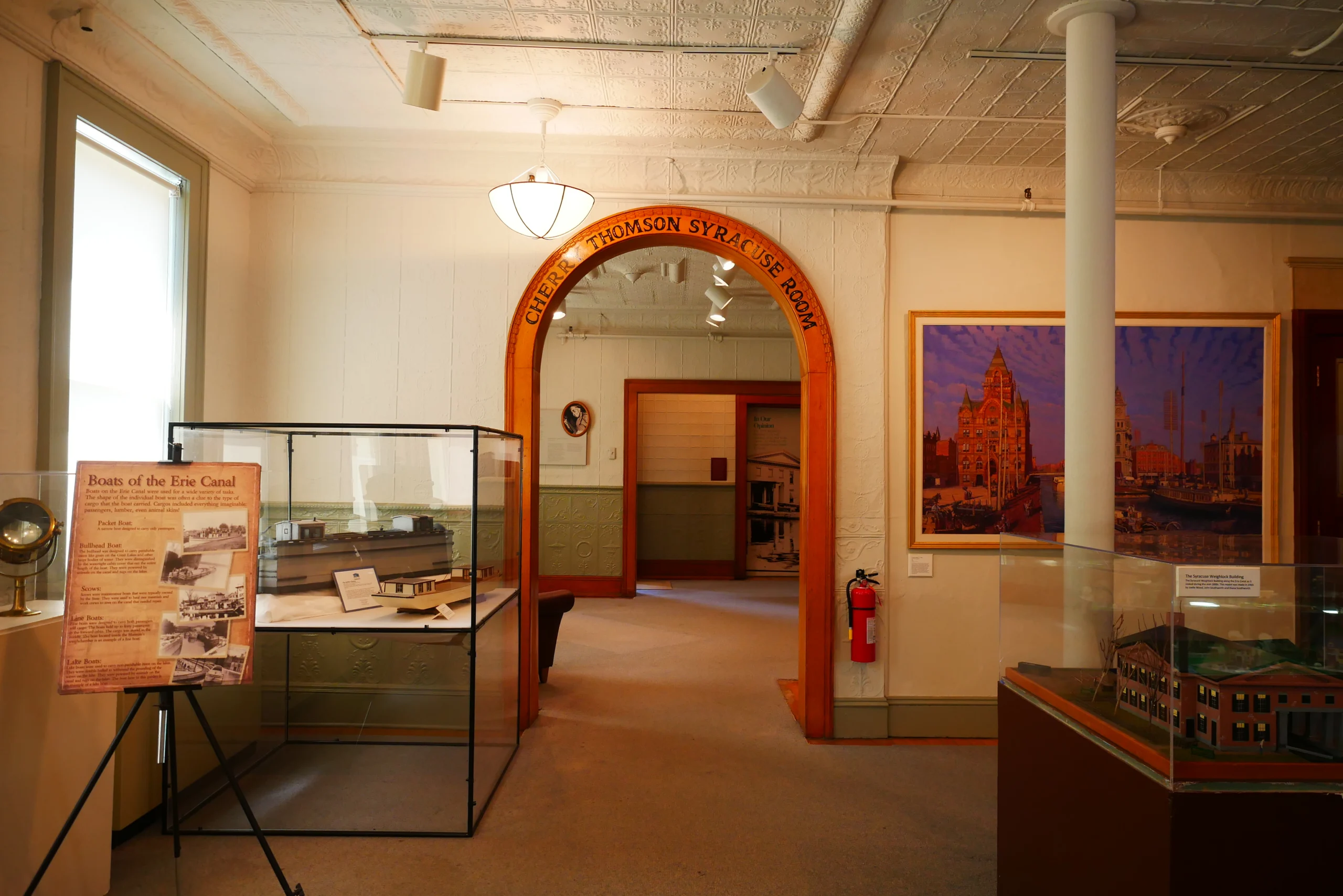
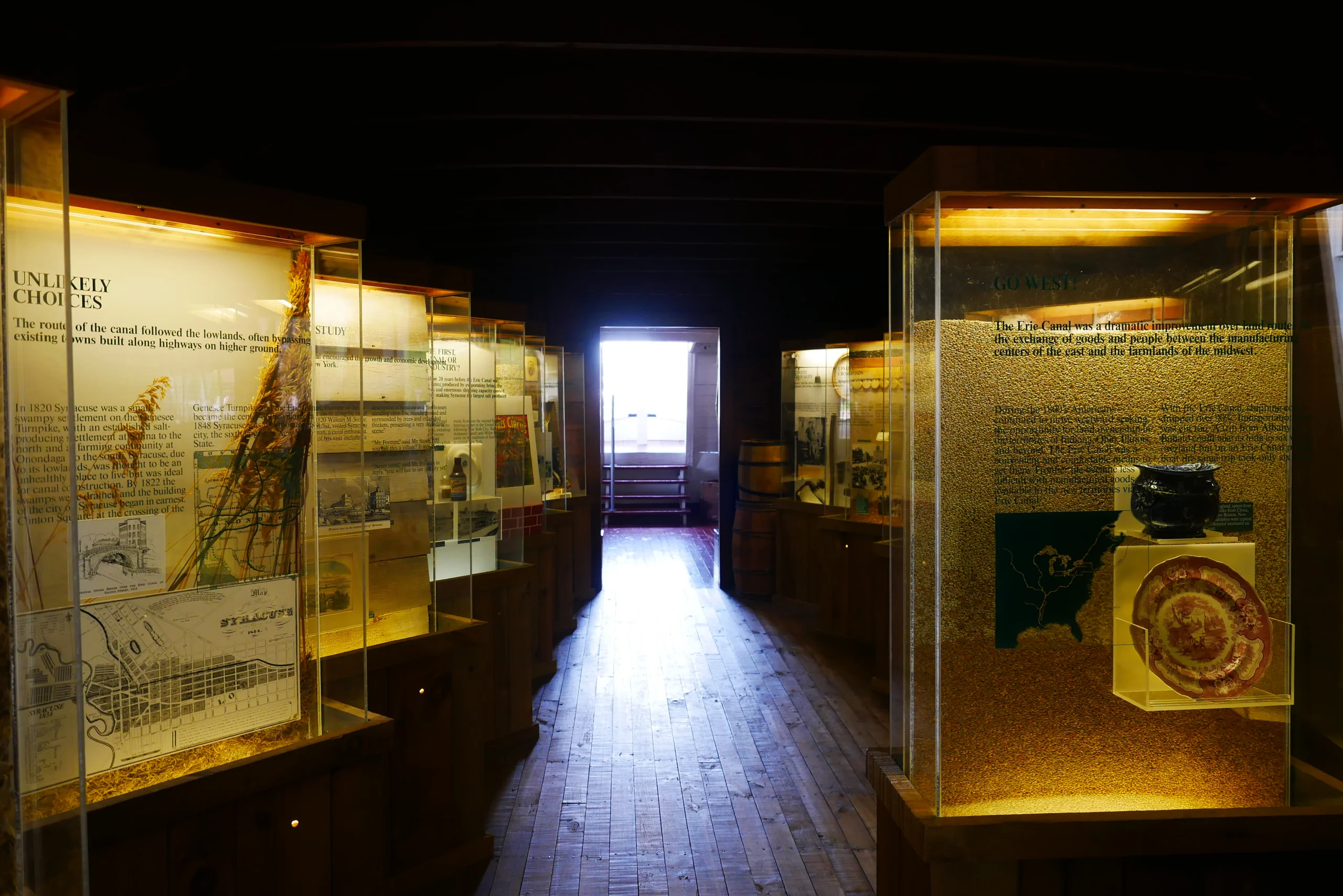
Enterprising Waters is the headline exhibit running through the spring and summer. The traveling show, produced by the New York State Museum in Albany, walks through two centuries of canal commerce, from the first grain barges of the 1820s through the container ports of the modern Erie Canalway. It landed in Syracuse as part of programming that began around the canal bicentennial in 2025 and is moving forward into the America 250 commemorations tied to the nation’s semiquincentennial on July 4, 2026.
The Sloan Lecture Series is also active. The talks, named for the late longtime trustee Albert W. “Bud” Sloan, cover canal history, preservation architecture, labor history, and the lives of the Irish and German immigrants who dug the original ditch. Lectures are free with admission and typically run monthly in the museum’s Convention Room.
Permanent installations include the Frank Buchanan Thomson, a full size replica of a canal line boat that sits in the former lock chamber where real boats once pulled in to be weighed. Visitors can board the replica, sit in the captain’s quarters, and see the bunks where canal families slept on trips between Albany and Buffalo that took about five days one way at a boat speed of roughly four miles per hour.
The Locktender’s Garden and the April 19 volunteer day
Tucked along the south side of the building is the Locktender’s Garden, a small heritage planting modeled on what a nineteenth century canal worker might have grown for his family. The museum runs an annual volunteer workday to rake, prune, and replant the beds on Saturday, April 19, 2026, coinciding with the opening weekend of the outdoor season. Volunteers are asked to bring garden gloves. The museum provides tools and snacks.
Clinton Square used to be a pool of water
One of the stranger things to tell visitors is that Clinton Square, the block with the fountain and the stage for the ice rink in winter, used to be open water. It was the weighlock pool, essentially the waiting room for boats queued up to be weighed. Boats tied up there, cargo was loaded and unloaded, and the Syracuse business district grew around it. The canal was filled in through downtown between 1922 and 1925 and paved into Erie Boulevard. The weighlock pool became a square, and the Syracuse Savings Bank, the Gridley Building, and the Soldiers’ and Sailors’ Monument ended up ringing what had been a water basin.
The ditch that built New York
The collection
The museum’s holdings, according to its own catalog, include about 1,400 objects ranging from costumes to canal boat tools, 1,500 prints, 950 sketches and drawings, 45 paintings, 39,000 photographs and negatives, 100 glass plate negatives, 200 rare books, and a run of maps, plans, receipts, and shipping manifests. The archive is open to researchers by appointment.
One notable piece on the main floor: the 1984 Grammy Award and 1996 Syracuse Area Music Award belonging to folk and blues guitarist Elizabeth “Libba” Cotten, who lived in Syracuse in her later years and whose song Freight Train has been covered by Peter, Paul and Mary, Bob Dylan, and dozens of others. The Grammy sits in a case not far from a nineteenth century canal boat captain’s logbook.
What it costs, when to go
Admission to the Erie Canal Museum is by donation. The suggested amount is twelve dollars for adults. The building also functions as the Syracuse Visitor Center, which means walking in is free if you just want maps, brochures, and a bathroom before you head to the Everson or the MOST. The museum is open Tuesday through Saturday from 10 a.m. to 5 p.m. and Sundays from 10 a.m. to 3 p.m. Mondays are closed.
Parking is eight visitor-marked spots in the New York State lot beneath the Interstate 690 overpass, with entrances off North State Street and James Street. On-street parking is available along Erie Boulevard and around Clinton Square. The Empire State Trail, the 750 mile paved route that runs from Manhattan to Buffalo and from Albany to the Canadian border, passes within two blocks of the building, and cyclists regularly lock up at the rack by the east door.
Plan your visit
How it fits with the rest of the canal corridor
The Syracuse museum is the largest of a string of canal sites along the original route. Chittenango Landing Canal Boat Museum in Madison County, twenty miles east, runs a working dry dock where volunteers are reconstructing a mule-drawn line boat. The Canal Society of New York runs headquarters out of Camillus, with a working aqueduct at the Camillus Erie Canal Park. The Little Falls Historical Society in Herkimer County interprets Lock 17, which at forty feet of lift is still the highest single-chamber lock on the modern Erie. The Erie Canalway National Heritage Corridor, designated by Congress in 2000, covers 524 miles and ties all of these sites together.
Closer to downtown Syracuse, the annual Canal Cleanup draws volunteers along the Onondaga Lake outlet and surviving segments of the old canal bed every April. The museum coordinates with Onondaga Earth Corps and the Onondaga County Parks department on cleanup routes.
School groups and families
The museum runs curriculum-linked school programs for grades three through eight, and the field trip schedule in spring and fall fills about a month out. A typical program lasts ninety minutes and includes a boat-boarding tour, a lock-model demonstration, and a puppet show about canal workers. A small hands-on room on the east side of the building has a build-your-own canal station with PVC troughs, plastic locks, and little wooden boats. It was donated in 2023 and remains one of the busiest corners of the building during the summer.
The gift shop near the front entrance stocks locally published canal histories, reproduction stereograph cards from the 1870s, small-batch maple syrup from Pompey, canal-themed children’s books, and the museum’s own souvenir pennies stamped with the Weighlock Building seal. The shop doubles as one of the few places in downtown Syracuse where you can still buy a paper map of the canal corridor.
What to expect from the next year
The museum’s stated fundraising goal for fiscal 2026 is tied to roof and masonry conservation on the 176 year old building, specifically to the south-facing stone and the cupola that sits above the old pilot’s platform. The America 250 programming overlay includes lectures on the role of canal freight in the Civil War, specifically the movement of Syracuse-made salt and Central New York grain to Union armies, and a short film produced in partnership with WCNY covering the stories of the Irish, German, and Black laborers who kept the canal running through the second half of the nineteenth century.
For a building that was nearly torn down in 1962, the Weighlock is in excellent shape. It is one of the few places in Central New York where you can stand inside a piece of infrastructure that literally built the region and still see how the thing worked. The museum does the explaining. The building does the rest.
The Erie Canal Museum is at 318 Erie Boulevard East in downtown Syracuse. More information at eriecanalmuseum.org or by calling the visitor center front desk.