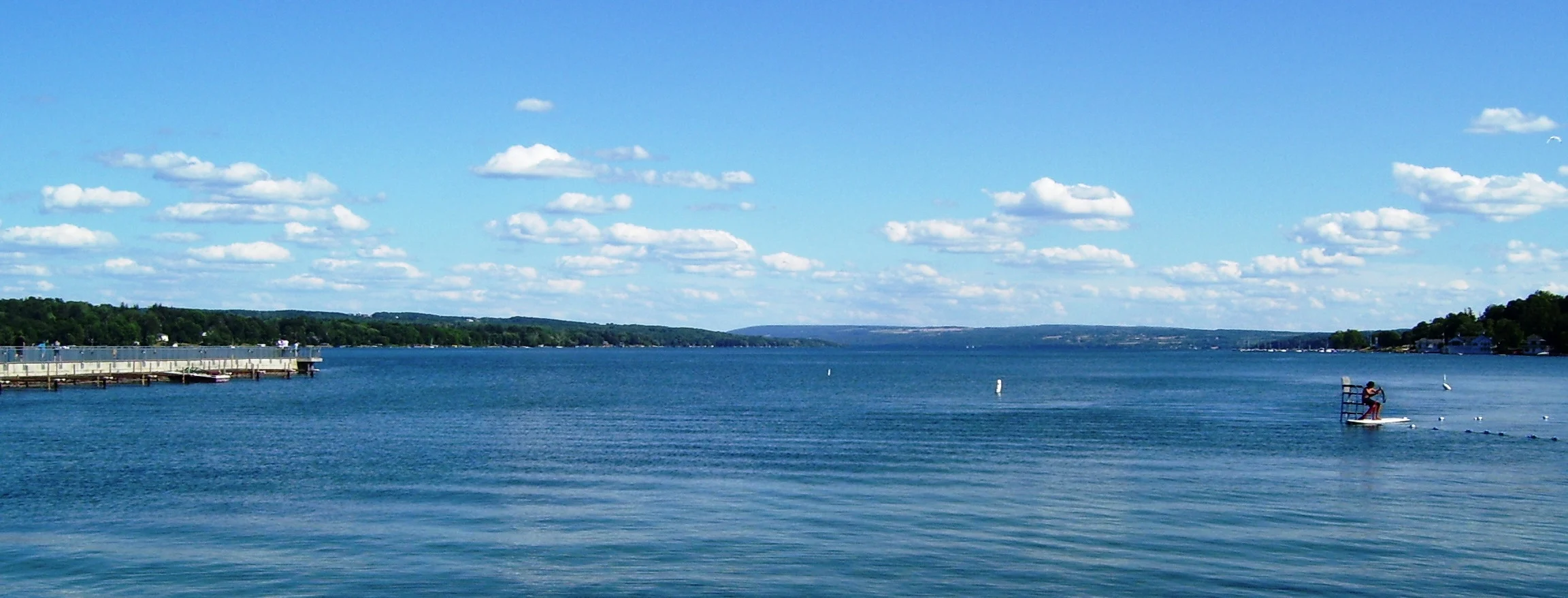
The Finger Lakes Land Trust will pitch its $3.3 million, 101 acre preserve at the mouth of Shotwell Brook on July 29, days after fresh bloom reports on the lake that runs unfiltered to roughly 200,000 Syracuse area taps.
Andrew Zepp will stand in front of a Skaneateles church on July 29 to make a case about 101 acres of fields, wetlands, and woods just outside the village. The Finger Lakes Land Trust president and Charles Driscoll, an environmental scientist who sits on the trust’s board, will explain to residents why that parcel matters to the water that flows out of roughly 200,000 taps in the Syracuse area every day. The free session runs from 7:30 to 8:30 p.m. at Saint James Episcopal Church, 96 East Genesee Street, and it lands at a pointed moment for the lake.
This story came from public records we pulled ourselves
Get the next one, plus overnight incidents, in your inbox at 6 AM. Free, no spam.
On July 14, a state research scientist pointed straight at this lake. Skaneateles, long described as one of the cleanest lakes in the country, is “a lake that now is having HAB reports,” Tony Prestigiacomo of the state environmental agency told Spectrum News. The Skaneateles Lake Association’s own bloom-alert page carried an active notice this week that blooms had been observed at the southeastern end of the lake. For a body of water that feeds an unfiltered public supply, a patch of blue-green algae is not a swimming nuisance. It is a drinking-water question.
Why an unfiltered lake makes 101 acres matter
Skaneateles Lake has been the primary drinking-water source for the City of Syracuse since the 1890s, and it is one of only a handful of unfiltered surface supplies serving a major metropolitan area anywhere in the United States. The lake sits about 200 feet higher than the city, so roughly 40 million gallons a day run to Syracuse by gravity. Before it reaches a faucet, that water passes through coarse screens and gets chlorination and fluoridation. It is not run through a filtration plant. The quality of the raw water in the lake is, in a real sense, the treatment.
That arrangement rests on a small watershed doing a lot of work. The Skaneateles Lake watershed covers about 59 square miles feeding a lake with a surface area of 13.6 square miles, a ratio of a little over four acres of land for every acre of water. Sewage discharges, including from treatment plants, are banned from surface waters in the watershed. What happens on the land near the tributaries shows up, eventually, in the intake pipe. Which is where Shotwell Brook comes in.
Shotwell Brook is one of four main tributaries that feed Skaneateles Lake, and it enters the lake near the water intake for the City of Syracuse’s supply. Protect the land at the mouth of that brook, and you slow the sediment and nutrients that reach the most sensitive point in the system. The Finger Lakes Land Trust, an Ithaca-based nonprofit, bought the 101-acre property for that reason. The parcel carries more than 1,000 feet of frontage on Shotwell Brook and more than 1,000 feet along U.S. Route 20, the eastern gateway into the village.
“It’s a win-win for everybody,” Rich Abbott, the City of Syracuse watershed manager, said of the acquisition in the trust’s project materials. Sean O’Keefe, a land trust board member, framed the buy as bringing together two of the group’s missions, expanding public access to the area around the lake while guarding the water that comes out of it. Chris Legg, the Skaneateles town supervisor, noted that the new conservation area abuts 89 acres of conserved land the town already owns to help protect the same brook.
How the deal was paid for
The land trust closed on the property in October 2024, buying it for $3.3 million from Dr. Marc Pietropaoli. “I look forward to seeing the community enjoy the benefits of this preserved land,” Pietropaoli said at the time. Paying for it took a stack of public and private money. The largest single piece was a $1.3 million grant from the New York State Department of Environmental Conservation through its Water Quality Improvement Program. The Central New York Community Foundation added $150,000. The Town of Skaneateles contributed $50,000 from its land and development-rights acquisition fund. An anonymous donor pledged $500,000 as a matching challenge to help close the gap, and the land trust drew on its internal Opportunity Fund to complete the purchase.
The July 29 session is not a groundbreaking. It is a status update and a pitch. The trust plans to convert the acreage into a publicly accessible preserve called the Shotwell Brook Conservation Area, with about two miles of walking paths, a universally accessible loop trail, scenic overlooks, wildlife viewing areas, and an interpretive kiosk. Parking will come off Route 20. The trust also plans wetland restoration, native plantings, and invasive-species control on the site. An opening date depends on when those public-access improvements are finished.
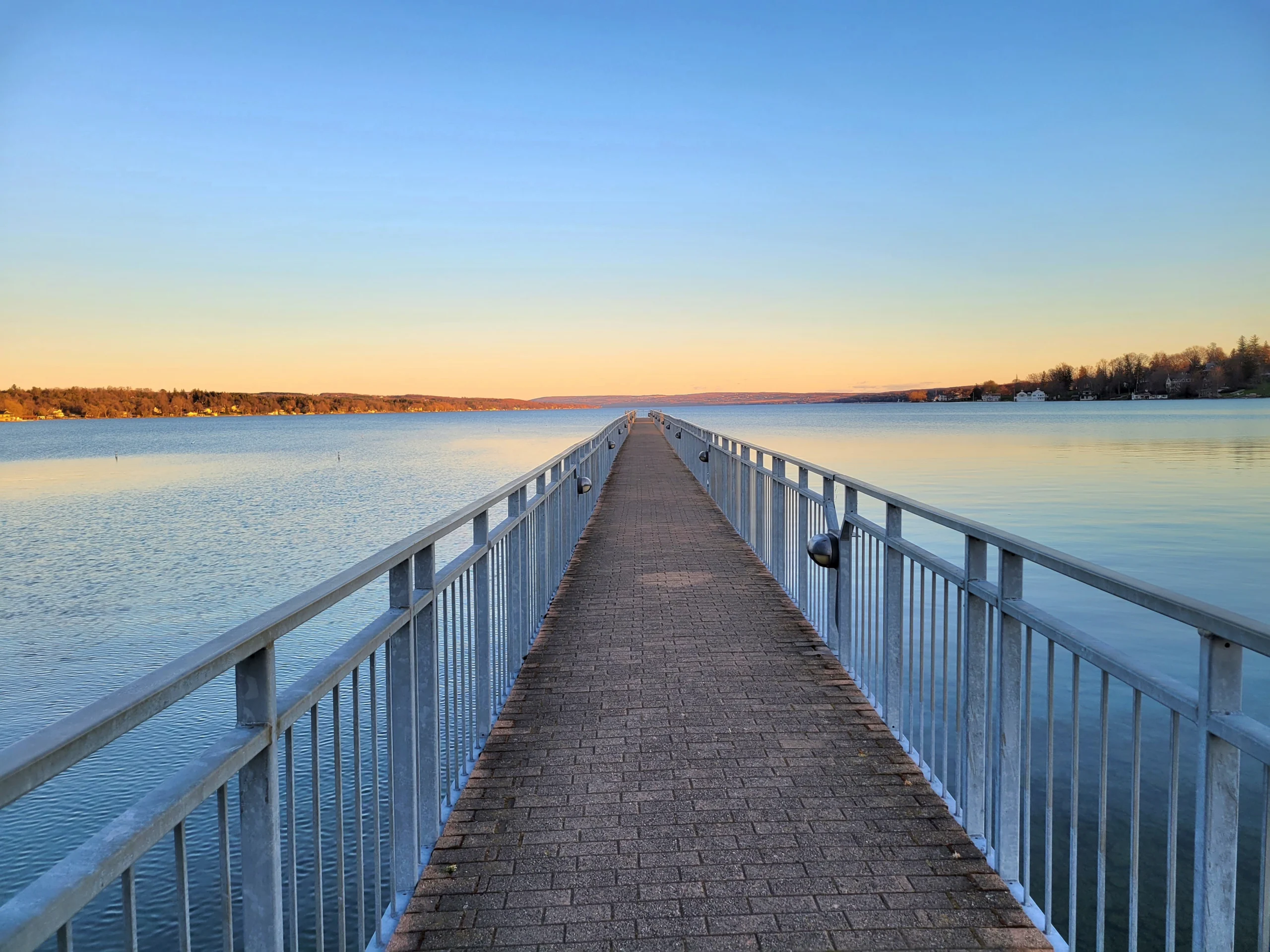
The bigger bloom problem, and the science chasing it
The Shotwell Brook work is one local answer to a statewide trend. Speaking to Spectrum News on July 14, Tony Prestigiacomo, a research scientist with the state environmental agency, said the data points one direction. “Science does suggest that increasing temperatures are certainly playing a role in HABs nationwide,” he said. More than 650 waterbodies across New York have experienced harmful algal blooms since the state began tracking them in 2012. In response, the environmental agency published a HAB Roadmap to guide short and long-term management, and the state committed $42 million toward cutting the sediment and runoff that feed blooms.
Skaneateles has been a live test case for how to watch a low-nutrient lake for trouble. From fall 2018 through fall 2020, the state environmental agency and the U.S. Geological Survey ran an advanced monitoring pilot on four Finger Lakes, including Skaneateles, Owasco, Seneca, and Canandaigua. The teams installed automated platforms carrying multiparameter probes at several depths, sensors for chlorophyll and phycocyanin fluorescence (a marker for cyanobacteria), optical nitrate and orthophosphate analyzers, weather stations, and web cameras. The rigs transmitted readings every 15 to 60 minutes, with hourly web updates, and crews pulled discrete water samples 12 times a year for toxin and phytoplankton analysis.
The pilot’s central finding is why blooms on Skaneateles are so hard to catch. Cyanobacteria on these clear lakes proved, in the state’s words, “extremely patchy and isolated in space and time,” clustering in nearshore pockets rather than spreading across open water. That is a warning to anyone hoping a single buoy will sound an alarm in time. It also explains why the Skaneateles Lake Association leans on shoreline volunteers and a public reporting form to log blooms as they surface at spots like Hardscrabble Point and Thayer Park.
Continuous data has become harder to come by, not easier. The USGS gauge at Skaneateles Lake, station USGS-04236000, carried a notice that it was slated for discontinuation on April 1, 2026 unless new funding partners stepped in, putting the future of its continuous record in question. That gap raises the value of academic work that maps the problem at its root.
At Syracuse University, a team led by earth sciences professor Christopher Scholz spent the summer of 2025 running a multibeam echo sounder across Skaneateles to map the lakebed and pin down where phosphorus-rich sediment collects. The instrument, an R2Sonic 2026V capable of firing up to 1,024 sonar beams, was mounted on the university’s research boat, known as “The Bob.” “The fine-grained sediment is one of the main reservoirs for nutrients,” Scholz said, “that can be the source of harmful algal blooms.” The work, described in an August 22, 2025 university report, was funded by the National Science Foundation, the Skaneateles Lake Association and its Legacy Fund, a direct donation from Sam and Carol Nappi, and the New York State Water Resources Institute at Cornell. The survey also turned up two 19th-century steamboat wrecks on the lake bottom, the Ossahinta and the City of Syracuse.
What residents can expect on July 29
The through-line connecting the sonar boat, the sensor pilot, and the 101 acres is phosphorus. Warm water and nutrient runoff feed cyanobacteria, phosphorus is the nutrient that matters most on Skaneateles, and land at the edge of a tributary is one of the few places a community can physically slow how much of it reaches the lake. Shotwell Brook was flagged as a conservation priority precisely because of where it empties.
The July 29 meeting is co-sponsored by the Skaneateles Lake Association, the volunteer group that also helps fund the university research and runs the bloom-alert system. No registration is required. Zepp and Driscoll are expected to lay out the trail design, the timeline for opening the preserve, and how the wetland and streambank work is meant to keep sediment out of the brook. The land trust says the parcel is the eastern doorstep to Skaneateles and the wider Finger Lakes, and it wants the public bought in before shovels move.
For a lake that has delivered unfiltered water to Syracuse for more than 130 years, the math is unforgiving. There is no filtration plant to fall back on if the raw water degrades. The state has now logged blooms on Skaneateles for several summers running, the nearest continuous federal gauge is on the chopping block, and a warming climate keeps tilting the odds. That is the case Zepp will make from a pew on East Genesee Street on the last Wednesday in July, and the 101 acres at the mouth of Shotwell Brook are the down payment.
Sources & Verification
- Finger Lakes Land Trust, “New Preserve Coming to Skaneateles: Shotwell Brook Conservation Area,” project page, accessed 2026-07-16, https://www.fllt.org/shotwellbrook
- Finger Lakes Land Trust, “Finger Lakes Land Trust Acquires 101 Acres Just Outside the Village of Skaneateles,” Oct. 2024, https://www.fllt.org/finger-lakes-land-trust-acquires-101-acres-just-outside-the-village-of-skaneateles/
- Fingerlakes1.com, “Finger Lakes Land Trust plans Shotwell Brook conservation session in Skaneateles,” 2026-07-16, https://www.fingerlakes1.com/2026/07/16/finger-lakes-land-trust-plans-shotwell-brook-conservation-session-in-skaneateles/
- Fingerlakes1.com, “Finger Lakes Land Trust secures 101 acres near Skaneateles,” 2024-10-03, https://www.fingerlakes1.com/2024/10/03/finger-lakes-land-trust-secures-101-acres-near-skaneateles-to-create-new-conservation-area/
- Spectrum News CNY, “A changing climate may be behind a rise in harmful algal blooms across the state,” 2026-07-14, https://spectrumlocalnews.com/nys/central-ny/news/2026/07/14/habs-nys-waterways
- NYSDEC, “HABs Advanced Monitoring Pilot Project Summary,” https://dec.ny.gov/environmental-protection/water/water-quality/harmful-algal-blooms/habs-advanced-monitoring-pilot-project-summary
- Skaneateles Lake Association, “Lake and Watershed Facts” and “HAB Alerts,” https://skaneateleslake.org/lake-and-watershed-facts/ and https://skaneateleslake.org/bloom-updates/
- Syracuse University College of Arts and Sciences, “Safer Lakes, Cleaner Water,” 2025-08-22, https://artsandsciences.syracuse.edu/news-all/news-2025/safer-lakes-cleaner-water/
- USGS Water Data, Skaneateles Lake at Skaneateles NY, station USGS-04236000, https://waterdata.usgs.gov/monitoring-location/USGS-04236000/
Reporter: Jen Okafor. Edited by: the CNY Signal news team. Published: 2026-07-17.