This story came from public records we pulled ourselves
Get the next one, plus overnight incidents, in your inbox at 6 AM. Free, no spam.
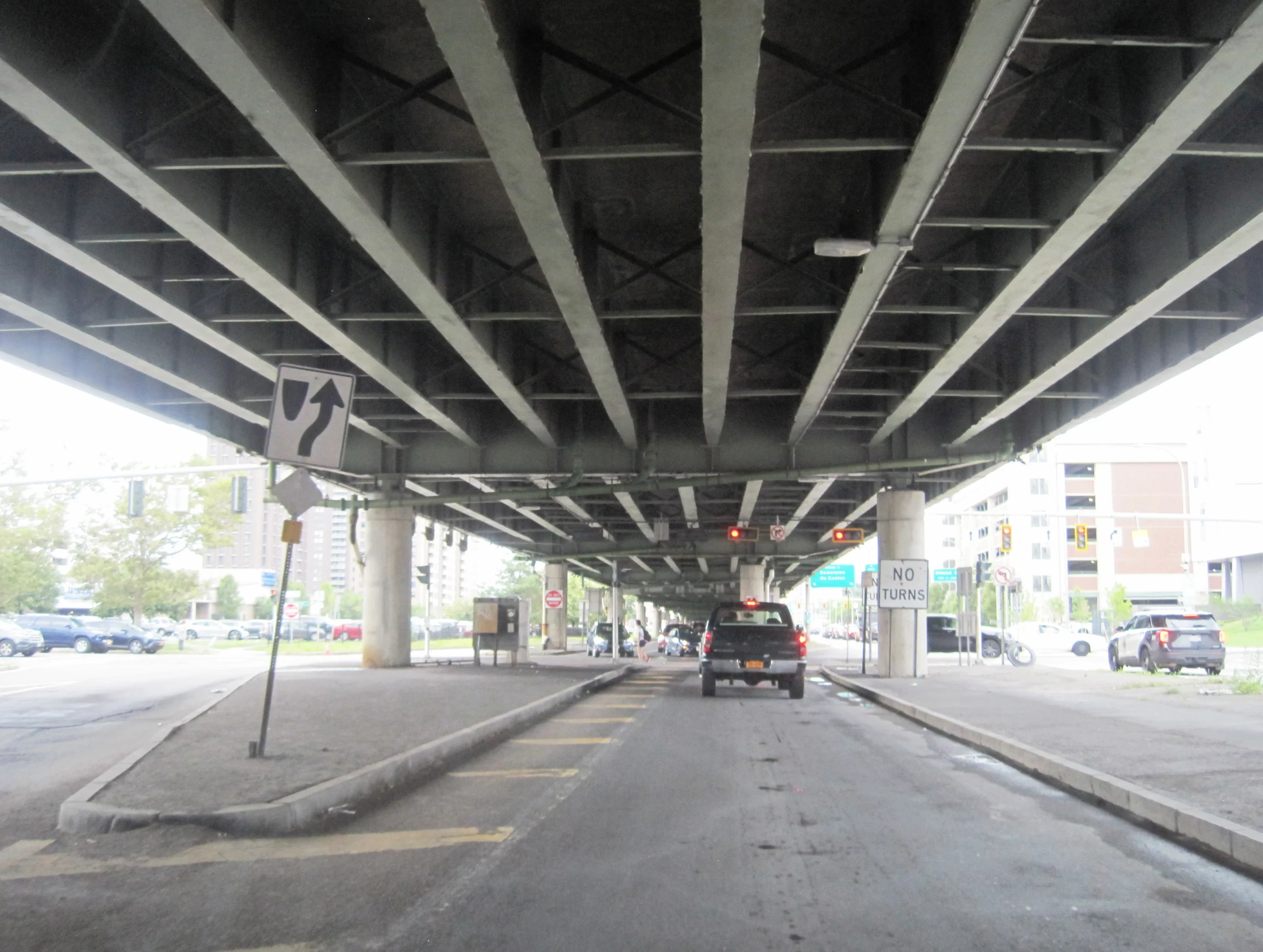
Crews will close the I-81 elevated viaduct in downtown Syracuse by the end of 2026 and start removing the first seven spans of a structure that has divided the city for sixty years, the largest single road job ever undertaken by the state of New York and a $2.25 billion build that will reshape every commute into and out of downtown for at least three years.
The work is no longer theoretical. All five Phase One construction contracts are now active, the final one awarded in April 2025 to a New York joint venture called Salt City Constructors. That fifth contract is worth nearly $251 million on its own and covers the section drivers will feel first: a 1.4-mile stretch of elevated highway from north of Colvin Street to Burt Street.
What is being built and why
The project demolishes the 1.4-mile elevated highway through downtown and replaces it with a street-level boulevard the state has redesignated as Business Loop 81. The current I-81 mainline is being rerouted onto a widened I-481, which will be redesignated as the new I-81. Long-haul traffic moves to the bypass; through-downtown drivers move to a city street with traffic signals.
The community grid replacement runs along Almond Street through downtown Syracuse, with a planned 45-foot-wide tree-lined center park for many blocks. State officials say the rebuild reconnects the former 15th Ward, the historically Black neighborhood that was bulldozed when the original elevated highway went up in the 1960s.
The new structure will not look like a highway. Plans call for designated bike lanes, shared-use paths, traffic signals, noise barriers along specified sections, and a new roundabout at Business Loop 81 and Van Buren Street, all confirmed in the official Contract 5 scope document.
Project at a glance
The numbers (cost, funding, timeline)
The headline figure is $2.25 billion across an estimated six years of construction. The money comes from a mix of federal and state sources. About $1.9 billion of the project comes from the $32.8 billion State Capital Plan adopted in 2022.
The federal share is locked in. A $180 million Reconnecting Communities and Neighborhoods grant was officially awarded under the federal Inflation Reduction Act. Of that grant, $150 million goes to NYSDOT and $30 million goes directly to the City of Syracuse to pay for community grid elements like sidewalks, plantings and complete-streets work along the local network.
Phase One contracts now total well over $1.4 billion in awarded construction work, including $313.5 million to CNY Alliance for the eastside community grid section and $251 million to Salt City Constructors for the southern Business Loop section. Three additional contracts will be awarded in later phases.
Where the $2.25 billion comes from
Sources: NYS Governor’s Office (Reconnecting Communities and Neighborhoods award), CNY Business Journal (State Capital Plan share), NYSDOT Phase One contract awards. Balance derived from $2.25B total minus stated components.
Who is doing the work
NYSDOT does not pour the concrete itself. It runs the bid and awards each contract to a joint venture of New York contractors. Five Phase One contracts have been awarded. Two joint ventures hold the largest pieces of the work that affects 2026 commuters.
CNY Alliance is a joint venture of A. Servidone Inc., B. Anthony Construction Corp., Rifenburg Construction Corp. and Crane-Hogan Structural Systems Inc. It holds the $313.5 million eastside community grid contract, which rebuilds the 15th Ward street network around Almond Street.
Salt City Constructors is a combined entity of three New York contractors: L&T Construction of Richmondville, D.A. Collins Construction of Wilton, and Cold Spring Construction of Akron. Salt City holds the $251 million southern Business Loop 81 contract, including the demolition of the first seven spans of the viaduct.
NYSDOT Commissioner Marie Therese Dominguez, in announcing the fifth contract, said the project reflects “working with the community to develop and progress a project that truly reflects the transportation needs” of central New York.
What it means for commuters
Drivers should plan for a different downtown by the end of 2026. Syracuse drivers will see the most visible road changes beginning in 2026, when Phase Two moves construction from the elevated viaduct to the streets motorists use every day.
Through-traffic that used the viaduct to skip the city center will instead be routed onto the rebuilt and rebranded I-481 bypass. Local trips into downtown will route onto Business Loop 81 along Almond Street, which carries traffic signals, lower speed limits and pedestrian crossings.
The southern end of the project corridor reopens to traffic by mid-2027 under the Contract 5 schedule. The full community grid is expected to be complete by 2028, with the last spans of the elevated highway between Burt Street and Burnet Avenue scheduled for removal in 2027 and 2028.
Detours and closures
The 2026 disruptions are already on the calendar. NYSDOT reduced northbound I-81 to one lane between Exit 22 and Exit 23 from 9 a.m. to 3 p.m. on Monday and Tuesday for overhead sign inspections, with additional southbound lane closures continuing through Thursday, April 30, for bridge work and viaduct construction.
Hospital traffic has been the highest-stakes disruption. Starting April 22, road closures and traffic pattern changes hit the area west of the Syracuse University campus to allow construction of a new roundabout on Van Buren Street, with adjustments lasting at least six months and affecting access to Upstate University Hospital, Crouse Hospital and the Syracuse VA Medical Center.
Drivers can check real-time updates at 511ny.org or through the I-81 Connect mobile app. The city has also installed permanent road closures along sections being absorbed into the new business loop.
Significant underground work is on the way too. A contingency plan tied to the viaduct project is set to bring significant underground construction to downtown starting at the end of summer or this fall 2026, including a new mile-long drainage trunkline, water lines and electric lines, with NYSDOT crews digging 30 feet underground, working block by block.
Accountability check: the project has already been delayed once
This is not the first time the viaduct demolition has been close to starting. The project was paused in late 2022. New York State Supreme Court Justice Gerard Neri ordered the state to halt project work in November 2022 after a group called Renew 81 for All sued and argued NYSDOT had failed to adequately study environmental impacts in light of the announced Micron Technology plant in Clay.
The opposition was bipartisan and included Syracuse-area suburban politicians. The Appellate Division for the Fourth Department of the state’s Supreme Court unanimously voted in February 2024 to dismiss the ruling, allowing demolition to proceed. Several opponents have raised follow-on claims about greenhouse gas analysis under the Climate Leadership and Community Protection Act.
That delay matters for the cost. The original contract awards moved forward only after the appeals court ruled. Phase One construction did not begin until spring of 2023, with the fifth and final Phase One contract not awarded until April 2025. NYSDOT is now building under a compressed schedule against a publicly committed completion year of 2028.
Central New York drivers have seen overruns on big NYSDOT jobs before. The I-690 reconstruction through the city in the late 1990s, the I-690/I-481 interchange work and the John Glenn Boulevard interchange all required schedule extensions during construction. The state has not yet publicly indicated any cost increase past $2.25 billion for I-81, but with three Phase Two contracts still to be awarded, the bid environment in 2026 and 2027 will determine whether that number holds.
Project timeline, 2022 to 2028
What happens next
Three contracts remain to be awarded for the northern end of the corridor between Burt Street and Burnet Avenue. Watch for those bids in late 2026 and 2027, since they cover the last spans of viaduct to be removed and the rebuild of Almond Street through downtown.
For drivers, the next twelve months will be the loudest stretch of disruption. Underground utility work begins late summer or early fall 2026. The viaduct itself closes by year-end. Hospital-area detours run through at least October 2026. Salt City Constructors is on a public mid-2027 deadline for the southern section.
The accountability question for Syracuse residents is whether the state holds the $2.25 billion line on cost and the 2028 line on completion. The dollars are public. The contracts are public. The bid awards are listed at webapps.dot.ny.gov/i-81-viaduct-project-contracts. Anyone with a stake in this project can track it. CNY Signal will.
Notice an error? Email [email protected]. the CNY Signal news team signs off on every correction.
Sources & Verification
- New York State Department of Transportation, I-81 Viaduct Project contract award listings, webapps.dot.ny.gov/i-81-viaduct-project-contracts. This is the primary record for every figure in this article that carries a contract value or an award date, and it is public. Any reader can check the same page the reporting was built from.
- NYSDOT I-81 Viaduct Project public documentation, including the Final Environmental Impact Statement and Record of Decision, for the community grid design and the corridor’s construction sequence.
- NYSDOT construction notices and lane-closure advisories for the detour schedules, the hospital-area routing and the utility relocation timing described above.
- Contractor of record for the southern section, Salt City Constructors, for the mid-2027 completion commitment cited here.
Nothing in this article rests on an unnamed source or an unpublished figure. Where a date is given as projected rather than complete, it is labeled as projected, because a construction schedule is a plan and not a fact until the work is done.
Two figures a reader should hold loosely. The $2.25 billion total and the 2028 completion date are the state’s current public commitments, not outcomes. Three contracts covering the corridor between Burt Street and Burnet Avenue have not been awarded, so neither number is settled. Those bids are the next real checkpoint.
Reporting by CNY Signal. Published May 2026. Unfilled photo placeholders removed and this verification block added August 6, 2026. Notice an error? Email [email protected].