The only large unfiltered surface supply still operating under New York’s filtration avoidance waiver enters its third summer of expanded toxin monitoring. Officials are watching weather, hydrilla on Cayuga, and a 59 square mile drainage basin that drains farms in three counties.
Truth-check: the CNY Signal news team, Editor-in-Chief
This story came from public records we pulled ourselves
Get the next one, plus overnight incidents, in your inbox at 6 AM. Free, no spam.
Volunteer monitors logged a single confirmed harmful algal bloom on Skaneateles Lake during the 2024 reporting year, a sighting at Hardscrabble Point on the evening of July 29. That tally compares to four confirmed blooms in 2023 and a six-bloom year in 2020. Officials at the Skaneateles Lake Association, the Onondaga County Health Department, and the City of Syracuse Water Department say a quiet ledger does not mean a quiet outlook. In March 2026 the New York State Department of Environmental Conservation released a new statewide HAB Roadmap, signaling that the agency now considers cyanobacteria a permanent management problem rather than an episodic one.
For a 13.6 square mile lake that supplies unfiltered drinking water to more than 200,000 people across Onondaga County, that shift in posture matters. Weather, watershed runoff, and recreational pressure all bear down on the same summer window. The lake enters the 2026 season with a mostly familiar set of rules, a still indefinite filtration avoidance waiver, and one big infrastructure project waiting on permits.
The lake by the numbers
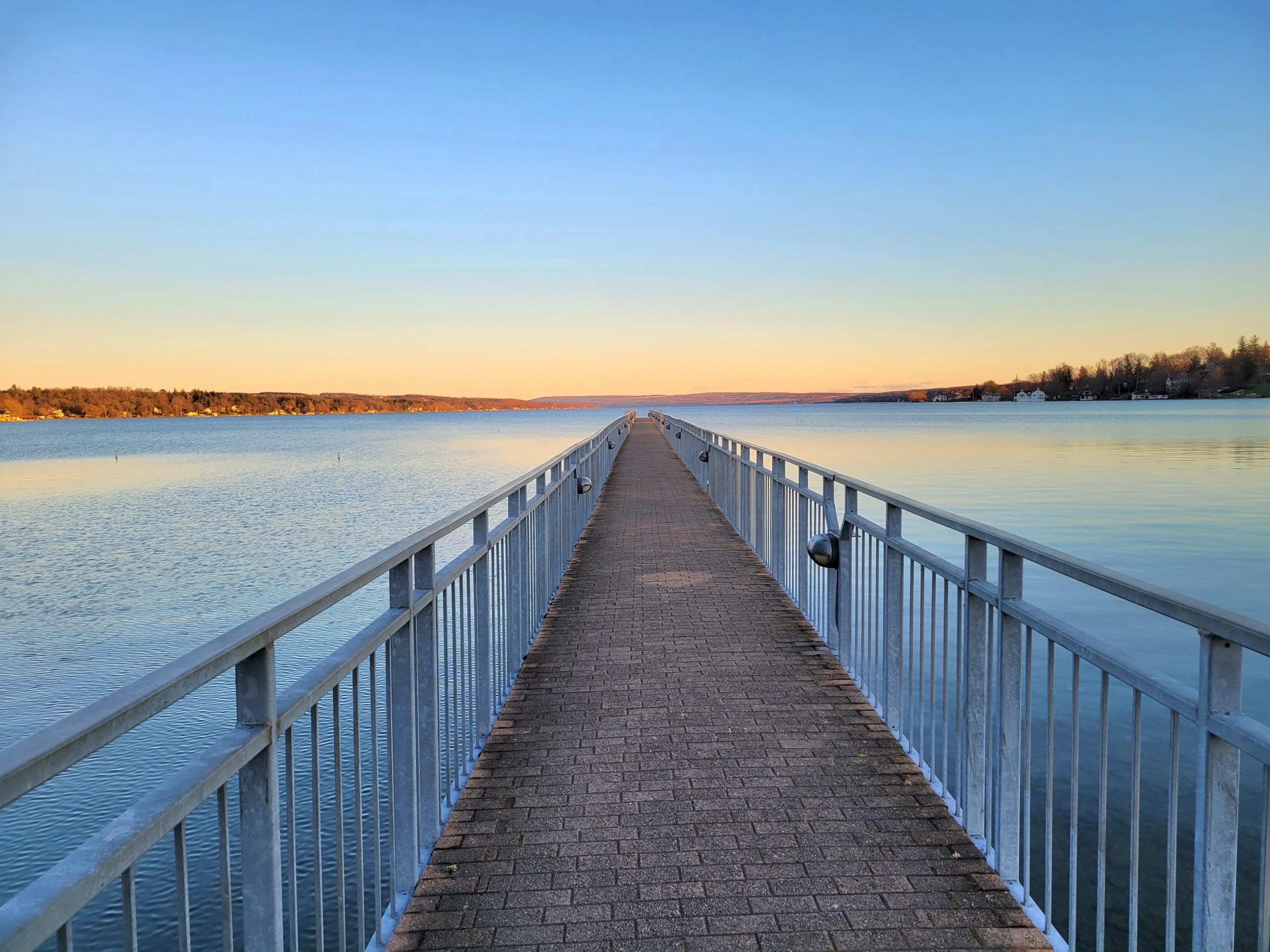
Skaneateles Lake sits in the Finger Lakes region of central New York, with its north end at the village of Skaneateles in Onondaga County and its south end running into Cortland and Cayuga counties. The lake measures 16 miles long, averages three quarters of a mile wide, and reaches a maximum depth of 315 feet, with a mean depth of 148 feet. The hamlets of Mandana, Borodino, New Hope, and Spafford sit along the south and west shores. Glen Haven anchors the southern tip.
The water that fills the lake stays put a long time. The Skaneateles Lake Association reports a water retention time of about 18 years and a stored volume of roughly 413 billion gallons. That long residence time is part of why the lake is classified as oligotrophic, meaning low in nutrients and high in clarity. It is also why a single bad season of phosphorus runoff can linger for more than a decade.
The watershed itself covers about 59 square miles of land that drains into the lake. Most of that drainage area is agricultural, with smaller pockets of residential and commercial development. The City of Syracuse owns the lake’s outlet and operates a watershed agricultural program that pays farmers to install conservation practices on those drainage acres.
Drinking water: Syracuse’s FAD status
Skaneateles Lake is the centerpiece of one of the country’s most unusual drinking water arrangements. The Village of Skaneateles, along with the City of Syracuse, operates under a filtration avoidance determination first extended in June 2004 by the New York State Department of Health. That waiver allows both systems to deliver lake water to taps without building a full conventional filtration plant. Treatment relies on chlorination, fluoridation, and ongoing monitoring rather than membrane filtration.
The waiver carries no termination date and remains in effect for as long as the City and Village comply with its conditions. Those conditions include source water protection spending, intake monitoring, watershed enforcement, and public reporting. The City of Syracuse pays for sixteen watershed inspectors who review about 2,600 properties in the drainage basin, generally twice per year.
The arrangement is rare. Skaneateles is the only large natural lake in New York that supplies drinking water unfiltered. New York City’s Catskill and Delaware systems operate under a similar FAD, but Skaneateles is the lone Finger Lake on that short national list. If the waiver were lost, the City of Syracuse would have to build a filtration plant projected to cost in the hundreds of millions of dollars.
The largest current pressure point on that waiver is turbidity. The shallower of the two Syracuse water intake lines has been shut down an average of 11 times each year over the last decade after heavy storm runoff stirred the lake. To address that, the City has begun permitting work for a deeper extension of the shallower intake. The project is intended both to reduce turbidity related shutdowns and to lower the risk of drawing cyanobacteria into the supply during a surface bloom.
HAB history and 2026 forecast
The Skaneateles Lake Association’s public log shows the lake’s recent HAB pattern is not linear. Six bloom incidents in 2020, four in 2021, one in 2022, four in 2023, and one in 2024 at Hardscrabble Point on July 29 place the lake well below peer Finger Lakes such as Owasco and Cayuga but still inside a clear risk window between mid August and mid October. The 2018 season, with eight confirmed events, remains the recent benchmark for a bad year.
The wider regional picture supplies the warning. During the final week of August 2024, the Finger Lakes saw widespread blooms across multiple basins, with Skaneateles logging 13 confirmed sightings on August 26 and 29 across volunteer reports. Those reports were not all reflected in the Skaneateles Lake Association’s narrow confirmed-event log, which uses a stricter standard, but they sat in the broader regional database the State uses to flag trouble. Microcystin toxins were detected in raw lake water during that stretch. The City of Syracuse’s treated drinking water remained below the federal action threshold throughout.
NYSDEC reports that the New York Harmful Algal Bloom System (NYHABS) reopens for the 2026 season in May, with bloom reports accepted directly from any member of the public. The Onondaga County Department of Health continues twice weekly microcystin sampling of raw and treated drinking water at the Syracuse intake. The City of Syracuse logs results publicly.
Researchers at Syracuse University have added a new tool. A lakebed mapping project is using advanced sonar to identify nutrient rich sediments that can fuel cyanobacteria growth. The work targets the same internal phosphorus loading questions that have driven recent HAB years on Owasco Lake to the west.
Invasives: hydrilla and others
Skaneateles Lake has so far avoided hydrilla, the aggressive submerged aquatic plant currently choking parts of Cayuga Lake’s southern end. The Skaneateles Lake Association lists six confirmed aquatic invasive species in the lake. Eurasian watermilfoil, curly-leaf pondweed, scuds, starry stonewort, viral hemorrhagic septicemia, and zebra and quagga mussels are all present. Hydrilla is the headline absent species and is the explicit focus of the lake’s prevention program.
The financial stakes on hydrilla are visible one watershed to the west. Cayuga Lake hydrilla management since the species was first detected in Cayuga Inlet has exceeded $3 million in total cost, with current annual operations and maintenance running over $350,000. That figure is what every Skaneateles boat steward is trying to keep off the books.
The Association runs the inspection program in partnership with the New York State Department of Environmental Conservation. Stewards, mostly high school and college students trained on invasive identification, work three of the lake’s seven active boat launches during the season. The inspection protocol is the standard Clean, Drain, Dry: remove plant fragments and debris from boats, trailers, and gear, drain motors, bilges, live wells, and bait buckets, and verify boats are dry before launch.
The state level program is also tightening. DEC has rolled out new aquatic invasive species requirements for motorized boats in Adirondack waters, a regulatory model the Finger Lakes community has watched closely. The Skaneateles program has not adopted those exact rules for 2026 but tracks them.
Boating rules and inspection stations
The main public boat launch on Skaneateles Lake is the New York State DEC launch at the north end of the lake. The launch operates sunrise to sunset, seven days a week, from April 15 through October 15. Stewards do not require a fee for inspection but do require boaters’ cooperation with the visual exterior check. Refusing inspection can mean refusal of launch.
The watershed rules layered on top of standard New York boating regulations are aggressive. Skaneateles enforces a 5 mile per hour zone within 100 feet of shore, a 10 mile per hour zone within 200 feet, and a 45 mile per hour lake-wide daytime cap with nighttime reductions. Watershed rules also restrict overboard discharge, including any discharge of marine sanitation device output anywhere in the lake. Boats with marine heads must use sealed holding tanks.
The 2026 launch season opened on April 15. The Skaneateles Lake Association steward program is scheduled to staff its three primary inspection points beginning Memorial Day weekend and running through mid October.
Watershed protection spending
The dollar figures behind the unfiltered status are large. The City of Syracuse invests roughly $2.3 million per year to protect lake water quality through its Skaneateles Lake Watershed Agricultural Program. That figure covers staffing, payments to participating farms for conservation practices, lab work, and program administration. It does not include the cost of the planned intake extension, which will sit on the capital ledger separately.
The watershed program pays farmers to install practices such as cover cropping, riparian buffers, manure storage upgrades, and fenced stream crossings. These practices target phosphorus loss, the nutrient most directly linked to cyanobacteria growth. The program is voluntary, watershed wide, and managed in partnership with the New York State Soil and Water Conservation Committee.
Beyond the City’s direct spending, the Skaneateles Watershed Municipal Partnership coordinates Onondaga, Cayuga, and Cortland county participation along with the towns of Skaneateles, Spafford, and Niles. The partnership exists to keep monitoring consistent and to keep the FAD compliant across a watershed that crosses three counties and multiple town lines.
Summer events to know
The village’s marquee summer event is the Skaneateles Antique and Classic Boat Show. The 48th annual show is scheduled for July 24 through July 26, 2026, at Clift Park, hosted by the Finger Lakes Chapter of the Antique and Classic Boat Society. The show typically brings about 35 to 40 boats in the water and another 35 to 40 on land. The Skaneateles Historical Society runs guided village bus tours during show weekend, and the Skaneateles Library hosts children’s wooden boat painting workshops.
The other long running weekend draw is Skaneateles Polo. The Skaneateles Polo Club holds Sunday matches at 3 p.m. through July and August at its grounds on Andrews Road. The club has confirmed at least one notable date on the calendar: a match Sunday, July 26, 2026, the same weekend as the boat show.
The lake itself fills with paddlers, sailors, and powerboaters every weekend from Memorial Day through Labor Day. Labor Day 2026 falls on Monday, September 7. State data consistently shows that the period from mid August through the first week of October produces the largest share of confirmed HABs across the Finger Lakes. The peak recreational window therefore overlaps with the peak risk window.
How residents can help
The Skaneateles Lake Association maintains a public bloom reporting channel. Anyone who sees suspected cyanobacteria, surface scum, or a paint like sheen along shore should photograph the area, record GPS coordinates if possible, and submit to NYHABS via the DEC online form. DEC’s HAB program treats public submissions as a primary input to the statewide notification system.
Watershed residents in the towns of Skaneateles, Niles, and Spafford in Onondaga County, Sempronius and Scott in Cayuga County, and the small slice of Cortland County that drains into the lake can support the agricultural program by maintaining lawn buffers, avoiding phosphorus fertilizers, and pumping septic systems regularly.
For boaters, the rule is simple. Inspect, drain, and dry every vessel before launch. The species that have caused the most operational pain in the Finger Lakes, including hydrilla, starry stonewort, and quagga mussels, all arrived on trailered boats.
Mayor Mary Sennett of the Village of Skaneateles, who leads the four member village board of trustees, has continued the village’s drinking water investment program. The board has been working with engineering firm GHD on a treatment alternatives analysis. The Town of Skaneateles, a separate municipality, operates its own board.
The lake’s recent year over year volatility, with one bloom one summer and four the next, suggests a quiet season is no guarantee. The City of Syracuse intake extension, the Syracuse University lakebed mapping work, and the DEC’s new statewide HAB Roadmap all point one way: the people responsible for keeping Skaneateles Lake drinkable and swimmable are betting on more data, deeper intakes, and more aggressive prevention.
For now, the launch is open, the stewards are reporting for duty, and the first antique mahogany Chris-Crafts will be in the water in just over two months.
Primary sources: Skaneateles Lake Association (skaneateleslake.org), Skaneateles Lake Watershed Website (skanlakeinfo.org), New York State Department of Environmental Conservation, Onondaga County Department of Health, City of Syracuse Department of Water, Village of Skaneateles, Antique and Classic Boat Society, Syracuse University College of Arts and Sciences, Inside Climate News, Wikipedia (Skaneateles Lake article, cross-referenced to USGS gauge 04236000).