Four decades after its 1984 National Register listing, the former warehouse district anchors a downtown that has grown to 4,400 residents with 96 percent apartment occupancy and more than $1 billion in investment since 2010. CNY Signal traces the numbers from the 1873 armory to the shot clock monument’s 2026 homecoming.
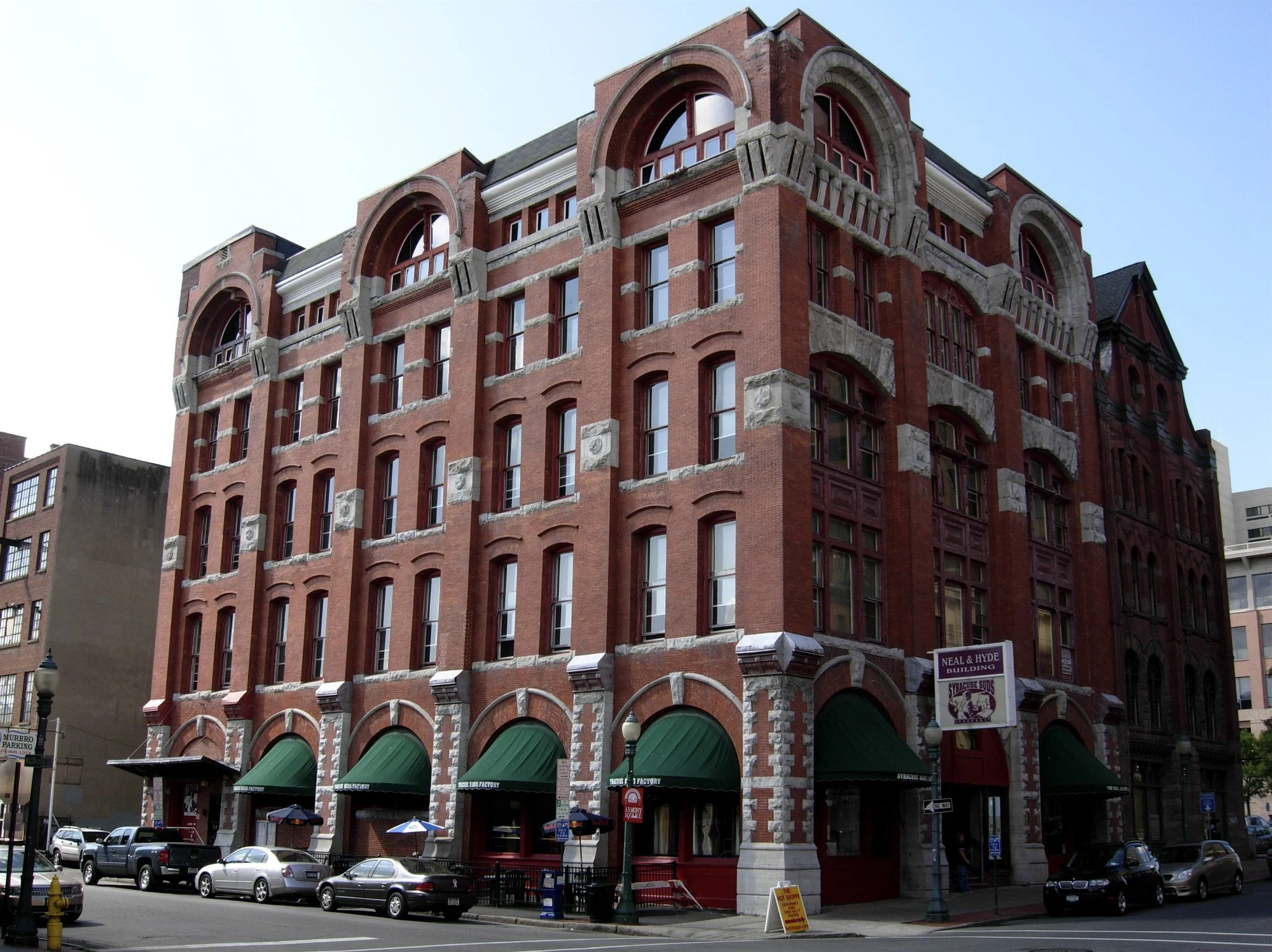
Stand at the corner of West Jefferson and South Franklin streets on a Friday night and it is hard to picture what preservationists saw in 1984: a district of soot-stained factory and warehouse blocks that Onondaga Historical Association curator of history Robert Searing, quoted in The Daily Orange, described as a place that “you just didn’t go.” That year, an application filed by the Downtown Committee of Syracuse won the neighborhood a spot on the National Register of Historic Places, formally recognizing 46 industrial and commercial buildings as the Armory Square Historic District.
This story came from public records we pulled ourselves
Get the next one, plus overnight incidents, in your inbox at 6 AM. Free, no spam.
Forty-two years on, the bet has paid out in numbers that would have sounded like fantasy in the Reagan era. Downtown Syracuse now houses roughly 4,400 residents, up from 2,440 in 2010 according to a housing study prepared by CommunityScale for the Downtown Committee, an increase of about 80 percent. Residential occupancy sits at 96 percent per the Downtown Committee’s Spring 2026 reporting, and more than $1.068 billion has been invested in downtown property since 2010.
Armory Square sits at the center of that story, physically and historically. It is where downtown’s revival started in the early 1980s, where the Museum of Science and Technology took over a decommissioned drill hall in 1992, and where, just last month, the city’s beloved 24-second shot clock monument was rededicated in front of the old armory itself. Here is the district by the numbers.
An arsenal, three armories, and a name
The neighborhood was first settled in 1804, according to the Armory Square Association’s district history, but its identity was forged by the military. New York State operated an arsenal on West Jefferson Street from 1859 to 1873, per the New York State Military Museum. The state demolished it in 1873 to build a proper armory, designed by architect Horatio Nelson White, which housed the 51st Infantry Regiment and later the 40th and 41st Separate Companies through the turn of the century.
That 1870s building gave the square its name, but it is not the one standing today. The state tore it down in 1906 and completed a third, grander armory in 1907: a brick and limestone complex that is really three buildings in one, with a cavalry wing to the west, an infantry wing to the east, and an arched-roof drill hall connecting them. The Military Museum records that it originally contained rifle and pistol ranges, a riding shed, and a stable for horses, and that it served National Guard units continuously from 1907 until 1994.
Boom, bust, and 46 buildings worth saving
The commercial district around the armory grew on freight. Most of the neighborhood’s historic buildings went up between 1860 and 1890 as factories and warehouses, drawn by the Erie Canal and the rail lines that crossed the west side of downtown. By 1900, the Armory Square Association’s history counts more than 20 hotels operating in the neighborhood to serve rail passengers. The building stock that survives reflects that layered economy: the 10-story Jefferson Clinton Hotel of 1927, and the Art Moderne Delaware, Lackawanna and Western passenger station of 1941, both contributing structures in the district.
Then the trains stopped. As railroads declined in the 1930s, most of the district’s industries and hotels relocated or closed, and the neighborhood hollowed out through vacancy and demolition between 1940 and 1960. The turnaround began on paper on September 7, 1984, when the Armory Square Historic District, reference number 84002816, was added to the National Register of Historic Places, covering sections of South Clinton, South Franklin, Walton, West Fayette and West Jefferson streets. The listing, initiated by the Downtown Committee of Syracuse, unlocked historic tax credits and gave developers a reason to renovate rather than raze.
The 1980s bet: two men and a labor temple
The revival had names and an address. In the early 1980s, developer Bob Doucette, co-founder of Paramount Realty and president of Armory Development & Management, and landscape architecture professor George Curry proposed rebuilding the district as what The Daily Orange described in a 2019 retrospective as “an all-inclusive place to live, eat, shop and work,” a 24-hour neighborhood, an idea that was rare in smaller American cities at the time.
They started by buying and renovating the Labor Temple Building at 309 S. Franklin St. Since 1985, its first floor has housed the restaurant Pastabilities, with apartments above, a mixed-use formula that became the district’s template. Through the late 1980s and 1990s the pattern repeated block by block: ground-floor restaurants, bars and shops with offices and apartments upstairs, filling the old warehouse shells with tenants ranging from national retailers like Urban Outfitters to locally owned coffeehouses and nightclubs serving students from Syracuse University and Le Moyne College.
Science moves into the drill hall
The armory itself found a second life in education. The Milton J. Rubenstein Museum of Science and Technology traces its roots to 1977 planning by the Junior League, the National Council of Jewish Women and the Technology Club of Syracuse, according to the museum’s official history. Its predecessor, the Discovery Center, opened on November 15, 1981 in a storefront at 321 South Clinton Street and logged more than 800,000 visits by the late 1980s, outgrowing the space.
On October 27, 1992, the institution reopened inside the former armory as the MOST, and it has kept building: the 214-seat Bristol IMAX Omnitheater, the only domed IMAX in New York State, opened in January 1997 and was replaced by the National Grid ExploraDome and MolinaCares Media Lab in April 2022. Today the museum operates 35,000 square feet of permanent and traveling exhibits inside the drill hall where cavalry horses once boarded.
24 seconds, two addresses, one homecoming
Armory Square also guards Syracuse’s single greatest contribution to professional sports. In 1954, Syracuse Nationals owner Danny Biasone, general manager Leo Ferris and scout Emil Barboni worked out the 24-second shot clock, famously sketching the math at Biasone’s Eastwood bowling alley, and demonstrated it at a scrimmage at Blodgett Vocational High School. The NBA adopted the clock for the 1954-55 season, the same season the Nationals won their championship.
The monument commemorating the invention, a working 24-second clock counting down in perpetuity, was dedicated on March 26, 2005 in a pocket park in Armory Square, with Hall of Famers Bill Walton, John Havlicek, Dolph Schayes and Earl Lloyd on hand, as columnist Sean Kirst has chronicled in Central Current. After roughly 20 years across from its original perch, the monument was displaced when the Crooked Cattle restaurant expanded into the park space. On May 11, 2026, following a restoration that cost about $4,000, it was formally rededicated in front of the MOST, per Central Current and WAER, placing the clock outside the very armory where the Nationals once played. Relatives of both Biasone and Ferris attended the ribbon cutting.
The residential wave around the district
The district’s bars and restaurants now sit inside a downtown that is increasingly a bedroom neighborhood. The Downtown Committee of Syracuse counts 1,597 housing units built downtown since 2010, backed by $443 million in housing investment, with more than 700 additional apartments under construction or planned. The CommunityScale housing study commissioned by the committee found downtown’s population climbing from 2,440 in 2010 to roughly 4,500 by 2024, an average annual growth rate near 6 percent, with 2022 alone adding 136 households, the strongest single year since 2010.
Demand shows no sign of slack. The study projects the market can absorb 176 new units per year over the next five years while keeping vacancy under a healthy 7 percent. The newcomers skew young and increasingly from elsewhere: 62 percent of household growth since 2015 came from householders aged 25 to 44, and since 2019 half of new downtown residents arrived from outside Onondaga County. The median downtown resident is 31 years old, and 56.2 percent hold at least a bachelor’s degree. Average asking rents stand at $1,382 for a one-bedroom and $1,889 for a two-bedroom, per the committee’s 2025 Housing Guide, with new and newly renovated buildings averaging $2.99 per square foot.
What fills the storefronts now
The tenant mix that Doucette and Curry imagined in 1982 is now measurable. Across the 82 blocks and 8 neighborhoods the Downtown Committee tracks, food and beverage is the dominant ground-floor use, with 109 establishments, followed by 64 service-based businesses and 37 retail shops. Those storefronts draw an estimated 9.3 million out-of-market visits per year, a figure that helps explain why restaurant seats keep multiplying faster than boutique racks.
Inside the historic district itself, the pattern the Downtown Committee measures is visible on foot: restaurants, coffeehouses, bars and nightclubs fill the ground floors along Walton and South Franklin streets, with professional firms and apartments above, exactly the vertical layering the 1984 listing was designed to preserve. Commercial occupancy downtown is tracked in the committee’s twice-yearly Commercial Occupancy Report, which in Spring 2026 also confirmed the 96 percent residential figure.
What the numbers say about the next decade
Armory Square’s arc, from arsenal to armory to abandonment to anchor, has become the template for the rest of downtown Syracuse. The unresolved question is capacity. With residential occupancy at 96 percent and the CommunityScale study identifying demand for 176 new units a year concentrated in studios and one-bedrooms renting between $1,500 and $2,000, the pressure now runs outward from the district into the Warehouse District, Clinton Square and beyond. The Downtown Committee lists more than $273 million in investment planned or underway, and Micron’s Clay fabrication project looms over every apartment pro forma in Onondaga County.
The district that once quartered cavalry horses now measures its health in lease rates and foot traffic. On the evidence of 42 years, betting against the old warehouse blocks has been the losing position.
Where to track this
The Downtown Committee of Syracuse publishes its Commercial Occupancy Report twice a year and updates its Downtown Stats page and annual Housing Guide at downtownsyracuse.com; the Spring 2026 occupancy report is the most recent. The CommunityScale Downtown Syracuse Housing Needs Assessment and Market Study is posted publicly and carries the household growth projections through 2050. The National Register nomination file for the district is reference 84002816 at the National Park Service. The Armory Square Association maintains district history and a business directory at armorysq.org, and the MOST posts attendance-driving exhibit changes at most.org. CNY Signal will revisit downtown occupancy and unit-count numbers when the Fall 2026 Commercial Occupancy Report lands.